







What Thickness Is Best for DTF Film?
Compare 75-micron and 100-micron DTF film by printer feeding, stiffness, heat stability, coating, cost, and production requirements.

Estimated reading time: 14 minutes
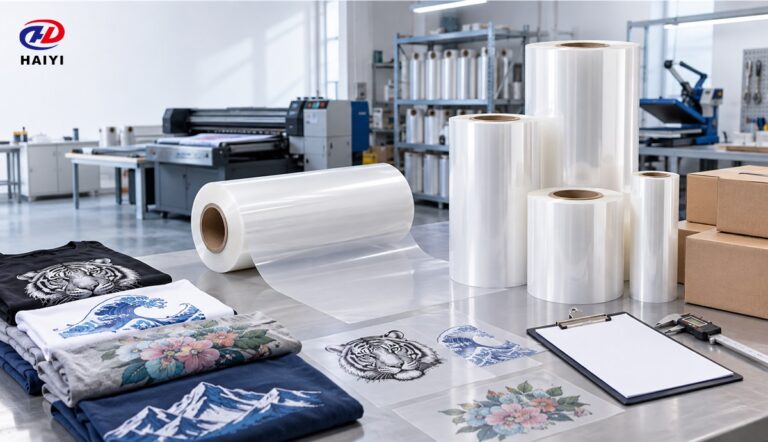
For most everyday DTF printing, a PET base film around 75 microns is a practical starting point because it balances flexibility, feeding, handling, and material efficiency. A film around 100 microns can be useful when a printer, long production run, heavy ink load, or heat path benefits from extra stiffness and dimensional stability. However, there is no universal best thickness. The correct choice depends on the printer’s feed system, roll format, coating construction, static control, curing conditions, transfer process, and the consistency of the film from one batch to the next.
The most important buying lesson is that thickness is not a quality grade. A well-coated 75-micron film can print more reliably than an inconsistent 100-micron film. Buyers should distinguish the nominal PET base thickness from the finished film’s total caliper, then validate both thickness and performance under actual production conditions.
This guide takes a production and purchasing angle. It explains how film thickness changes handling, roll feeding, thermal behavior, inspection, cost, and application fit. It also provides a decision process that importers, print shops, and production managers can use without treating one number as a universal specification.
What does DTF film thickness actually measure?
DTF film is a layered material. The structural core is a PET base film. One side carries an ink-receiving and release system, while dual-matte products may also have a functional back coating for handling and static control. A supplier may quote the PET base thickness, the finished film’s total thickness, or an approximate commercial grade. Those values are related, but they are not automatically identical.
A purchase specification should therefore state exactly what the number represents. “75-micron DTF film” may mean a nominal 75-micron PET base before functional coatings, while another supplier may report a finished caliper that includes coatings. Comparing those two numbers without a measurement definition can create a false difference.
Coatings are thin, but their distribution matters. Uneven coating can create local caliper variation, inconsistent ink absorption, variable release, or edge behavior even when the average PET thickness looks correct. The site’s guide to DTF ink-absorbing coating explains why coating chemistry and uniformity control print behavior more directly than the base film number alone.
Buyers should ask for four separate pieces of information:
- Nominal PET base thickness and its tolerance.
- Finished film caliper and the measurement method.
- Whether the product is single-sided or dual-matte coated.
- Coating-weight or coating-uniformity controls used during production.
Is 75-micron DTF film the best general-purpose choice?
Around 75 microns is a sensible general-purpose starting point for many roll and sheet workflows. It is flexible enough to travel through common feed paths, light enough for efficient roll handling, and stiff enough for normal printing when the PET quality, coating, winding, and environmental controls are sound.
This thickness class often suits small and medium DTF printers, standard graphic coverage, routine garment production, sample work, and businesses that want a broadly usable film. Its lower material mass can also reduce roll weight compared with a thicker base at the same width and length. That can simplify manual loading and reduce freight mass, although packaging, core size, coating, and roll length also contribute to shipment weight.
The limitation is that a thinner base provides less bending stiffness. On a poorly adjusted printer, that may make the web more sensitive to slack, edge curl, uneven vacuum, high static, or aggressive heating. The correct response is not always to buy thicker film. Feed tension, platen temperature, pinch rollers, vacuum settings, humidity, winding quality, and film conditioning should be checked first.
A consistent 75-micron product is often preferable to a nominally thicker film with uneven gauge, unstable coating, telescoped winding, or damaged edges. For a broader explanation of PET construction, see the site’s PET film thickness, coating, and material quality guide.
When does 100-micron DTF film make sense?
Around 100 microns can be useful when extra stiffness improves handling or process stability. The thicker base may resist buckling, flutter, or edge deformation better in some wide-format and high-throughput systems. Operators may also find individual sheets easier to load and retrieve because the material feels more substantial.
Potential use cases include wide film widths, long unattended runs, printers with a demanding feed path, high graphic coverage, production environments with repeated handling, and processes in which the film experiences a longer or more intense heat path. Extra thickness can provide a larger mechanical margin, but it does not eliminate the need for correct tension, temperature, and coating.
Thicker film also has tradeoffs. It increases material use and roll mass. The same outside roll diameter may contain less length if every other roll variable remains equal. Higher stiffness may not suit every feed path, take-up system, cutter, or sheet tray. It can also change how the film curls after heating or how quickly it equilibrates with ambient temperature.
Do not specify 100 microns merely because it sounds more durable. DTF film is a temporary process carrier, not the final structural layer of the garment. After transfer, the PET is peeled away. The final hand feel is driven mainly by the printed ink, white layer, adhesive powder, artwork coverage, curing, pressing, and fabric. Base thickness can affect processing, but it does not remain inside the finished transfer.
How do 75-micron and 100-micron films compare?
| Decision factor | Around 75 microns | Around 100 microns |
|---|---|---|
| General positioning | Flexible, efficient general-purpose starting point | Stiffer option for workflows needing more handling margin |
| Roll weight | Usually lower for the same width and length | Usually higher for the same width and length |
| Bending stiffness | Lower; follows compact feed paths more easily | Higher; may resist flutter and buckling better |
| Sheet handling | Flexible and easy to store | More substantial feel during manual loading |
| Wide-format feeding | Can work well with correct tension and winding | May add stability in some machines and widths |
| Material efficiency | Uses less PET per square meter | Uses more PET per square meter |
| Heat response | Lower thermal mass; settings still require testing | Higher thermal mass; not automatically more heat resistant |
| Print quality | Can be excellent with uniform coating | Can be excellent with uniform coating |
| Best selection rule | Choose when actual printer trials are stable | Choose when trials show a measurable production benefit |
This table describes typical tendencies, not guaranteed results. PET resin quality, orientation, heat setting, coating, surface treatment, storage, winding, width, and equipment configuration can change how two films with the same nominal thickness behave.
How does thickness affect printer feeding?
Film thickness changes bending stiffness, but printer feeding is a system behavior. The film interacts with rollers, pinch pressure, vacuum, platen surface, take-up torque, static charge, humidity, ink load, and heat. A reliable film must remain flat enough for the printhead clearance while advancing at a predictable rate.
A thinner film can conform well to rollers and compact paths, but it may show more waves when web tension is too low or heat is uneven. A thicker film can bridge small gaps more firmly, but excessive stiffness may resist tight turns or place more load on a weak take-up motor. Neither outcome should be assumed without testing.
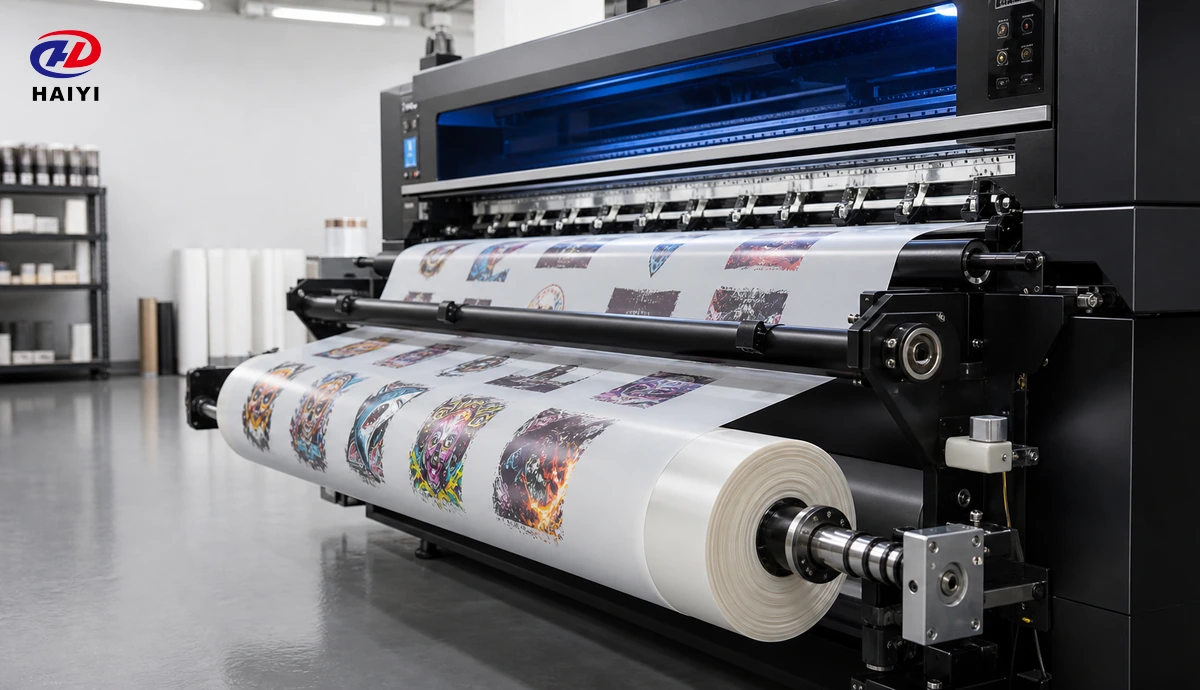
Wide rolls deserve particular attention because small tension differences can become visible across the web. Inspect whether the film tracks centrally, whether edges lift, whether the roll telescopes, and whether the printed web remains flat before powder application. The article on large-roll DTF film for high-speed production provides additional context for industrial winding and batch stability.
Does thicker DTF film produce better print quality?
No. Image sharpness, color density, white-ink support, powder bonding, and release depend primarily on the functional surface and the complete print process. A thicker PET base may improve handling in a particular machine, but it cannot compensate for poor coating chemistry or nonuniform application.
For example, ink spreading is usually a coating and ink-load problem rather than a base-thickness problem. Patchy white ink may result from surface energy, coating inconsistency, ink condition, waveform, pass settings, or maintenance. Difficult peeling may come from release-layer behavior, curing, pressing, peel timing, storage, or contamination. Thickness should be investigated only when evidence points to deformation, feeding, or thermal stability.
The site’s guide to how DTF film coating affects print quality covers sharpness, color, white ink, powder bonding, and release. Buyers evaluating overall suitability can also use the criteria in the DTF film selection guide for textile printing.
Does film thickness change the feel of the finished transfer?
Not directly, because the PET carrier is removed after pressing. A thicker carrier does not automatically create a thicker print on the garment. The deposited ink and adhesive layers determine the transferred layer’s mass and flexibility.
Film choice can still influence the process indirectly. If a more stable film supports accurate ink placement, even powder coverage, and controlled curing, the resulting transfer may be more consistent. Conversely, excessive white ink, too much powder, dense artwork, incorrect curing, or overpressing can create a heavy hand regardless of carrier thickness.
When comparing thickness samples, use the same artwork, printer mode, ink set, white-ink density, powder, curing profile, press settings, fabric, and peel timing. Otherwise, a difference attributed to film thickness may actually come from another process variable.
How does thickness interact with heat?
PET base thickness affects thermal mass and mechanical response, but heat stability is not defined by thickness alone. PET manufacturing conditions, molecular orientation, heat setting, residual stress, coating cure, and storage history all influence shrinkage and curl.
A thicker film may feel more stable when moving through a shaker oven, but it can still distort if the PET has poor dimensional stability or the temperature is excessive. A thinner high-quality film may remain flat under the same conditions. Buyers should request heat-shrinkage or dimensional-stability data when available and run a controlled oven test.
During testing, mark a measured rectangle on an unprinted sample, expose it to the normal curing path, condition it at room temperature, and measure it again. Observe length change, width change, edge curl, waves, surface blocking, coating discoloration, and release behavior. Repeat the test with printed and powdered samples because wet ink and powder can change heat exposure and web tension.
What thickness is best for sheets, desktop printers, and roll printers?
Sheet-fed and desktop workflows
Sheet users often value easy loading, flatness, and resistance to corner damage. Both 75- and 100-micron classes may work, depending on the printer path. A stiffer sheet can be easier to handle, but it may not follow a tight feed path as readily. Confirm the printer’s accepted media range and test full-size sheets, not only small cut samples.
Small and medium roll printers
A consistent 75-micron film is often an efficient starting point. It can provide good flexibility and manageable roll weight. If operators see recurring waves, head-strike risk, or unstable take-up after mechanical and environmental settings are corrected, a thicker sample may be worth evaluating.
Wide-format and high-throughput lines
Wide and fast production makes web behavior more sensitive to winding and tension. A 100-micron option may offer helpful stiffness, but roll build, core quality, edge alignment, static control, and coating friction can be equally important. Run the full printer, powder shaker, dryer, and take-up system at target speed before approving a bulk order.
Manual powdering or short-run prototyping
Handling preference may matter more than maximum line speed. The film should remain flat while ink is wet and powder is applied. Choose the thickness that operators can handle without touching the coated print area, creasing the carrier, or disturbing the wet ink.
How should buyers measure DTF film thickness?
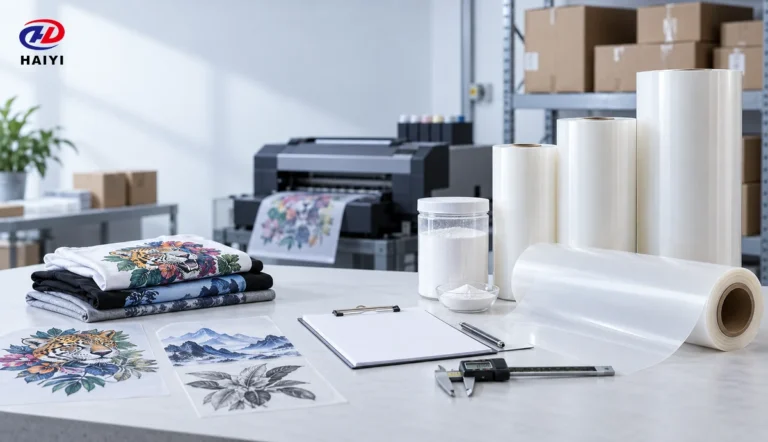
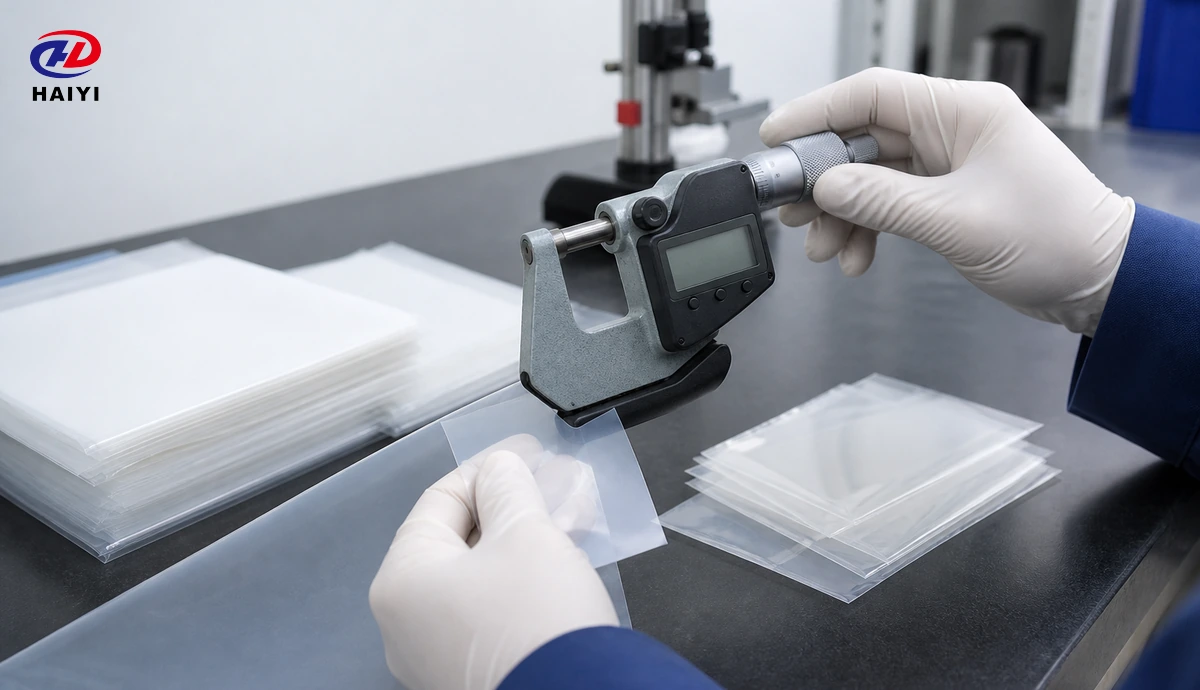
Use a calibrated thickness gauge or micrometer designed for thin flexible materials. A sharp-point micrometer can compress or damage a coated film, while excessive measuring force can produce a reading that is artificially low. A suitable instrument should apply controlled pressure over a defined contact area.
- Condition the sample. Let film reach the specified laboratory temperature and humidity before measuring.
- Check the instrument. Clean the anvils, verify zero, and use a reference standard if required by the quality system.
- Sample across the width. Measure the left, center, and right areas, avoiding damaged edges unless edge quality is being investigated.
- Sample along the roll. Check the beginning, middle, and end when validating a production lot.
- Use repeat readings. Record the average, minimum, maximum, and range, not only one convenient result.
- State what was measured. Identify finished film, uncoated PET, or a supplier certificate value.
- Protect the coating. Use clean gloves and avoid dragging the sample across the measuring faces.
Thickness data becomes useful when it is connected to an acceptance rule. A purchase order should define the nominal value, allowable tolerance, sampling plan, instrument type, conditioning method, and disposition process for out-of-specification material. The factory-process guide, How DTF Film Is Made, explains where PET selection, coating, curing, slitting, and QC fit into manufacturing.
What production test should compare two thicknesses?
A controlled A/B trial is more reliable than operator impressions. Use rolls or sheets from documented lots and keep every other variable constant. The test should be long enough to expose feed, heat, and winding problems that a short sample may miss.
| Test stage | What to record | Reason |
|---|---|---|
| Loading | Roll mass, edge condition, core fit, initial flatness | Reveals handling and packaging differences |
| Feeding | Tracking, skew, wrinkles, vacuum response, head clearance | Shows mechanical compatibility |
| Printing | Registration, ink spread, white layer, static, cockling | Separates surface and web behavior |
| Powdering | Flatness, powder pickup, unwanted background powder | Checks coating and handling interaction |
| Curing | Shrinkage, curl, waves, blocking, odor changes | Evaluates thermal stability |
| Pressing | Positioning, peel timing, release force, residue | Confirms transfer operation |
| Final textile | Edges, color, stretch, hand feel, wash result | Confirms customer-facing performance |
| Economics | Waste, stops, labor, meters per roll, freight mass | Measures total production cost |
How does thickness affect cost and shipping?
Thicker PET normally uses more polymer per square meter. At equal width and length, that raises film mass and can increase material and freight cost. At equal outside roll diameter, a thicker web may also reduce the available length, although core diameter, winding tension, coating, and packaging affect the final roll geometry.
Unit price is only part of the decision. A more expensive film may lower total cost if it reduces head strikes, feed corrections, wrinkles, rejected transfers, or operator intervention. A thinner film may be the better economic choice when it runs smoothly and meets all output requirements. Calculate usable printed area, waste rate, downtime, labor, and accepted transfers rather than comparing only price per roll.
Importers should also confirm whether quoted roll length is measured or calculated, whether net film weight is controlled, and whether thickness tolerance could change the actual meters delivered at a specified roll diameter. Clear definitions prevent commercial disputes.
Which specification matters more than thickness?
No single property replaces thickness, but coating consistency, release behavior, dimensional stability, static control, winding quality, and batch repeatability often have a more direct effect on daily production. A strong specification treats them as a connected system.
- Coating uniformity: supports controlled ink absorption and clean image edges.
- Release consistency: makes peel timing predictable across the design and roll.
- Dimensional stability: limits shrinkage, curl, and waves under printing and curing heat.
- Static behavior: affects dust attraction, powder contamination, and feeding.
- Surface friction: influences transport through rollers and take-up equipment.
- Winding and slitting: affect edge alignment, tension, telescoping, and roll tracking.
- Storage stability: protects coating performance between manufacture and use.
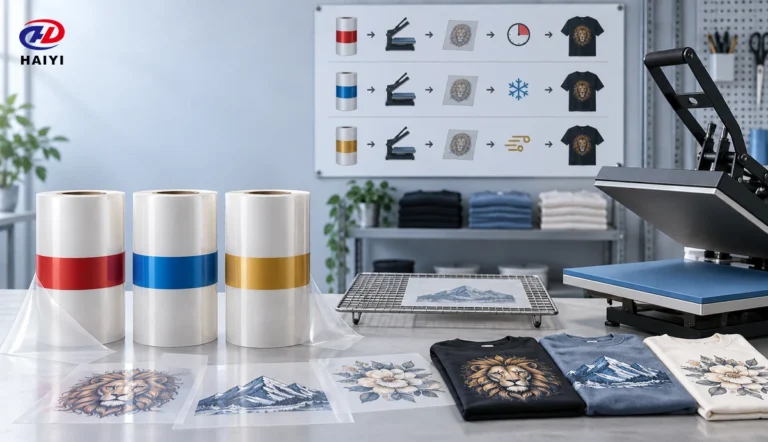
For process setup beyond film selection, consult the complete guide to printing DTF transfers. It connects film loading, ink, powder, curing, pressing, and peeling into one workflow.
How should an importer specify DTF film thickness?
A useful purchasing specification should avoid vague phrases such as “standard thick film” or “premium 100 micron.” It should define measurable requirements and link them to an approved sample.
Include the following:
- Nominal PET base thickness and tolerance.
- Finished total caliper and whether coatings are included.
- Film width, roll length, core size, winding direction, and maximum roll diameter.
- Single-sided or dual-matte construction.
- Hot, warm, cold, or universal peel designation with test conditions.
- Static-control and surface-friction expectations.
- Heat-shrinkage or dimensional-stability test method.
- Coating-uniformity and release acceptance tests.
- Sampling frequency and batch traceability.
- Approved printer, ink, powder, oven, press, fabric, and artwork conditions.
The approved sample should be retained by both buyer and supplier. Future shipments can then be compared for thickness, appearance, winding, coating, release, and print performance. This makes the specification a production control tool rather than a marketing description.
Frequently asked questions
Is 100-micron DTF film always better than 75-micron film?
No. A 100-micron film is stiffer, but quality depends on PET consistency, coating, winding, static control, heat stability, and compatibility with the production line. Choose the option that performs better in a controlled trial.
Can a printer use both 75-micron and 100-micron DTF film?
Many printers may handle both, but feed tension, vacuum, heat, take-up, and head clearance can require adjustment. Confirm the equipment specification and test the full workflow before changing production material.
Does thicker film require a different heat press temperature?
Not automatically. Press settings depend on the ink, powder, fabric, coating, and peel system. Carrier thickness may influence handling and thermal response, so validate the supplier’s recommended window rather than changing temperature based on thickness alone.
Does DTF film thickness affect peeling?
Thickness can change handling stiffness during peeling, but release behavior is controlled mainly by the release coating, curing, pressing, peel temperature, peel timing, and technique.
What is the fastest way to compare two film thicknesses?
Run a controlled A/B production test using the same artwork and process settings, then record feeding, printing, powdering, curing, shrinkage, pressing, release, final textile quality, waste, and downtime.
Should buyers measure every roll?
The sampling plan should reflect risk, supplier history, lot size, and quality agreements. Incoming inspection may use representative samples, while suppliers should control thickness continuously or at defined production intervals.
Final verdict: what thickness is best for DTF film?
Around 75 microns is the best starting point for many general-purpose DTF workflows because it offers a useful balance of flexibility, feeding, handling, roll weight, and material efficiency. Around 100 microns is worth choosing when actual trials show that extra stiffness improves wide-format feeding, long-run stability, sheet handling, or resistance to deformation in a specific production line.
The final decision should not be based on thickness alone. Define whether the number refers to PET base or finished caliper, compare tolerance across the web and roll, inspect coating and winding, run the complete print-to-press process, and calculate accepted output rather than price per roll. The best DTF film thickness is the thinnest consistent construction that runs reliably, protects print quality, and meets the production system’s mechanical and thermal requirements.