



PET Film for DTF Printing Explained: How Thickness, Coating, and Material Quality Create Perfect Transfers
Learn how PET film for DTF printing works and how thickness, coating quality, release performance, and material selection affect transfer results. A complete guide for printers, distributors, and DTF film buyers.

Read Time: 11 min read
The Plastic Sheet That Isn’t “Just Plastic”: What PET Film Actually Does in DTF Printing
PET film is one of the most underestimated components in the DTF printing process, largely because of a common misunderstanding: that it’s simply a plastic carrier the design gets printed on before transfer. In reality, professional DTF PET film is a precision-engineered material built from multiple functional layers — a PET base, an ink-receiving coating, a release layer, and an anti-static treatment — each solving a different problem in the printing-to-transfer sequence.
Getting this material wrong has direct, measurable consequences: poor color reproduction, uneven powder adhesion, difficult peeling, outright transfer failure, and higher production waste overall. Understanding thickness, coating technology, and quality standards is what lets printing companies and distributors make an informed purchasing decision rather than treating film as an interchangeable commodity.
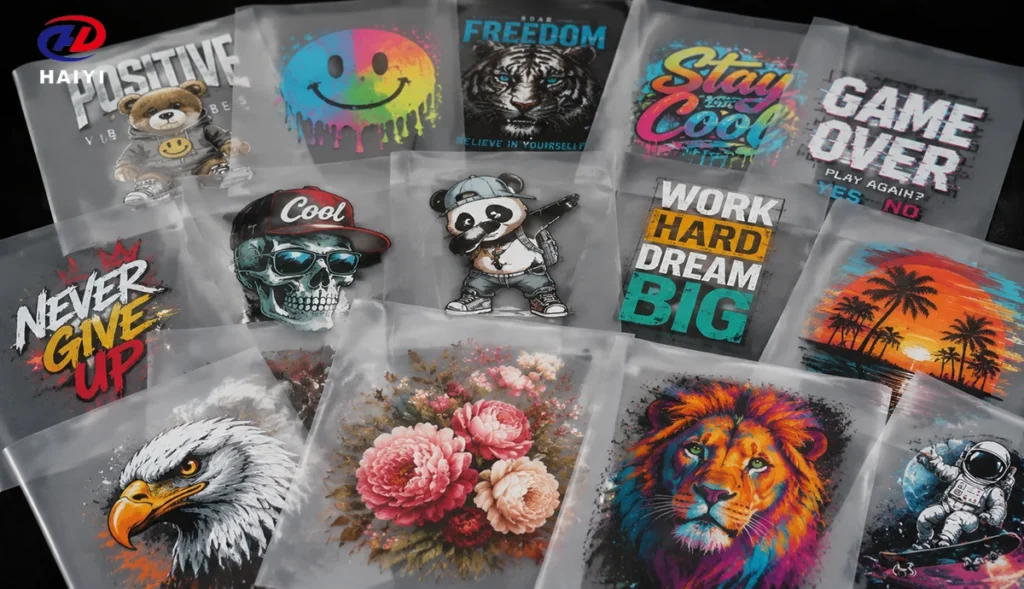
What Is PET Film for DTF Printing?
How Does DTF PET Film Work During the Printing Process?
The complete DTF workflow runs through five stages: printing CMYK and white ink onto coated PET film, applying hot-melt adhesive powder onto the wet ink, heating and curing that powder into a bonding layer, transferring the design onto fabric under heat and pressure, and finally removing the PET carrier film once the transfer is complete. Throughout that sequence, the PET film’s job is to temporarily hold the printed image with enough stability and precision to allow a controlled, clean transfer onto textile — it’s an active production tool, not a passive backing sheet.
Why Is PET Used Instead of Ordinary Plastic Film?
PET offers a specific combination of properties that ordinary plastic films don’t reliably provide: excellent dimensional stability under heat, high heat resistance during curing and pressing, a smooth surface structure suited to fine ink detail, good mechanical strength for handling through automated feeding systems, and stable performance across repeated print cycles. Standard plastic films tend to warp, stretch, or degrade under the repeated heat cycles DTF printing requires, which is exactly why generic plastic substrates can’t deliver reliable, repeatable transfer results at commercial volume.
How Does PET Film Structure Affect DTF Printing Quality?
High-performance DTF film isn’t simply “PET material” — it’s a multi-layer structure where each layer is engineered for a specific function in the printing process.
PET Base Layer: The Foundation of Film Stability
The PET substrate itself determines flatness during printing, heat resistance during pressing, and mechanical strength during handling and feeding. An unstable PET layer creates a cascade of downstream problems: film deformation under heat, feeding errors as the printer struggles with an uneven surface, and misalignment during printing that shows up as registration errors in the finished design.
Ink Receiving Coating: The Key to Sharp Images
The coating layer determines how ink behaves the moment it lands on the film, which makes it one of the single biggest quality variables in the entire process. High-quality coating provides better ink absorption, clearer image detail, stronger color saturation, and reduced ink spreading. Poor coating produces the opposite pattern reliably: ink bleeding beyond intended edges, uneven color density across a single print, and blurry edges on fine detail. High-quality coating, by contrast, delivers sharp graphics, stable color output, and better overall transfer consistency batch to batch.
Release Layer: Controlling Peeling Performance
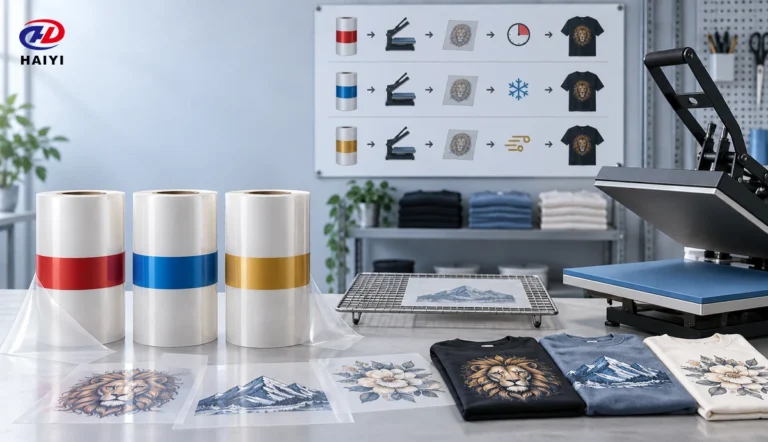
The release coating controls exactly how and when the film separates from the transferred design, and different film types require fundamentally different release characteristics. Hot peel film needs fast-release performance so it separates cleanly the moment pressing finishes. Cold peel film needs controlled release that only activates after the transfer has cooled and stabilized. Warm peel film needs a balanced release profile tuned for a short cooling window. Improper release performance — regardless of which type is intended — causes film sticking, physical damage to the transfer during peeling, or adhesive residue left behind on the fabric.
Does DTF Film Thickness Affect Printing Performance?
Thickness is one of the most important specifications to evaluate when selecting PET film, since it affects handling, feeding, and heat behavior simultaneously.
Common DTF Film Thickness Options
The most common thickness ranges in commercial use are 75 micron and 100 micron, with custom thicknesses available for specific requirements. The right choice depends on printer compatibility, the specific transfer application, and the production environment the film will run in — there’s no universal “correct” thickness across every use case.
How Does Thicker PET Film Improve Stability?
Thicker film generally provides better dimensional stability, easier handling during production, reduced curling under heat, and improved feeding performance through the printer. This makes thicker film particularly well suited to large-format printing, industrial-scale production, and high-volume applications where feeding consistency directly affects throughput.
Can Film Thickness Be Too High?
Yes. Excessive thickness introduces its own disadvantages: higher material cost per print, different heat transfer behavior that may require press parameter adjustments, and reduced flexibility during handling and operation. The best thickness isn’t automatically the thickest option available — it’s the thickness that matches the specific printing process, printer model, and application in use.
What Coating Features Determine High-Quality DTF Film?
Coating technology is often the single biggest difference between an ordinary film and a professional-grade one, even when both look similar on a spec sheet.
Ink Absorption Performance
Coating directly controls ink drying speed, dot accuracy, and color reproduction. Balanced absorption matters because both extremes cause problems: absorption that’s too fast reduces color vibrancy by pulling ink into the film before it fully develops, while absorption that’s too slow causes ink spreading and slows down production as prints need longer to stabilize before the next step.
Powder Adhesion Performance
Coating quality directly affects how well TPU adhesive powder bonds to the printed ink layer. A well-formulated coating produces uniform powder attachment across the full design, a strong adhesive bonding layer, and better wash durability in the finished garment — all three of which trace back to the same underlying coating chemistry.
Anti-Static Performance
Static control matters more than it initially appears, since static electricity causes dust attraction onto the film surface, film sticking to rollers or itself, powder contamination from attracted debris, and general printing errors from unstable feeding. Anti-static treatment addresses all of these simultaneously, which is why it materially improves production reliability rather than solving just one isolated issue.
Single Matte vs. Double Matte DTF PET Film: Which One Is Better?
| Feature | Single Matte Film | Double Matte Film |
|---|---|---|
| Printable Side | One side | One side |
| Surface Treatment | One matte surface | Both sides matte |
| Handling | Standard | Easier feeding |
| Static Control | Good | Better |
| Industrial Use | General applications | High-volume production |
When Should You Choose Single Matte DTF Film?
Single matte film suits standard garment printing, small and medium print shops, and cost-sensitive applications where production volume doesn’t push the limits of feeding consistency or static control.
When Is Double Matte DTF Film Better?
Double matte film is generally the better fit for commercial printing factories, high-speed production lines, and long continuous printing sessions, since the matte treatment on both sides improves handling, reduces slipping during feeding, and supports more stable operation over extended runs — exactly the conditions where single matte film’s limitations become more noticeable.
How to Identify High-Quality PET Film for DTF Printing?
Check Surface Uniformity
Professional-grade film should show consistent coating thickness across the full roll, a smooth surface with no visible texture irregularities, and no visible defects like spotting or uneven gloss.
Test Printing Performance
Before committing to bulk volume, verify ink sharpness on fine detail, color density consistency, powder adhesion strength, and peeling performance under the specific press parameters you plan to use in production.
Evaluate Heat Resistance
Quality PET film should maintain flatness, dimensional stability, and reliable release performance across repeated heating cycles — not just on a first test print, since degradation under repeated heat exposure is a common way lower-grade film reveals itself only after a supplier switch.
Common Problems Caused by Poor-Quality DTF PET Film
Ink Spreading and Blurry Images
Possible causes include poor coating quality or incorrect surface treatment during manufacturing. The fix is switching to professionally coated PET film with verified absorption performance rather than adjusting printer settings alone.
Difficult Film Peeling
Possible causes include an unstable release layer or a mismatch between the film type in use and the intended peeling method. The fix is selecting the correct hot peel, warm peel, or cold peel film for your specific process rather than assuming any DTF film works the same way.
Transfer Cracking or Poor Wash Resistance
Possible causes include weak powder bonding or poor compatibility between the film’s coating and the adhesive powder in use. The fix is improving material matching between film and powder and verifying processing conditions rather than treating it purely as a curing problem.
How to Choose PET Film for Different DTF Printing Applications
For T-shirt printing businesses: prioritize easy peeling, stable color reproduction, and good flexibility for a comfortable finished hand feel.
For industrial garment factories: prioritize high batch-to-batch consistency, fast production speed compatibility, and stable, reliable supply that can support continuous large-volume runs.
For DTF film distributors and wholesalers: prioritize availability across multiple specifications, OEM packaging capability, reliable quality control, and export capability suited to international order fulfillment.
Wholesale Buying Guide: How to Select a Reliable DTF PET Film Manufacturer
Manufacturing Capability
Evaluate actual production capacity, the coating technology the manufacturer has in place, and documented quality inspection systems — these three factors together indicate whether a supplier can maintain quality as your order volume scales.
Product Customization Options
Discuss custom roll widths, customized packaging, and private label solutions if you’re building a branded product line rather than reselling generic film.
Quality Consistency Between Batches
Distributors specifically need suppliers capable of maintaining stable coating performance, consistent thickness, and reliable production standards across every batch — inconsistency between batches is often more damaging to a distribution business than a single below-average batch, since it erodes downstream customer trust repeatedly.
About Haiyi Materials: Haiyi Materials is a professional manufacturer of DTF film materials, based in the Pearl River region of Foshan, Guangdong — one of China’s most developed manufacturing hubs. With more than 10 years of professional experience in the coating industry, Haiyi Materials produces PET DTF film engineered around exactly the structural and coating standards covered in this guide, supplying distributors and OEM buyers with consistent thickness, coating performance, and batch-to-batch reliability.
Frequently Asked Questions About PET Film for DTF Printing
What thickness PET film is best for DTF printing? 75 micron and 100 micron are the most commonly used thicknesses, but the ideal choice depends on your specific printer type, application, and production requirements rather than a single universal recommendation.
Is thicker DTF film always better? No. Thickness improves dimensional stability and handling, but it needs to match your specific printing process — excessive thickness adds cost and can change heat transfer behavior in ways that require press adjustments.
What coating does DTF PET film need? Professional DTF film requires both an ink-receiving coating and a release coating, each specifically engineered for transfer printing rather than general-purpose plastic film coating.
Can PET film affect transfer durability? Yes. Coating quality and release layer performance directly influence how well the adhesive layer bonds to fabric, which in turn determines wash resistance and how long the finished transfer lasts under normal wear.
How should DTF film be stored? Store film in a dry environment with stable temperature, protected from dust and excess moisture — inconsistent storage conditions are a common, avoidable cause of curling and coating degradation before the film is ever used.
Conclusion: Choosing the Right PET Film Creates Better DTF Printing Results
PET film quality directly influences every stage of DTF production, from initial printing accuracy through final transfer durability. Thickness, coating technology, release performance, and overall material consistency all have to work together to achieve professional, repeatable results — no single specification compensates for weakness in another.
For printing businesses, distributors, and importers, selecting a reliable DTF PET film manufacturer means more stable production, lower material waste, better transfer quality, and a stronger foundation for long-term business growth. Haiyi Materials brings over a decade of coating industry experience from its Foshan production base to deliver exactly that kind of consistency. A high-quality PET film isn’t just a consumable — it’s the foundation of consistent DTF printing performance, and Haiyi Materials is ready to discuss specifications and sample orders for your production line.