







How DTF Film Is Made: The Complete Factory Manufacturing Process Revealed

Read time: 11 minutes
Introduction
Most people who use DTF film every day have no idea how it is made. They load a roll into the printer, run a job, press the transfer — and never think about what happened at the factory before the film arrived.
That gap in knowledge costs money.
The manufacturing process is what determines everything about the film’s performance: how evenly it absorbs ink, how cleanly it releases the transfer, how well the adhesive powder bonds, and whether roll 50 performs identically to roll 1. Two rolls of DTF film can look identical and perform completely differently — because the manufacturing process that created them was different.
This article covers the complete factory production process for DTF film — from raw PET substrate to the finished 60cm x 100m roll sitting in your print room. Understanding how it is made tells you exactly what to look for when evaluating suppliers, why some film costs three times more than others, and what “in-house coating” actually means in practice.
Key Takeaways
- DTF film is made from a PET (polyethylene terephthalate) base substrate coated with a proprietary ink-absorbing layer — the coating, not the PET itself, is what determines print quality
- The manufacturing process has 8 distinct stages: PET sourcing, surface treatment, coating application, drying, back coating (for dual-matte), quality control, slitting, and packaging
- The coating application stage is the most technically complex — it requires precision coating equipment and a proprietary chemical formula that controls ink absorption rate, anti-static performance, and release behavior
- Dual-matte film requires a second coating pass on the reverse side — this back coating is what prevents powder adhesion in non-print areas and eliminates static-related production failures
- Finished DTF film rolls are typically produced at 1.2 meters wide, then slit to final widths (13 inch, 24 inch, 60cm) using industrial slitting machines
- Standard finished roll dimensions: 60cm wide x 100m long for production rolls; also available in 30cm (A3) and custom widths
- Manufacturers that develop their own coating formula in-house — rather than purchasing pre-coated PET substrate — can control batch-to-batch consistency in ways that resellers cannot
- Quality control at the factory level includes coating uniformity testing, tensile strength measurement, release force measurement, and visual inspection of every production batch
What Is DTF Film Made From?
DTF film consists of two components bonded together during manufacturing:
1. PET (Polyethylene Terephthalate) Base Substrate
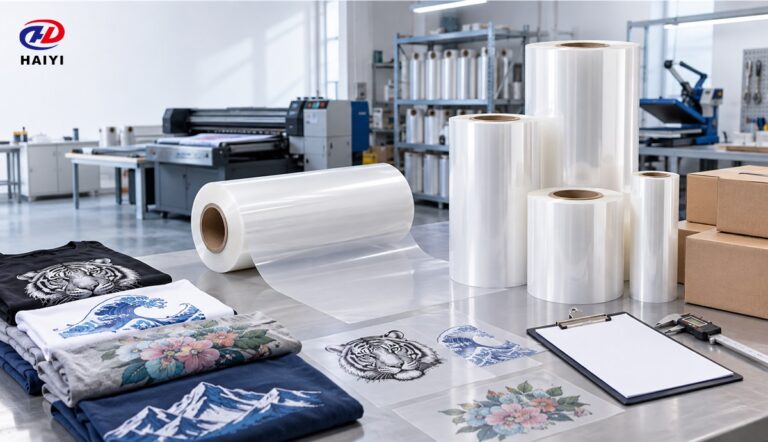
PET is a thermoplastic polymer — the same base material used in plastic bottles, food packaging, and industrial films. For DTF film, PET is produced in thin, clear sheet form with precise thickness specifications: typically 75 microns (0.075mm) to 100 microns (0.1mm) for standard production film.
PET is chosen for DTF film for three reasons: it is dimensionally stable under heat (it does not stretch or deform during pressing at 300 to 325°F), it has excellent mechanical properties (high tensile strength prevents tearing during printer feed and transfer application), and its surface can be engineered to accept specialized coatings.
The PET substrate itself does not absorb ink — plain PET is hydrophobic (water-repellent). Without coating, DTF ink deposited on PET film would bead and slide off the surface, exactly as water beads on a waxed car hood.
2. The Coating Layer
The coating is the functional component of DTF film. Applied to one or both sides of the PET substrate, the coating is a proprietary chemical formulation — typically polymer-based — that transforms the hydrophobic PET surface into a precisely controlled ink-absorbing medium.
The coating does four things:
- Absorbs DTF water-based pigment ink at a controlled rate that prevents bleeding without reducing density
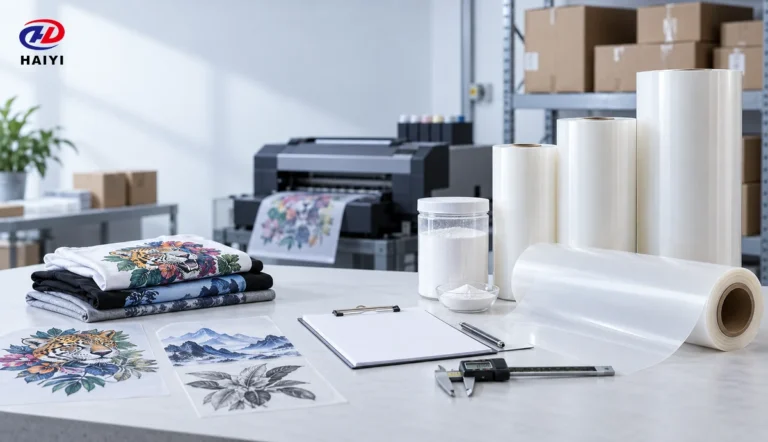
- Provides the surface texture that allows hot-melt adhesive powder to bond uniformly to printed areas
- Creates the release mechanism that allows the film to separate cleanly from the design after heat pressing
- On dual-matte film: provides anti-static properties on the reverse side that prevent powder adhesion in non-print areas
The coating formula is proprietary — different for every manufacturer. This is why two films with identical PET substrates can perform completely differently. The PET is a commodity. The coating is the intellectual property.
Stage 1 — PET Base Film: The Raw Material
The manufacturing process begins with procuring or producing the PET base film.
How PET Film Is Produced
PET resin pellets are melted and extruded through a flat die onto a chilled roll — a process called cast film extrusion. The molten polymer cools rapidly on the chilled surface, forming a clear, flat film of controlled thickness. The film is then biaxially oriented — stretched both lengthwise and crosswise — to align the polymer chains and improve mechanical properties: higher tensile strength, better dimensional stability, and improved optical clarity.
The result is BOPET (Biaxially Oriented PET) film — the industrial standard for DTF base substrate.
Specifications That Matter
Not all PET base film performs equally in DTF applications. The specifications that affect DTF performance:
Thickness uniformity: Tolerance of ±3 to ±5 microns across the full roll width. Inconsistent thickness causes uneven coating weight distribution and feed irregularities in the printer.
Surface roughness: Measured in Ra (arithmetic mean roughness). DTF film requires controlled surface roughness to accept coating adhesion without being so rough that it creates visual texture in the finished print.
Tensile strength: Minimum 35 N per 15mm width in both machine direction and transverse direction. Insufficient tensile strength causes film tearing during high-speed printing or transfer application.
Dimensional stability: Resistance to thermal expansion under pressing temperatures. PET is chosen specifically for this property — polyethylene or polypropylene films deform at DTF pressing temperatures.
Large-scale DTF film manufacturers, including Haiyi, source high-specification BOPET film and maintain strict incoming quality control on every delivery from the PET supplier. Inconsistent base film is the first potential point of failure in the production chain.
Stage 2 — Surface Treatment: Preparing the Base for Coating
PET film fresh from extrusion has poor adhesion properties. The polymer surface is chemically inert — coating adhesives do not bond well to untreated PET. Surface treatment converts this chemically inert surface into one that accepts and retains the coating layer.
Corona Treatment
The most common surface treatment for PET film. The film passes between two electrodes at high voltage, creating a corona discharge — a plasma field that bombards the film surface with energetic ions and free radicals. This oxidizes the surface layer of the PET, increasing surface energy from approximately 36 dyne/cm (untreated) to 52 to 56 dyne/cm (treated).
Higher surface energy means better wettability — coating solutions spread more uniformly across the treated surface rather than beading or pulling away from edges.
Why this matters for you: A film with inadequately treated base substrate has poor coating adhesion. The coating may delaminate during use — showing up as areas where the ink layer separates from the PET carrier, causing ink to transfer partially to the fabric with ragged edges or missing sections.
Primer Coating
Some manufacturers apply a thin primer layer after corona treatment before the main functional coating. The primer further improves adhesion of the main coating and provides a more consistent bonding surface. This is an additional manufacturing step that increases cost but improves coating durability and long-term performance.
Stage 3 — Coating Application: The Critical Manufacturing Step
This is the most technically complex and commercially significant stage of DTF film manufacturing. The coating formula and application method are what separate manufacturers with proprietary technology from those reselling generic substrate.
The Coating Machine
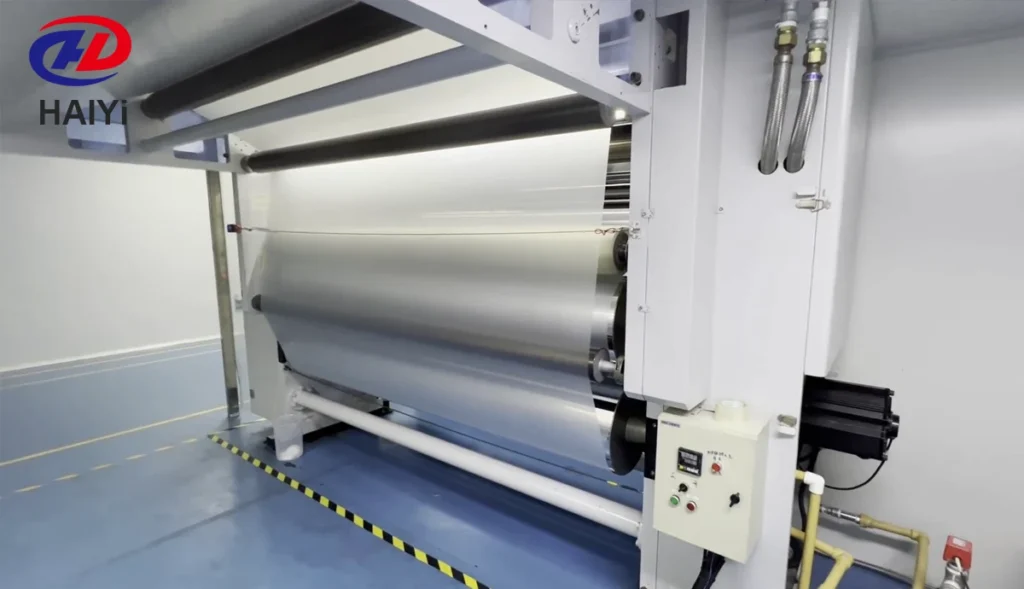
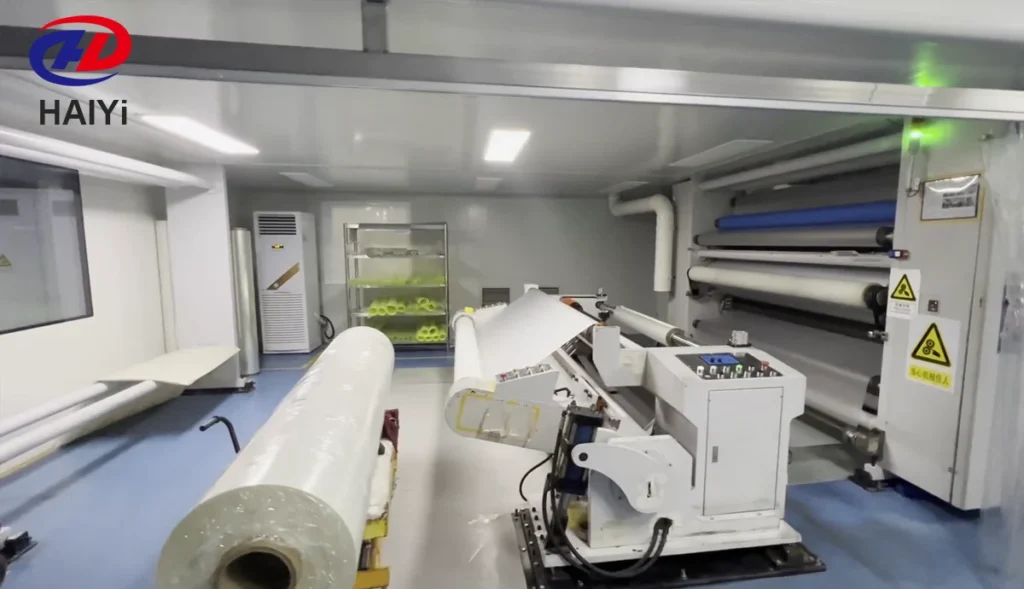
Industrial coating machines apply liquid coating formulations to film substrates at production speeds of 50 to 200 meters per minute. The coating machine holds a large reel of base PET film (typically 1.2 meters wide), unwinds it under controlled tension, applies the coating solution, and winds the coated film onto output reels.
Coating application methods used in DTF film production:
Comma coating (knife-over-roll): A fixed blade positioned at a precise gap above the film surface meters the coating thickness. As the film passes beneath the blade, excess coating is scraped off, leaving a controlled wet film thickness. Very precise and consistent — used for the primary ink-absorbing coating on DTF film.
Gravure coating: A rotating engraved roll picks up coating from a trough and transfers a metered amount to the film. Suitable for thin coating weights and high-speed application. Used for some anti-static back coatings.
Slot-die coating: Coating solution is pumped through a precision slot directly onto the film surface. Produces highly uniform coating thickness — the preferred method for premium-grade film production where coating uniformity tolerance is tight.
The Coating Formula
The coating formula for DTF film is a proprietary combination of:
- Polymer binders that provide adhesion to the PET substrate and form the coating film
- Porosity-controlling agents that determine ink absorption rate — too porous and ink bleeds; too dense and ink sits on the surface
- Release agents that allow the film to separate cleanly from the cured adhesive layer after heat pressing
- Anti-static agents (in dual-matte formulations) that reduce static charge buildup during powder application
- Leveling agents that ensure the coating dries to a flat, uniform surface without cratering or orange-peel texture
The formula is the intellectual property of the manufacturer. This is why manufacturers that develop their own coating formula — like Haiyi, with an in-house R&D team and more than 20 registered patents — produce fundamentally different products from those who purchase ready-made coating solutions or pre-coated PET from external suppliers.
A manufacturer purchasing pre-coated generic PET substrate cannot control the coating formula. They have no ability to adjust porosity for specific ink systems, optimize release force for specific peel types, or troubleshoot adhesion failures that originate in the coating chemistry. They can change their PET supplier, but they cannot change the coating.
Wet Coating Weight
The volume of coating applied per unit area — typically expressed as wet grams per square meter (g/sqm) — determines coating thickness after drying. Standard DTF film uses wet coating weights of 20 to 40 g/sqm for the primary ink-absorbing coating.
Coating weight uniformity across the full roll width is a critical quality parameter. Coating weight variation greater than ±3 g/sqm produces visible print quality differences within a single sheet — ink density is higher where coating weight is higher, lighter where it is lower.
Stage 4 — Drying and Curing the Coating
After coating application, the film passes through a multi-zone drying oven. Controlled heat evaporates the coating solvent (water or organic solvent) and initiates the polymer cross-linking reactions that give the coating its functional properties.
Drying Oven Specifications
Industrial coating lines use drying ovens typically 20 to 60 meters in length divided into multiple temperature zones. At production speeds of 50 to 100 meters per minute, the film has 12 to 60 seconds in the oven — enough time to drive off 95%+ of solvent and achieve adequate cross-linking.
Zone 1 (inlet): Low temperature (50 to 80°C) — gentle evaporation prevents skin formation (a surface film that traps solvent underneath and causes coating defects).
Zone 2-4 (main drying): Medium temperature (80 to 120°C) — primary solvent evaporation.
Zone 5+ (final curing): Higher temperature (100 to 140°C) — completes cross-linking reactions that give the coating its final adhesion, porosity, and release properties.
Why Drying Conditions Affect Performance
Incorrect drying produces coating defects that are invisible in the finished film but visible in use:
Under-cured coating: Insufficient cross-linking produces a coating that is too soft. The coating absorbs ink correctly but has poor abrasion resistance — the coating surface can be damaged during printer feed, and the release layer may not function correctly during film removal after pressing.
Over-cured coating: Excessive temperature or time produces a coating that is too cross-linked — too dense, with reduced porosity. Ink absorption slows, producing lower print density or requiring higher ink volume to achieve correct color density.
Solvent entrapment: Drying too fast in the first zone creates a surface skin that traps solvent. Trapped solvent continues to evaporate after coating and causes micro-blistering — visible as a slight texture or haze in the film that reduces print sharpness.
Stage 5 — Back Coating (Dual-Matte Film Only)
Standard single-sided DTF film has coating on one side only. The production process described in Stages 3 and 4 produces this film in a single pass.
Dual-matte film — the production standard for professional DTF print shops — requires a second coating pass on the reverse side of the film.
Purpose of the Back Coating
The back coating on dual-matte film serves two functions:
Anti-static treatment: Static electricity builds up on plain PET film surfaces during high-speed printing and powder application. This static charge attracts hot-melt adhesive powder to non-printed areas of the film surface — creating powder contamination in blank areas of the design. Anti-static back coating dissipates this charge, preventing powder adhesion outside the ink-printed areas.
Matte surface finish: The back coating gives the reverse side a matte appearance that is visually similar to the print side. This is why identifying the correct print side on dual-matte film requires the water drop test rather than visual inspection alone.
The Second Coating Pass
The film is loaded back onto the coating machine with the already-coated (print) side protected and the uncoated reverse side facing the coating head. The anti-static coating is applied at a lower coating weight than the primary coating — typically 5 to 15 g/sqm — and dried in a second oven pass.
This second pass doubles the production time and material cost for dual-matte film — explaining why it costs 15 to 25% more per meter than single-sided film. The production benefit (elimination of powder contamination failures) significantly exceeds this cost premium for any production operation running more than 20 transfers per day.
Stage 6 — Quality Control and Testing
Before the coated film advances to slitting and packaging, it undergoes quality control testing at the factory level. The scope of QC testing distinguishes manufacturers with documented quality systems from those relying on visual inspection only.
Standard QC Tests for DTF Film
Coating uniformity measurement: The coating weight per unit area is sampled across the roll width and at multiple points along the roll length. A properly calibrated coating machine produces ±3 g/sqm or tighter uniformity. Results outside specification trigger a process review before the batch is approved.
Tensile strength testing: Film samples are pulled to breaking point in both machine direction and transverse direction using a tensile testing machine. Minimum values (typically 35 N per 15mm width) confirm the film can withstand the mechanical stresses of printer feed and transfer application without tearing.
Release force measurement: A standardized adhesive test tape is applied to the print surface, pressed with a roller, and pulled off at a controlled angle and speed. The force required to remove the tape measures the coating’s release properties. This directly predicts how easily the film will separate from the pressed transfer during hot peel or cold peel.
Ink absorption test: A controlled volume of standard DTF ink is deposited on the film surface and the spread diameter is measured after a defined time. The result is compared to specification — too much spread indicates over-porous coating (bleeding risk); too little spread indicates under-porous coating (density risk).
Static dissipation test (dual-matte): A charge is applied to the film surface and the dissipation time is measured. Adequate anti-static performance is confirmed if the charge dissipates to below a threshold level within a defined time period.
Visual inspection: The full roll is inspected under strong lighting for coating defects — streaks (caused by coating knife contamination), voids (caused by substrate contamination), edge damage, and surface contamination.
Haiyi tests every production batch against all of the above parameters. Batch test reports are available to wholesale customers — a QC transparency that distinguishes manufacturers from resellers.
Stage 7 — Slitting and Roll Formation
Coated film exits the production line on master rolls — typically 1.2 meters wide and several hundred meters long. These master rolls are too wide for most DTF printers. Slitting converts them to the finished widths used in production.
The Slitting Process
Industrial slitting machines unwind the master roll, pass the film through a set of circular slitting blades positioned at precise intervals, and wind the resulting narrower strips onto individual output cores.
Standard finished widths cut from 1.2m master rolls:
- 30cm (approximately 12 inches) — for A3 desktop DTF printers
- 33cm (approximately 13 inches) — the most common production width, fits most A3+ desktop printers
- 60cm (approximately 24 inches) — for production-grade roll-fed DTF printers
- Custom widths cut to specific customer requirements (OEM orders)
Core Sizes
Film is wound onto paper or plastic cores of 0.75-inch (19mm) or 1.0-inch (25.4mm) internal diameter. Core size must match the printer’s film holder specification — the wrong core size causes the roll to sit incorrectly on the printer’s feed spindle.
Standard Roll Lengths
100 meters: The production standard for wholesale rolls. At 100m length, a 60cm-wide roll weighs approximately 5 to 6 kg — manageable for manual roll changes.
50 meters: Available for trial orders and smaller operations.
200 meters: Available for high-volume production operations that want to minimize roll changes.
Slitting Quality
The quality of the slitting operation affects film performance in two ways:
Edge quality: Clean, straight slit edges without fraying, delamination, or raised burrs. Poor edge quality causes film feeding problems in roll-fed printers and can cause static discharge at the film edges that attracts powder to the edge zone.
Winding tension: Consistent winding tension across the roll length is essential for stable film feeding. Rolls wound too tight develop internal stresses that cause the film to buckle when unwound. Rolls wound too loose unwind unevenly and cause registration problems.
Stage 8 — Packaging and Storage
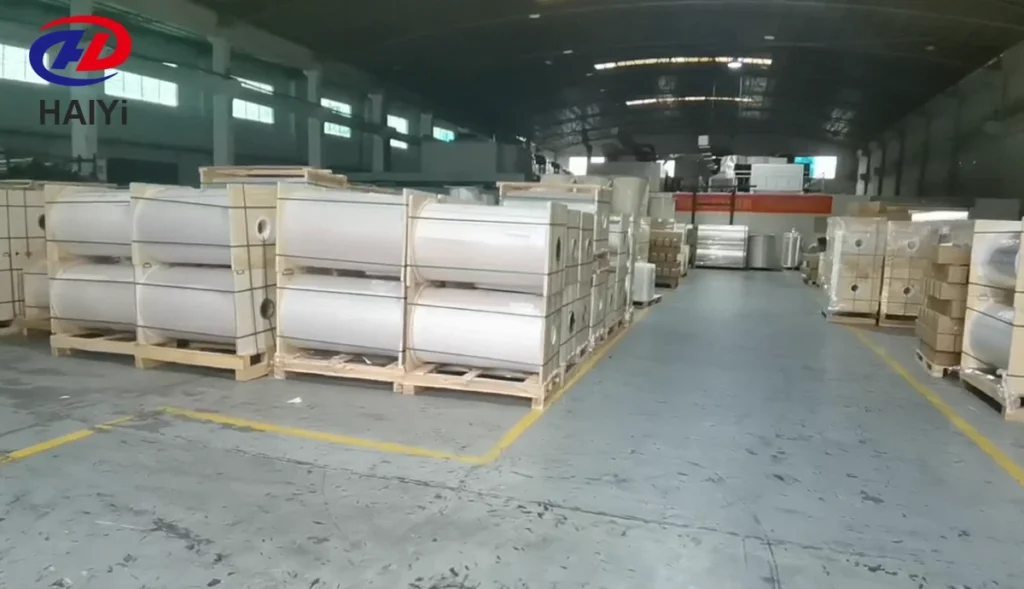
Finished rolls are packaged to protect the coating from the primary environmental threats: moisture, UV light, contamination, and physical damage.
Standard Packaging
Individual rolls are wrapped in moisture-resistant packaging — typically a foil-lined polyethylene bag sealed with a desiccant pack inside. The wrapped roll is placed in a cardboard box that provides physical protection during shipping and storage.
Labeling on each roll and box includes: product specification (film type, width, length, peel type), production batch code, manufacture date, and storage instructions.
Why Packaging Matters
The coating on DTF film is hygroscopic — it absorbs moisture from the air. In high-humidity environments, an unsealed roll can absorb enough moisture within days to affect ink absorption uniformity. Moisture-compromised film shows up in production as inconsistent ink density, spreading at fine detail areas, or irregular powder adhesion.
Proper sealed packaging with desiccant maintains coating performance from the factory to your print room. Once a roll is opened, it should be resealed in its original packaging between print sessions.
Why In-House Coating Matters for Film Quality
Throughout this manufacturing process, the coating stage (Stage 3) is the single step where manufacturer expertise most directly determines product quality.
A manufacturer that develops and applies its own coating formula has full control over:
- The chemical composition of the ink-absorbing layer
- The coating application parameters (wet coating weight, machine speed, blade gap)
- The drying profile (zone temperatures, line speed)
- The testing specifications for batch release
When you encounter a production problem — inconsistent adhesion, ink bleeding in fine details, powder contamination in blank areas — a manufacturer with in-house coating capability can diagnose the root cause and adjust the formula or process. A reseller of pre-coated substrate cannot.
Haiyi’s in-house R&D team has developed and refined the coating formula over 15 years, resulting in more than 20 registered patents covering the coating chemistry and application process. The dual-matte anti-static coating applied to Haiyi’s production rolls is formulated to deliver consistent ink absorption across the full 100m roll length — not just the first 10 meters that represent the sample you received.
How Manufacturing Quality Affects Your Production
Understanding the manufacturing process makes the performance differences between film types predictable rather than mysterious.
Coating uniformity → print density consistency. A film produced on a well-calibrated coating machine with tight ±3 g/sqm coating weight tolerance produces uniform ink density from edge to edge and meter to meter. A film with ±8 g/sqm variation produces visible density differences within the same print — lighter areas where the coating is thinner, denser areas where it is thicker.
Anti-static back coating → powder contamination rate. Single-sided film with no back coating accumulates static charge that attracts powder to non-printed film areas. This shows up as a powder haze outside design edges on finished transfers. Dual-matte film with proper anti-static back coating eliminates this failure mode entirely.
Cross-linking completeness → release behavior. Under-cured coating produces variable release force — sometimes peeling easily, sometimes requiring more force than expected. Variable release force causes inconsistent print edge quality in hot peel applications and occasional ink lifting in cold peel applications.
PET base quality → dimensional stability. Film produced from high-specification BOPET substrate maintains flat, stable dimensions through the printer feed path and into the pressing stage. Film from lower-specification PET substrate may exhibit curl, edge wave, or slight dimensional instability that causes print registration errors on fine patterns.
FAQ
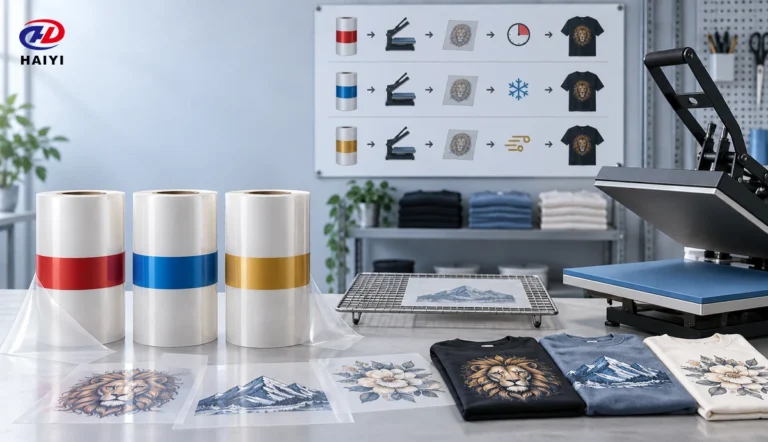
How is DTF film different from regular plastic film? Regular plastic film (polyethylene, polypropylene) has no ink-absorbing coating and cannot accept DTF water-based pigment ink. DTF film is PET-based for thermal stability at pressing temperatures and has a proprietary coating applied to the print side that absorbs ink at a controlled rate, accepts hot-melt powder, and releases cleanly from the bonded transfer after heat pressing.
What does “dual-matte” mean in DTF film manufacturing? Dual-matte film has a coating on both sides of the PET substrate. The print side carries the full ink-absorbing functional coating. The back side carries a secondary anti-static matte coating that prevents static charge buildup and eliminates powder adhesion in non-print areas during the powdering step. Manufacturing dual-matte film requires two coating passes and is more expensive to produce than single-sided film.
Why does some DTF film cost three times more than others? The price difference reflects the coating. Budget-tier film uses generic pre-coated PET purchased from external suppliers — the manufacturer applies no proprietary coating. Premium film is manufactured with a proprietary coating formula developed in-house, applied on precision coating equipment, and tested against tight specifications. The PET substrate itself represents a small fraction of total film cost — the coating chemistry and application process represent most of the value.
What is the standard width for DTF film production? DTF film is produced on coating machines in master roll widths of 1.2 meters (120cm). The master rolls are then slit to final customer widths: 30cm (12 inches) for A3 desktop printers, 33cm (13 inches) for A3+ printers, and 60cm (24 inches) for production roll-fed printers. OEM customers can specify custom widths within the available range.
How does the coating machine affect film quality? The coating machine controls coating weight uniformity across the roll width and along the roll length. A well-calibrated slot-die or comma coating system on a modern coating line maintains ±3 g/sqm coating weight tolerance — ensuring consistent print quality across every meter of a 100m roll. Older or poorly maintained coating equipment produces ±8 g/sqm or greater variation, resulting in inconsistent production performance.
Why do manufacturers develop proprietary coating formulas? The coating formula determines the film’s functional performance — ink absorption rate, powder adhesion uniformity, release force, anti-static properties, and long-term durability. A proprietary formula that has been developed and refined over years of production provides performance advantages that competitors cannot replicate by purchasing the same PET substrate. It also enables technical support — a manufacturer that developed the formula can diagnose and resolve production issues that a reseller cannot.
What QC tests should a DTF film manufacturer perform? Industry-standard QC for DTF film includes: coating uniformity measurement (g/sqm across roll width), tensile strength testing (machine and transverse direction), release force measurement, ink absorption test (spread diameter under controlled conditions), anti-static dissipation test (dual-matte only), and full visual inspection for coating defects. Manufacturers should be able to provide batch test reports with specific numerical values — not just qualitative quality claims.
How are DTF film rolls stored to maintain coating performance? Finished rolls should be sealed in moisture-resistant packaging with a desiccant pack, stored horizontally at 15 to 25°C (59 to 77°F) and 40 to 60% relative humidity, away from direct sunlight and UV sources. The coating is hygroscopic — moisture absorption from air in high-humidity environments degrades ink absorption uniformity within days on unsealed film. Haiyi packages every roll in foil-lined sealed bags with desiccant to maintain coating performance from factory to customer.
Conclusion
DTF film is not a simple piece of plastic. It is a precisely engineered composite material — PET base substrate plus a proprietary coating layer — where the coating chemistry and application process determine everything about how it performs in production.
The manufacturing process has eight stages. Four of them (surface treatment, coating application, drying, and back coating) are where manufacturing expertise matters most and where the quality differences between film products originate.
The key insight: the coating formula is intellectual property. Manufacturers that develop their own coating in-house — with dedicated R&D teams, precision coating equipment, and documented batch QC testing — produce fundamentally different products from those who purchase generic pre-coated PET and relabel it. The performance difference is visible in production: in print density consistency, powder adhesion uniformity, release behavior, and wash durability of finished transfers.
When you choose a DTF film supplier, you are choosing a coating manufacturer as much as a film supplier. The question “do you develop your own coating formula in-house?” cuts through all marketing claims to the technical reality of what you are buying.
Haiyi manufactures DTF film using proprietary in-house coating technology developed over 15 years. Our production facility in Foshan, Guangdong operates at 60,000 sqm/day capacity with precision coating lines, an in-house R&D team, and over 20 registered coating patents. Every batch is tested against documented QC specifications before shipment. Factory-direct wholesale pricing, OEM packaging, low MOQ, and 15 years of international export experience.