
How to Print DTF Transfers: Complete Production Guide

Read time: 15 minutes
Introduction
DTF printing has a short learning curve — but a wide gap between average results and professional results.
Average results come from following the basic steps: print, powder, press, peel. Professional results come from understanding why each step works the way it does, which variables matter most, and what separates a transfer that lasts 50 washes from one that peels after two.
This guide covers the full process from design file to finished garment. Every setting. Every variable. Every comparison to the methods you may already be using. By the end, you will know exactly what to do — and more importantly, why — to produce consistently professional DTF prints.
Key Takeaways
- DTF printing produces professional-quality, full-color results on any fabric type and color — cotton, polyester, blends, nylon, denim — with no pretreatment required
- The heat press settings that determine whether a transfer lasts 50 washes or fails after two: temperature 305 to 325°F for cotton, time 10 to 15 seconds, medium-high pressure — always verified with a contact thermometer, not the display
- The second press — 5 to 10 seconds through parchment paper after peeling — is the single most impactful step for wash durability that most operators skip
- DTF film quality is the most underestimated variable: generic film with inconsistent coating produces problems no press setting can fix; factory-direct film from a manufacturer with in-house coating technology eliminates batch variation
- DTF vs screen printing: DTF has no setup cost and works at any quantity; screen printing has lower per-unit cost at 100+ piece identical runs on cotton
- DTF vs sublimation: DTF works on cotton and dark fabrics; sublimation is limited to white or light polyester — for general apparel, DTF is more versatile
- Is DTF printing good quality? Yes — properly applied DTF transfers produce sharp detail, vibrant color, and 50+ wash cycle durability that matches or exceeds correctly applied screen printing on comparable fabrics
- Factory-direct wholesale DTF film from Chinese manufacturers saves 20 to 40% versus US distributor pricing — the film cost difference compounds significantly at production volume
What Is DTF Printing?
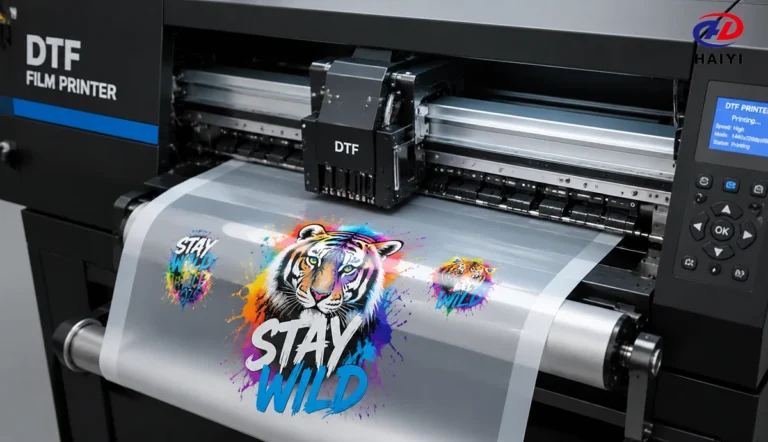
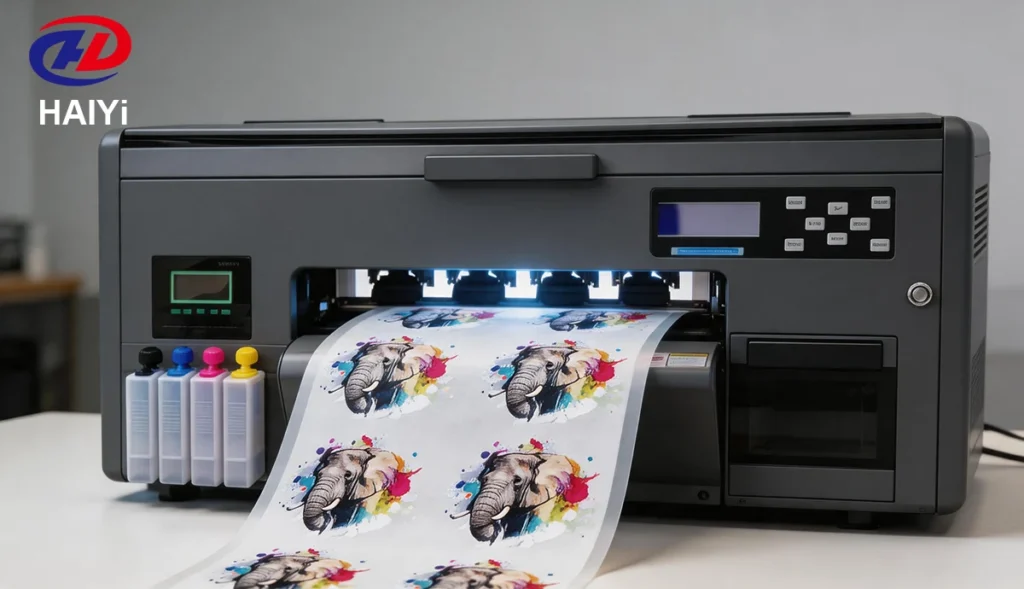
DTF stands for Direct to Film — a printing process where:
- A design is printed onto a coated PET transfer film using water-based pigment ink (white ink base layer first, then CMYK color layers)
- Hot-melt adhesive powder is applied to the wet ink surface immediately after printing
- The powder is cured with heat (250 to 280°F) to bond it permanently to the ink layer
- The cured transfer is heat-pressed to fabric at 305 to 325°F for 10 to 15 seconds
- The film is peeled away, leaving the design bonded to the garment
What makes DTF different from every other garment printing method:
No fabric restrictions. Cotton, polyester, nylon, blends, denim, canvas, leather — one workflow, any fabric. No pretreatment required on any of them.
No color restrictions. Light and dark fabrics print identically. The white ink underbase creates opacity that makes colors accurate on black fabric the same way they appear on white.
No minimum quantities. One shirt costs as much to produce as one shirt. The economics do not change with quantity the way screen printing does.
Is DTF Printing Good Quality?
The direct answer: yes, when done correctly.
A properly printed and applied DTF transfer produces:
Color accuracy: Full-color photographic reproduction including gradients, shadows, and fine detail. The white ink underbase ensures consistent color across any fabric color without compromise.
Edge sharpness: Fine text at 6 points, thin lines, and complex artwork transfer cleanly when film coating quality is adequate. The coating controls ink absorption and prevents bleeding at detail edges.
Wash durability: A correctly applied transfer on quality film lasts 50 or more wash cycles without cracking, peeling, or significant color loss. This is the professional standard — comparable to correctly cured screen printing on equivalent fabrics.
Flexibility: The TPU adhesive moves with the fabric through stretching, washing, and wearing without cracking. DTF handles stretch fabrics better than most screen printing inks.
The honest caveat: DTF output quality varies significantly with film quality, press settings, and process execution. A poorly applied DTF transfer peels after one wash. A correctly applied transfer on quality film lasts years. The technology works — the execution determines whether you see the technology’s potential or its failure modes.
Is DTF Show Good?
“Is DTF show good” likely refers to whether DTF printing performs well at trade shows, pop-up events, and live printing environments. The answer is yes with one caveat: DTF requires a heat press, not just a printer. Pop-up printing with DTF means bringing and setting up a heat press alongside the printer. The advantage is that pre-made gang sheets can be printed in advance and pressed quickly at the event — making DTF viable for show environments where fast one-off customization is the value proposition.
The Complete DTF Printing Workflow: Step by Step
Step 1 — Design Preparation
File requirements:
- Format: PNG with transparent background
- Resolution: 300 DPI minimum
- Color mode: RGB
- Do not mirror the design — RIP software handles mirroring automatically
RIP software: Load the design into DTF RIP software. Set white ink underbase for dark fabric printing. Arrange multiple designs on a single sheet (gang sheeting) to maximize film efficiency — this is the most important cost control in DTF production.
Gang sheet target: 80% or higher film utilization. Printing one full-front design per A3 sheet wastes 38% of the film. Nesting 4 to 6 smaller designs per sheet reduces film cost per transfer by 60 to 80%.
Step 2 — Load DTF Film Correctly
Identify the printable (coated) side: it is the matte, slightly frosted-looking surface. The non-printable side is glossy. For dual-matte film where both sides appear matte, perform the water drop test — water spreads on the printable side and beads on the back.
Load the film with the printable (matte) side facing the print heads. Loading the wrong side produces a completely unusable print and potentially damages print heads.
Step 3 — Print
The DTF printer deposits layers in sequence:
- White ink first (opacity base for dark fabrics)
- CMYK color layers on top of white
- Varnish (optional — adds gloss and scratch resistance)
Print time for an A3 sheet: 2 to 8 minutes depending on printer speed and resolution.
Handle printed film by the edges immediately after printing. The ink is wet. Do not stack printed sheets face-down or touch the ink surface.
Step 4 — Apply Adhesive Powder Immediately
This step must happen while the ink is still wet. The powder adheres only to wet ink — delay allows partial ink drying that prevents powder adhesion in affected areas.
How to apply:
- Place the printed film ink-side up in a clean tray
- Sprinkle hot-melt powder generously across the entire printed surface
- Tilt and rotate the film to distribute powder to all edges and details
- Gently tap the film back to dislodge excess powder from unprinted areas
- Confirm the design edges and fine details have full powder coverage before curing
Key mistake to avoid: Insufficient powder at design edges. Edge peeling after washing almost always originates from incomplete powder coverage at the perimeter of the design.
Step 5 — Cure the Powder
Heat melts the powder and bonds it permanently to the ink layer. Correctly cured powder has a smooth, slightly glossy surface with a faint texture — like an orange peel. Under-cured powder appears matte and grainy; it will fail at washing.
Curing methods:
- Heat gun: acceptable for very low volume, uneven results
- Curing oven: consistent, professional standard
- Integrated powder shaker + curing unit: most efficient for production
Curing temperature: 250 to 280°F (120 to 140°C) Duration: Until all powder melts to a smooth, continuous glossy surface
Allow the cured transfer to cool completely before pressing.
Step 6 — Press to Garment
Pre-press the garment first. Place the empty shirt on the platen and press for 3 to 5 seconds. This removes moisture and smooths wrinkles. Moisture trapped between transfer and fabric creates steam that prevents adhesion.
Position the transfer face-down on the garment (film side up, ink side facing fabric). Apply heat and pressure at fabric-appropriate settings (see table below).
Step 7 — Peel the Film
Hot peel: Remove the film within 10 to 15 seconds of pressing while still warm. Faster workflow, slightly less forgiving of peel speed.
Cold peel: Allow full cooling (60 to 90 seconds) before peeling. Better edge definition, more forgiving of technique, recommended for fine-detail designs.
Peel at a flat, low angle (15 to 30 degrees) rolling the film back rather than pulling upward. Fast perpendicular pulling causes ink lifting at edges regardless of settings.
Step 8 — Second Press (Never Skip This)
Place parchment paper or a Teflon sheet over the design and press again for 5 to 10 seconds at the same temperature and medium pressure.
This step drives the adhesive deeper into the fiber weave, seals the edges, and is the primary determinant of whether transfers survive 20 washes or 50. Skipping it is the most common cause of premature edge peeling in production.
DTF Heat Press Settings by Fabric: Full Reference Table
Always verify actual platen temperature with a contact thermometer before production. Heat press displays frequently read 15 to 30°F higher than actual surface temperature.
| Fabric Type | Temperature | Time | Pressure | Peel Type | Notes |
|---|---|---|---|---|---|
| 100% Cotton | 315–325°F (157–163°C) | 10–12 sec | Medium-High | Hot or Cold | Most forgiving fabric for DTF |
| Cotton/Poly 50/50 | 305–315°F (152–157°C) | 10–12 sec | Medium-High | Hot or Cold | Reduce temp vs pure cotton |
| 100% Polyester | 280–300°F (138–149°C) | 10–12 sec | Medium | Hot Peel preferred | Risk of dye migration above 300°F |
| Performance/Moisture-Wicking | 300–315°F (149–157°C) | 12–15 sec | Medium-High | Cold Peel | Pre-test for coating compatibility |
| Nylon | 275–290°F (135–143°C) | 10 sec | Medium | Cold Peel | Heat-sensitive — verify film spec |
| Fleece / Heavy Hoodie | 310–320°F (154–160°C) | 15–18 sec | Firm | Hot or Cold | Use silicone pad for uneven surface |
| Denim | 315–325°F (157–163°C) | 12–15 sec | Firm | Hot or Cold | Pre-press extra 5 sec for moisture |
| Canvas / Tote Bags | 310–320°F (154–160°C) | 12–15 sec | Medium-High | Hot or Cold | |
| Leather / Faux Leather | 275–290°F (135–143°C) | 8–10 sec | Light-Medium | Cold Peel | Test before production |
Second press: 5 to 10 seconds at same temperature through parchment paper or Teflon — always.
Hot Peel vs Cold Peel: Which Produces Better Results?
This question does not have a single answer — both work when executed correctly. The relevant question is which one fits your film and your workflow.
Hot peel — characteristics:
- Peel within 10 to 15 seconds of pressing while still warm
- Faster production cycle — no waiting time between shirts
- More sensitive to peel speed — peeling too fast causes edge lifting
- Suitable for most standard cotton and blend garments
- If you miss the window and the film cools: re-press for 3 to 5 seconds to reactivate
Cold peel — characteristics:
- Allow full cooling (60 to 90 seconds minimum) before peeling
- Adhesive fully solidifies before film removal — cleaner edges, better detail retention
- More forgiving of peel speed variation
- Generally superior wash durability on equivalent settings
- Best for fine-detail designs, performance fabrics, and production environments where timing consistency is difficult
The practical recommendation: Cold peel produces more consistent results across operators and production environments. Hot peel delivers faster throughput when speed is the priority and the team is trained on consistent timing. If you are experiencing edge lifting with hot peel, switch to cold peel before adjusting settings — it requires no equipment change and resolves most timing-related peel failures.
The Second Press: Why Skipping It Costs You
This is the step that distinguishes 20-wash prints from 50-wash prints. It is also the step most commonly eliminated when production gets busy.
After film removal, the adhesive surface is slightly irregular — peaks and valleys from the powder layer that was not fully flattened during the first press. A second press at the same temperature for 5 to 10 seconds through parchment paper or a Teflon sheet:
- Drives the adhesive deeper into the fiber structure of the fabric
- Seals the design edges, which are the failure point for most washing-related peel
- Smooths the surface texture for a softer, less noticeable hand feel
- Produces measurably better adhesion strength in pull tests
The time investment is 5 to 10 seconds per garment. The return is transfers that consistently pass the wash test rather than failing at the edges after the second or third cycle.
Critical detail: Always use parchment paper or a Teflon sheet for the second press. Direct platen contact on the exposed design surface can damage the print texture and create glossy spots that affect appearance.
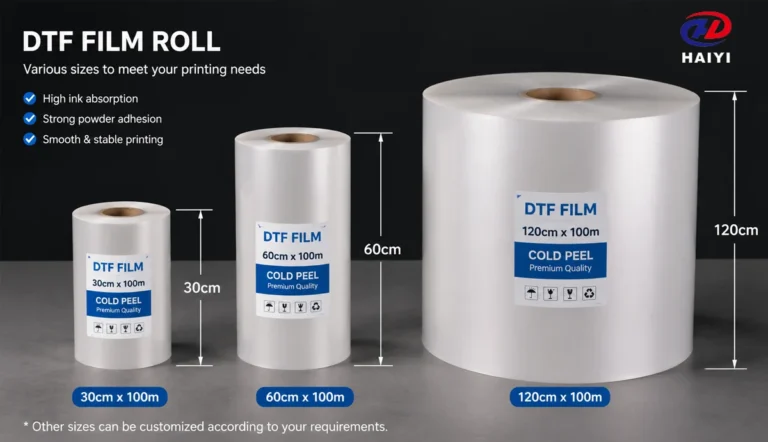
How DTF Film Quality Affects Your Output
DTF film is the most underestimated variable in the printing quality equation. Two shops can run identical printers, inks, and settings — and produce completely different output quality — because of the film.
What the Coating Controls
The coating applied to the PET film substrate determines:
Ink absorption precision: The coating must absorb ink at a controlled rate — enough to hold the color without bleeding at fine detail edges. A coating with inconsistent porosity produces ink bleeding in some areas and insufficient density in others on the same sheet.
Powder adhesion uniformity: The coating must hold hot-melt powder evenly across the entire ink-covered area. Gaps in powder coverage create gaps in the adhesive layer — which become edge peel or missing detail after pressing.
Anti-static performance (dual-matte film): Anti-static coating prevents powder from adhering to non-printed areas. Without it, powder contamination outside the design creates a haze of melted adhesive on the garment around the design.
Release behavior: The coating must release cleanly from the cured adhesive after pressing. Inconsistent release causes ink lifting during peel in some areas and excessive resistance in others.
Generic vs In-House Coating
Most budget-tier DTF film is produced from generic pre-coated PET substrate purchased from external manufacturers. The coating formula is not controlled by the film brand — it is whatever the substrate supplier produced. Batch-to-batch variation in coating properties is inherent and unavoidable.
Premium film from manufacturers like Haiyi that develop their own coating formula in-house have full control over ink absorption rate, anti-static performance, and release force. Every production batch is tested against documented specifications. Batch 50 performs identically to batch 1.
The business consequence: if you are running production and your results change unexpectedly between rolls at the same settings — ink bleeding, edge peeling, powder contamination — the film coating is almost certainly the variable that changed. In-house coating control eliminates this.
DTF Printing vs Screen Printing: Durability and Quality Compared
This is one of the most common comparisons in the custom apparel industry. Here is the honest assessment.
Quality Comparison
Color range: DTF produces full-color photographic reproduction including gradients and shadows at any quantity. Screen printing achieves equivalent quality but each color requires a separate screen — complexity and cost increases with color count.
Detail: Both methods achieve excellent fine-detail reproduction when executed correctly. DTF on quality film with correct settings matches screen printing on fine text and thin lines.
Feel on fabric: Screen printing with standard plastisol ink sits on the fabric surface with a variable thickness feel. DTF produces a thin, flexible layer with a soft feel that most people describe as less intrusive than thick screen prints. Discharge and water-based screen printing produce a softer feel competitive with DTF, but at higher production complexity.
DTF vs Screen Printing Durability
This is where context matters enormously.
Correctly applied DTF on cotton: 50+ wash cycles without cracking or peeling — matching correctly cured plastisol screen printing on the same fabric.
Screen printing durability advantages: For very high-volume production of a single design on 100% cotton, properly cured plastisol screen printing can outlast the garment itself. On performance polyester and blended fabrics where plastisol cracks easily, DTF matches or exceeds screen printing durability.
DTF durability advantages: DTF on synthetic and blended fabrics significantly outperforms screen printing — plastisol is more prone to cracking on polyester and stretch fabrics where DTF’s flexible TPU adhesive handles movement without failure.
Business Decision Matrix
| Factor | DTF | Screen Printing |
|---|---|---|
| Setup cost per order | None | $15–$30 per color per screen |
| Minimum quantity for cost efficiency | 1 piece | 12–48 pieces |
| Cost advantage at 100+ same design | Equal or worse | Lower per-piece cost |
| Full-color complex designs | No cost premium | Cost increases with color count |
| Dark fabric printing | Standard (white ink) | Requires special inks and process |
| Fabric compatibility | Any | Best on cotton; limited on polyester |
| Rush single orders | Yes | No (setup time required) |
Bottom line: DTF wins for small runs, mixed designs, dark fabrics, and synthetic fabrics. Screen printing wins for very high volume (100+ pieces) of identical designs on cotton where setup cost amortizes.
DTF Printing vs Sublimation: Which Is Better?
| Feature | DTF | Sublimation |
|---|---|---|
| Works on cotton | Yes | No |
| Works on dark fabrics | Yes | No (light colors only) |
| Works on polyester | Yes | Yes (best performance) |
| Works on mugs and hard goods | No | Yes |
| Surface feel | Thin flexible layer | Zero feel — embedded in fiber |
| Startup cost | $1,500–$3,000 | $400–$1,000 |
| Wash durability on polyester | 50+ cycles | Permanent |
| All-over print | Limited | Excellent |
| Maintenance required | High (white ink) | Low |
Choose DTF when: Your customers want cotton, dark garments, or mixed-fabric orders. You serve a general apparel market.
Choose sublimation when: Your primary products are white or light polyester sportswear, and you want branded hard goods like mugs and mousepads.
For most apparel businesses: DTF is the more versatile choice because it covers the full range of consumer apparel fabrics. Sublimation is the best complement for polyester sportswear and hard goods — the most successful print shops run both.
Common DTF Problems and Exact Fixes
Transfer Peels at Edges After Washing
Cause: Under-pressing (temperature too low, time too short, or pressure too light), skipping the second press, or insufficient powder coverage at design edges.
Fix: Verify press temperature with a contact thermometer. Add second press. Check powder coverage reaches all design edges before curing.
Ink Bleeding at Fine Detail
Cause: Film coating with insufficient porosity control causing lateral ink spread, or white ink density too high creating bleed at the design perimeter.
Fix: Test a replacement roll from a manufacturer with in-house coating quality control. Adjust white ink underbase density in RIP software — 70 to 85% is sufficient for most dark fabrics.
Powder Contamination Outside the Design
Cause: Single-sided film without anti-static coating allowing static electricity to attract powder to non-printed areas.
Fix: Switch to dual-matte anti-static film. The back coating eliminates powder adhesion in non-print areas.
Film Hard to Peel
Cause: Over-pressing (temperature, time, or pressure exceeds release coating tolerance), wrong peel timing for the film type, or degraded film coating.
Fix: Reduce temperature by 10°F. Verify peel type matches your film (hot vs cold). Test replacement film if problem persists at correct settings.
Colors Appear Dull or Washed Out
Cause: White ink underbase density insufficient (colors on dark fabric), press temperature too high damaging ink layer, or over-cured adhesive powder.
Fix: Increase white ink density in RIP software. Reduce press temperature by 10°F. Verify curing temperature is 250 to 280°F — not higher.
Design Cracks After a Few Washes
Cause: Press temperature too high making adhesive brittle, or fabric washed in hot water without turning inside out.
Fix: Reduce temperature. Provide care instructions with every garment — wash inside out, cold water, no high-heat drying.
Where to Find DTF Printing Near Me vs. Factory Direct Film
Finding DTF Printing Near Me
For buyers looking to purchase finished DTF transfers rather than print in-house, local DTF printing suppliers offer same-day or next-day turnaround. Search “DTF printing near me” on Google Maps, or in local Facebook groups for custom apparel.
Local pricing is typically $0.04 to $0.08 per square inch for wholesale transfers. For occasional one-off orders or emergency supply, local suppliers are convenient. For regular production volume, the cost difference versus in-house printing or factory-direct film quickly justifies the setup investment.
In-House vs. Buying Transfers
The breakeven point where in-house printing becomes more cost-effective than buying pre-made transfers is approximately 20 to 30 shirts per day. Below this volume, buying transfers is more economical. Above it, in-house printing pays for itself within 2 to 4 months.
Wholesale DTF Film from China: What Buyers Need to Know
China produces over 79% of the world’s DTF film. Every US and regional DTF film distributor is sourcing from China — the question is whether you pay factory price or distributor price.
Price Comparison
| Source | Per 100m Roll (13-inch) | Per Meter |
|---|---|---|
| US retail | $30–$50 | $0.30–$0.50 |
| US online distributor | $22–$32 | $0.22–$0.32 |
| China factory-direct (standard) | $16–$22 | $0.16–$0.22 |
| China factory-direct (premium) | $18–$28 | $0.18–$0.28 |
At 20 rolls per month, factory-direct saves $1,440 to $2,400 per year versus US distributor pricing.
What “DTF Film Manufacturer in China” Actually Means
Not every Chinese DTF film listing is from a manufacturer. The critical distinction:
Factory (manufacturer): Develops and applies its own coating formula on in-house coating lines. Can control batch-to-batch quality. Can adjust specifications for OEM requirements. Can provide batch QC test reports.
Trading company (reseller): Purchases finished film from factories and relabels it. Cannot control coating specifications. Cannot guarantee batch-to-batch consistency. Cannot provide QC test reports for the coating.
The diagnostic question: “Do you develop your coating formula in-house, or source pre-coated PET from an external supplier?” A genuine manufacturer answers specifically. A reseller cannot.
Haiyi, based in Foshan, Guangdong, operates with in-house coating technology developed over 15 years, 60,000 sqm/day production capacity, and more than 20 registered coating patents. Factory-direct wholesale pricing with low MOQ is available for international buyers, with documentation support for import.
Getting Wholesale DTF Film from China
Steps for first-time factory-direct sourcing:
- Request samples from two separate production batches — test both through the complete workflow
- Verify factory status through a video call showing coating production equipment
- Confirm certifications (ISO 9001, OEKO-TEX) with issuing bodies directly
- Place a trial order of 10 to 20 rolls before committing to monthly volumes
- Use a licensed freight forwarder for sea freight customs clearance
- Maintain 60 to 90 days of inventory buffer to cover 25 to 45 day sea freight lead time
FAQ
Is DTF printing good quality? Yes — correctly applied DTF transfers produce professional-quality results with full-color photographic detail, sharp edges, and 50+ wash cycle durability. Quality depends primarily on film coating quality, press settings accuracy, and process execution. Beginner failures are almost always process problems rather than technology limitations.
How does DTF printing compare to screen printing for durability? DTF vs screen printing durability is equivalent on cotton when both are applied correctly — both achieve 50+ wash cycle performance. DTF has a significant durability advantage on polyester and stretch fabrics where screen printing plastisol cracks. Screen printing has a cost-per-unit advantage only at 100+ pieces of identical designs on cotton.
Is DTF better than sublimation? For general apparel: DTF is more versatile because it works on cotton and dark fabrics that sublimation cannot handle. Sublimation is better for white polyester sportswear (zero surface feel, permanent durability) and hard goods like mugs and mousepads. Most successful print operations run both.
What are the correct DTF heat press settings? For 100% cotton: 315 to 325°F (157 to 163°C), 10 to 12 seconds, medium-high pressure. Always verify actual platen temperature with a contact thermometer — displays are frequently 15 to 30°F higher than actual surface temperature. See the full settings table by fabric type above.
Where can I find DTF printing near me? Search “DTF printing near me” or “DTF transfers near me” on Google Maps. Local DTF print suppliers and custom apparel shops offer same-day or next-day transfer printing. For regular production volume, in-house printing or factory-direct film sourcing delivers better economics than local purchase pricing.
What is wholesale DTF film and where can I buy it? Wholesale DTF film is film purchased in bulk quantities directly from manufacturers or distributors at volume pricing — typically 20 rolls or more per order. Factory-direct wholesale from Chinese manufacturers like Haiyi offers the lowest per-meter cost at $0.16 to $0.28 depending on film type and volume, with 20 to 40% savings versus US distributor pricing.
How does DTF film quality affect print results? DTF film coating quality controls ink absorption, powder adhesion, anti-static performance, and release behavior. Generic film with inconsistent coating produces printing problems that press settings cannot fix: ink bleeding, edge peeling, powder contamination, and variable results between rolls. Factory-direct film from a manufacturer with proprietary in-house coating technology delivers consistent results across every meter of every roll.
Can I use DTF printing for detailed designs? Yes. DTF printing handles fine text at 6 points and smaller, thin lines, gradients, and photographic detail when film coating quality is adequate. The coating controls ink absorption precision — quality film from a manufacturer with in-house coating technology produces sharp fine detail consistently. Generic film with variable coating porosity causes detail bleeding.
Conclusion
DTF printing delivers professional-quality results consistently when three variables are controlled: settings, process, and film.
Settings: Verify your actual press temperature with a contact thermometer. Display readings are not reliable. The table in this guide gives the correct starting point for every fabric type — but a thermometer gives you the actual number.
Process: Pre-press every garment. Apply powder immediately after printing. Cure fully (smooth glossy surface). Peel at the right time for your film type. Always second-press. These five steps, done consistently, produce professional results on every shirt.
Film: The coating on your DTF film controls print quality more than any other variable. Generic pre-coated PET with variable coating produces inconsistent results that press settings cannot compensate for. Factory-direct film from a manufacturer with in-house coating development eliminates the coating variable from your troubleshooting equation.
The comparison positions: DTF outperforms screen printing for small runs, dark fabrics, and mixed-fabric orders. DTF is more versatile than sublimation for general apparel. DTF is accessible at home-operation scale and competitive at commercial production scale.
Factory-direct wholesale DTF film from China — specifically from manufacturers with proprietary coating technology and documented quality control — is where production operations get the cost and quality combination that drives consistent margins.