




Best DTF Film for Textile Printing: How to Choose the Right Film for Every Fabric and Application

Read time: 14 minutes
Introduction
There is no single “best” DTF film for textile printing. There is only the best film for your specific fabric, your production volume, your printer, and your quality standard.
That might sound like a way to avoid answering the question. It is not. The best film for printing fine-detail logos on 100% cotton hoodies in low volume is not the same film as the best choice for high-speed gang sheet production on polyester sportswear. These are genuinely different technical requirements.
This guide gives you the specific criteria to identify the right film for each application — with the practical knowledge to evaluate films critically rather than taking supplier marketing at face value. By the end, you will know exactly what to look for, what to test, and where the real quality differences originate.
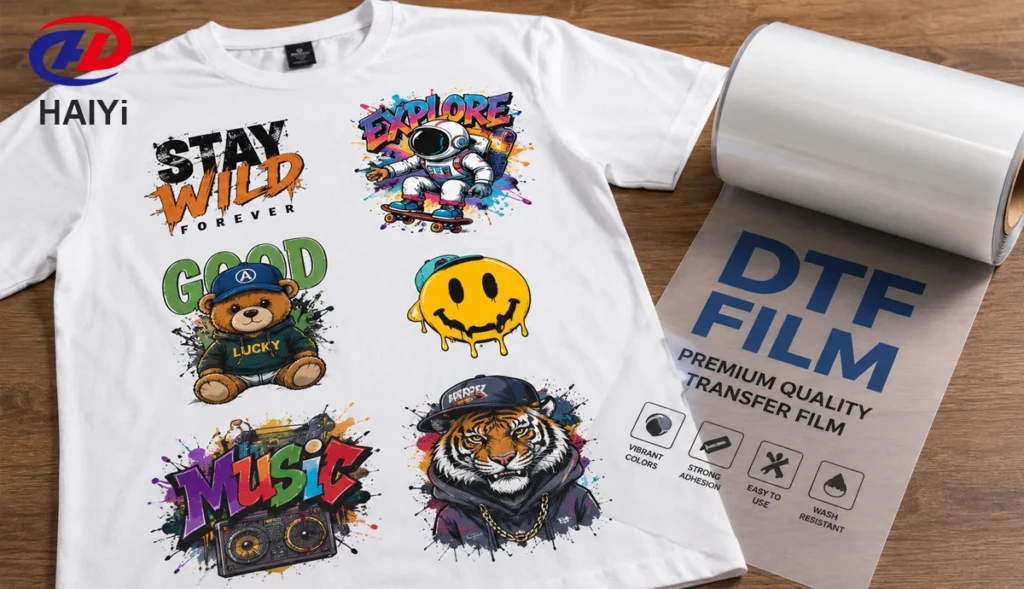
Key Takeaways
- The coating — not the brand or price point — is the primary determinant of DTF film quality for textile printing; manufacturers that develop their own coating formula in-house produce more consistent results than those reselling generic substrate
- Dual-matte anti-static film is the production standard for textile printing shops — the back coating eliminates powder contamination in non-print areas that single-sided film consistently produces
- Film thickness matters for specific applications: 75-micron film is better for fine detail work; 100-micron film provides better mechanical durability for high-volume roll-fed production
- For stretch and athletic fabrics, standard DTF film produces adequate results at moderate stretch levels; high-stretch applications (lycra, spandex above 20%) benefit from stretch-grade film formulations
- The wash test is the only reliable quality test — print a design, heat press it to your most common fabric, wash inside-out five times at 40°C, and inspect edges and center
- Gang sheet efficiency targets of 80%+ reduce film cost per transfer by 60 to 80% compared to single-design printing — film selection affects production economics significantly
- Factory-direct sourcing from a manufacturer with in-house coating technology delivers 20 to 40% cost savings versus US/regional distributor pricing for equivalent quality
- Batch-to-batch consistency — not single-sample quality — is the correct quality metric; request samples from two separate production batches and compare
What Makes a DTF Film “Best” for Textile Printing?
The term “best” needs to be broken down into the properties that actually determine performance outcomes for textile printing specifically.
DTF film for textile printing must perform across a chain of interactions: it must hold ink precisely during printing, accept adhesive powder uniformly, release cleanly from the cured adhesive after pressing, and allow the finished design to bond durably to fabric fibers through repeated washing.
Every “best film” claim ultimately reduces to one of four performance outcomes:
Print quality: Sharp edges, accurate color, fine detail reproduction, no ink bleeding. Determined primarily by coating porosity and uniformity.
Transfer quality: Clean release from the film, complete adhesion to the fabric, no lifting at edges or details. Determined by the coating’s release properties and powder adhesion characteristics.
Wash durability: Design integrity through 50 or more wash cycles. Determined by the interaction of film, powder, pressing parameters, and fabric type — but film coating consistency is a primary variable.
Production efficiency: Low rework rate, consistent performance across rolls, no feed problems or static-related powder contamination. Determined by anti-static coating quality, dimensional stability, and batch consistency.
The “best” film maximizes all four outcomes for your specific production context.
The 6 Quality Criteria That Matter Most
Use these criteria to evaluate any DTF film for textile printing — regardless of who is selling it.
Criterion 1 — Coating Formula Ownership
The single most predictive quality indicator. Ask directly: does the manufacturer develop the coating formula in-house, or source pre-coated PET substrate from an external supplier?
In-house coating development means:
- Ink absorption rate is controlled and reproducible
- Anti-static performance is specified and testable
- Release force is consistent across roll length
- Batch-to-batch variation is controlled through QC testing
Manufacturers reselling pre-coated generic PET — regardless of how their products are marketed — cannot control these properties. Their coating performance is whatever the substrate manufacturer delivered.
Criterion 2 — Coating Uniformity
Coating weight variation across the roll width and along the roll length determines print density consistency. A film with ±8 g/sqm coating weight variation produces visible density differences within the same gang sheet — ink appears darker where coating is heavier, lighter where it is thinner.
Quality specification: coating weight tolerance ±3 g/sqm or tighter. Request batch QC reports with specific numerical values from the manufacturer.
Criterion 3 — Anti-Static Performance
For production textile printing, anti-static coating on the back of the film (dual-matte) is non-negotiable. Without it, static electricity attracts hot-melt powder to non-printed areas of the film during the powdering step. This produces powder contamination around design edges that melts onto the garment during pressing — appearing as a faint haze of adhesive outside the design.
Dual-matte anti-static film eliminates this failure mode. Single-sided film cannot.
Criterion 4 — Release Consistency
The film must release from the cured adhesive consistently — neither too easy (ink lifting before adhesive bonds to fabric) nor too hard (requiring excessive force that damages design edges).
Release force specifications: measured in grams per centimeter (g/cm). Standard DTF film typically specifies 5 to 15 g/cm release force. The specific value matters less than the consistency — the same release force at meter 1 and meter 100 of a 100m roll.
Criterion 5 — Dimensional Stability
Film that curls, stretches, or deforms during printing causes misregistration — white ink underbase shifts position relative to CMYK layers, producing color fringing at design edges. Good PET substrate with tight thickness tolerance (±3 to ±5 microns) maintains flat, stable dimensions throughout the printing process.
Test for dimensional stability: load a meter of film flat on a surface at room temperature. It should lay completely flat without curl or edge lift within 30 seconds.
Criterion 6 — Batch-to-Batch Consistency
A film that performs perfectly on sample roll 1 but variably on production rolls 5 through 20 is not a reliable supply source. The only way to test this is to request samples from two different production batches and run both through identical workflow and wash testing.
Consistent results across batches = controlled coating process = a manufacturer that actually produces the film.
DTF Film Types for Textile Printing: Full Breakdown
Hot Peel Film
Releases from the garment immediately after pressing while still warm (within 10 to 15 seconds). Faster production cycle — no cooling wait between shirts.
Best for: High-volume cotton and cotton-blend production with trained operators. Standard apparel decoration.
Limitation: Narrow peel window — missed timing causes peel difficulty and edge damage. Less forgiving for fine detail work.
Cold Peel Film
Must be fully cooled to room temperature (60 to 90 seconds) before film removal. The adhesive fully solidifies before separation, producing cleaner edges and generally better wash durability.
Best for: Fine-detail designs, performance fabrics, smaller production operations, mixed-fabric workflows. Best choice for beginners.
Limitation: Slower workflow — 60 to 90 seconds cooling adds to per-shirt cycle time at production scale.
Instant Hot Peel (All-Temperature Peel)
Engineered to release cleanly at any temperature — immediately after pressing or after full cooling. Eliminates timing variable from production workflow.
Best for: High-volume mixed-skill production where timing consistency is difficult to maintain. The most production-forgiving film type.
Dual-Matte Anti-Static Film (The Production Standard)
Available in hot peel, cold peel, or instant hot peel variants. The back-side anti-static coating eliminates powder contamination in non-printed areas. Standard for professional textile printing operations.
Best for: Any production operation running more than 20 transfers per day. Should be the default film choice unless specific constraints prevent it.
Stretch-Grade DTF Film
Formulated for high-elasticity fabrics — the adhesive and release coating system accommodates the dimensional changes of stretch fabric through movement and washing without cracking.
Best for: Athletic jerseys, yoga wear, compression garments, leggings, and any application with more than 20% fabric stretch.
Single-Sided Film (Entry Level)
Coating on one side only. No anti-static back coating. The non-print side is glossy PET.
Best for: Very low volume operations where powder contamination is managed manually. Not recommended for production use.
Best DTF Film for Cotton and Cotton Blends
Cotton is the most forgiving fabric for DTF printing — it accepts a wide range of pressing temperatures and has fiber structure that bonds reliably with hot-melt adhesive.
Recommended film: Dual-matte anti-static film, hot peel or cold peel, 75 to 100 microns.
Why: Cotton presses at 315 to 325°F — the full operating range of most DTF film formulations. The anti-static coating eliminates powder contamination on cotton’s textured surface. Both hot and cold peel work well on cotton; hot peel is appropriate for volume production, cold peel for fine detail work.
Pressing parameters: 315 to 325°F (157 to 163°C), 10 to 12 seconds, medium-high pressure.
Key consideration: Cotton-poly blends (50/50) require slightly lower temperature (305 to 315°F) to avoid polyester dye migration. Film selection does not change for blends, but pressing parameters do.
For fashion and detail-critical applications on cotton: 75-micron cold peel dual-matte produces the sharpest fine detail and cleanest edge definition.
Best DTF Film for Polyester and Performance Fabrics
Polyester presents two specific challenges for DTF film selection: lower pressing temperature (to avoid dye migration) and surface coatings on performance fabrics that can interfere with adhesion.
Recommended film: Dual-matte anti-static film, cold peel or instant hot peel, 75 microns for fine detail.
Why: Polyester presses at 280 to 300°F — significantly lower than cotton. This lower temperature input makes hot peel timing more critical. Cold peel or instant hot peel is recommended because:
- Lower pressing temperature means less heat available to maintain the hot peel release window
- Performance fabric coatings (moisture-wicking, DWR) reduce adhesion — cold peel allows maximum set time
- Polyester retains heat longer than cotton — cold peel cooling time is extended but the result is more reliable
Pressing parameters: 280 to 300°F (138 to 149°C), 10 to 12 seconds, medium pressure. Avoid exceeding 300°F on polyester — dye migration risk increases significantly above this threshold.
Dye migration warning: Polyester dyes can bleed into the white ink layer during pressing if temperature is too high or press time too long. Lower temperature and shorter press time reduce this risk. Film selection does not prevent dye migration — pressing parameters do.
Best DTF Film for Stretch and Athletic Fabrics
Standard DTF film performs adequately on moderate stretch fabrics (blends with up to 10 to 15% spandex/elastane). For high-stretch applications (lycra, compression garments, athletic wear with 20%+ stretch), standard film has limitations.
Recommended film: Stretch-grade DTF film, cold peel, 75 microns.
Why stretch-grade film differs: The adhesive powder bonded to stretch-grade film has a formulation that allows the cured adhesive layer to elongate with the fabric. Standard film’s adhesive layer is less elastic — it cracks at stretch percentages that exceed its elongation limit.
Test for stretch compatibility: Press a transfer with your current film onto a sample of your most demanding stretch fabric. Stretch the fabric 30% horizontally and vertically. Inspect the transfer edges and design center under magnification. Cracking or white stress marks indicate the adhesive has exceeded its elongation limit.
Pressing parameters for stretch fabrics: 290 to 305°F (143 to 152°C), 12 to 15 seconds, medium pressure. Lower temperature, longer time, medium pressure are the adjustments for stretch fabrics to achieve adhesion without exceeding adhesive elasticity limits.
Best DTF Film for Dark Fabrics
Dark fabrics do not require a different film specification — they require a correctly calibrated white ink underbase.
The film coating controls how white ink is absorbed and held on the print surface. A coating with correct porosity holds white ink precisely in place — preventing lateral spread into areas that should be blank, and preventing vertical bleed that reduces opacity.
Recommended film: Dual-matte anti-static film (any peel type), with a coating that has verified white ink absorption specifications.
The opacity challenge: The white ink underbase must be dense enough to produce vivid colors on black and dark fabric — but not so dense that it produces a raised, visible layer that peels at edges.
Test white ink opacity on your film by printing a solid white rectangle on your darkest test fabric, pressing at standard settings, and comparing the white area to a paper sample at the same size. If the white appears grey or translucent, white ink density in the RIP software needs adjustment — not the film.
Film specification that helps: Films with higher porosity coating absorb white ink more efficiently, allowing less ink volume to achieve the same opacity. This reduces ink cost and produces a thinner white layer that peels less readily.
Best DTF Film for High-Volume Production
High-volume textile printing has specific requirements that go beyond quality — supply consistency, roll format efficiency, and feed reliability are production-critical.
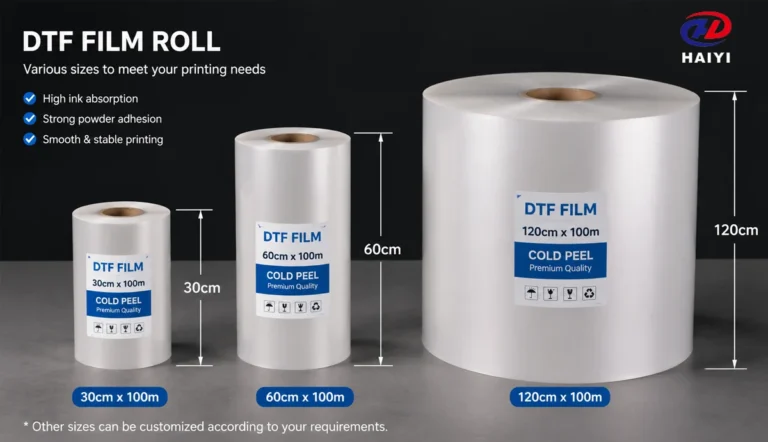
Recommended film: Dual-matte anti-static film, instant hot peel or hot peel, 24-inch (60cm) rolls, 100m roll length.
Why these specifications:
Dual-matte anti-static: eliminates powder contamination failures that cost production time. In a high-volume environment, one contamination failure per 100 sheets multiplies to significant daily rework.
Instant hot peel: removes timing variable. At 50+ shirts per hour with multiple operators, consistent hot peel timing is difficult to maintain. Instant hot peel eliminates that failure mode.
24-inch roll format: gang sheet efficiency on 24-inch rolls is significantly better than A3 (13-inch) for production volumes. More designs per roll meter = lower film cost per transfer. At 100m roll length, roll changes happen less frequently — reducing setup time.
100m roll length: fewer roll changes per shift. At 50 shirts per hour, an A3 100m roll lasts approximately 30 to 40 minutes. A 24-inch roll lasts 90 to 120 minutes.
Supply consistency requirement: At production volume, film inconsistency between rolls produces waste in the form of settings adjustments, test runs, and reprints. A manufacturer with in-house coating quality control and batch testing provides the roll-to-roll consistency that high-volume production requires.
Film Thickness: 75 Micron vs 100 Micron
Film thickness is one of the most commonly misunderstood specifications in DTF film selection.
75 Micron (0.075mm)
Advantages:
- Better fine detail reproduction — thinner film has lower thermal resistance, meaning heat transfers more evenly across the design during pressing
- Softer hand feel on finished transfers — the thinner adhesive layer is less noticeable against fabric
- Better for low-volume and detail-critical work
Limitations:
- Less mechanically robust — more susceptible to tearing during high-speed roll-fed printing
- Requires careful handling in production environments
100 Micron (0.1mm)
Advantages:
- Better mechanical durability — handles high-speed printer feed without tearing
- More forgiving of pressing temperature variation — thicker film absorbs minor temperature fluctuations more evenly
- Better for roll-fed production on high-speed printers
Limitations:
- Slightly less fine detail precision at very high resolution (above 1200 DPI, 8-point text)
- Marginally stiffer hand feel on finished transfers
Practical Recommendation
| Application | Recommended Thickness |
|---|---|
| Fine text, intricate detail, fashion | 75 microns |
| Standard apparel, logos, bold designs | 75 or 100 microns |
| High-speed production, roll-fed | 100 microns |
| Heavy-use workwear and industrial apparel | 100 microns |
Single-Sided vs Double-Sided Matte Film
This is the comparison that matters most for production-level textile printing.
Single-Sided Film
Coating on the print side only. The back is plain glossy PET substrate. No anti-static treatment on the reverse.
The problem: Static charge builds up on the plain PET back during high-speed printing and the powdering step. This charge attracts hot-melt powder to non-printed areas of the film surface. During pressing, this powder melts onto the garment fabric as a faint adhesive contamination outside the design — particularly visible on dark fabrics where the adhesive creates an unintended sheen.
When to use: Very low volume only (under 5 shirts per day), or when powder contamination is managed through manual cleaning between sheets.
Double-Sided Matte Film (Dual-Matte)
Anti-static matte coating on both sides. The back coating dissipates static charge before it can attract powder to non-printed areas.
The result: Powder adheres only to wet ink. Non-printed areas of the film remain clean. No contamination outside the design on the garment.
Cost difference: Dual-matte film typically costs 15 to 25% more per meter than single-sided film. At 100 transfers per day, the rework cost from single-sided film powder contamination (typically 5 to 15% of prints affected) far exceeds the per-meter price premium for dual-matte.
For any production operation: Dual-matte anti-static is the correct default. Single-sided film is entry-level, not production-grade.
How to Test DTF Film Quality Before Committing
Never commit to a large film order based on a single sample evaluation. This is the testing protocol that reveals actual production performance.
Step 1 — Request Multi-Batch Samples
Ask for samples from two separate production batches, labeled with batch codes. This is the most important differentiation step — batch-to-batch consistency is what matters in production, not single-sample quality.
Step 2 — Print the Right Test Designs
Use test designs that reveal quality differences:
- Fine text at 6 points and 10 points
- Thin lines at 0.5mm and 1mm
- Full coverage area (100% white underbase, full CMYK on top)
- Gradient transitions from 100% to 5% coverage
- A design with complex fine detail and a simple bold logo side by side
Step 3 — Test on Your Actual Fabrics
Print on every fabric type you regularly use in production. A film that performs well on cotton but poorly on polyester blend is not the right film for a shop that serves both markets.
Step 4 — Wash Test
Heat press the test transfers to sample garments. Wash inside-out in cold water five times. Inspect:
- Edge adhesion (no lifting)
- Design center (no cracking)
- Color (no significant fading)
- Surface texture (no delamination)
A film that passes five wash cycles at correct settings will pass 50+. A film that fails at five wash cycles will fail in production.
Step 5 — Compare Batch Results
Compare wash test results from batch 1 and batch 2 samples. If results are consistent, the coating process is controlled. If results differ significantly, the manufacturer does not control the coating — avoid for production use.
Why Film Coating Quality Matters More Than Brand
The most important thing to understand about DTF film quality for textile printing: the coating is the product. The PET substrate is a commodity. The coating formula is intellectual property.
Manufacturers that develop their own coating formula in-house — with dedicated R&D teams, proprietary formulations, and coating application equipment — can control every quality parameter:
- Ink absorption rate (porosity of the coating surface)
- Anti-static dissipation (secondary coating formulation on dual-matte film)
- Release force (chemical release agent concentration and distribution)
- Batch-to-batch reproducibility (controlled through closed-loop production QC)
Manufacturers reselling pre-coated PET substrate — which represents the majority of mid-tier and budget film suppliers — cannot control any of these parameters. Their coating is whatever the substrate manufacturer produced. When their coating inconsistency causes production problems, they have no technical knowledge of the coating to draw on.
How to identify in-house coating manufacturers:
Ask: “Is your coating formula developed in-house, or do you purchase pre-coated PET from an external supplier?”
A genuine in-house coating manufacturer answers specifically — they can describe the coating type, the application method, the key specifications. Haiyi, for example, develops its coating formulas in-house, tests every batch for coating uniformity and release force, and can provide batch QC documentation. A reseller cannot provide this because they do not have the coating knowledge.
How to Source the Best DTF Film at Wholesale Price
The Cost Reality
For textile printing operations, film cost is the most significant consumable expense. At 50 prints per day on A3 sheets:
- 50 sheets × $0.65 each (US retail) = $32.50/day = $8,125/year
- 50 sheets × $0.30 each (US wholesale) = $15/day = $3,750/year
- Factory-direct equivalent: $0.14 per sheet equivalent from 100m roll = $7/day = $1,750/year
The difference between US retail and factory-direct: $6,375 per year for a 50-print-per-day operation.
Factory-Direct Sourcing Criteria
For reliable factory-direct sourcing from China:
1. Confirm in-house coating manufacturing. The diagnostic question above separates manufacturers from resellers.
2. Request multi-batch samples. Consistent results across batches is the minimum quality standard for production supply.
3. Verify certifications. ISO 9001 for quality management, OEKO-TEX Standard 100 for chemical safety compliance in garment applications.
4. Establish supply agreement. Manufacturers with reserved monthly production capacity for wholesale accounts provide supply continuity that spot-market purchasing cannot.
5. Maintain inventory buffer. Sea freight from China to major markets takes 25 to 45 days. Maintain 60 to 90 days of inventory to absorb lead time variation.
Haiyi manufactures DTF film with in-house coating technology, 60,000 sqm/day production capacity, and 15 years of international export experience — providing the combination of coating quality, production scale, and logistics experience that makes factory-direct sourcing reliable rather than risky.
FAQ
What is the best DTF film for textile printing? The best DTF film for textile printing is dual-matte anti-static film from a manufacturer that develops its own coating formula in-house — in the appropriate peel type and thickness for your specific fabric and production volume. For general production on cotton and blends: hot peel or cold peel dual-matte, 75 to 100 microns. For stretch fabrics: stretch-grade film. For high-volume production: instant hot peel dual-matte in 24-inch roll format.
Is single-sided or double-sided matte DTF film better for textiles? Double-sided (dual-matte) anti-static film is better for production textile printing. The anti-static back coating prevents hot-melt powder from adhering to non-printed areas — eliminating powder contamination around designs on finished garments. Single-sided film consistently produces contamination artifacts at production volume.
What DTF film thickness is best for textile printing? 75-micron film is better for fine detail work and soft hand feel. 100-micron film is more mechanically durable for high-speed production printing. For most standard apparel decoration, either thickness works well. For text below 10 points and lines below 1mm, 75-micron film produces cleaner reproduction.
How do I test DTF film quality for textile printing? Request samples from two separate production batches. Print test designs including fine text, thin lines, full coverage, and gradients. Press to your actual production fabrics at your standard settings. Wash inside-out five times. Compare adhesion, edge quality, and color between the two batches. Batch consistency is more important than single-sample quality.
Why does my DTF film produce powder contamination outside the design? Powder contamination outside the design is caused by static electricity attracting hot-melt powder to non-printed areas of the film. This is a single-sided film problem — switching to dual-matte anti-static film eliminates it. If you are already using dual-matte film and experiencing contamination, the anti-static coating may be degraded from improper storage (high humidity) or the film may have inadequate anti-static treatment.
What makes one DTF film better than another for wash durability? Wash durability depends on: coating uniformity (consistent powder adhesion), pressing parameters (temperature, time, pressure — verified with a contact thermometer), the second press after film removal (5 to 10 seconds through parchment paper), and film batch consistency. Film from a manufacturer with in-house coating quality control and batch testing delivers the baseline consistency that makes wash durability achievable at production scale.
Is factory-direct DTF film from China good quality for textile printing? Yes, from the right manufacturer. Chinese manufacturers that develop their own coating formula in-house produce film used by professional textile printing operations worldwide. The key is identifying a genuine manufacturer (not a trading company reselling generic substrate) through the coating question and multi-batch sample testing. Factory-direct pricing from these manufacturers is 20 to 40% below US distributor pricing for equivalent quality.
Conclusion
The best DTF film for textile printing is not the most expensive, the most marketed, or the most frequently purchased in your market. It is the film with consistent in-house coating quality, matched to your specific fabric and production requirements.
The decision framework:
- Cotton and cotton blends: Dual-matte anti-static, hot or cold peel, 75 to 100 microns
- Polyester and performance fabrics: Dual-matte anti-static, cold peel or instant peel, 75 microns
- High-stretch athletic fabrics: Stretch-grade film, cold peel
- High-volume production: Dual-matte anti-static, instant hot peel, 24-inch rolls
- Fine detail and fashion: 75-micron cold peel dual-matte
Three things matter more than any specification on a product sheet:
1. Who made the coating. In-house coating manufacturers produce consistent, controllable film. Generic substrate resellers do not.
2. Batch consistency. Test two batches, not one sample. Production quality is determined by how consistent the film is, not how good one roll can be.
3. The second press. No film — however good — achieves maximum wash durability without a second press of 5 to 10 seconds through parchment paper after film removal.
Sourcing film from Haiyi — which develops coating formulas in-house, tests every production batch, and offers factory-direct wholesale pricing — eliminates the coating quality variable from your production equation. The rest is process execution.
Haiyi manufactures DTF film for textile printing with proprietary in-house coating technology — dual-matte anti-static rolls in 13-inch and 24-inch widths (100m), A3/A4 sheets, stretch-grade film, and instant hot peel variants. Factory-direct wholesale pricing with low MOQ, OEKO-TEX compliance, and 15 years of international export experience.