







DTF Film Buying Guide: Everything You Need to Know Before Buying
Use a risk-based DTF film buying process to define the product, scale testing, compare usable cost, approve a pilot, and control repeat supply.

Estimated reading time: 13 minutes
A sound DTF film purchase begins by identifying the buying situation, not by selecting a peel label or comparing a price per roll. A routine reorder of an approved product needs identity and batch controls. A substitute film needs a controlled comparison with the approved reference. A film for a new printer, ink, powder, fabric, or application needs compatibility development. A private-label program needs product approval plus packaging, traceability, inventory, and change control. The higher the novelty, volume, customer exposure, and switching cost, the stronger the evidence should be before release.
This DTF film buying guide uses a risk-based approval method rather than repeating a catalog of film types and roll sizes. Buyers first classify the purchase, then define the exact product, verify production fit, approve finished output, compare commercial exposure, and release only the order quantity supported by the evidence. Readers who need a basic format overview can use the existing DTF film roll buying guide; the framework below explains how much verification a particular buying decision deserves.
What should you know before buying DTF film?
Before buying DTF film, a buyer should know the intended printer and feed system, ink and adhesive powder, curing method, heat press, peel timing, target fabrics, artwork mix, production speed, roll format, storage conditions, finished-transfer acceptance criteria, order volume, packaging, and repeat-supply needs. These facts turn a generic request for good film into a testable product brief.
DTF film is one component in a connected transfer process. Its receiving coating affects ink control, powder interaction, curing behavior, and release, while the back treatment can influence feeding and static. The finished garment also depends on ink, powder, heat, pressure, fabric, and care. A film should therefore be purchased for a verified system and use case rather than from one isolated product claim.
No single specification proves overall quality. Thickness does not prove coating uniformity, a smooth peel does not prove wash resistance, and an attractive test image does not prove roll-to-roll consistency. A defensible decision combines product identity, physical evidence, production observations, finished-transfer tests, batch controls, and commercial terms.
Classify the purchase before deciding how much to test
A routine reorder is the lowest-risk situation only when the product code, specification revision, supplier, manufacturing process, packaging, and approved use remain unchanged. Incoming identity, damage, dimensions, winding, traceability, and selected functional checks may be sufficient when previous batches have performed consistently. Any undisclosed change moves the order out of the routine category.
A substitute purchase occurs when a new film is intended to replace an approved film without redesigning the complete workflow. The candidate should be compared with the reference under the same printer, ink, powder, artwork, fabric, curing, pressing, peeling, and inspection conditions. Similar nominal thickness or peel type does not prove equivalent production behavior.
A new-application purchase includes a new printer, printhead, ink set, powder, garment family, production speed, artwork demand, or durability target. The purpose is not merely to compare films; the buyer must establish a workable consumable and process combination. Development should define a center condition and an acceptable process window before a bulk order is approved.
A private-label or distribution purchase has the widest business boundary. Product performance must be connected to branded SKU definitions, packaging versions, labels, samples, customer guidance, inventory, complaint handling, batch traceability, and repeat-order controls. A good demonstration roll is only the beginning because every market claim becomes an obligation that the distributor must support.
How can a buyer assign a practical risk level?
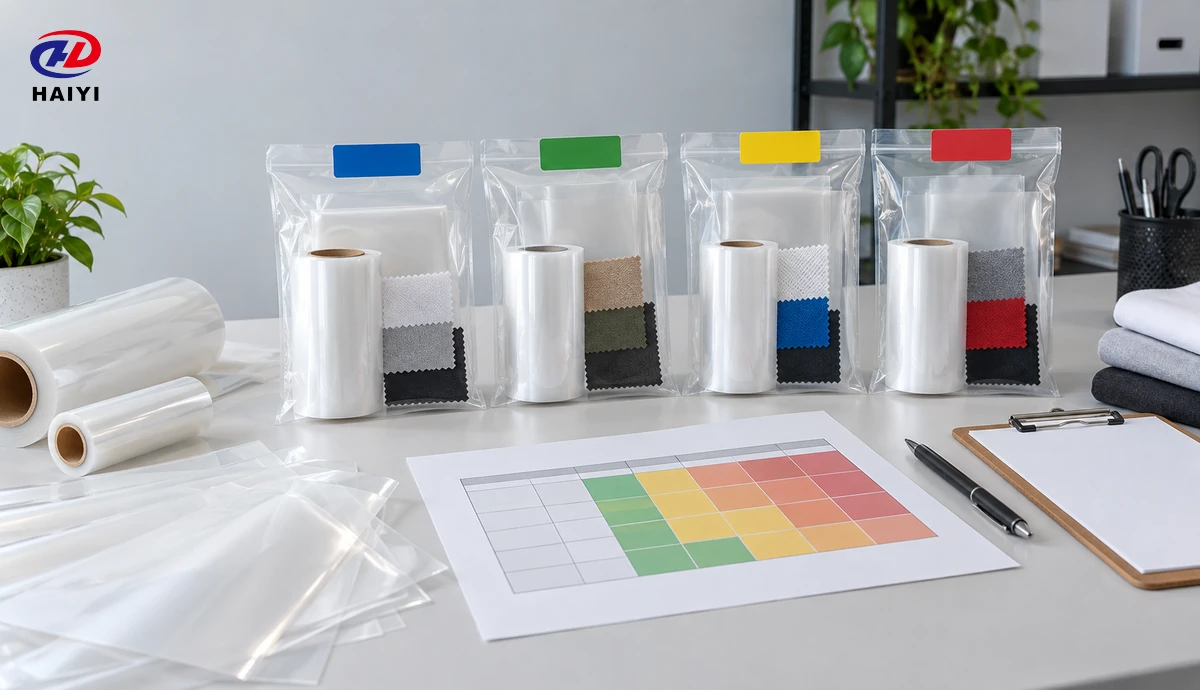
A practical risk assessment considers five factors: material novelty, process novelty, order exposure, customer consequence, and recovery difficulty. Material novelty asks how different the candidate is from the approved film. Process novelty asks how many other consumables or settings are changing. Order exposure covers quantity and inventory commitment. Customer consequence covers claims, returns, and downstream disruption. Recovery difficulty covers replacement lead time, rework, and switching cost.
Each factor can be rated low, medium, or high with a written reason. A same-SKU reorder with complete change confirmation may remain low risk. A nominally similar substitute for an established workflow may be medium risk. A new private-label SKU for several customers may be high risk even when the first sample looks excellent. The rating guides approval depth; it does not replace technical judgment.
| Risk level | Typical situation | Minimum decision emphasis |
|---|---|---|
| Low | Verified repeat order with unchanged identity and use | Incoming identity, condition, traceability, and selected confirmation checks |
| Medium | Alternative supplier, nominal substitute, or meaningful lot change | Reference comparison, coded samples, functional testing, and controlled pilot |
| High | New system, demanding application, large commitment, or private-label launch | Compatibility development, multiple samples or lots, pilot production, documentation, packaging, and release plan |
Define the exact DTF film before comparing offers
An exact product definition should include the supplier product code, intended application, printable side, peel category, sidedness or back treatment, nominal thickness and tolerance, width, roll length, core, winding direction, splice policy, edge condition, packaging, storage guidance, shelf-life basis, batch identification, and any agreed functional properties. The quotation, sample, purchase order, shipment label, and quality record should reference the same identity.
Hot, warm, and cold peel descriptions refer to handling after pressing, but the label alone does not define the usable peel window. Single-sided and double-sided terms may describe different surface treatments across suppliers. Buyers should request functional definitions and product-specific instructions rather than assume that familiar words make different products interchangeable. The DTF film types guide provides a broader comparison of common release and surface categories.
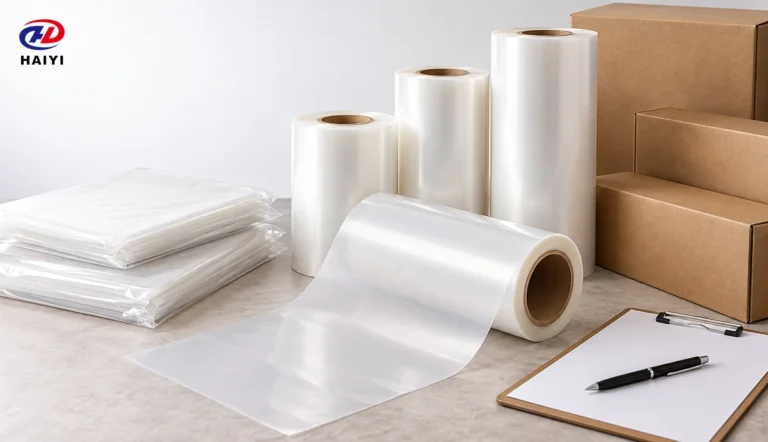
Roll dimensions should be verified as usable supply rather than only nominal packaging. Width must suit the printer and artwork plan, roll length must match the quotation basis, the core must suit the holder, winding direction must present the correct surface, and roll weight must remain practical for handling. Edge damage, telescoping, tight winding, loose winding, blocking, and splices can reduce usable output even when nominal area is correct.
Check printer feeding before judging print quality
A candidate film should track through the intended printer without unacceptable skew, slipping, wrinkling, head contact, static attraction, uneven take-up, edge curl, or stopping. These observations matter because a film that prints one short sample can still become unstable during a long production run. Test length and speed should represent the planned workflow rather than a convenient demonstration.
Feeding performance and print appearance should be scored separately. A film can feed smoothly but control ink poorly, while another can produce a sharp image but create frequent take-up interruptions. Combining both into one general quality score hides the operational tradeoff. The purchase decision should consider accepted output per stable production hour rather than the best individual print.
Verify compatibility as a complete material system
Compatibility means that an identified film, ink, powder, printer, cure process, press process, peel method, artwork, and fabric combination produces acceptable results within a defined operating window. Supplier starting settings can help establish a trial, but they cannot guarantee performance on every equipment and consumable combination.
A controlled test changes one defined factor at a time. If several films are being compared, the ink, powder, artwork, fabric, and process should remain fixed. If the purpose is to develop a new complete system, combinations can be tested in a planned matrix. The DTF consumables compatibility protocol explains how to identify materials, use references, control run order, inspect each stage, and record an approval decision.
Diagnostic artwork should include solid areas, gradients, fine lines, small isolated details, high and low ink coverage, and features that expose edge or registration problems. Commercial artwork should also be included because a diagnostic pattern may not represent real production demands. The test should observe printing, powdering, curing, pressing, peeling, and finished fabric as separate stages.
Which finished-transfer properties should be approved?
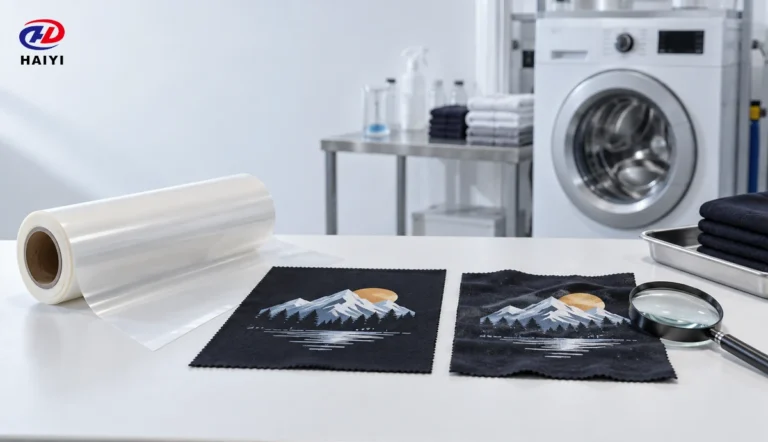
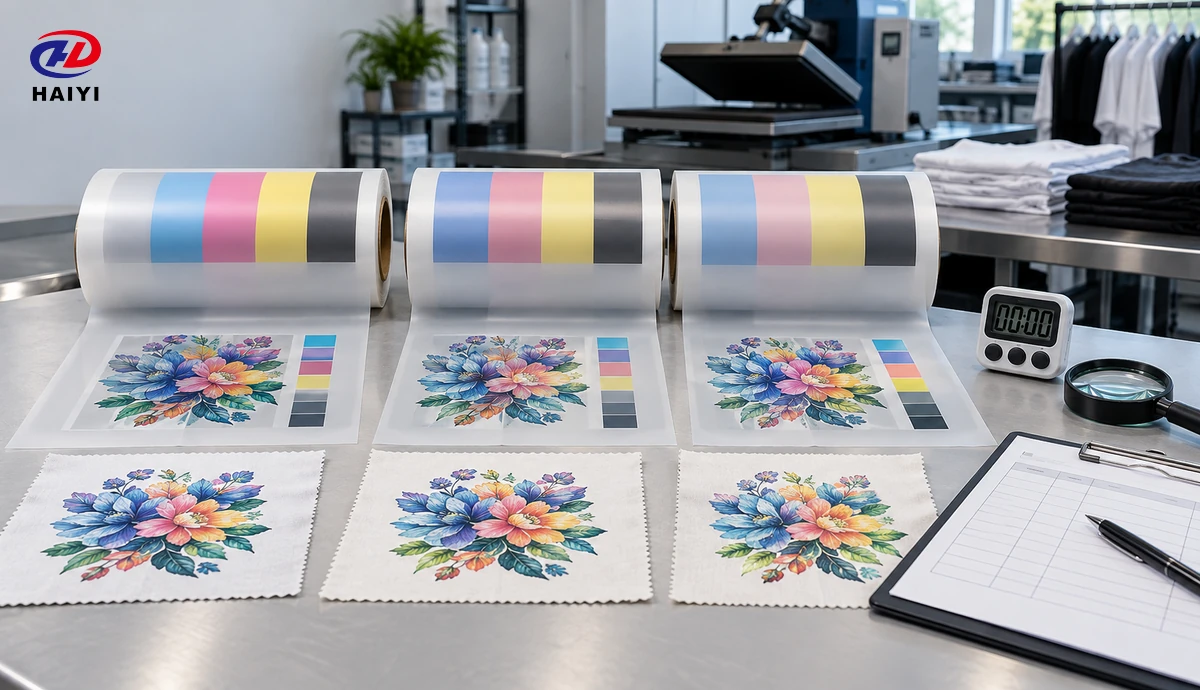
Finished-transfer approval should cover the properties that affect the intended customer: edge definition, color appearance, white coverage, unwanted background powder, release completeness, surface texture, hand feel, adhesion, flexibility, stretch recovery, wash behavior, and any application-specific durability. Every criterion should have a defined observation method and acceptance rule before testing begins.
Peel quality should be evaluated under the intended timing and temperature condition. A successful peel should transfer the complete design without lifting intended areas, leaving unwanted residue, or requiring uncontrolled operator force. A clean release can improve productivity, but it should not be treated as proof of adhesion or durability after the carrier is removed.
Wash resistance is a system outcome involving film, ink, powder, curing, pressing, fabric, and care conditions. Buyers should define the wash and drying sequence, inspection intervals, and failure limits rather than compare unsupported cycle claims. The guide on choosing DTF film for strong wash resistance provides a buyer-focused acceptance matrix for edge lift, cracking, appearance, flexibility, and batch verification.
One attractive transfer is evidence that one sample worked once. Replicates reveal consistency within the trial, different artwork features expose different risks, and representative fabrics show whether approval transfers across applications. The amount of testing should rise with risk, but every approval should remain linked to the exact tested configuration.
How should samples be requested and identified?
A sample request should state the printer, print width, ink, powder, cure equipment, press, peel preference, main fabrics, target output, current problems, comparison reference, roll format, expected quantity, and packaging objective. This information helps the supplier propose a relevant SKU and prevents an unrelated sample from creating false confidence.
Every sample should carry a product code and batch or production identity that can be traced to the quotation and later order. If a supplier sends several candidates, the buyer can use coded testing to reduce expectation bias. The code key should be protected until observations are recorded, then results can be connected back to the commercial options.
When should a buyer place a pilot order?
A pilot order should follow successful technical screening and precede a high-exposure bulk commitment. The pilot tests commercial rolls, normal packaging, transport, warehouse handling, printer setup, production operators, output yield, customer use, traceability, and supplier communication. It answers whether the approved sample can become repeatable supply.
Pilot quantity should be large enough to expose normal roll and process behavior but limited enough to contain loss if the candidate fails. No universal quantity fits every buyer because printer capacity, customer demand, lead time, storage, and recovery cost differ. The release plan should define what the pilot must prove and who approves expansion.
A pilot should not become an uncontrolled sales launch. Separate technical approval from commercial release, retain material and transfers, record output and defects, and limit customer claims to evidence actually established. If settings or consumables change during the pilot, the record should identify the new approved configuration.
How do you verify repeatability between batches?
Repeatability means that future production lots continue to meet agreed identity, physical, process, transfer, and commercial requirements. A buyer should not expect every measurement to be numerically identical, but meaningful differences must remain inside approved limits and should not create a change in production or customer results.
A matched comparison uses the same sampling locations, conditioning, equipment, consumables, artwork, fabrics, settings, operator rules, and acceptance criteria. Both average performance and variation within a roll or batch matter. The DTF film batch comparison guide explains how to use an approved reference, matched samples, physical checks, print trials, and predefined decision rules.
Change control protects the meaning of approval. The supplier and buyer should agree which changes require notice, which records identify each shipment, how retained samples are managed, and when requalification is required. A new code, coating change, PET base change, process change, format change, or packaging change can alter risk even when the product name remains familiar.
Compare usable cost instead of price per roll
Price per roll is useful only when every offer uses the same verified width, usable length, specification, packaging, trade boundary, and service scope. Price per square meter improves normalization, but it still ignores waste, stoppages, reprints, damaged rolls, labor, freight, duties, inventory, payment terms, and customer claims.
Usable cost divides the relevant landed and operating cost by accepted output. A lower-priced film can cost more when poor feeding, edge damage, powder contamination, inconsistent release, or rework reduces yield. A higher-priced film can also be poor value when the claimed advantage is irrelevant to the buyer. The comparison must connect cost to the approved use case.
The DTF film wholesale price guide provides a method for normalizing area, landed cost, packaging, payment, lead time, inventory exposure, and usable yield. Quotations should be compared in one table so that missing costs and different commercial boundaries remain visible.
What should be verified about the supplier?
A supplier should be able to connect the sample, quotation, product specification, production batch, inspection, packaging, shipment, and complaint process. Useful evidence includes clear product codes, controlled specifications, batch traceability, defined checks, retained samples, change notification, packaging controls, and a technical escalation path. A polished listing cannot replace these operating records.
Buyers should ask what is controlled, how it is measured, which limits apply, who releases a batch, and what happens when a result is outside the limit. The DTF film supplier questions cover product identity, compatibility, samples, batch control, documentation, pricing, lead time, storage, complaints, and support.
What belongs in the final purchase specification?
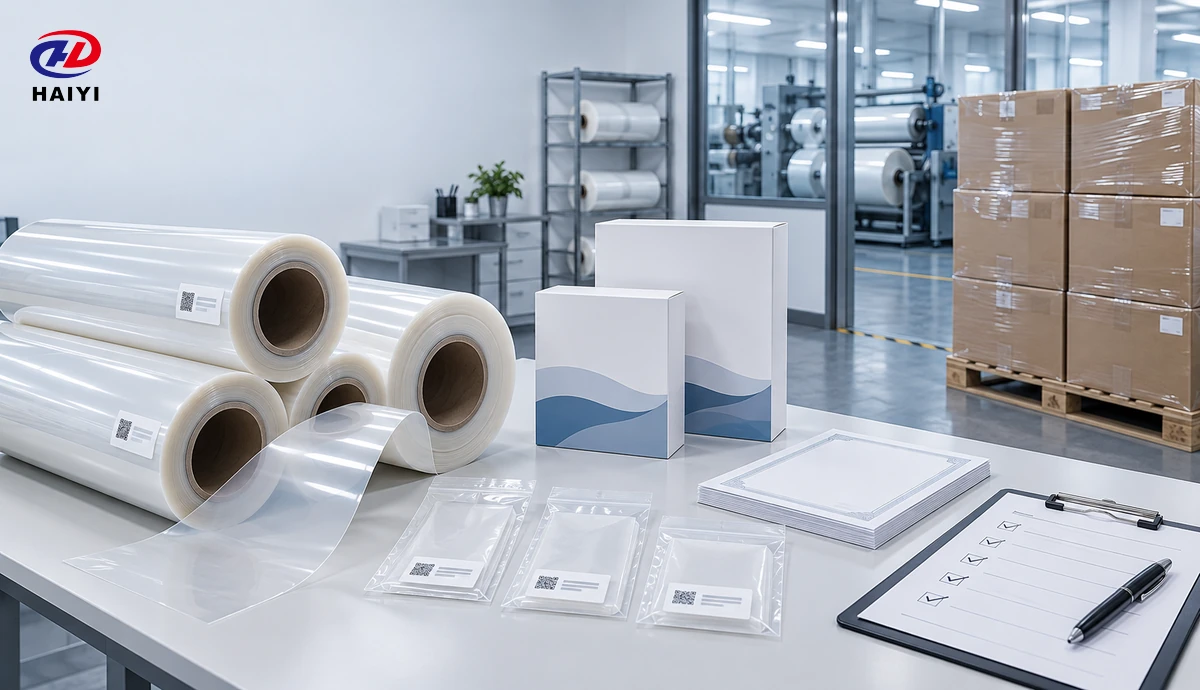
The purchase specification should identify the approved product code, revision, film construction or functional category, printable side, peel method, thickness and tolerance, width, usable roll length, core, winding, splices, edge condition, packaging, storage, shelf-life basis, batch coding, documentation, inspection, acceptance, change notice, and complaint evidence. Functional requirements should name the validated material and process context.
The purchase order should distinguish product requirements from starting process guidance. Film dimensions, identity, packaging, and agreed inspection limits can be supplier obligations. Printer, ink, powder, curing, pressing, fabric, and care conditions remain part of the buyer application unless the parties have explicitly agreed on a tested system. Clear boundaries reduce arguments after a failure.
Private-label orders also need approved artwork versions, label fields, barcode data, carton layout, language, responsible-party information, packing quantities, sample approval, and ownership of obsolete packaging. Product approval and packaging approval should be separate gates because a passing film can still be delayed by incorrect commercial artwork.
A risk-based DTF film buying sequence
- Classify the purchase. Identify whether the order is a repeat, substitute, new application, or private-label program.
- Set the risk level. Evaluate novelty, order exposure, customer consequence, and recovery difficulty.
- Define the product. Freeze identity, format, functional category, packaging, documentation, and traceability requirements.
- Request relevant samples. Share the real equipment, consumables, fabrics, artwork, process, quantity, and acceptance needs.
- Run controlled trials. Compare candidates with an approved reference and inspect every production stage separately.
- Approve finished output. Apply predefined rules for appearance, release, adhesion, flexibility, wash behavior, and intended use.
- Normalize commercial offers. Compare usable cost, order boundary, MOQ, lead time, packaging, freight, terms, and inventory exposure.
- Release a pilot. Verify commercial rolls, normal operations, shipment protection, traceability, yield, and support.
- Control repeat supply. Use incoming checks, retained references, batch records, change notice, and requalification triggers.
This sequence is intentionally scalable. A verified reorder may move quickly through the steps because evidence already exists. A high-risk private-label launch should document every gate because the buyer carries inventory, brand, and customer exposure. Skipping a step should be a conscious risk decision rather than an accidental omission.
Common DTF film buying mistakes
Approving a supplier demonstration alone is a mistake because the demonstration uses supplier-controlled equipment and consumables. It can show capability and provide starting settings, but the buyer should validate the exact film on the intended system and fabrics.
Choosing the lowest roll price is a mistake when quotations differ in usable area, packaging, quality evidence, freight boundary, payment, lead time, yield, or support. The correct comparison is cost per accepted output under the same commercial assumptions.
Placing a bulk order directly after one sample is a mistake when the purchase carries substantial exposure. A pilot provides information about commercial rolls, normal operators, transport, storage, traceability, and supplier response that a small sample cannot provide.
Frequently asked questions
Which DTF film type is best for every printer?
No DTF film type is best for every printer because feed design, ink, powder, cure equipment, production speed, peel workflow, fabrics, and acceptance criteria differ. The best candidate is the identified film that passes a controlled trial and remains stable inside the required process window.
Is thicker DTF film always more stable?
Thickness can influence handling and dimensional behavior, but it does not independently prove coating quality, static control, feeding, release, or finished durability. Buyers should verify the thickness tolerance and then evaluate the complete film in the intended production process.
How many samples should a buyer test?
Sample quantity should be based on the decision risk and the tests required. The buyer needs enough material for setup, stable printing, representative artwork, fabrics, repeats, durability checks, retained samples, and possible confirmation. One small successful sheet cannot prove long-roll behavior or repeatability.
Can a product data sheet replace sample testing?
A product data sheet defines intended properties and guidance, while sample testing checks behavior in the buyer system. Both are useful and neither replaces the other. Documents establish what should be supplied; controlled trials establish whether the identified supply fits the application.
When is a DTF film ready for a bulk order?
A DTF film is ready for bulk ordering when product identity is controlled, compatibility and finished output meet predefined acceptance criteria, a suitable pilot confirms commercial handling, the quotation and specification describe the same product, and repeat-supply controls match the order risk.
Source wholesale and customized DTF film from Haiyi
Haiyi supplies wholesale and customized DTF film for distributors, importers, print-supply businesses, and high-volume production users. A useful B2B inquiry should include the printer and print width, ink and powder, peel preference, target fabrics, production speed, roll format, estimated volume, packaging needs, private-label requirements, destination, current reference, and the results the buyer needs to approve.
To start a risk-matched sample and purchasing process, contact Haiyi with your application brief and order plan. Haiyi can discuss suitable film formats, sample selection, compatibility evaluation, wholesale quantities, customized dimensions, private-label packaging, and a pilot path for repeat supply. Final performance claims should remain tied to the buyer-approved consumables, process, fabrics, test method, and production lots.