







Large Roll DTF Film Manufacturer in China | High-Speed Production PET Transfer Film Supplier

Read time: 13 minutes
Introduction
What is a large roll DTF film manufacturer? It is a factory that produces industrial-scale PET transfer film rolls — designed for continuous, high-volume DTF printing operations where replacing small rolls every 30 minutes is not acceptable production practice.
Large roll DTF film is engineered for industrial DTF printing. Where small rolls (30cm × 100m) or A3/A4 sheet format suits desktop operations and low-volume shops, large rolls — typically 600mm × 100m, 1200mm × 4000m, or wider custom formats — are designed for production facilities running multiple printers in continuous shifts.
The differences are not merely dimensional. A professional large roll DTF film manufacturer controls the PET substrate selection, coating formula, application technology, thickness tolerance, and batch-to-batch consistency at a level that produces reliable industrial output. Every meter of every roll performs identically. Every batch matches the last.
This guide covers the complete picture for industrial buyers and distributors sourcing large roll DTF film from China — specifications, manufacturing process, supplier evaluation, OEM options, and how to build a supply relationship that keeps production running.

What Is Large Roll DTF Film?
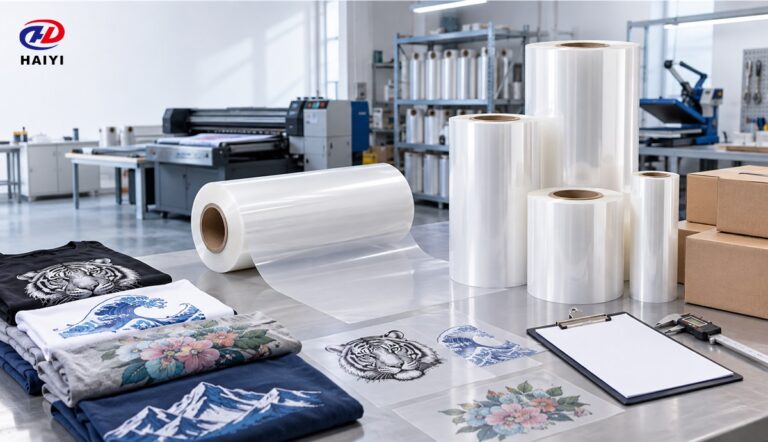
Large roll DTF film is a coated PET (polyethylene terephthalate) transfer film produced in industrial-scale roll formats — wider and longer than standard desktop printer rolls — for use in high-volume, continuous DTF printing operations.
The Layer Structure
Large roll DTF film is a multi-functional composite:
PET Base Film (BOPET): Biaxially oriented polyethylene terephthalate — the structural backbone. Provides dimensional stability under heat, excellent tensile strength for high-speed roll-fed production, and the flat, consistent surface required for precision coating application.
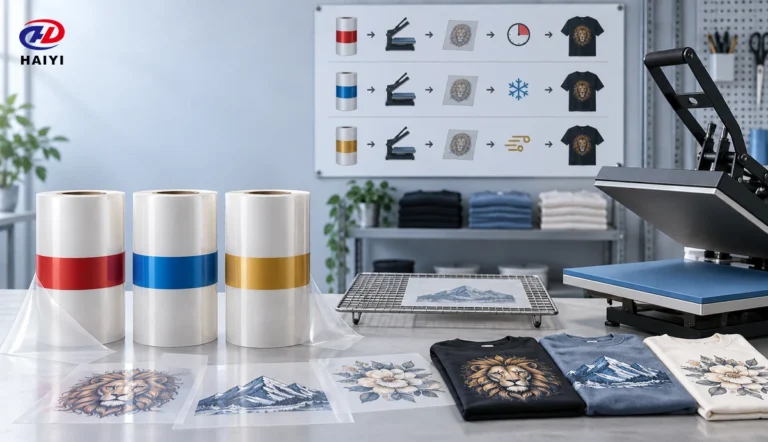
Release Coating: Applied to the print side. Controls how the film separates from the cured adhesive after pressing — either during warm temperature (hot peel), after full cooling (cold peel), or at any temperature (instant peel). The release chemistry is formulated independently for each peel type variant.
Ink-Receiving Layer: The primary functional coating that controls ink absorption. Microporous polymer structure (typically polyurethane resin with nano-scale alumina or silica filler) absorbs water-based DTF ink droplets precisely — controlling lateral spread for sharp detail, and holding color density for accurate reproduction.
Powder Adhesion Layer: At the printing stage, hot-melt TPU adhesive powder bonds to wet ink surface. The coating’s surface chemistry determines whether powder adheres uniformly in printed areas and stays clear of non-printed areas (controlled by anti-static back coating on dual-matte film).
How Large Roll DTF Film Works
How does large roll DTF film work?
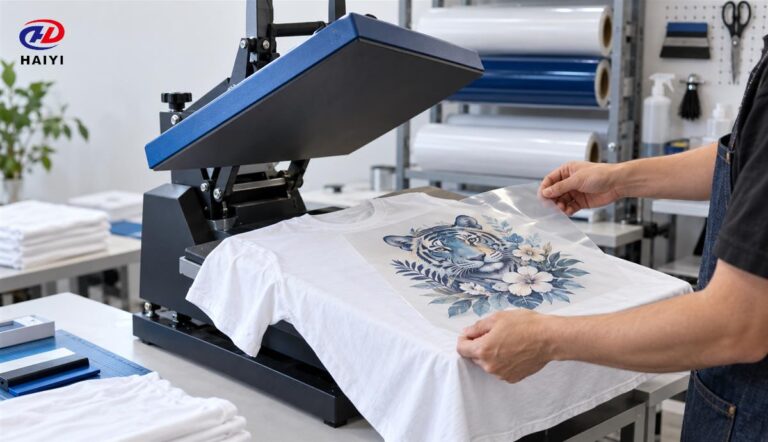
Large roll DTF film provides a stable, continuous printing surface that allows production DTF printers to create high-resolution designs at commercial throughput. The process:
- The large roll feeds through the DTF printer — CMYK plus white ink is deposited in sequence onto the coated surface
- Hot-melt adhesive powder is applied immediately to wet ink, then cured at 250 to 280°F (120 to 140°C) until smooth and glossy
- The cured transfer roll is stored or cut to individual transfer size
- Transfers are heat-pressed to fabric at 305 to 325°F (152 to 163°C) for 10 to 15 seconds
- Film is peeled (cold, hot, or instant depending on variant) — design remains permanently on the garment
Why Choose Large Roll DTF Film for Industrial Printing?
Higher Production Efficiency
Small rolls (30cm × 100m) produce approximately 238 gang sheet lengths before the roll requires changing. At production throughput on a mid-speed DTF printer, a 30cm roll is depleted in 30 to 45 minutes of continuous printing.
Each roll change requires: stopping the printer, removing the depleted core, loading the new roll, threading the film path, running calibration, and restarting. In a one-shift operation, this happens 10 to 16 times per day. Each changeover takes 5 to 10 minutes.
Daily downtime from roll changes on 30cm format: 50 to 160 minutes.
Large roll format (600mm × 100m or wider):
- Covers twice the print width per linear meter
- Reduces roll changes to 4 to 6 per day for equivalent output
- Each changeover saves 10 minutes of production time
- Net daily efficiency gain: 40 to 100 minutes of additional printing time
For operations running two or three printers simultaneously, these gains multiply.
Lower Printing Cost Per Transfer
Large roll format reduces cost through three mechanisms:
Lower packaging cost per meter: A 1200mm × 4000m jumbo roll contains 4,800 sqm of film in a single package versus 3 sqm per A3 sheet pack. Packaging cost per sqm drops dramatically at industrial roll scale.
Lower handling labor cost: Fewer roll changes mean less operator time spent on non-printing tasks. At production scale, labor is the most expensive variable cost after materials.
Better gang sheet utilization: Wider rolls enable larger and more complex gang sheet layouts — nesting more designs per linear meter and achieving higher film utilization percentages (85%+ versus 70 to 75% typical on narrow sheet format).
Better Consistency for Bulk Orders
For wholesalers, apparel manufacturers, and uniform suppliers running batch orders of 200 to 2,000 identical garments, batch-to-batch consistency is not a preference — it is a contractual requirement.
A large roll DTF film manufacturer with controlled in-house coating technology delivers coating weight uniformity, ink absorption consistency, and release force repeatability across every meter of every roll. The shirt pressed from meter 1 of roll 1 is visually identical to the shirt pressed from meter 80 of roll 25.
Generic film from a trading company cannot guarantee this. Their product is whatever the factory delivered this batch — which may not match last batch.
Large Roll DTF Film Specifications
| Item | Specification |
|---|---|
| Material | BOPET (biaxially oriented PET film) |
| Thickness | 75 µm / 100 µm (±3 µm) |
| Width | 300mm / 330mm / 600mm / 1200mm / Custom (100mm–1600mm) |
| Length | 100m / 200m / 4000m jumbo roll |
| Surface (print side) | Matte (ink-absorbing coating) |
| Surface (back) | Matte anti-static (dual-matte) / Glossy (single-sided) |
| Peel type | Cold peel / Hot peel / Instant (warm) peel |
| Coating type | Dual-matte anti-static (production standard) |
| Coating weight | 20–35 g/sqm (±3 g/sqm tolerance) |
| Tensile strength | ≥35 N/15mm (MD and TD) |
| Release force (cold peel) | 3–10 g/cm at room temperature |
| Release force (hot peel) | 5–15 g/cm at pressing temperature |
| Anti-static resistance | ≤10^10 Ω |
| Wash resistance | 50+ machine washes at 40°C |
| Core inner diameter | 0.75 inch (19mm) / 1.0 inch (25.4mm) / 3 inch (76mm) for jumbo |
| Storage conditions | 15–25°C, 40–60% RH, away from UV |
| Shelf life (sealed) | 12–24 months |
| Certifications | ISO 9001, OEKO-TEX Standard 100 |
Standard Industrial Formats
600mm × 100m — The production standard for 24-inch roll-fed DTF printers. This is the most common large roll format for production print shops and small-to-medium apparel manufacturers.
1200mm × 100m — For wide-format production systems and industrial converting operations that slit to multiple narrower widths on-site.
1200mm × 4000m (Jumbo Roll) — Industrial converting and distribution format. Distributors purchase jumbo rolls and slit to customer-specified widths and lengths. Lowest per-meter cost; highest volume commitment.
Custom widths — Any width from 100mm to 1600mm available from manufacturers with precision slitting capability.
Manufacturing Process: How Industrial DTF Film Is Made
Understanding the manufacturing process helps buyers evaluate suppliers and identify genuine manufacturers versus converters and traders.
Step 1 — PET Film Selection and Incoming Quality Control
The process begins with BOPET (biaxially oriented PET) master rolls. At a genuine large roll DTF film manufacturer, incoming substrate is tested before coating:
- Thickness uniformity (±3 µm tolerance)
- Tensile strength (minimum specifications for production speed)
- Surface energy (must meet minimum threshold for coating adhesion)
- Thermal shrinkage (confirmed within spec for heat press processing)
Generic or off-spec substrate produces downstream quality problems that no coating formula can fully compensate for. A serious manufacturer specifies and tests incoming substrate rather than accepting whatever arrives.
Step 2 — Surface Pre-Treatment
BOPET surface energy must be raised to ensure coating adhesion. Corona treatment — electrical discharge that oxidizes the PET surface — increases surface energy from the typical 35 to 38 dynes/cm of untreated PET to 50+ dynes/cm required for reliable coating adhesion.
Corona treatment uniformity across the full roll width is critical for large roll production. Uneven treatment produces coating adhesion variations that show up as quality inconsistencies in the finished film.
Step 3 — Precision Coating Application
The ink-absorbing coating is applied using slot-die or comma coating heads at controlled wet coating weight. Precision coating equipment maintains:
- Coating weight uniformity: ±3 g/sqm across the full roll width and along the roll length
- Coating edge quality: clean, defined coating edge without run-off
- Speed-consistent application: no coating weight variation from speed changes during roll start or stop
This step is where genuine manufacturers and converters diverge completely. A converter purchasing pre-coated film does not perform this step — they have no coating equipment. A manufacturer performs this step on every roll produced.
Step 4 — Multi-Zone Drying and Curing
The coated film passes through a multi-zone drying oven. Temperature profile across zones controls:
- Initial evaporation of water carrier from water-based coating
- Polymer chain cross-linking in the final high-temperature zones
- Controlled cooling before winding to prevent curl from thermal stress
Under-drying produces a coating with inadequate cross-link density — the ink-absorbing structure is soft and produces excessive lateral ink spread. Over-drying produces a brittle coating that cracks during pressing.
Industrial large roll production requires oven temperatures precise to ±2°C across zones. This precision is achievable with modern industrial coating lines and not achievable with improvised or under-maintained equipment.
Step 5 — Back Coating (Dual-Matte Anti-Static)
For dual-matte production (the standard for professional DTF film), a second coating pass applies the anti-static matte layer to the reverse side. This pass uses a different formulation — anti-static agents in a polymer binder — that dissipates static charge below the threshold that attracts DTF powder to non-printed film areas.
Back coating must be uniform to perform correctly. Variation in anti-static agent concentration produces localized static charge accumulation — visible as powder contamination “hot spots” around designs on finished garments.
Step 6 — Quality Inspection
Every production lot is tested before slitting and packaging:
- Coating weight: Gravimetric measurement of sample sections across the roll width
- Ink absorption uniformity: Test print evaluation — fine detail, solid areas, and gradients
- Release force: Peel force measurement at temperature (hot peel variants) or room temperature (cold peel)
- Anti-static performance: Surface resistivity measurement on both sides
- Visual inspection: Surface defects, coating streaks, contamination
- Dimensional verification: Width and thickness confirmation to specification
Step 7 — Precision Roll Slitting and Packaging
Master rolls (typically produced at 1200mm or wider) are slit to customer-specified widths using precision rotary slitting equipment. Edge quality from slitting determines whether the film feeds cleanly through the printer’s film path — ragged edges cause feed jams and waste.
Slit rolls are wound to specified length, fitted with specified core size, sealed in moisture-resistant foil-lined packaging with desiccant packs, and labeled with lot number, production date, and specifications.
Key Factors When Choosing a Large Roll DTF Film Manufacturer
5.1 Factory Production Capability
A reliable large roll DTF film manufacturer should have:
Coating production lines — precision slot-die or comma coating equipment capable of maintaining ±3 g/sqm coating weight tolerance across industrial roll widths (600mm to 1600mm). This is the defining equipment that separates manufacturers from converters.
Wide-format roll processing — slitting equipment capable of producing clean, consistent edges at specified widths. Roll handling equipment for large-diameter, heavy master rolls.
Quality control infrastructure — tensile testing, gravimetric coating weight measurement, peel force measurement, anti-static resistivity testing, and UV testing capability.
Stable monthly capacity — production capacity that accommodates wholesale accounts without affecting quality. Haiyi produces 60,000 sqm per day — sufficient to supply large wholesale accounts with reserved capacity.
Verifiable with a video call. Request a facility video tour before committing to a production order. Any legitimate manufacturer accommodates this request within a few days. A trading company cannot.
5.2 Coating Technology
The coating formula is the intellectual property that determines film performance. Key questions:
Do you develop your coating formula in-house? A manufacturer answers specifically — they describe the resin system, filler type, and key performance parameters. A converter or trader cannot answer this question.
What coating system do you use? For production-grade large roll DTF film: aliphatic waterborne polyurethane resin matrix with nano-scale fumed alumina or silica filler (particle size below 500nm) is the specification that delivers ink absorption precision, wash durability, and coating stability.
Can you provide coating QC data? Batch test reports with specific numerical values — coating weight (g/sqm ± tolerance), release force (g/cm), anti-static surface resistivity (ohms) — are available from manufacturers. They do not exist at converters or traders.
5.3 Quality Stability Across Batches
The test that reveals more than any single sample: request samples from two different production batches, labeled with batch codes. Run both through identical workflow and compare results.
Poor-quality film from a non-manufacturing supplier may cause:
- Ink bleeding at fine detail edges (coating porosity inconsistency)
- Powder contamination in non-printed areas (inadequate anti-static coating)
- Uneven transfer (coating weight variation across roll width)
- Difficult peeling or ink lifting during peel (release force inconsistency)
- Variable results between rolls (no coating quality control)
All of these problems originate in the coating, not in the printer or press settings.
Large Roll DTF Film Applications
Apparel Printing — T-Shirts, Hoodies, Sportswear
The largest application volume for large roll DTF film. Fashion brands, uniform suppliers, sports team apparel producers, and promotional merchandise manufacturers run continuous production on roll-fed DTF printers. Large roll format reduces downtime and enables gang sheet layouts that maximize film utilization.
Industrial Textile Production
Fashion brands and clothing manufacturers with in-house DTF transfer production run at volumes where small roll format is impractical. Industrial production of 500 to 2,000 garments per day requires large roll supply reliability — consistent coating performance, reserved production capacity, and predictable lead times.
Custom Printing Business
Print shops serving multiple clients with varying design requirements benefit from large roll gang sheet flexibility. A 60cm roll accommodates mixed design layouts that optimize film cost across diverse client orders. For shops running two to four DTF printers simultaneously, large roll format is the economically correct choice at any production volume above 100 transfers per day.
Wholesale Transfer Production
Operations producing ready-to-press DTF transfers for resale to print shops require industrial film consistency. Every transfer in a batch must look identical — which requires coating consistency across every meter of every roll. This application has zero tolerance for batch-to-batch coating variation.
Large Roll DTF Film Manufacturer vs Trading Company
| Manufacturer | Trading Company | |
|---|---|---|
| Coating formula development | In-house, proprietary | No — resells pre-coated film |
| Production control | Direct — owns coating lines | None — purchases finished product |
| Custom width/length | Yes — slitting capability | Usually no — sells standard sizes only |
| OEM service | Yes — custom specs, private label | Limited — packaging only |
| Batch QC documentation | Specific numerical data | Not available |
| Technical troubleshooting | Coating-level analysis | Press settings only |
| Quality consistency | Controlled — same formula every batch | Depends on upstream supplier |
| Price level | Factory price | Factory price + trading margin |
| Certification depth | ISO 9001, OEKO-TEX with batch traceability | Certificates may exist, batch traceability does not |
| Video facility verification | Yes — coating lines, testing equipment | No production equipment to show |
The practical impact: a trading company selling DTF film cannot tell you what is in the coating, cannot guarantee batch consistency, cannot provide numerical QC data, and cannot troubleshoot coating-level production problems. At small volume, this may be acceptable. At industrial production scale, these gaps create production risk that compounds into real cost.
OEM and Custom DTF Film Solutions
For distributors and brands building proprietary DTF film products, large roll format OEM is available from established manufacturers.
Custom Specifications Available
Custom roll width: Any width from 100mm to 1600mm with precision slitting. Creating a proprietary width that is not a standard market offering differentiates your product from direct competition.
Custom peel type: Cold peel, hot peel, and instant peel are standard. Some manufacturers develop custom release force specifications for specific customer applications — requiring in-house coating formula control.
Custom thickness: 75 micron and 100 micron are standard. Custom thickness specifications (e.g., 80 micron or 90 micron) available from manufacturers with full production control.
Private label packaging: Custom roll labels with your brand, logo, specifications, and contact information. Custom outer box. Technical documentation in your brand name.
Bulk roll format: OEM jumbo rolls (1200mm × 4000m or custom) for distributors who slit to specification on their own converting equipment.
OEM Minimums
- Standard OEM (custom label on standard rolls): 50 rolls per SKU
- Custom width/specification: negotiable based on volume commitment
- First OEM lead time: 15 to 20 days (packaging design and production)
- Repeat OEM: standard production lead time
Large Roll DTF Film Buying Guide
What size DTF film roll should I choose?
600mm × 100m (60cm roll): The most common large roll format. Fits all production-grade 24-inch roll-fed DTF printers. Suitable for print shops running 100 to 500 transfers per day. First step up from desktop A3 format.
1200mm × 100m: For wide-format production systems and operations running two printers simultaneously from a single roll via splitter or dual-output configuration.
1200mm × 4000m (Jumbo Roll): For distributors and industrial converters. Maximum per-meter cost efficiency. Requires on-site slitting capability or agreement to purchase slit to specification from the manufacturer.
Custom width × custom length: For OEM buyers creating proprietary product formats. Requires direct manufacturer relationship with slitting capability.
What thickness is better for large roll DTF film?
75 micron:
- Better for fine detail reproduction — lower thermal resistance produces more uniform heat penetration during pressing
- Softer hand feel on finished transfers
- Slightly lower mechanical strength — adequate for standard production speeds
100 micron:
- Better mechanical durability for high-speed, high-tension roll-fed production
- More robust handling for wide-format rolls (1200mm+) that carry significant weight
- Slightly less fine-detail precision than 75 micron
- Preferred for industrial apparel production at 300+ transfers per day
How do I select a reliable DTF film supplier?
Check factory capability: Request a video call showing coating lines, wide-format roll handling, and QC testing equipment. If they cannot show coating equipment, they are not a manufacturer.
Verify coating technology: Ask about their coating formula (in-house or purchased pre-coated). Request QC batch documentation with specific numbers — coating weight, tensile strength, release force, anti-static resistivity.
Test multiple batches: Request samples from two separate production batches. Run both through your workflow including wash test. Compare results. Consistent output across batches confirms coating control.
Check certifications: ISO 9001 and OEKO-TEX Standard 100. Verify certificate numbers directly with issuing bodies — not just accept certificate copies.
Confirm export experience: How long have they been exporting? Which markets? An established exporter handles freight, customs documentation, and logistics complications without creating delays for your business.
Why Choose Haiyi as Your Large Roll DTF Film Factory in China
Haiyi Material Technology Co., Ltd. is a professional large roll DTF film manufacturer based in Foshan, Guangdong, China — producing industrial PET transfer film with proprietary in-house coating technology at 60,000 sqm per day.
Production Capability
| Capability | Detail |
|---|---|
| Coating lines | Precision slot-die coating, full-width uniformity control |
| Production width | Up to 1600mm |
| Standard large roll formats | 600mm × 100m, 1200mm × 100m, 1200mm × 4000m jumbo |
| Daily capacity | 60,000 sqm/day |
| Slitting precision | Custom widths, clean edge quality |
| Core sizes | 0.75 inch, 1.0 inch, 3 inch (jumbo) |
Coating Technology
Our coating formula is proprietary — developed in-house over 15+ years of production and R&D, backed by 20+ registered patents in coating technology. We use aliphatic waterborne PU resin with nano-scale filler dispersion (particle size below 500nm) — the formulation that delivers ink absorption precision, anti-static performance, and wash durability at industrial scale.
Every production batch is tested: coating weight uniformity, tensile strength, release force, anti-static resistivity, and visual inspection. Batch QC reports with specific numerical values are available to wholesale accounts.
Quality Standards
- ISO 9001:2015 — Quality management system certification
- OEKO-TEX Standard 100 — Chemical safety for garment applications
- 20+ registered coating patents — Intellectual property in coating technology
Export Experience
15+ years exporting to Latin America, Southeast Asia, Middle East, and Europe. We understand the freight routes, customs requirements, and documentation that your market needs. English and Spanish language support.
Full Product Range
In addition to large roll DTF film, Haiyi produces:
- 30cm × 100m standard rolls (A3 desktop printers)
- UV DTF AB film (hard surface applications)
- Crystal label film (水晶标)
- Reflective heat transfer film
- Sublimation paper
- DTF printers, sublimation printers, UV printers
Single-supplier procurement for multiple printing consumables is available.
Wholesale Program
- New account MOQ: 20 rolls (standard formats)
- Large roll / jumbo roll: Contact for volume-based pricing
- OEM minimum: 50 rolls per SKU
- Established accounts: Reserved monthly capacity at tiered pricing
- Response time: Within 4 business hours for qualified wholesale inquiries
FAQ
Q1: What is a large roll DTF film manufacturer? A large roll DTF film manufacturer is a factory that develops coating formulas and applies them to PET substrate on in-house coating lines, producing industrial-scale DTF transfer film in wide, long roll formats (typically 600mm+ width, 100m to 4000m length). This is distinct from a converter (who slits pre-coated film) or a trading company (who resells finished rolls). A genuine manufacturer can show you coating production equipment on a video call and provide batch QC documentation with specific numerical values.
Q2: What sizes are available for large roll DTF film? Standard large roll formats: 600mm × 100m (most common production format for 24-inch DTF printers), 1200mm × 100m (wide-format production), and 1200mm × 4000m jumbo rolls for industrial converting and distribution. Custom widths from 100mm to 1600mm and custom lengths are available from manufacturers with precision slitting capability.
Q3: Is a 100m DTF film roll suitable for commercial printing? Yes — 600mm × 100m is the most common commercial production format globally. At typical production throughput, a 600mm × 100m roll runs for 90 to 180 minutes before requiring a roll change (versus 30 to 45 minutes for a 30cm × 100m roll). For very high-volume operations, 200m rolls or 4000m jumbo rolls reduce roll changes further.
Q4: Can large roll DTF film manufacturers provide OEM service? Yes — established manufacturers like Haiyi offer OEM private label on large rolls: custom roll labels, custom outer boxes, custom widths, and technical documentation in your brand name. Minimum typically 50 rolls per SKU for standard OEM; custom specifications require negotiated volume commitments.
Q5: What is the difference between small roll and large roll DTF film? The core difference is production efficiency and economics. Small rolls (30cm × 100m, A3/A4 sheets) suit desktop printers and low-volume operations. Large rolls (600mm × 100m, 1200mm+ jumbo) reduce roll change frequency, improve gang sheet utilization, lower per-meter film cost, and enable continuous production at industrial throughput. The film itself — coating chemistry, peel type, quality specifications — can be identical; the format determines production economics.
Q6: How do I import large roll DTF film from China? Large roll DTF PET film is classified under HS code 3920.62. Your freight forwarder handles customs clearance. The manufacturer provides commercial invoice, packing list, certificate of origin, and certification documentation (ISO 9001, OEKO-TEX). Sea freight from Guangdong to major markets: 14 to 21 days to US West Coast, 25 to 42 days to Latin America, 28 to 35 days to Europe. Maintain 60 to 90 days of inventory buffer for supply continuity.