
DTF Transfer vs. CMYK Transfer: What Are the Differences?

Introduction
In the textile printing industry, choosing the right heat transfer technology is essential for achieving high-quality garment decoration. Two popular transfer methods are DTF transfer and CMYK transfer. Although both technologies are used for transferring designs onto fabrics, they have significant differences in ink systems, printing processes, application range, production costs, and final results.
As an experienced DTF film manufacturer, we understand that different customers, from apparel brands to printing factories, require different solutions. This article will explain the differences between DTF printing and CMYK transfer to help you select the best heat transfer film solution for your business.
What Is DTF Transfer?
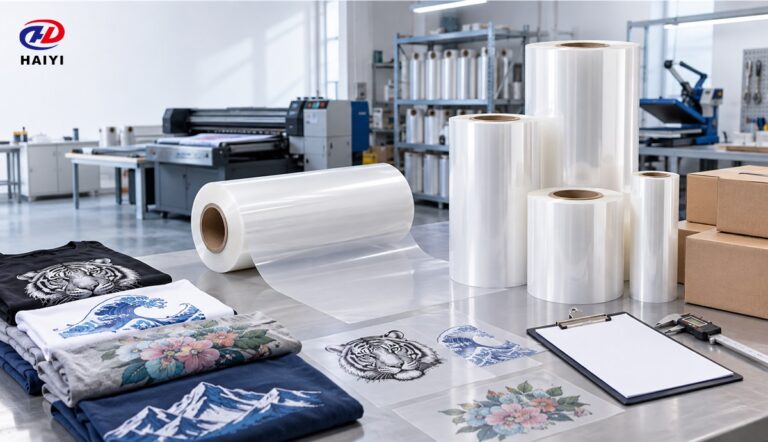
DTF transfer (Direct To Film transfer) is a modern digital textile printing technology that prints designs directly onto special PET transfer film.
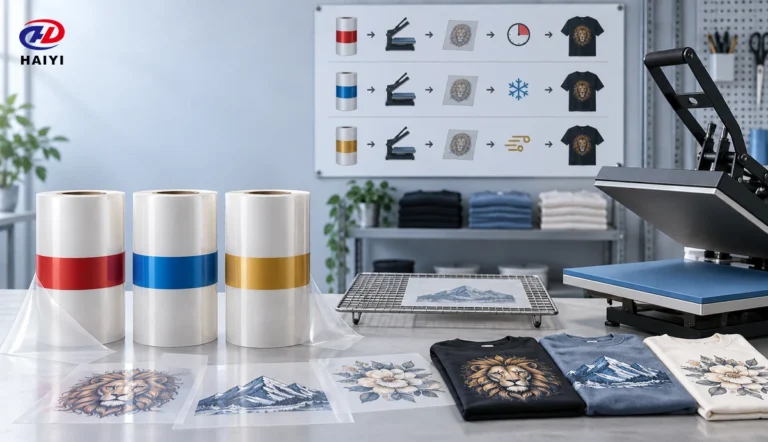
The DTF printing process includes:
- Printing CMYK colors onto DTF film
- Printing a white ink layer as a base
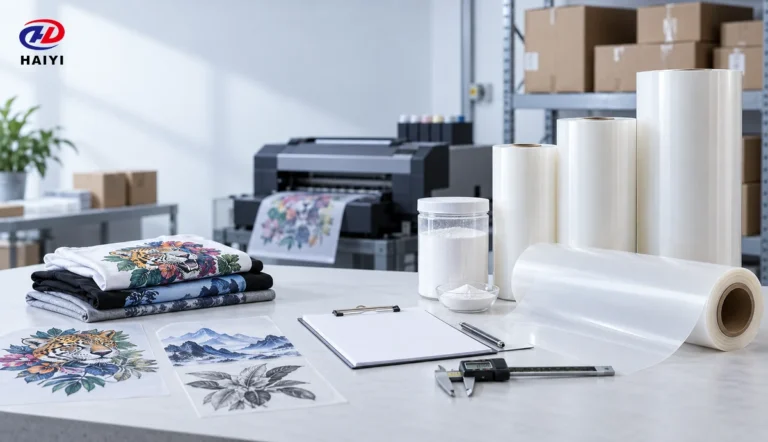
- Applying hot melt adhesive powder
- Heating and drying
- Heat pressing the design onto fabric
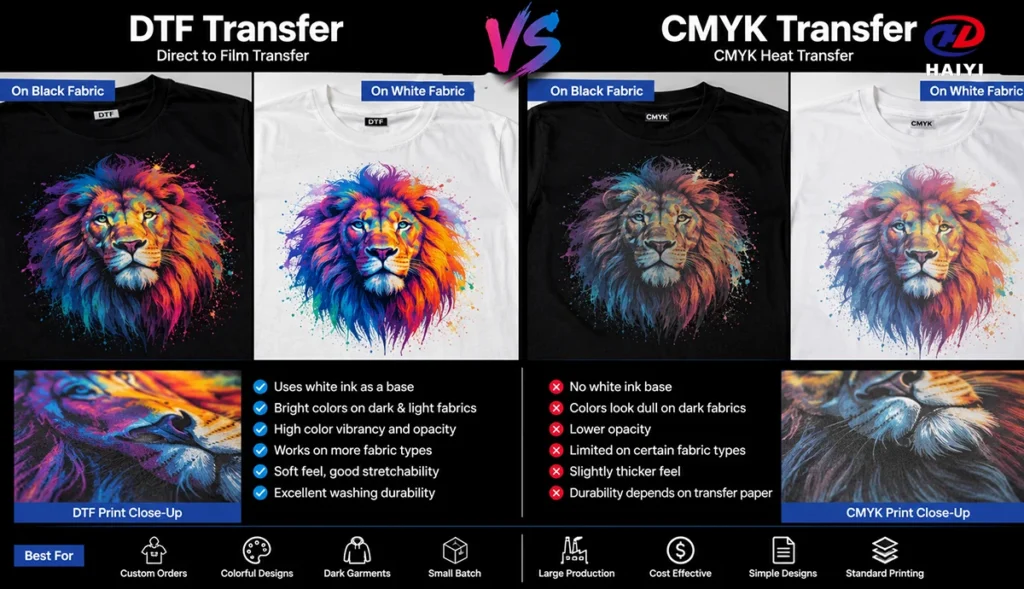
The key feature of DTF technology is the use of white ink transfer. The white ink layer works as a background, blocking the original fabric color and allowing bright, vivid designs even on dark garments.
DTF transfer is widely used for:
- T-shirts
- Hoodies
- Sportswear
- Work uniforms
- Custom apparel
- Fashion brands
Because it supports cotton, polyester, nylon, and blended fabrics, DTF has become one of the fastest-growing solutions in modern textile printing.
What Is CMYK Transfer?
CMYK transfer is based on traditional four-color printing technology, using Cyan, Magenta, Yellow, and Black inks to reproduce images.
Unlike DTF printing, CMYK transfer normally does not use a separate white ink layer. The colors are created by combining tiny ink dots to achieve photo-like images and detailed designs.
The CMYK transfer process usually includes:
- Graphic color separation
- CMYK printing on PET transfer film
- Applying adhesive coating
- Drying and cutting
- Heat transfer onto fabric
CMYK transfer performs especially well on light-colored fabrics because the fabric background helps enhance the printed colors.
DTF Transfer vs. CMYK Transfer: Material and Ink Differences
1. White Ink Technology
The biggest difference between DTF transfer and CMYK transfer is the use of white ink.
DTF Transfer:
- Uses a white ink base layer
- Provides strong opacity
- Maintains bright colors on dark fabrics
- Suitable for black, navy, and colored garments
CMYK Transfer:
- Uses only four-color printing
- No standard white ink layer
- Colors may appear weaker on dark fabrics
- Often requires additional white backing for dark textiles
For customers printing dark clothing, DTF provides a clear advantage.
Printing Process Comparison
DTF Printing Process
DTF printing requires a multi-layer printing process:
Design → White ink printing → Color printing → Powder coating → Drying → Heat transfer
The precise alignment between white ink and color layers is important to ensure:
- Clear edges
- Strong color coverage
- Better durability
Because of the additional steps, DTF production requires more advanced equipment and professional operation.
CMYK Transfer Process
CMYK transfer follows a simpler workflow:
Design separation → CMYK printing → Adhesive coating → Drying → Cutting → Heat pressing
Due to its mature printing process, CMYK transfer is suitable for large-volume production with lower production costs.
Color Performance Comparison
DTF Transfer
DTF transfer provides:
- High color brightness
- Excellent opacity
- Strong contrast
- Better performance on dark fabrics
It is ideal for:
- Brand logos
- Cartoon graphics
- Fashion designs
- High-impact artwork
The white ink layer allows colors to remain vivid without being affected by the fabric color.
CMYK Transfer
CMYK transfer provides:
- Fine image details
- Smooth color gradients
- Photo-quality reproduction
It works best for:
- Light-colored T-shirts
- Detailed images
- Large production orders
However, without a white base layer, colors may lose brightness on dark materials.
Touch Feel and Durability
DTF Transfer
Advantages:
- Strong adhesion
- Good stretchability
- Excellent washing resistance
The transferred layer is slightly thicker because of the white ink and adhesive powder structure.
For high-quality DTF film, proper printing parameters and heat press settings are important to prevent cracking.
CMYK Transfer
Advantages:
- Thin transfer layer
- Soft hand feel
- Comfortable wearing experience
However, durability depends greatly on:
- Transfer material quality
- Ink formulation
- Fabric type
- Washing conditions
Application Differences
DTF Transfer Applications
DTF is suitable for:
- Small batch orders
- Custom clothing
- Personalized products
- On-demand printing
- Complex colorful designs
It is especially popular among online clothing brands and customization businesses.
CMYK Transfer Applications
CMYK transfer is suitable for:
- Large-scale production
- Promotional clothing
- Event merchandise
- Standardized designs
It offers better cost efficiency when producing large quantities of the same design.
Cost and Environmental Comparison
Production Cost
DTF transfer generally has higher equipment and material costs because it requires:
- DTF printer
- White ink system
- Special transfer film
- Hot melt powder
The cost per piece may be higher compared with CMYK transfer.
CMYK transfer benefits from mature industrial production and is more economical for large orders.
Environmental Considerations
DTF printing mainly uses water-based inks, which are widely considered more environmentally friendly.
CMYK transfer may use oil-based inks depending on the printing system, which requires proper handling during production.
Future Trend: Combination of DTF and CMYK Technology
With the development of textile printing technology, the differences between DTF and CMYK transfer are becoming smaller.
Future solutions may combine:
- White ink technology for better coverage
- CMYK color reproduction for detailed images
- Improved adhesive formulas
- More flexible transfer films
This hybrid approach can provide both strong color performance and high production efficiency.
Conclusion
Both DTF transfer and CMYK transfer have their own advantages.
Choose DTF transfer when you need:
- Bright colors on dark fabrics
- Flexible production
- Small MOQ orders
- High-quality textile printing
Choose CMYK transfer when you need:
- Large-scale production
- Cost-effective printing
- Photo-quality designs on light fabrics
For garment manufacturers, wholesalers, and printing companies, selecting the right technology and a reliable DTF film manufacturer is the key to achieving stable quality and long-term business growth.
Frequently Asked Questions (FAQ)
1. What is the main difference between DTF transfer and CMYK transfer?
The main difference is that DTF transfer uses white ink technology, while CMYK transfer mainly uses four-color printing. DTF performs better on dark fabrics.
2. Can DTF transfer print on black shirts?
Yes. DTF transfer is specially designed for dark fabrics because the white ink layer creates a bright background.
3. Is DTF printing more durable than CMYK transfer?
Generally, high-quality DTF transfer offers excellent washing resistance and flexibility. Durability depends on film quality, ink, powder, and heat press conditions.
4. Which transfer method is better for small orders?
DTF transfer is better for small batches and customized products because it requires less preparation and supports flexible designs.
5. Why is white ink important in textile printing?
White ink improves opacity and color brightness, especially when printing on dark-colored fabrics.