



How Does DTF Film Work? From Printing to Heat Transfer

Read Time: 11 min read
From Blank PET Roll to Wash-Proof Print: What Actually Happens Inside DTF Film
Most buyers searching “how does DTF film work” already know the finished result — a bright, durable, full-color transfer that peels off a plastic sheet and bonds to almost any fabric. What’s less obvious is why it works: a specific stack of coatings, a white ink layer doing more work than people expect, and a powder-and-heat sequence that has to happen in the right order or the whole transfer fails.
This guide breaks down the film structure, walks through the five-step printing-to-transfer process, compares the film types buyers actually get quoted on, and covers what separates a factory-grade PET film from one that jams printers and peels unevenly. If you’re sourcing film for a print shop, a distribution business, or a private-label program, the sourcing section near the end is built specifically for that decision.

1. What Is DTF Film, Exactly?
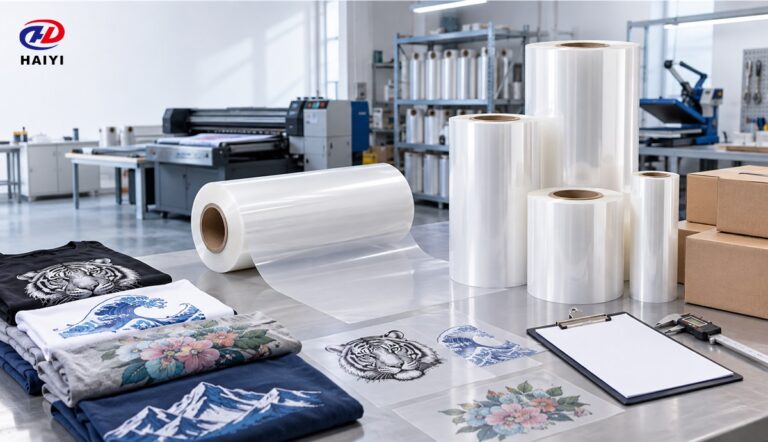
DTF — Direct-to-Film — printing uses a specially coated PET (polyester) film as a temporary carrier. The design is printed onto the film, not onto the garment. Once cured and pressed, the printed layer transfers off the film and bonds permanently to the fabric, and the film itself is peeled away and discarded.
That makes DTF film functionally closer to a transfer medium than a printing substrate — its job is to hold ink and adhesive powder perfectly still until a heat press locks the design into the fabric.
The Four Functional Layers
A properly manufactured DTF film isn’t a single material — it’s a laminate of layers, each solving a different problem in the process:
| Layer | Function |
|---|---|
| PET Base Film | Provides dimensional stability so the film doesn’t stretch, curl, or warp under heat |
| Ink-Receiving Coating | Controls how ink absorbs into the surface, affecting color sharpness and vibrancy |
| Anti-Static Treatment | Prevents static buildup that causes powder contamination and feeding errors |
| Release Layer | Lets the finished transfer peel cleanly off the film without glue residue |
Weak performance in any single layer shows up downstream — usually as a print quality issue that looks like a printer problem but is actually a film problem.
2. How Does DTF Film Work? The 5-Step Transfer Process
This is the sequence that answers the core question directly — from blank film to finished garment.
Step 1: Printing the Design (CMYK + White Ink)
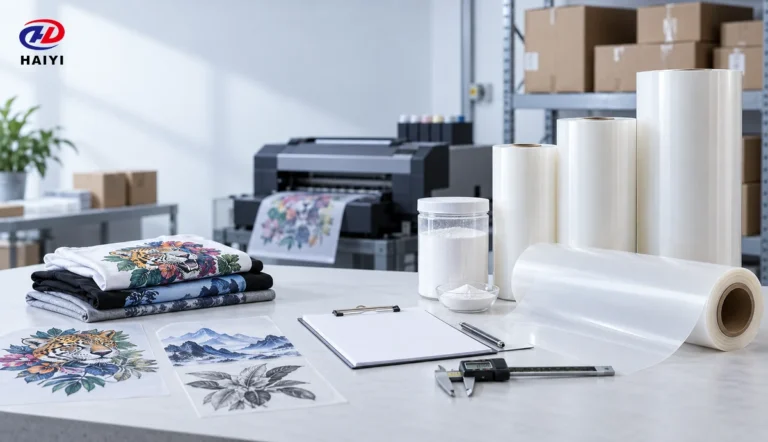
The design is printed directly onto the coated side of the PET film using a DTF printer. Standard CMYK inks lay down color, but a white ink layer is what makes DTF work on dark or colored fabrics — it acts as an opaque base that the color layer sits on top of, so the final print isn’t washed out or dulled by the fabric color underneath.
Without a properly calibrated white layer, prints on black or navy garments come out faded or gray-tinted, regardless of print resolution.
Step 2: Applying Hot-Melt Adhesive Powder
While the ink is still wet, the film passes through a powder shaker that coats it with TPU (thermoplastic polyurethane) adhesive powder. The powder sticks only to the wet ink area, and excess powder is shaken or vacuumed off.
This step is where film quality matters most. Three variables determine success:
- Powder particle size — affects how evenly the powder distributes across fine detail
- Adhesion uniformity — inconsistent ink coating causes patchy powder pickup
- Melting behavior — the powder needs to melt fully and evenly in the next step
A film with poor ink absorption causes powder to clump or fall off before curing, which is one of the most common causes of transfer failure reported by buyers switching suppliers.
Step 3: Curing the Powder
The powder-coated film moves through a curing oven or under an infrared/heat unit, where the TPU powder melts into a smooth, continuous adhesive film. Curing temperature and time depend on the powder type and film thickness — too little heat leaves the powder incompletely melted; too much can pre-activate the adhesive before pressing.
Step 4: Heat Pressing onto Fabric
The cured film is placed print-side down onto the garment and pressed. Typical parameters:
| Parameter | Typical Range |
|---|---|
| Temperature | 140–160°C (284–320°F) |
| Pressure | Medium, even pressure |
| Time | 10–20 seconds |
These ranges vary by fabric type — cotton, polyester, nylon, and blends all respond slightly differently, which is why film and powder specs are usually matched to the target fabric category during sourcing.
Step 5: Peeling the Film
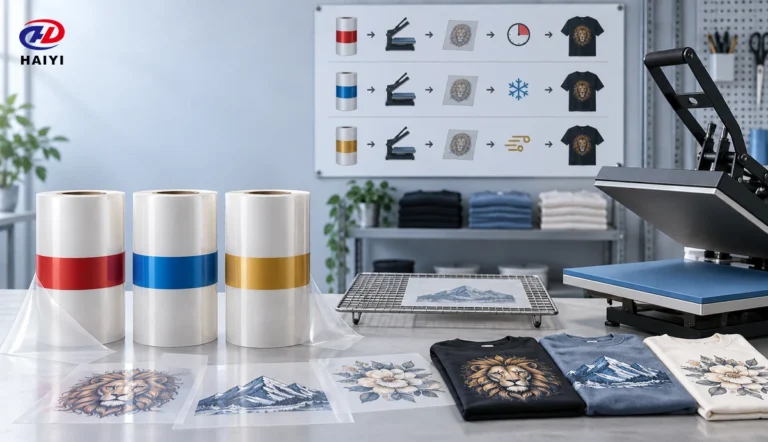
Once pressed, the film is peeled away, leaving the ink-and-adhesive layer bonded to the fabric. How and when you peel depends on the film type:
- Hot Peel Film — peeled immediately after pressing, while still warm. Faster for high-volume production lines.
- Cold Peel Film — requires cooling before peeling. Gives more control and often a smoother final finish, but slows down throughput.
Neither is universally “better” — the right choice depends on production volume and workflow, which is covered in the next section.
3. DTF Film Types Compared
Single Matte vs. Double Matte
Single Matte Film is coated on one side only. It’s the standard, cost-effective option for general apparel printing and works well for most small-to-mid volume print shops.
Double Matte Film is coated on both sides, which reduces static buildup and improves feeding consistency through the printer. High-volume operations tend to prefer double matte because feeding jams and static-related misprints get expensive at scale.
Hot Peel vs. Cold Peel
| Feature | Hot Peel | Cold Peel |
|---|---|---|
| Production Speed | High | Medium |
| Operator Skill Needed | Low | Moderate (timing matters) |
| Best Fit | High-volume, continuous production | Detail-sensitive or smaller batch runs |
| Finish | Slightly firmer hand-feel | Often smoother, softer finish |
Buyers running automated or semi-automated lines usually standardize on hot peel for throughput. Shops focused on premium finish quality on lower volumes often prefer cold peel.
4. What Separates High-Quality DTF Film from Low-Grade Film
This is the section that matters most for import and wholesale buyers, because film quality problems are rarely visible until a full production run is already underway.
PET Film Thickness. Common thicknesses run 75–100 micron, with custom gauges available for specific printer models or fabric applications. Thickness affects feeding stability and how the film handles heat without warping.
Coating Quality. A well-formulated coating layer delivers sharper ink absorption, stronger color reproduction, and — critically — stable powder adhesion. This is usually where cheaper films cut corners, since coating consistency is harder to inspect visually than film thickness.
Anti-Static Performance. Static electricity is a quiet production killer — it causes film sticking inside the printer, misfeeds, and powder contamination that shows up as speckling on the finished print.
Release Performance. The release layer determines whether the film peels cleanly with no adhesive residue left behind, or leaves a tacky, uneven surface that requires rework.
5. Common DTF Film Problems and What Causes Them
| Problem | Likely Cause | Fix |
|---|---|---|
| Ink won’t dry properly | Poor coating absorption, excess ink volume | Adjust printer ink settings; switch to a higher-absorption coated film |
| Powder won’t stick | Weak coating quality, wrong powder type, incorrect curing temp | Match powder to film spec; recalibrate curing temperature |
| Transfer peels unevenly or fails | Incorrect press temperature, weak release layer, fabric mismatch | Adjust press parameters; verify film-fabric compatibility before full runs |
Most of these issues get diagnosed as “printer settings” problems when the root cause is actually inconsistent film quality from a supplier — which is why buyers switching factories often see problems disappear even without changing any machine settings.
6. Where DTF Film Is Used
- Apparel: T-shirts, hoodies, sportswear, workwear
- Promotional Products: Bags, caps, accessories
- Industrial Textile Printing: Uniform manufacturing, fashion production runs, textile factories
The common thread across all of these is that DTF film works on cotton, polyester, blends, and most common apparel fabrics — one of the reasons it’s replaced screen printing setups for shops that need to run mixed fabric orders without changing equipment.
7. How to Choose a Reliable DTF Film Manufacturer
For importers, distributors, and print-consumable wholesalers, film quality is a supplier-selection problem, not just a spec-sheet problem. Four things worth verifying before placing a bulk order:
- Manufacturing capability — actual production capacity and in-house quality control, not just trading-company resale
- Quality certifications — ISO 9001, SGS testing, and RoHS compliance are reasonable baseline requests
- Customization options — custom width, roll length, and private-label packaging for distributors building their own brand
- Supply chain stability — consistent raw material sourcing and export experience, since inconsistent supply is what causes reorder delays
8. Sourcing DTF Film from a Chinese Manufacturer
China’s PET film and coating supply chain is one of the more mature manufacturing bases for DTF consumables, which is why a large share of global DTF film supply is sourced there. For distributors and wholesale buyers, the practical advantages are:
- Manufacturing cost efficiency from an established coating and PET film production base
- OEM and private-label support — custom packaging, brand labeling, and container-level order volumes
- Export experience suited to distributors, wholesale suppliers, and printing consumable companies operating internationally
9. Wholesale Buying Checklist
| Specification | Recommended Range |
|---|---|
| Material | PET |
| Thickness | 75–100 micron |
| Surface | Matte coating |
| Peel Type | Hot or cold, matched to production volume |
| Width | Customizable to printer model |
| Packaging | Roll or sheet, private-label available |
Frequently Asked Questions
Is DTF film reusable? No. DTF film is a single-use transfer carrier — it’s peeled away and discarded after the design transfers to fabric.
Does DTF film work on cotton? Yes. DTF transfers work well on cotton, polyester, blends, and most common apparel fabrics.
What’s the difference between DTF film and sublimation paper? DTF film transfers an adhesive-bonded ink layer onto fabric, while sublimation paper works through a dye-sublimation process that only works on polyester or polymer-coated substrates.
How durable is a DTF transfer after washing? With correct film, powder, and pressing parameters, DTF transfers typically hold up through many wash cycles without cracking or peeling.
Sourcing Reliable DTF Film — Talk to Haiyi Materials
Print quality is only as consistent as the film underneath it. Haiyi Materials supplies PET-based DTF transfer film — including hot peel, cold peel, single matte, and double matte options — for distributors, print shops, and OEM/private-label programs sourcing at wholesale volume. If you’re evaluating suppliers for a new production line or switching away from an inconsistent factory, get in touch to discuss specs, customization, and sample orders.