





Single-Sided vs Double-Sided DTF Film: Which Is Better?
Compare single-sided and double-sided DTF film to understand differences in coating, printing performance, static control, handling, cost, and applications. Learn which DTF film is better for your printing business.

Read Time: 11 min read
One Coated Side or Two? The DTF Film Choice That Quietly Shapes Your Production Costs
DTF film selection affects printing stability, transfer quality, production efficiency, and operating cost all at the same time — which makes it a bigger decision than its surface appearance suggests. Single-sided and double-sided DTF film can look nearly identical at a glance, but their surface structures create genuinely different printing experiences on the production floor.
The core distinction is straightforward: single-sided DTF film has one printable matte coating surface, built for standard DTF applications. Double-sided DTF film has matte treatment applied to both sides, which improves handling, feeding stability, and general production convenience — without necessarily meaning both sides are printable. Which one actually makes sense for your operation depends on printing volume, equipment requirements, production environment, budget, and customer expectations, all of which this guide walks through directly.
What Is Single-Sided DTF Film?
How Does Single-Sided DTF Film Work?
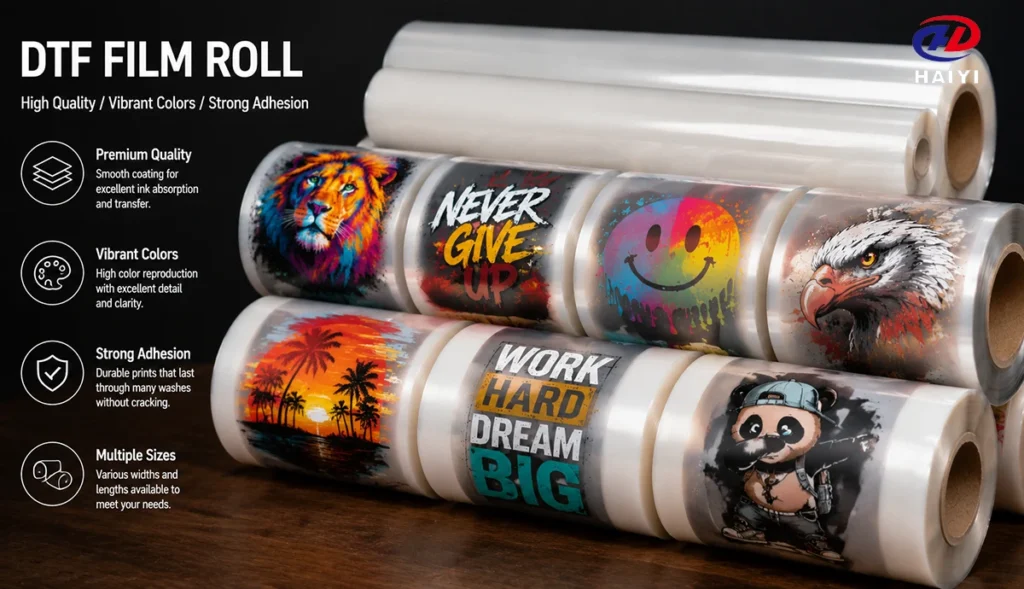
Single-sided DTF film consists of a PET base layer, a matte coating applied to one side only, and a release treatment that controls transfer separation. The coated side is where all the production activity happens — it receives CMYK ink, white ink, and hot-melt adhesive powder in sequence. The opposite, uncoated side plays no active role in the printing process; it mainly functions as the carrier surface that gets handled during feeding and production.
What Are the Advantages of Single-Sided DTF Film?
Lower material cost. Because only one surface requires coating treatment during manufacturing, single-sided film is generally more economical to produce and purchase. This makes it a practical fit for small businesses, entry-level DTF users, and any operation where cost control is a primary concern.
Simple printing operation. Single-sided film is easy to identify correctly during handling, since the printing side has a visibly distinct matte surface compared to the untreated back. That visual clarity reduces operation complexity and simplifies workflow management, particularly useful for smaller teams without dedicated, specialized operators.
Good performance for general applications. Single-sided film performs reliably for custom T-shirt printing, small garment orders, promotional products, and basic textile printing — the majority of use cases that don’t involve continuous, high-speed, multi-operator production.
What Are the Limitations of Single-Sided DTF Film?
Single-sided film is more sensitive to handling direction, since only one side is treated to resist sticking and static — a film fed in incorrectly is more likely to cause problems than double-sided film would be. It also carries a somewhat higher likelihood of static-related issues and is less convenient for high-volume production, where speed and continuous handling put more strain on a single-surface treatment. None of this makes single-sided film unsuitable for its intended use — it simply means large-scale factories running continuous production often need the additional operational stability double-sided film provides.
What Is Double-Sided DTF Film?
How Is Double-Sided DTF Film Different From Single-Sided Film?
Double-sided DTF film also has a PET base layer, but with matte treatment applied to both surfaces rather than just one, while the printable coating remains on one designated side. This is an important distinction worth stating plainly: “double-sided” refers to the matte surface treatment, not two independently printable layers. The primary purpose of the second treated side is improved handling, feeding, and anti-static performance — not additional printing capacity.
What Are the Advantages of Double-Sided DTF Film?
Better film handling during production. The matte surface on both sides improves operator handling, gives more predictable film movement control through the printer, and improves stacking stability when rolls or sheets are stored or transported between production stages.
Improved anti-static performance. Double matte treatment reduces film sticking, dust attraction, and the feeding interruptions that static buildup commonly causes — advantages that become especially noticeable in dry production environments and high-speed printing operations, where a single-sided film’s static sensitivity is more likely to disrupt continuous runs.
More stable printer feeding. The consistent surface treatment on both sides reduces slipping, misalignment, and general feeding errors during transport through the printer, which directly benefits continuous commercial production where even small feeding inconsistencies compound into meaningful downtime over a full shift.
What Are the Limitations of Double-Sided DTF Film?
Double-sided film costs more to manufacture, given the additional coating treatment involved, which translates to a somewhat higher purchase price for the buyer. For low-volume users, this added cost may simply be unnecessary — the handling and stability advantages only translate into real business value when production volume and speed are high enough for those advantages to matter operationally.
Single-Sided vs. Double-Sided DTF Film: Complete Comparison
| Feature | Single-Sided DTF Film | Double-Sided DTF Film |
|---|---|---|
| Matte Coating | One side | Both sides |
| Printing Surface | One side | One designated side |
| Material Cost | Lower | Higher |
| Handling | Standard | Easier |
| Anti-Static Performance | Good | Better |
| Feeding Stability | Good | Excellent |
| Production Volume Fit | Small–medium | Medium–large |
| Operation Difficulty | Easy | Easier for factories |
| Recommended Users | Small print shops | Commercial printers |
Which DTF Film Provides Better Printing Quality?
Printing quality depends primarily on coating technology, PET material quality, ink compatibility, adhesive powder performance, and processing parameters — not simply on whether a film is single-sided or double-sided. The single-vs-double distinction is a handling and production-efficiency question more than a raw quality question.
Does Double-Sided Film Produce Better Colors?
No — not directly. Color performance depends mainly on the printable coating layer itself, which can be identical in formulation whether the back side is treated or not. Double-sided film improves handling and production stability, but that doesn’t automatically translate into brighter or more accurate colors; a well-formulated single-sided coating can match a double-sided film’s color output entirely.
Does Single-Sided Film Reduce Transfer Quality?
No. High-quality single-sided film can achieve excellent transfer results when printer settings are correctly calibrated, environmental conditions are controlled, and proper heat pressing technique is used. Transfer quality is a function of the coating and process control, not the number of treated surfaces — a common misconception that leads some buyers to overspend on double-sided film when their actual quality issue lies elsewhere.
Which DTF Film Is Better for Different Business Types?
Best Choice for Small DTF Printing Shops
Single-sided film is generally the better fit when production volume is limited, cost control matters, and operation remains largely manual rather than fully automated. The lower material cost provides a stronger return on investment for exactly this profile of business, since the operational advantages of double-sided film go largely unused at lower volumes.
Best Choice for Commercial Printing Factories
Double-sided film is generally the better fit for continuous production runs, environments where multiple operators handle film through the day, and any operation where printing speed is a competitive priority. The improved feeding and handling stability directly reduces downtime and material waste at the volumes commercial factories typically run.
Best Choice for DTF Film Distributors and Wholesalers
Offering both film types creates a stronger, more complete product portfolio, since distributor customers span the full range from beginner printers testing DTF for the first time to professional print shops and industrial garment factories with very different volume and handling requirements. Carrying only one type limits a distributor’s ability to serve that full customer range.
How Does Production Environment Influence Film Selection?
The same film can perform differently depending on the working conditions it’s used in, which is why production environment deserves consideration alongside business type.
Dry Environments and Static Problems
In areas with consistently low humidity and elevated static electricity risk, double-sided matte film provides a real, measurable advantage — its improved anti-static performance directly addresses the specific failure mode that dry conditions tend to trigger.
High-Speed Production Environments
As production volume and speed increase, stable feeding and predictable handling become progressively more important, since a small feeding inconsistency that’s a minor annoyance at low speed becomes a recurring bottleneck at high throughput. This is a second, independent reason high-speed operations tend to favor double-sided film beyond just the environmental humidity factor.
What Should You Check Before Buying DTF Film Wholesale?
Evaluate PET Material Quality
Check film thickness consistency across the roll, overall flatness, and heat resistance under repeated pressing cycles — these three factors determine baseline handling reliability regardless of which coating type you ultimately choose.
Test Coating Performance
Evaluate ink absorption behavior, powder adhesion strength, and release performance directly through sample testing rather than relying on spec sheet claims alone, since coating performance is where quality differences between suppliers show up most clearly.
Verify Manufacturing Consistency
Confirm batch-to-batch stability, actual production capacity, documented quality inspection procedures, and export experience — these indicate whether a supplier can maintain the same quality as your order volume scales up over time.
Consider OEM and Custom Packaging Options
Check whether the supplier can support private label branding, customized roll sizes, and packaging tailored to distributor requirements, particularly relevant for buyers building their own branded product line rather than reselling generic film.
Common Mistakes When Choosing DTF Film
Choosing only based on price. Cheaper film often creates more production waste, a higher rate of failed transfers, and ultimately higher total operating costs once rework and material loss are factored in — the lowest unit price rarely translates to the lowest total cost.
Assuming double-sided film is always better. Film selection should match actual production needs rather than defaulting to the option with more features; a small shop paying for double-sided film’s handling advantages it never uses is simply overspending relative to its actual requirements.
Ignoring printer compatibility. Different printer models and workflows can require different film characteristics, so a film that performs well on one setup may not perform identically on another — compatibility should be verified specifically, not assumed from general specifications.
Frequently Asked Questions About Single-Sided and Double-Sided DTF Film
Can both sides of double-sided DTF film be printed? No, typically not. “Double-sided” usually refers to the matte surface treatment applied to both sides for handling and anti-static purposes, not two independently printable ink-receiving layers.
Is double-sided DTF film worth the extra cost? It depends on your operation. It’s generally worth the added cost for businesses that need better handling, greater feeding stability, and higher production efficiency at volume — but it may be unnecessary spending for lower-volume, cost-sensitive operations.
Which DTF film is better for beginners? Single-sided film is usually sufficient for beginners, given its lower cost and simpler, more visually straightforward operation while learning the printing process.
Which film is better for mass production? Double-sided film is generally preferred for industrial, high-volume environments because of the improved workflow stability it provides during continuous, high-speed operation.
Does film coating affect transfer durability? Yes. Coating quality directly influences ink adhesion, powder bonding strength, and final wash resistance — this holds true regardless of whether the film is single-sided or double-sided.
Conclusion: Choosing the Right DTF Film Depends on Your Production Goals
Single-sided DTF film offers a cost-effective solution well suited to standard printing applications and smaller-scale operations. Double-sided DTF film offers improved handling, stronger anti-static control, and greater production stability, best suited to continuous, high-volume commercial production. Neither is a universal “best” choice — the right decision depends on your production scale, equipment requirements, operating environment, and quality expectations working together.
For printing companies, distributors, and importers, the deciding factor is ultimately less about single-sided versus double-sided and more about the manufacturer behind either option — consistent coating technology and stable supply are what turn either film type into a dependable production input. Haiyi Materials, based in the Pearl River region of Foshan, Guangdong, brings more than 10 years of coating industry experience to both single-sided and double-sided DTF film production, supporting distributors and OEM buyers with the batch consistency long-term business growth depends on. Contact us to discuss which film type fits your production line and to request samples.