


10 Critical Factors That Determine DTF Film Printing Quality | Complete Quality Control Guide
Discover the top factors affecting DTF film printing quality, including film coating, ink, powder, printer settings, curing, and heat pressing. Learn practical solutions to achieve vibrant, durable, and consistent DTF transfers while choosing the right DTF film for professional production.

Read Time: 13 min read
The 10 Variables That Separate Professional DTF Transfers from Failed Ones
DTF printing has become one of the fastest-growing textile decoration technologies precisely because it works across cotton, polyester, blends, and many specialty fabrics without requiring a different setup for each one. But that versatility hides a common misconception: that print quality is mostly a function of the printer.
In practice, a professional-grade transfer — vibrant color, sharp detail, strong wash durability — depends on a chain of ten variables that all have to perform correctly at the same time. A weak link anywhere in that chain, from the film coating to the final press, shows up as a visible defect. This guide breaks each factor down individually, so manufacturers, distributors, and print shops can trace a quality problem back to its actual cause instead of guessing.
1. What Defines High-Quality DTF Film Printing?
Quality in DTF printing isn’t subjective — it’s measurable against a specific set of characteristics. A professional-grade transfer shows vibrant, accurate color; smooth gradients with no visible banding; sharp, clean image edges; complete and even white ink coverage under the color layer; strong resistance to cracking or peeling after repeated washing; a soft hand feel rather than a thick, plastic-like layer; and stable adhesion that doesn’t loosen with wear.
Common production defects fall into a predictable pattern: cracking along stress points, peeling at the edges first, faded or dull colors, blurry fine detail, and uneven powder distribution visible as patchy texture. Knowing these indicators matters because they tell you where in the process to look — color fading points toward curing or ink density, while cracking usually points toward powder or press settings. Quality control teams should check for these signs at both mid-production and final inspection, not only after a customer complaint.
2. How Does DTF Film Quality Affect Printing Results?
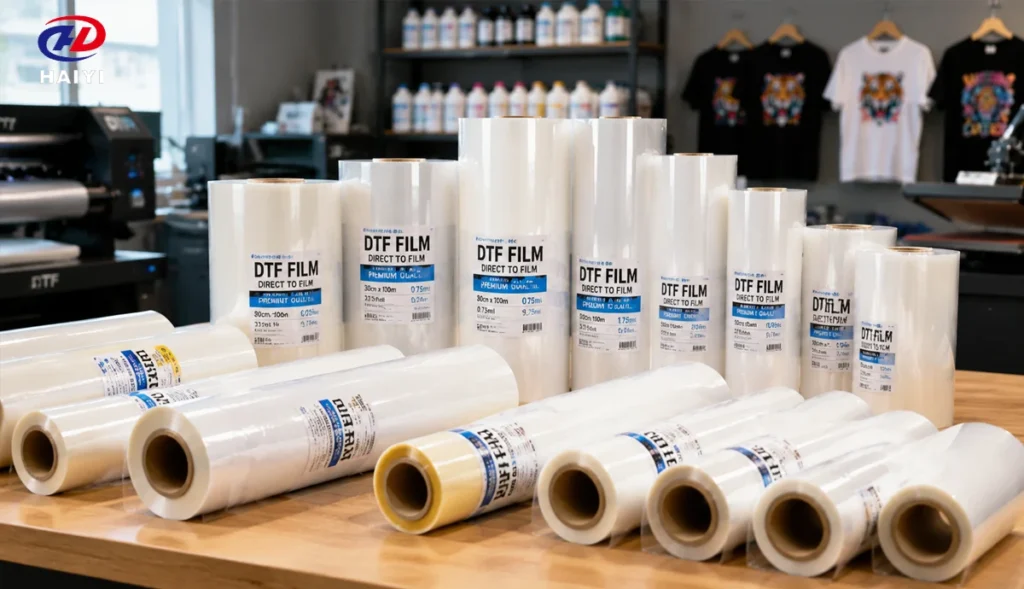
The film itself is the foundation every other variable builds on. PET base stability determines whether the film holds its shape under heat instead of curling or stretching. Coating consistency controls how evenly ink is absorbed across the surface — inconsistent coating creates visible patches of over- or under-saturated color even when the printer settings are correct. Release layer performance determines whether the finished transfer peels cleanly, and anti-static treatment prevents the film from clinging to itself or the printer rollers during feeding.
Premium coated film and lower-grade film produce noticeably different failure patterns. Lower-grade film tends to show ink bleeding at fine edges, inconsistent white ink coverage across a single print run, curling after curing, and outright transfer failure where the powder-and-ink layer doesn’t release from the film cleanly onto fabric. Because film sits at the start of the process, a quality issue here compounds through every later step — which is why buyers switching from an unreliable film supplier often see multiple, seemingly unrelated defects disappear at once.
3. Why Is Ink Compatibility Essential for Consistent Color Output?
DTF inks are formulated specifically to interact with coated PET film — they are not interchangeable with inks designed for other transfer media. Viscosity affects how the ink sits on the coating before it’s absorbed; pigment concentration determines color saturation and vibrancy; white ink stability governs whether the opaque base layer stays evenly mixed instead of settling; and drying characteristics affect how sharp the final printed edge is.
A properly matched ink-and-film system produces consistent color across a full production run. A mismatched combination shows up as poor adhesion between ink and coating, visible color shifting from batch to batch, clogged printheads from unstable pigment settling, and reduced wash durability even when every other step was executed correctly. Maintaining stable ink performance means using ink formulated for the specific film type in use, agitating white ink regularly to prevent settling, and monitoring viscosity as ambient temperature changes through the day.
4. How Does Hot Melt Powder Influence Adhesion and Wash Durability?
TPU hot melt adhesive powder is what physically bonds the printed graphic to the fabric during heat pressing — without it, DTF prints would sit on top of the fabric with no lasting adhesion at all. Particle size, melting temperature, storage conditions, and coating uniformity all affect how strong and even that bond turns out to be.
Fine powder particles suit detailed artwork with small text or thin lines, since they fill fine detail without clumping. Coarser powder is often preferred for heavy-coverage, solid-color graphics where maximum adhesive volume matters more than fine detail resolution. Improper application — powder that’s too thick, unevenly distributed, or exposed to humidity before use — creates a rough surface texture, weak adhesion that fails prematurely, or incomplete transfer where sections of the design don’t bond to the fabric at all during pressing.
5. Which Printer Settings Have the Greatest Impact on Print Quality?
Printer configuration directly shapes every printed image before it ever reaches the heat press. Print resolution determines fine detail capture; carriage speed affects how precisely ink lands on the film; ink volume and white ink density control color depth and opacity; bidirectional alignment prevents ghosting or doubling on detailed graphics; and color profiles keep output consistent across different print jobs and operators.
Optimized settings produce sharp detail and consistent, repeatable color across an entire production run. Incorrect configuration is one of the most common causes of visible banding across gradients, color inconsistency between identical designs printed hours apart, and blurry graphics that look like a film or ink problem but actually trace back to printer calibration. Regular calibration — not a one-time setup — is what keeps output repeatable as usage accumulates.
6. Why Are Temperature and Humidity Critical During DTF Production?
Environmental conditions in the production space affect film stability, powder behavior, ink drying speed, and printer reliability all at once, which is why climate-controlled workshops consistently outperform uncontrolled ones on defect rates. Excessive humidity causes hot melt powder to clump before it’s even applied and slows ink drying enough to cause smudging or bleeding on the film. Low humidity has the opposite problem — it increases static electricity, which causes film feeding issues, powder scatter, and ink misting inside the printer.
Ideal production environments maintain both temperature and humidity within a controlled range year-round, rather than adjusting reactively when defects appear. Workshops without climate management tend to see quality fluctuate seasonally — more static-related defects in dry winter conditions, more powder clumping and drying issues during humid months — even when every other variable in the process stays constant.
7. How Does the Curing Process Affect Final Transfer Performance?
Curing is the stage where the adhesive powder melts into a continuous bonding layer, preparing the transfer for fabric application. Curing temperature, heating duration, and airflow all determine how completely and evenly that melting happens across the full printed area.
Properly cured transfers show consistent elasticity, strong durability through repeated washing, and even bonding performance across the entire design. Under-cured transfers leave powder partially unmelted, which shows up later as patchy adhesion and premature peeling. Over-cured transfers can become stiff and brittle, cracking at flex points like elbows or knees even though the initial press looked fine. Because curing problems often aren’t visible until after washing, curing consistency has to be verified through process control rather than visual inspection alone.
8. What Heat Press Variables Produce the Best Transfer Results?
Even a perfectly printed, properly cured transfer can fail at the final step if heat press parameters are wrong. Pressing temperature, pressure, dwell time, platen surface uniformity, and fabric preparation (removing moisture and wrinkles before pressing) all affect the outcome.
Excessive heat can scorch fabric or over-activate the adhesive, leaving a stiff, glossy finish. Insufficient pressure prevents full contact between the transfer and fabric surface, leading to partial bonding and edge lifting. Incorrect dwell time — too short or too long — produces the same under- or over-cured symptoms described above, but introduced at the pressing stage instead of the curing stage. Maintaining repeatable results across different fabric types means adjusting these parameters per fabric category rather than using one universal setting for every job.
9. How Does Fabric Selection Influence DTF Transfer Quality?
Different textile materials respond differently to the same heat transfer process, which is why fabric-specific adjustment is standard practice rather than optional. Cotton generally handles standard DTF parameters well. Polyester requires more careful temperature control to avoid dye migration or fabric distortion. Blended fabrics sit between the two and often need testing to find a stable middle ground. Canvas and heavier textiles may need longer dwell times to achieve full adhesion through a thicker weave. Nylon and treated performance textiles often require lower temperatures to avoid damaging moisture-wicking or stretch coatings.
Surface texture, moisture absorption, elasticity, and any factory-applied coating treatments all influence how well the adhesive layer bonds and how the final color appears. This is why transfer parameters that work perfectly on a cotton T-shirt run can produce visibly different results when the same design is pressed onto a polyester blend without any adjustment.
10. Why Is Routine Equipment Maintenance Essential for Stable Printing?
Preventive maintenance is what keeps every other factor on this list performing consistently over time, rather than degrading gradually until a batch fails. Daily printhead cleaning prevents dried ink from affecting nozzle output. White ink circulation prevents pigment settling that causes uneven opacity. Regular nozzle inspection catches clogging before it shows up as missing lines in printed output. Capping station maintenance protects printheads between print jobs. Film feeding systems and powder shakers need regular cleaning to prevent residue buildup that causes misfeeds or uneven powder application.
Production environments with a regular maintenance schedule show far fewer unexplained quality fluctuations than those that only service equipment after a visible failure. Neglected equipment typically shows a predictable decline: clogged nozzles first, then inconsistent ink output, then mechanical misalignment that’s harder and more expensive to correct. Maintenance is best treated as a scheduled investment in consistency, not a reactive expense.
Common DTF Printing Quality Problems and Their Root Causes
| Printing Problem | Most Likely Cause | Recommended Solution |
|---|---|---|
| Color fading after transfer | Incorrect curing or insufficient white ink | Optimize curing temperature and ink density |
| Ink bleeding | Poor film coating or excessive ink volume | Use premium coated film and recalibrate ink limits |
| Powder not bonding evenly | High humidity or uneven powder application | Control environmental humidity and improve powder distribution |
| Peeling after washing | Incomplete curing or incorrect pressing | Verify curing time/temperature and heat press parameters |
| Blurry image edges | Printhead misalignment or unstable film feeding | Recalibrate printer and inspect the film feeding system |
| Static-related defects | Low humidity or insufficient anti-static treatment | Improve humidity control and switch to anti-static film |
How Can Manufacturers Build a Reliable DTF Quality Control System?
High-quality production depends on catching problems before printing, not correcting defects after the fact. A systematic quality control approach includes incoming material inspection (checking film and ink batches against spec before they enter production), continuous production monitoring, environmental control, scheduled equipment calibration, sample testing before full runs, wash testing to verify durability claims, and final product verification before shipment.
Reactive quality control — inspecting only after a customer complaint — allows defects to reach production volume before anyone catches them, which is far more costly than catching a coating inconsistency in an incoming material check. Standardized inspection procedures at each stage reduce waste, protect customer confidence, and make manufacturing output more predictable batch to batch.
How to Choose High-Quality DTF Film for Wholesale and OEM Orders
For distributors, importers, printing consumable brands, and OEM buyers, film selection is a supplier evaluation problem more than a spec-sheet comparison. Key factors to verify before committing to bulk volume include: coating consistency across production batches, PET raw material quality, dimensional stability under heat, anti-static performance, actual production capacity (not just resale capability), batch-to-batch consistency, export experience, customization capability for private-label programs, and documented quality assurance procedures.
Selecting a professional manufacturer with strong process control reduces long-term operating costs through stable, repeatable product performance — fewer production rejects, fewer customer complaints, fewer emergency reorders. Buyers who select suppliers purely on lowest unit price frequently find that inconsistent batch quality costs more in wasted production than the price difference ever saved.
Frequently Asked Questions About DTF Film Printing Quality
Can premium DTF film improve print quality without changing the printer? Yes. Higher-quality coating and stable PET material improve ink acceptance, reduce feeding issues, and produce more consistent transfer performance even when the printer itself stays the same.
What causes DTF transfers to peel after washing? Peeling after washing is most commonly caused by insufficient curing, improper heat pressing, an incompatible powder-and-film combination, or poor-quality film with weak adhesive bonding — often more than one of these at once.
Does film thickness affect transfer quality? Yes. Appropriate film thickness supports dimensional stability, smoother printer feeding, and more predictable handling through the process. Excessively thin or inconsistent film thickness increases the risk of curling, misfeeds, and uneven transfer.
How often should DTF printers be calibrated? Calibration frequency should scale with production volume — high-volume operations typically calibrate more often to catch drift before it affects a full batch, while lower-volume shops can work on a longer scheduled interval.
Is expensive DTF film always better? Not necessarily. Performance depends on coating technology, manufacturing consistency, and compatibility with your specific ink and powder system — not price alone. Buyers should evaluate testing data and production reliability rather than assuming cost correlates directly with quality.
Conclusion: Quality Is Controlled at Every Stage, Not Just One
Outstanding DTF printing quality is the result of managing all ten of these variables together, not optimizing a single one and hoping the rest fall into place. Premium film, compatible ink and powder, stable environmental conditions, accurate printer calibration, correct curing, proper heat pressing, and standardized quality inspection all have to function as one system to produce transfers that are vibrant, durable, and consistent from the first unit to the ten-thousandth.
For wholesale buyers, distributors, and printing businesses, this points to a clear sourcing priority: partner with manufacturers who can demonstrate process control and batch consistency, not just a favorable price on paper. Haiyi Materials supplies PET-based DTF transfer film engineered for stable coating, strong anti-static performance, and reliable powder adhesion across production runs — built for distributors and OEM buyers who need consistent results order after order. Reach out to discuss specifications, sample testing, and volume pricing for your next order.