







How to Find a Reliable UV DTF Film Supplier in China
Learn how to verify a reliable UV DTF film supplier in China with a practical checklist for factory checks, A/B film testing, quality controls, and first orders.

To find a reliable UV DTF film supplier in China, verify the factory and its quality controls first, then test matched A and B film on your own printer and target substrates before committing to volume. A low quotation is useful only when the rolls deliver consistent ink reception, clean release, stable lamination, and dependable repeat supply.
Estimated reading time: 7 minutes
For buyers of UV DTF AB film, the most practical approach is a staged supplier evaluation: define the application, request documents and samples, run a controlled test, confirm the commercial terms in writing, and scale only after the first batch performs as expected. This guide gives purchasing teams a repeatable checklist for doing that.
Start by defining the UV DTF film you actually need
鈥淯V DTF film鈥?is not one universal product. The A film is the printable coated layer; the B film is the adhesive transfer carrier. A supplier can only recommend a reliable pairing when it understands your printer width, UV ink set, laminator, target surfaces, finish expectations, and order volume.
Before contacting suppliers, prepare a short specification sheet covering A-film finish (clear, white-ground, matte, or metallic where applicable), B-film tack, roll width and length, core size, packaging, and the substrates you plan to decorate. For a refresher on the two-film process and width pairing, see this UV DTF film buying guide.
| Question to answer | Why it matters | What to tell the supplier |
|---|---|---|
| Which printer and ink are you using? | Coating compatibility affects ink anchoring, curing, and release. | Printer model, ink type, white/varnish configuration, and print mode. |
| Which surfaces will receive transfers? | B-film tack and adhesive behavior vary by glass, acrylic, metal, coated plastic, and other surfaces. | Your top three substrates, including textured or delicate finishes. |
| What is your production format? | Width, roll length, and winding consistency affect feed and lamination efficiency. | A3 or 60 cm workflow, required roll length, and monthly demand. |
| What finish is required? | Clear, white-ground, matte, and metallic films create different visual results. | Photos or approved samples showing opacity, gloss, and color expectations. |
Verify that the supplier is a real manufacturer or a transparent trading partner
A reliable supplier should be able to explain its role in the supply chain clearly. A manufacturer may control coating, slitting, inspection, and packaging; a trading company may add value through sourcing and export service. Either model can work, but buyers should not accept vague claims about production capability.
Ask for a live video call or a recent factory walkthrough that shows the relevant processes: raw-film storage, coating or converting equipment, slitting, finished-roll inspection, and packing. Request the company name, factory address, export contact, and a named person responsible for technical questions. If certificates are important to your market, ask for the current document, issuing body, scope, and validity date rather than relying on a logo in a brochure.
Use certification as one data point, not a substitute for product testing. For example, a supplier’s quality management and product certification information can help you raise questions, but only through sampling can you confirm the product’s performance on your equipment.
Evaluate the technical details that determine film consistency
Film quality is most visible during printing, lamination, peeling, and application. Ask the supplier to provide the technical specification and the acceptable tolerance for the items below. A reliable answer should describe a measurable control point, rather than simply calling the film a “value edition”.
- Ink receptivity: A film should accept cured UV ink without bleeding, beading, or lift during lamination.
- Release consistency: The A film should peel cleanly across the full sample, not only at the start of the roll.
- Adhesive clarity and tack: B film should preserve visual clarity and match the intended surface; higher tack is not automatically better.
- Dimensional stability: Film should feed and laminate without excessive curl, edge wandering, or bubbles.
- Roll construction: Check usable width, length, winding direction, splice policy, core, and protective packaging.
- Batch traceability: Ask whether the carton or roll label identifies a production batch so problems can be investigated.
Ask whether the proposed A and B films were designed and tested as a matched system. Mixing films from unrelated sources can introduce release or adhesion problems even when each individual roll appears acceptable.
Run a sample test that reflects real production
Do not make a bulk decision from a small hand-applied sample alone. Order enough sample material to print several designs, laminate them with your normal settings, and apply them to the same products you sell. Include fine type, solid color, white ink, varnish, and areas that reveal bubbles or edge lift.
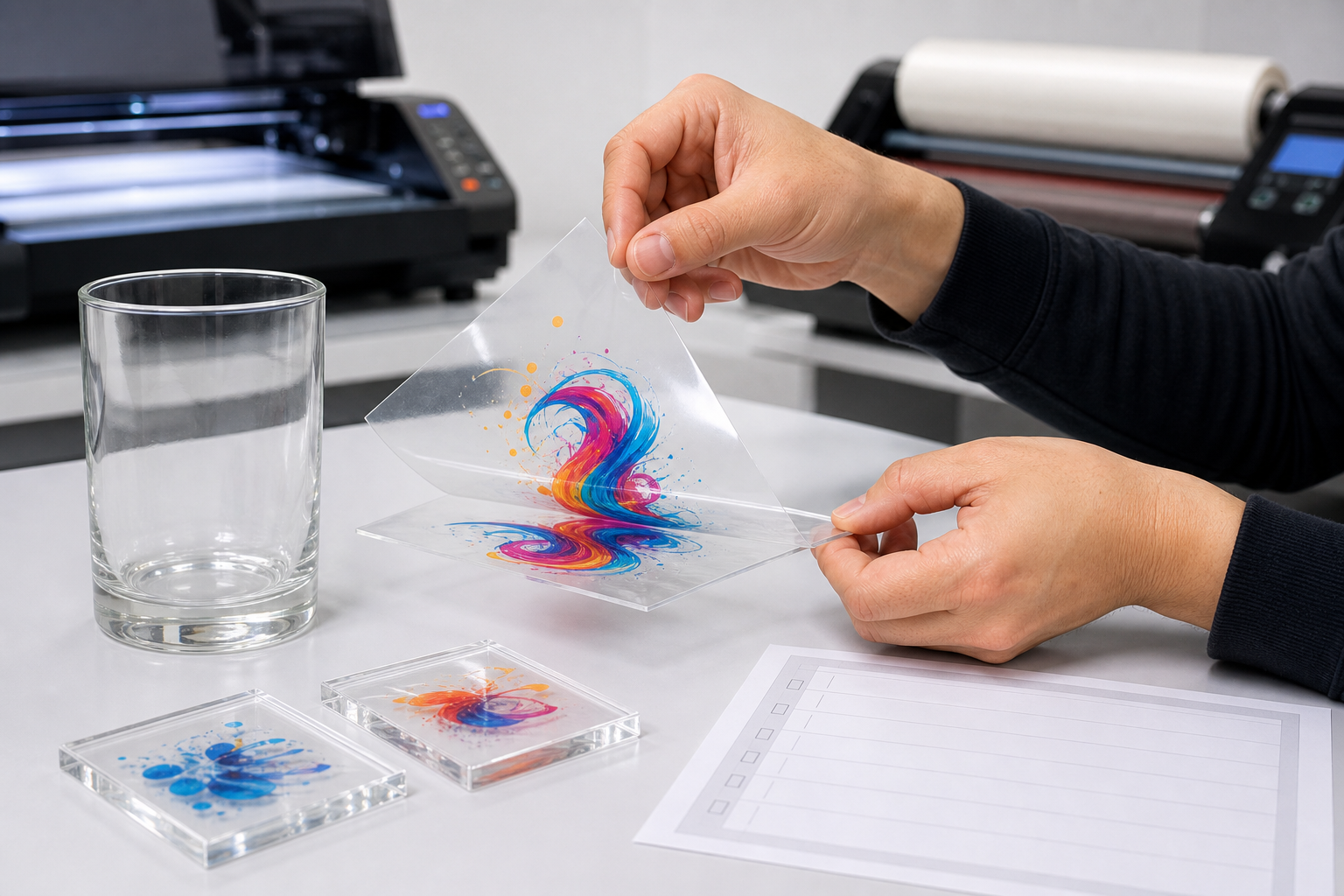
Evaluate the sample at four points: immediately after printing, after lamination, after transfer application, and after a suitable dwell period for the adhesive. Record the printer profile, cure setting, laminator pressure, room conditions, substrate preparation, and any defects. This record helps distinguish a film issue from a setup issue and gives the supplier enough information to recommend a corrective trial.
| Test checkpoint | Pass condition | Potential warning sign |
|---|---|---|
| Printing | Controlled dot shape and clean, even ink laydown. | Bleeding, poor white coverage, or ink repelling from the A film. |
| Lamination | Even bond without trapped air, wrinkles, or edge curl. | Frequent bubbles or inconsistent contact across the web. |
| A-film release | Design remains intact on the B-film carrier. | Ink lifts with the A film or fine details break away. |
| Final application | Clean transfer and appropriate adhesion on each intended substrate. | Edge lift, residue, discoloration, or damage to a delicate surface. |
Test more than one target surface. A pairing that works well on clean glass may not suit coated powder metal, textured plastic, or a low-energy surface. For difficult substrates, ask the supplier to recommend the tack level, preparation method, and any known limitations before you scale.
Assess communication, documentation, and after-sales support
Supplier reliability also shows up in how a team handles a technical question. During sampling, note whether the supplier asks relevant follow-up questions, provides a clear specification, responds with actionable troubleshooting, and acknowledges uncertainty where a test is needed.

Before placing the first production order, confirm the details in a pro forma invoice or purchase order: product code, A/B pairing, dimensions, quantity, unit price, packing, Incoterm, lead time, payment schedule, shipment method, and claim process. Define what evidence is required for a quality claim, the time limit for reporting it, and the available remedy. This avoids relying on chat messages when a batch issue needs resolution.
Factory capacity can matter when you are scaling or require custom packaging. Carefully review the supplier’s stated production capacity and request a reasonable delivery time commitment for the size of your order. Haiyi Company’s corporate and factory profile is an example; buyers should be able to review this type of operational information before establishing a long-term purchasing relationship.
Compare total landed value, not just the price per roll
The lowest ex-works price can become the most expensive option if a roll causes reprints, lamination waste, missed delivery dates, or customer returns. Compare quotations on the same specification and include freight, duties, sample cost, payment risk, expected scrap, and the support available if the material does not perform as agreed.
For repeat buying, calculate a simple usable-output measure: transfers produced per roll minus the material lost to setup, defects, and rework. A consistent film that costs slightly more per meter may have the stronger total value if it reduces downtime and waste.
Red flags when sourcing UV DTF film from China
- The supplier will not identify the proposed A-film and B-film specifications or provide a current sample.
- Marketing claims replace answers about compatibility, testing, tolerances, or batch traceability.
- The quote changes after you request width, roll length, tack level, or packaging details.
- The supplier guarantees universal adhesion to every material without asking about surface type or preparation.
- There is no written process for quality claims, replacement, or corrective action.
- The team pressures you to skip sampling and place a large first order.
A practical first-order plan
- Shortlist suppliers that can clearly identify their product, factory role, and export contact.
- Send the same written specification to each supplier and request matched A/B samples.
- Run a documented print, laminate, peel, and application test on your real substrates.
- Compare results, lead time, communication quality, and total landed cost.
- Place a manageable trial order with written specifications and batch identification.
- Approve regular volume only after the delivered batch matches the sample standard.
FAQ
Should I choose a factory or a trading company for UV DTF film?
Choose the partner that can transparently meet your specification, support sampling, communicate clearly, and deliver consistently. A factory may offer more direct control over production; a capable trading company may provide useful export coordination. Verify the role instead of assuming it.
How many suppliers should I test?
Testing two to four suppliers is usually enough to compare sample quality and service without making the process unmanageable. Use the same artwork, settings, and substrates for every test.
What is the most important UV DTF film test?
The most useful test is a complete workflow test on your actual printer and final product: print, cure, laminate, peel, apply, and inspect after the adhesive has had time to settle. It reveals compatibility problems that a data sheet cannot.
Can a supplier guarantee adhesion on every surface?
No. UV DTF transfers perform differently on various surface chemistries, textures, coatings, and preparation conditions. A reliable supplier will help you test the surfaces you intend to sell rather than promising universal results.
Final takeaway
A dependable UV DTF film supplier earns trust through evidence: clear specifications, verifiable operations, representative samples, responsive technical support, and repeatable batches. Start small, record test results, and only scale up when the complete A/B film system works properly on your printer and your customers’ substrates. When you are ready to compare specifications or request samples, please contact the Haiyi team and provide your printer, film width, substrate list and expected order quantity.