







How Long Is The Shelf Life Of Heat Transfer DTF Film?

The Film on the Shelf
The roll had been sitting in the corner of the studio for four months. Partially used, loosely wrapped in the original packaging, near the window that caught afternoon sun.
When it went back into the printer, the results were immediately off. Ink absorption was uneven. Powder stuck in blank areas despite using dual-matte film. The finished transfers felt slightly stiff. After three washes, the design edges were lifting.
Nothing had changed. Same printer, same settings, same ink, same press. Everything the same — except the film had been sitting exposed for four months in conditions that slowly degraded its coating.
This is the shelf life question nobody asks until something goes wrong.
How long does white ink heat transfer film actually last? And what determines whether the answer is six months or two years?
What Is White Ink Heat Transfer Film Made Of?
Understanding shelf life requires understanding what the film is made of — because each component ages differently.
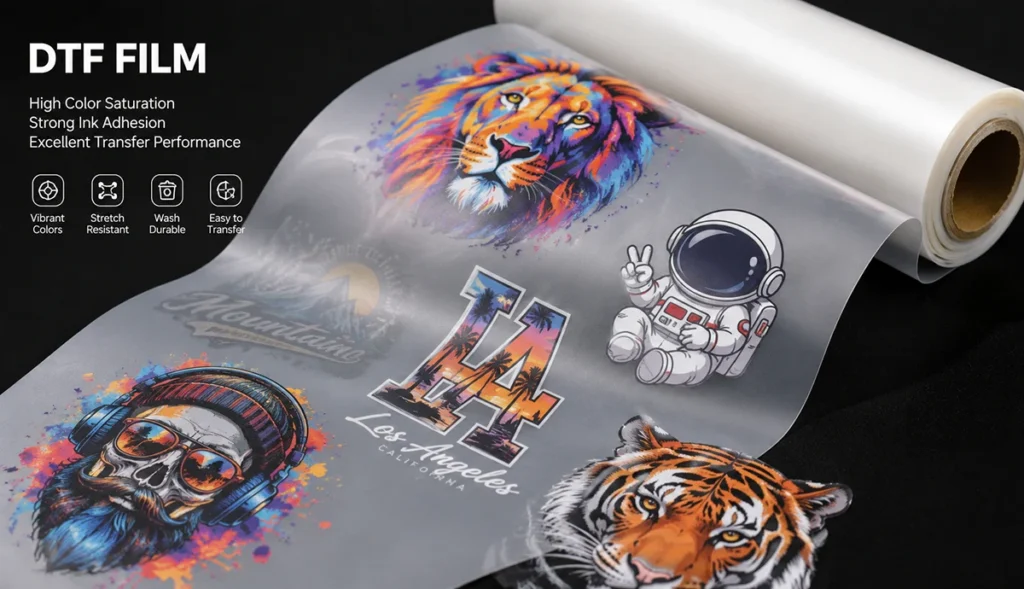
White ink heat transfer film for DTF printing is a layered system:
PET Base Substrate (BOPET) Biaxially oriented polyethylene terephthalate — a dimensionally stable thermoplastic. PET itself is chemically stable and has a very long lifespan. The base substrate is rarely the failure point in shelf life degradation.
Ink-Absorbing Front Coating A polymer-based coating applied to the print side. This coating controls ink absorption rate and creates the surface properties that allow white ink (titanium dioxide pigment in water-based binder) and CMYK inks to be held precisely before transfer. This coating is hygroscopic to a degree — it was designed to accept water-based ink, which means it also accepts ambient moisture.
Anti-Static Back Coating (Dual-Matte) A secondary coating that dissipates static charge and prevents powder adhesion to non-printed areas. Less sensitive to moisture than the front coating but still subject to degradation.
Adhesive Powder (TPU — Thermoplastic Polyurethane) Applied to wet ink after printing. TPU is hygroscopic — it absorbs moisture from air. In cured transfers (where the powder has been melted and bonded to the ink layer), the TPU adhesive is partially cross-linked. This cross-linked adhesive can continue to react with oxygen and moisture over time, gradually hardening and losing elasticity.
White Ink Layer White DTF ink uses titanium dioxide (TiO₂) as the pigment. TiO₂ is stable in most conditions but undergoes photocatalytic reactions under UV exposure — a process that causes progressive yellowing, reduced opacity, and eventual embrittlement.
Every one of these components degrades at different rates under different conditions. Understanding which enemies attack which components leads directly to the correct storage strategy.
Shelf Life: The Direct Answer
| Product State | Storage Conditions | Expected Shelf Life |
|---|---|---|
| Sealed, unopened film roll | Correct (15–25°C, 40–60% RH, no UV) | 12–24 months |
| Sealed, unopened film roll | Poor (above 30°C, >70% RH, UV exposure) | 3–6 months |
| Opened roll, resealed after use | Correct conditions | 3–6 months |
| Opened roll, loosely wrapped | Workshop environment | 1–3 months |
| Cured transfer (powdered and cured, awaiting press) | Correct conditions | 6–12 months |
| Cured transfer | Poor conditions | 1–3 months |
| Pressed transfer (on garment) | Normal garment wear and wash | 50+ wash cycles (correctly pressed) |
These are operational estimates — the actual numbers depend on coating formulation quality, ambient conditions at your facility, and how consistently storage protocols are followed.
The baseline standard from most DTF film manufacturers: 12 months sealed shelf life. Quality manufacturers specify up to 24 months under controlled conditions. Generic film with less stable coating chemistry may fall short of 12 months even sealed.
The Chemistry of DTF Film Aging: Why Film Degrades
Shelf life is a chemistry problem. Film does not sit inert — its components continue reacting with the environment.
Polymer Cross-Linking (The Slow Hardening)
The adhesive powder (TPU) and coating polymers contain reactive groups that continue to cross-link with oxygen over time. This is a slow process at room temperature, accelerated by heat.
Progressive cross-linking produces:
- Adhesive that is harder and less flexible
- Reduced elasticity in the coating
- Transfers that crack when stretched or washed — even if they pressed correctly
This is why transfers that looked perfect on month one begin failing by month eight: the adhesive has been slowly hardening in storage.
Moisture Absorption (The Silent Contamination)
TPU hot-melt adhesive powder is hygroscopic. Ambient moisture enters the powder granule structure, particularly at relative humidity above 60%.
The effects:
- Powder partially activates prematurely — granules begin to fuse into clumps
- Adhesion strength decreases because moisture occupies bonding sites
- Steam bubbles form under the transfer during pressing as trapped moisture vaporizes
- Uneven melting creates patchy adhesion on the finished garment
Film coating is also moisture-sensitive. The ink-absorbing coating was designed to accept water-based fluids — it will absorb ambient moisture over time. Moisture in the coating changes its porosity and reduces ink absorption uniformity, causing inconsistent print density on affected areas.
UV Photodegradation (The Yellowing)
White ink titanium dioxide pigments undergo photocatalytic reactions under UV exposure. The TiO₂ absorbs UV energy and generates reactive oxygen species that oxidize surrounding organic molecules — including ink binders, coating polymers, and adhesive components.
The visible result: white ink areas yellow progressively. In severe cases, the ink layer becomes brittle and the adhesive loses elasticity. This process is accelerated by direct sunlight but also occurs under fluorescent office lighting over months of exposure.
Plasticizer Migration (The Stiffening)
Some coating and adhesive formulations contain plasticizers — compounds added to maintain flexibility. At elevated temperatures, these plasticizers migrate out of the material over time. The result is increasing stiffness and increasing crack risk, particularly for transfers stored in warm environments.
The Five Enemies of DTF Film Shelf Life
Enemy 1 — Moisture and Humidity
Relative humidity above 60% is the most impactful single variable. The coating and adhesive powder both absorb moisture. Effects appear faster than any other degradation mechanism.
Critical threshold: Above 70% RH, visible degradation can begin within weeks on unprotected film.
Enemy 2 — UV and Direct Light
Sunlight contains UV radiation that directly attacks TiO₂ white ink pigments and organic polymer chemistry. Even indirect daylight through windows causes cumulative damage.
Critical threshold: Direct sunlight causes visible yellowing of white ink areas within 2 to 4 weeks of exposure.
Enemy 3 — Temperature Extremes and Cycling
Sustained high temperature (above 35°C / 95°F) accelerates cross-linking and plasticizer migration. Repeated temperature cycling — cool nights and hot days — causes expansion and contraction that creates micro-fractures in the adhesive and coating structure.
Critical threshold: Storage above 30°C (86°F) reduces shelf life to 3 to 6 months even for sealed film.
Enemy 4 — Oxygen Exposure
Oxidation of adhesive and coating polymers is a slow but continuous process whenever the film is exposed to air. The effects are subtle — progressive hardening and loss of elasticity — but accumulate significantly over months.
Critical response: Sealed packaging that limits oxygen exposure is the most effective mitigation. This is why sealed film lasts 12 to 24 months but opened film exposed to air degrades in 3 to 6 months.
Enemy 5 — Physical Stress (Pressure and Deformation)
Rolls stored vertically (on one end) develop flat spots under their own weight. Transfers stacked with heavy objects on top compress the adhesive texture. Rolls stored loosely wound can develop surface pressure marks.
Physical deformation affects film feed behavior in the printer and creates press surface irregularities that produce inconsistent adhesion.
Correct Storage Conditions: The Numbers That Matter
| Parameter | Correct Range | What Happens Outside Range |
|---|---|---|
| Temperature | 15–25°C (59–77°F) | Above 30°C: accelerated cross-linking, plasticizer loss |
| Relative humidity | 40–60% RH | Above 60%: moisture absorption begins; below 30%: increased static, brittleness |
| Light exposure | None — dark storage | UV exposure: TiO₂ photodegradation, yellowing |
| Oxygen | Sealed packaging | Open air: progressive oxidation of adhesive and coating |
| Orientation (rolls) | Horizontal — on side | Vertical: flat spots from weight in 3 to 7 days |
| Physical pressure | Minimal — shallow stacks | Heavy stacking: compressed adhesive texture, surface marks |
Practical implementation:
Store film in a climate-controlled room (or in a climate-controlled cabinet if your facility has temperature/humidity variation). Keep sealed rolls in their original foil-lined packaging with desiccant packs. Store on horizontal roll racks. Keep away from windows and fluorescent lighting.
If your facility is not climate-controlled — common in workshops and garages — invest in a portable dehumidifier and keep film inventory sealed in airtight bins with silica gel desiccant packs.
How to Store Opened DTF Film Rolls
An opened roll cannot be resealed to the same airtight standard as the original factory packaging. But you can significantly extend its useful life with the right approach.
Immediate resealing after use. Return the roll to the original foil-lined packaging or a replacement moisture-barrier bag. Seal completely — avoid leaving excess air inside the bag if possible. Add a fresh desiccant pack inside the sealed bag.
Avoid rolling the film backward. Rewinding used film introduces tension stress and can crease the coated surface. Leave the roll in the position it was in after the last use — do not attempt to rewind to a tight cylinder.
Label the opening date. Write the date you first opened the roll on the packaging. This gives you a reference for FIFO management and a starting point for estimating remaining shelf life.
Target usage: Within 30 to 60 days of opening for production-quality results. Film opened and used within this window under correct storage conditions performs essentially identically to fresh film. Film opened and stored for 3 to 6 months shows progressive degradation depending on storage quality.
How to Store Cured DTF Transfers (Pre-Pressed Inventory)
Cured transfers — film printed, powdered, and cured but not yet pressed — have different storage requirements and shorter shelf life than uncured film.
Why cured transfers degrade faster:
The powdering and curing step has already activated the TPU adhesive chemistry. The partially cross-linked adhesive continues reacting with oxygen and moisture. The ink layer is now exposed as a surface layer, not protected inside the print head. Every additional environmental exposure continues this reaction.
Correct storage for cured transfers:
Store flat — never roll cured transfers. The cured adhesive layer will crack under tight rolling.
Separate individual transfers with parchment or glassine paper to prevent static attraction and adhesive contact.
Store in sealed poly bags with desiccant in a dark, cool location at 65 to 75°F (18 to 24°C) and 40 to 55% RH.
Practical shelf life for cured transfers:
Correctly stored: 6 to 12 months. Many production shops report cured transfers pressing correctly at 8 to 10 months under proper storage. Beyond 12 months, test before production.
Poorly stored (workshop environment, not sealed): 1 to 3 months before noticeable performance degradation.
Warning Signs: How to Tell If Your Film Has Gone Bad
These are the observable indicators that film or transfers have degraded past reliable use. Check before running production on any inventory that has been stored for more than 4 months.
Warning Sign 1 — Yellowing of White Areas
Under good lighting, the white portions of a test print (or the white ink layer on a cured transfer) show a cream or yellow tint rather than bright white. UV degradation of TiO₂ is irreversible — yellowed white ink will not recover and finished garments will have dull color on dark fabrics.
Warning Sign 2 — Unusual Stiffness or Brittleness
A fresh DTF transfer film is flexible — the coated surface should feel smooth and the film should bend without any crackling sensation. Aged film feels stiffer, and heavily degraded film may show fine surface cracks when bent.
Warning Sign 3 — Inconsistent Powder Adhesion in Test Print
Print a test sheet and apply powder. If powder adheres unevenly — some areas correct, some areas insufficient, some areas with contamination in blank spaces despite using anti-static film — the coating has been compromised. Moisture absorption alters coating porosity and affects powder adhesion behavior.
Warning Sign 4 — Curl or Warp
Film that has been exposed to humidity fluctuations or thermal cycling may show persistent curl — particularly at the edges. This causes feed irregularities and press surface contact problems. Mild curl can sometimes be flattened by pressing the film between flat boards for 24 hours, but structural warp is not recoverable.
Warning Sign 5 — Ink Bleeding on Test Print
Print a test design with fine text (6 to 8 point). If edges bleed or blur compared to your reference standard, coating porosity has changed — moisture absorption has altered the ink absorption rate. This cannot be corrected by press settings.
Warning Sign 6 — Single-Wash Test Failure
The definitive test. Press a transfer to a cotton garment, wash inside-out in cold water once, and inspect. Fresh film pressed correctly survives this test with complete adhesion. Degraded film will show edge lifting, adhesion loss in the adhesive layer, or design cracking on the first wash.
Can You Revive Degraded DTF Film?
The short answer: partially, for mild degradation. Not at all for severe degradation.
Mild moisture absorption: If film has absorbed humidity but has not yet shown visible coating changes (no warp, no inconsistent powder adhesion), pre-conditioning may help. Store the film sealed with fresh desiccant packs at correct temperature for 24 to 48 hours before use. This draws excess moisture out of the coating without exposing it to more ambient humidity.
Yellowed white ink areas: Not recoverable. TiO₂ photodegradation is a permanent chemical change. Yellowed film should not be used for production.
Brittle or cracked adhesive: Not recoverable. Over-cross-linked adhesive cannot be re-plasticized through any practical shop-level process.
Mildly curled film: May be usable after flattening — press the film between flat boards or weighted plates for 24 hours. Run a test sheet after flattening to confirm feed behavior and ink absorption are acceptable.
General guidance: If any warning sign from the previous section is present, test a sheet before running production. If the test fails the single-wash check, do not use the film for sale-quality garments regardless of how mild the visible degradation appears.
The Pre-Production Test Protocol for Older Film
For any film that has been stored for more than 4 months or in non-ideal conditions, run this protocol before committing it to production.
Step 1 — Visual and flex inspection Examine the coating surface under good lighting. Check for curl, warp, surface irregularities, and yellow tint in white areas. Flex a corner — no crackling.
Step 2 — Print test sheet Print a design including 6-point text, 1mm lines, and a solid white area. Inspect ink absorption uniformity, fine detail sharpness, and white ink color.
Step 3 — Powder test Apply powder to the test sheet. Observe powder adhesion distribution — correct on all printed areas, clean on all blank areas. Any contamination in blank areas on dual-matte film indicates coating degradation.
Step 4 — Press and peel Press the test transfer to a standard cotton shirt. Note peel behavior — resistant peel can indicate adhesive degradation. Inspect the finished transfer for color accuracy and surface uniformity.
Step 5 — Wash test Wash the test shirt inside-out in cold water. Inspect after drying. Pass = all adhesion intact, no edge lifting, colors as expected. Fail = any adhesion loss, cracking, or color degradation.
If the test fails at any step, do not use this inventory for customer orders.
How Film Coating Quality Affects Shelf Life
Not all DTF film ages at the same rate. The coating formulation — and who controls it — determines how stable the film chemistry is over time.
Generic Film: Narrower Stability Window
Generic pre-coated PET substrate sourced from external suppliers has variable coating chemistry that was not optimized by the brand selling it. The specific polymer composition, plasticizer content, and coating density may vary between batches and are not fully known by the reseller.
This produces two shelf life consequences:
Less predictable degradation timeline. The manufacturer cannot tell you the shelf life precisely because they do not know the exact coating formulation. Generic guidance of “6 to 12 months” may be optimistic for specific batches.
Narrower acceptable storage conditions. Coating formulations with less stable chemistry are more sensitive to humidity and temperature variation — they degrade noticeably at conditions where quality film remains acceptable.
Quality Film From In-House Coating Manufacturers: Wider Stability Window
A genuine DTF film manufacturer that develops its own coating formula controls the polymer composition, plasticizer content, anti-oxidant additives, and all other chemistry variables that determine shelf life.
This means:
- Accurate shelf life specifications based on actual aging tests
- Consistent performance at specified storage conditions
- Formulation designed for stability, not just print performance at time of manufacture
- Batch dating that reflects actual production date
Haiyi tests film coating formulation stability as part of product development — the 12 to 24 month shelf life specification for sealed film is based on testing, not industry convention.
About Haiyi: DTF Film Manufacturer With Sealed Storage and Batch Dating
Every roll of DTF film Haiyi ships leaves the factory in moisture-resistant, UV-blocking sealed packaging with a desiccant pack and a batch production date label.
The batch date is not a suggestion — it is the starting point for your shelf life calculation. FIFO inventory management is straightforward when every roll is dated.
Haiyi Material Technology Co., Ltd. is a genuine DTF film manufacturer based in Foshan, Guangdong, China. We develop our own coating formula in-house. The coating chemistry is our intellectual property — we know exactly what is in it, and we test its aging behavior as part of product qualification.
What we produce:
- DTF film (hot peel, cold peel, instant hot peel) with dual-matte anti-static coating
- Roll formats: 30 cm × 100 m, 60 cm × 100 m, 1200 mm × 4000 m jumbo
- A3/A4 sheet format
- UV AB film
- DTF printers, sublimation printers, UV printers
Production capacity: 60,000 sqm per day
Certifications: ISO 9001, OEKO-TEX Standard 100
Export experience: 15+ years serving Latin America, Southeast Asia, Middle East, and Europe
For wholesale DTF film, OEM/ODM packaging, or DTF printer inquiries:
Contact Haiyi → https://www.haiyidtf.com/contact-us/
FAQ
How long does white ink heat transfer film last in storage? Sealed and stored correctly (15 to 25°C, 40 to 60% relative humidity, no UV exposure): 12 to 24 months. Once opened, film used within 30 to 60 days performs near-optimally. Film opened and left in workshop conditions for 3 to 6 months shows measurable coating degradation. Film stored poorly — above 30°C, above 70% humidity, or near windows — can degrade in 3 to 6 months even sealed.
What are the signs that DTF film has gone bad? Six warning signs: yellowing of white ink areas, unusual stiffness or crackling when bent, inconsistent powder adhesion on test prints, persistent curl or warp that does not flatten, ink bleeding at fine detail edges in test prints, and adhesion failure on a single cold-water wash test. Any of these signs warrants testing before production use.
Does DTF film go bad if it sits unused? Yes. The coating, adhesive powder, and white ink chemistry all degrade over time even without use. Oxidation hardens the adhesive, moisture absorption alters the coating porosity, UV exposure yellows white ink, and thermal cycling creates micro-fractures in adhesive layers. The rate of degradation depends entirely on storage conditions.
Should you refrigerate DTF film to extend shelf life? No. Refrigeration introduces condensation risk — when cold film warms to room temperature, moisture condenses on the film surface. This moisture is more damaging than moderate room temperature storage. A stable climate-controlled room at 15 to 25°C is better than cold storage.
How long do cured DTF transfers last before pressing? Cured transfers (powdered and cured film awaiting pressing) last 6 to 12 months stored correctly — sealed flat, in darkness, at 65 to 75°F (18 to 24°C), 40 to 55% relative humidity. Poorly stored cured transfers degrade in 1 to 3 months. Always test old transfers with a single wash before using on customer orders.
Does film coating quality affect shelf life? Yes significantly. Film from a DTF film manufacturer with in-house coating technology has predictable, tested shelf life specifications. Generic pre-coated PET from resellers has variable coating chemistry with less stable aging behavior. Quality film with in-house-developed coating typically achieves 12 to 24 month sealed shelf life; generic film’s actual shelf life is less predictable.
What is the best way to store open DTF film rolls? Reseal in the original foil-lined packaging or a moisture-barrier bag after each use. Add a fresh desiccant pack inside the sealed bag. Store horizontally (never vertical) in a cool, dark location. Label the opening date. Use within 30 to 60 days of opening for production-quality results.
Conclusion
The roll in the corner of the studio had done nothing wrong. It had just been left in conditions that slowly consumed its useful life — moisture from summer humidity in the coating, UV from the afternoon window in the white ink chemistry, oxidation in the adhesive from four months of open-air storage.
The settings were not wrong. The printer was not malfunctioning. The film was simply old.
DTF film is a chemically active material, not a passive plastic sheet. Every day it sits in storage, the polymer chemistry responds to the environment. Control that environment, and film performs reliably for 12 to 24 months. Neglect it, and degradation begins in weeks.
The storage rules are not complicated:
- Sealed, cool, dark, and horizontal. This is the complete strategy.
- FIFO rotation. First in, first out. Oldest roll used first.
- Test before production for any inventory older than 4 months or stored in non-ideal conditions.
- Label opening dates — one piece of tape on the packaging saves you from guessing later.
And when you source film, choose a manufacturer who can tell you the specific shelf life of their specific formulation — based on testing, not convention. Because the manufacturer who developed the coating knows how long it stays stable. The reseller who bought it from someone else does not.