







DTF Film Wholesale Order Planning: MOQ, OEM Packaging, and Reorders
Plan MOQ, OEM packaging, pilot orders, inventory, and reorders for wholesale DTF film.

A wholesale DTF film order should be planned as a repeatable supply program, not as a one-time search for the lowest roll price. Importers and distributors need clear rules for MOQ, mixed specifications, artwork approval, packaging, lot control, inventory, and reorder timing. This guide provides a practical framework for planning those decisions.
If you need the complete sourcing process, including supplier evaluation, samples, quotations, shipping, and receiving checks, start with how to buy DTF film wholesale from China. This page focuses on order architecture after a supplier enters qualification.
Separate the Four Types of MOQ
A single MOQ number can hide several different limits. Ask the supplier to separate:
- Material MOQ: the minimum production volume for a film grade or coating.
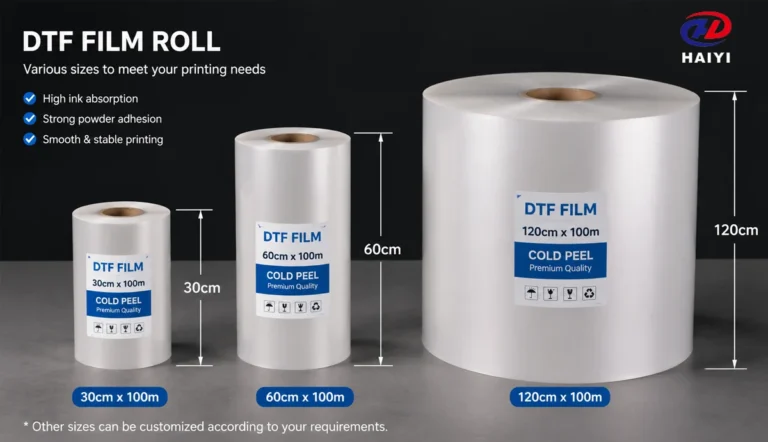
- Format MOQ: the minimum for each roll width, sheet size, or length.
- Packaging MOQ: the minimum for printed boxes, labels, cores, or cartons.
- Shipment MOQ: the quantity needed for an efficient carton, pallet, or freight plan.
This breakdown allows a buyer to combine standard film with customized packaging without assuming every component has the same minimum.
Build a Specification Matrix Before Requesting a Quote
| Field | Decision to record |
|---|---|
| Film type | Release method, coating sides, finish, and intended process |
| Format | Width, length, sheet size, core, and winding direction |
| Quality controls | Lot identification, sampling plan, and agreed inspection items |
| Packaging | Inner protection, label, box, carton, pallet, and marks |
| Commercial terms | Price basis, payment, lead time, Incoterm, and quote validity |
| Reorder trigger | Minimum inventory, forecast window, and approval owner |
Plan Private-Label Packaging in Stages
Do not begin with a large printed-box commitment before the film and packaging system have passed distribution tests. A lower-risk sequence is: neutral sample packaging, branded label or sleeve, short pilot order, then fully printed packaging after dimensions and damage rates are confirmed. Freeze approved artwork with a version number and require written approval before production.
Use a Pilot Order to Validate Operations
The pilot should test more than print quality. Check carton strength, moisture protection, label accuracy, barcode scanning, pallet stability, customs documents, warehouse handling, customer instructions, and complaint traceability. Record problems by lot and packaging level so the supplier can correct the actual source.
Calculate the Reorder Point
A practical reorder point includes average weekly demand, supplier production time, transport time, receiving and inspection time, and a safety buffer. Separate fast-moving standard formats from slower private-label variants. A distributor may keep deeper stock of standard DTF film rolls while ordering customized sizes on a forecast schedule.
Control Changes Between Orders
Every reorder should reference the approved specification, packaging artwork, control sample, and previous lot. Require notification before changes to PET base, coating, release behavior, core, protective packaging, labeling, or production site. A reorder is not automatically identical unless change control is part of the agreement.
Review Performance with Useful Metrics
- Accepted roll or sheet yield after incoming inspection
- Print, curing, and peel stability across lots
- Packaging damage and label error rate
- On-time production and shipping performance
- Customer complaint rate by specification and lot
- Inventory turns and emergency reorder frequency
Choose a Format Mix by Customer and Printer
Do not build the first wholesale order from every available width and sheet size. Start with the formats supported by the installed customer base and the distributor’s actual sales history. Separate production rolls, desktop sheets, sample packs, and specialty finishes because they have different turnover, packaging, and handling needs.
For each proposed format, record the target printer class, expected monthly demand, customers served, units per carton, storage space, and replenishment lead time. Remove a slow variant unless it supports a clear customer segment or a planned private-label bundle. A smaller, better controlled assortment normally produces stronger availability than a broad catalog with shallow inventory.
Use an MOQ Decision Worksheet
| MOQ question | Buyer decision |
|---|---|
| Is the minimum per film grade or per size? | Confirm whether formats can be mixed within one coating batch |
| Does custom packaging have a separate minimum? | Compare labels, sleeves, and printed boxes as different stages |
| Can unused packaging be stored for reorders? | Define ownership, storage term, and inventory reporting |
| What quantity creates a full carton or pallet? | Align the commercial MOQ with freight efficiency |
| How long will the stock cover? | Compare the order cycle with demand and shelf management |
An MOQ is acceptable only when the inventory can be sold or used before it creates cash-flow, storage, or obsolescence risk. Negotiate the configuration of the minimum, not only the number.
Define What OEM Packaging Includes
An OEM or private-label order may include branded labels, instructions, core labels, retail boxes, cartons, barcodes, color references, and market-specific marks. List every deliverable in the quotation and artwork approval. State who supplies translations, barcode data, regulatory text, and final print files.
Also define what customization does not change. A branded box does not automatically change the film coating, base, release behavior, roll tolerance, inspection plan, or performance specification. If the product itself will change, qualify it as a new material rather than treating it as a packaging revision.
Control Artwork and Packaging Versions
- Assign a code and revision to every label, insert, box, and carton mark.
- Approve dimensions, copy, colors, barcode readability, and placement.
- Request a physical or production-equivalent packaging sample.
- Confirm which version applies to the purchase order.
- Document how remaining old-version packaging will be used or segregated.
Plan the Second Order Before Placing the First
Agree on the information needed for a reorder: forecast date, production slot, material lead time, packaging balance, artwork version, approved sample, and shipping plan. Set an early review after the pilot arrives. Waiting until stock reaches a critical level leaves no time to investigate quality feedback or packaging changes.
Wholesale and OEM DTF Film from Haiyi
Haiyi supports DTF film wholesale, size customization, packaging development, and private-label supply for B2B customers. Contact Haiyi with your target formats, monthly demand, destination market, packaging level, and forecast. The team can help structure a sample, pilot, and reorder plan around your distribution model.