







DTF Transfer Film The Complete Guide

Read time: 16 minutes
Introduction
Every DTF print starts with film. Not the printer. Not the ink. Not the heat press. The film.
The film determines whether ink bleeds or stays sharp. Whether powder contaminates blank areas or falls away cleanly. Whether the transfer releases with a gentle peel or tears design edges. Whether the finished garment survives 50 washes or starts lifting after 5.
Yet film is the consumable most buyers think about last.
They obsess over printer models, compare printhead specifications, debate ink brands. Then they order the cheapest film they can find and wonder why results are inconsistent.
This guide fixes that. Everything you need to know about DTF transfer film — what it is, how it works, which types exist, what specifications matter, how to identify and load it correctly, how to troubleshoot problems that come from film rather than settings, and how to source it from a manufacturer who actually controls the coating.
By the end, you will make better film decisions. And better film decisions mean better prints.
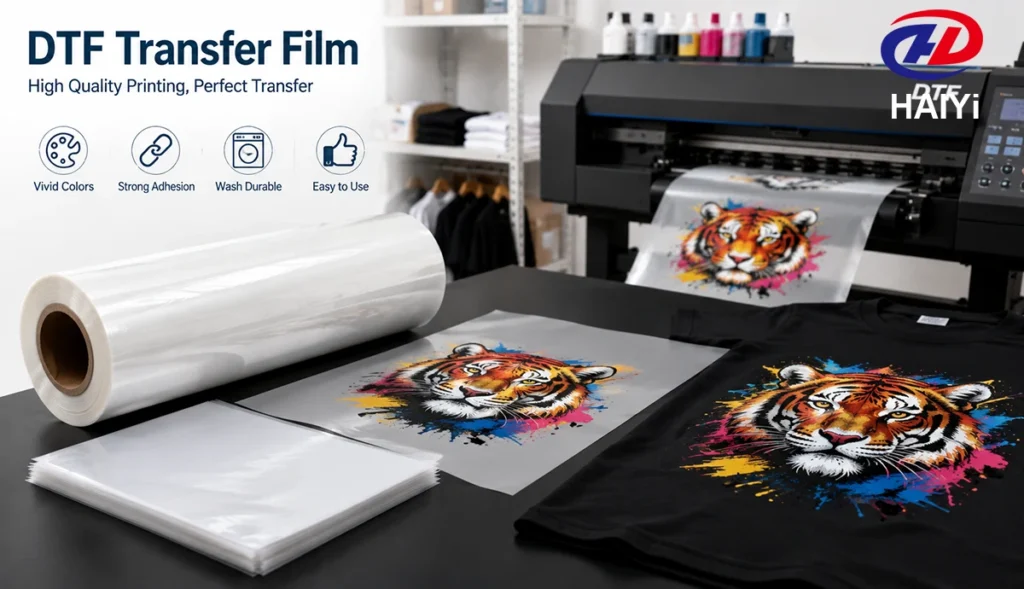
Key Takeaways
- DTF transfer film is a coated PET (polyethylene terephthalate) substrate — the coating, not the base, is where all quality differentiation lives
- Dual-matte anti-static film is the production standard; single-sided film produces powder contamination artifacts that require manual cleaning between sheets
- Film types include hot peel, cold peel, instant hot peel, stretch-grade, reflective, and UV DTF — each serves a specific application
- Film thickness (75 micron vs 100 micron) affects detail precision and mechanical durability — 75 micron for fine detail, 100 micron for high-speed production
- The printable side is always matte or frosted; for dual-matte film, use the water drop test to confirm the printable side
- Standard roll formats: 30 cm × 100 m (A3 desktop printers), 60 cm × 100 m (24-inch production printers), 1200 mm × 4000 m (industrial / converting)
- A DTF transfer film manufacturer that develops its own coating formula in-house produces consistent, testable quality across every batch — resellers of generic substrate cannot guarantee this
- Gang sheet efficiency above 80% is the single most impactful cost control in DTF production — film efficiency determines economics more than printer speed
What Is DTF Transfer Film?
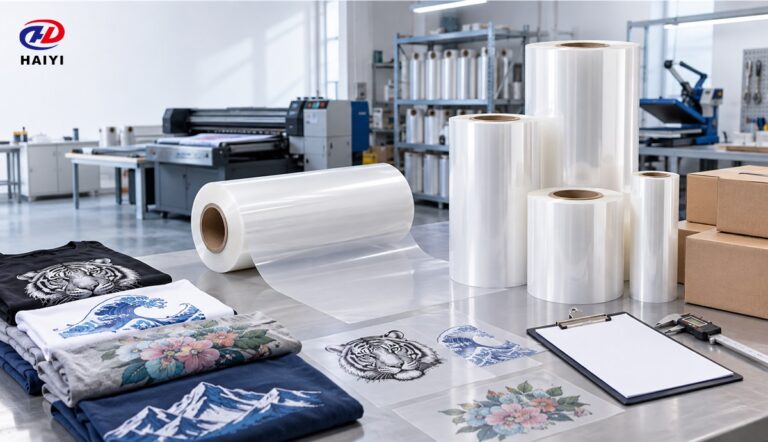
DTF transfer film is the coated PET plastic substrate onto which a DTF printer deposits ink before the design is transferred to fabric.
Break down the name:
DTF (Direct to Film): The printing process where a design is printed onto a film carrier, powdered with hot-melt adhesive, cured, and then heat-pressed to fabric.
Transfer: The film serves as a temporary carrier. The design starts on the film and ends on the garment.
Film: A thin, flexible sheet of biaxially oriented polyethylene terephthalate (BOPET) — a high-performance plastic chosen for its dimensional stability under heat, excellent mechanical properties, and ability to accept specialized coatings.
The raw BOPET substrate by itself does nothing useful for DTF printing. It is hydrophobic — water-based ink beads on plain PET and cannot be absorbed. The coating applied to one (or both) surfaces transforms the PET from an inert plastic into a precision printing medium.
The coating is the product. The PET is a commodity.
How DTF Transfer Film Works: The Full Process
Understanding the film’s role in the complete DTF process explains why each film property matters.
Step 1 — Ink Absorption During Printing
The DTF printer deposits water-based pigment ink onto the coated side of the film. The coating controls how the ink is absorbed: precisely enough to prevent bleeding at fine detail edges, with enough density to hold full color saturation.
A coating with inconsistent porosity — characteristic of generic pre-coated PET — produces ink bleeding in some areas and insufficient density in others on the same sheet. A controlled in-house coating formula produces uniform absorption across every square centimeter.
Step 2 — Powder Adhesion
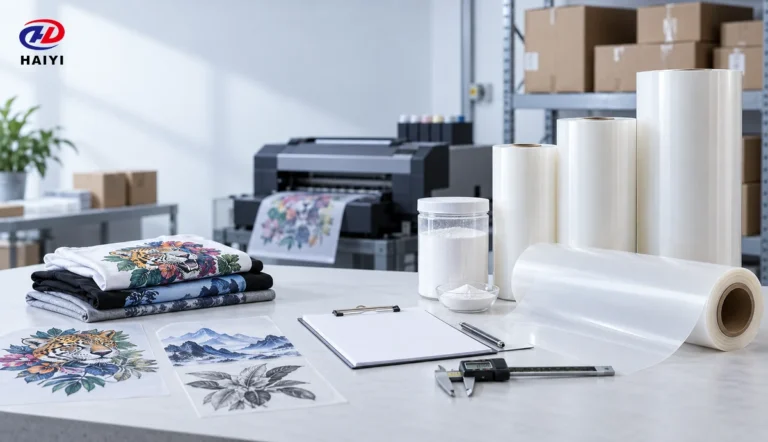
Immediately after printing, hot-melt adhesive powder (TPU — thermoplastic polyurethane) is applied to the wet ink surface. The powder adheres only to wet ink — not to the film coating surface itself.
This is where anti-static coating matters. Without it, static electricity attracts powder to non-printed areas. With proper dual-matte anti-static film, powder falls away from unprinted areas cleanly during the shaking step.
Step 3 — Curing
Heat melts the powder at 250 to 280°F (120 to 140°C), bonding it permanently to the ink layer and creating the adhesive interface that will bond the design to fabric.
Step 4 — Heat Press Transfer
The cured film is placed ink-side-down on the garment and pressed at 305 to 325°F (152 to 163°C) for 10 to 15 seconds. The adhesive melts and bonds with fabric fibers.
Step 5 — Film Release (Peeling)
The film carrier separates from the design — either immediately while warm (hot peel) or after full cooling (cold peel). The release coating on the film is engineered to separate cleanly at the correct temperature without lifting ink at fine detail edges.
Step 6 — Second Press
Five to ten seconds through parchment paper drives the adhesive deeper into the fabric fiber structure. This step is what determines whether a transfer lasts 20 washes or 50.
Types of DTF Transfer Film: Complete Breakdown
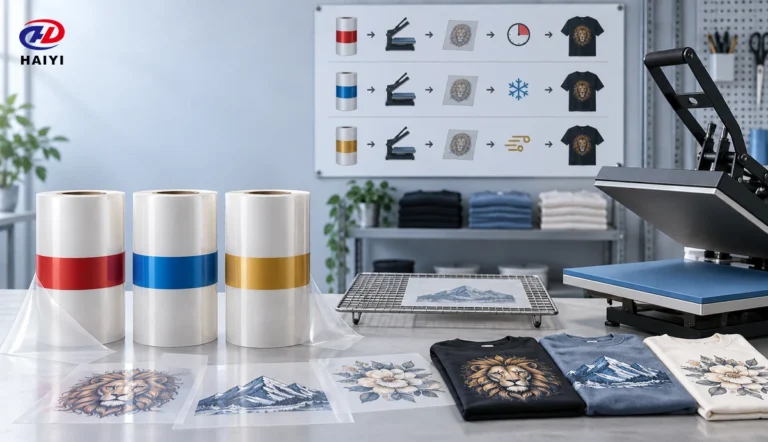
Standard Hot Peel DTF Film
The most widely used type for production apparel printing. Film is peeled while still warm — within 10 to 15 seconds of pressing. The release coating activates at warm temperature, enabling clean separation without waiting for cooling.
Best for: High-volume cotton and cotton-blend production with trained operators. Standard logo and apparel decoration.
Key limitation: Narrow peel window. Missing the 10 to 15 second window by even 30 seconds makes the film significantly harder to peel.
Cold Peel DTF Film
Film must be fully cooled to room temperature (60 to 90 seconds minimum) before peeling. The adhesive fully solidifies before film removal, producing cleaner edges and better wash durability.
Best for: Fine-detail designs, performance fabrics, beginners, and production environments where timing consistency is difficult to maintain.
Advantage: Wide, forgiving peel window — once cooled, timing is not critical.
Instant Hot Peel (Universal / All-Temperature Peel)
Engineered to release cleanly at any temperature — immediately after pressing while hot, partially cooled, or fully cooled. Eliminates timing variables from production workflow.
Best for: High-volume operations with multiple operators, mixed-skill teams, and environments where consistent peel timing is difficult to guarantee.
Stretch-Grade DTF Film
Formulated for high-elasticity fabrics. The adhesive system accommodates the dimensional changes of stretch fabric through movement and washing without cracking.
Best for: Athletic jerseys, yoga wear, compression garments, leggings, and any application with more than 15% fabric stretch.
Reflective DTF Transfer Film
Incorporates retroreflective elements (glass beads or microprismatic layers) that return light toward its source. Applied to fabric as a heat transfer for safety workwear, sportswear, and fashion.
Best for: High-visibility safety apparel, cycling jerseys, outdoor gear, and fashion applications where reflective aesthetics are part of the design.
UV DTF Film (A/B System)
A two-film system for hard surface decoration. UV-curable ink is printed on A film, laminated with pressure-sensitive B film, and transferred to glass, acrylic, metal, ceramic, or plastic without heat pressing.
Best for: Tumblers, phone cases, acrylic panels, branded merchandise, and any hard surface that cannot be decorated with fabric DTF.
DTF Film Specifications: Every Number That Matters
| Specification | Value / Range | Why It Matters |
|---|---|---|
| Base substrate | BOPET (biaxially oriented PET) | Dimensional stability under pressing heat |
| Thickness | 75 micron or 100 micron | Affects detail precision and mechanical durability |
| Thickness tolerance | ±3 micron | Ensures consistent feed and coating uniformity |
| Coating type (front) | Ink-absorbing, controlled porosity | Controls ink precision and detail sharpness |
| Coating type (back) | Anti-static matte | Prevents powder contamination in non-print areas |
| Coating weight | 20–35 g/sqm (controlled ±3 g/sqm) | Determines ink absorption rate uniformity |
| Tensile strength | ≥35 N/15mm (MD and TD) | Prevents tearing during high-speed feed |
| Release force | 5–15 g/cm (hot peel); 3–10 g/cm (cold peel) | Determines ease of peeling and edge quality |
| Anti-static performance | Surface resistance ≤10^10 Ω | Controls powder contamination in non-print areas |
| Ink compatibility | Water-based DTF pigment ink (CMYK + white) | Ensures ink adhesion without bleeding |
| Storage temperature | 15–25°C (59–77°F) | Prevents coating degradation |
| Storage humidity | 40–60% RH | Prevents coating moisture absorption |
| Shelf life (sealed) | 12–24 months | Guidelines for inventory management |
75 Micron vs 100 Micron: Which to Choose
75 micron: Better for fine detail reproduction. Lower thermal resistance allows more even heat penetration during pressing. Softer hand feel on finished transfers. More delicate — better suited for lower-speed desktop printers and careful handling.
100 micron: More mechanically robust for high-speed production printing. Better for roll-fed systems that apply mechanical tension to the film. Slightly less fine detail precision but more consistent in production environments.
Single-Sided vs Dual-Matte Film: The Production Standard
This is the specification most buyers get wrong when they first start purchasing DTF film.
Single-Sided Film
Ink-absorbing coating on the print side only. The reverse side is plain, glossy PET substrate with no anti-static treatment.
The problem: Plain PET surface accumulates static charge during high-speed printing and the powdering step. This charge attracts hot-melt powder to non-printed areas of the film — including blank areas around the design.
During pressing, this contamination powder melts and bonds to the garment outside the design area. On dark fabrics, this shows as a visible haze or sheen around the design perimeter. On light fabrics, it creates a subtle texture change that observant customers notice.
Managing this manually requires cleaning each sheet after powdering — time-consuming and impractical at production scale.
When single-sided film is appropriate: Very low volume (under 5 transfers per day) where manual sheet management is feasible.
Dual-Matte Anti-Static Film (Production Standard)
Anti-static matte coating on both sides. The back coating dissipates static charge before it can attract powder to non-printed areas.
The result: Powder adheres exclusively to wet ink. Unprinted film areas remain completely clean. No powder contamination artifacts on finished garments.
Cost difference: Dual-matte film costs 15 to 25% more per meter. At 50 transfers per day, the rework cost from single-sided film powder contamination (typically 5 to 15% of prints affected) far exceeds the per-meter premium. The math is not close.
For any operation printing more than 20 transfers per day: Dual-matte anti-static is not optional — it is the correct choice.
Hot Peel vs Cold Peel vs Instant Peel
| Feature | Hot Peel | Cold Peel | Instant (All-Temp) Peel |
|---|---|---|---|
| Peel timing | 5–15 sec after pressing (warm) | After full cooling — 60–90 sec minimum | Any temperature — no timing required |
| Timing window | Narrow — 10 to 20 seconds | Wide — once cooled, timing flexible | No window — peel anytime |
| Production speed | Fastest | Slower (cooling wait) | Fast (no wait) |
| Edge quality | Good | Better — adhesive fully set | Good to excellent |
| Wash durability | Good | Generally better | Good to excellent |
| Fine detail | Adequate | Best — fully set separation | Good |
| Best fabric | Cotton, blends | Performance, stretch, fine detail | Any — most versatile |
| Beginner-friendly | Less forgiving | More forgiving | Most forgiving |
The practical decision:
- Running a high-volume trained team on cotton? Hot peel.
- Running fine-detail work or performance fabrics? Cold peel.
- Running mixed fabrics, multiple operators, high volume? Instant peel.
- Just starting out? Cold peel — it is the most forgiving of timing mistakes.
DTF Film Roll Sizes and Formats
Standard Roll Widths
| Width | Use Case | Common Printer Type |
|---|---|---|
| 30 cm (12 inch) | A3 and A3+ desktop DTF printers | Desktop entry and mid-range |
| 60 cm (24 inch) | Production roll-fed DTF printers | Mid to high volume production |
| 1200 mm (120 cm) | Industrial converting / distribution | Jumbo rolls for distributors |
Standard Roll Lengths
100 m: The production standard for wholesale buyers. At 50 transfers per day (A3 gang sheets), a 30 cm × 100 m roll lasts approximately 30 to 40 production minutes. A 60 cm × 100 m roll produces roughly twice the output from the same linear length.
50 m: Available for trial orders and smaller operations that cannot commit to 100 m inventory.
4000 m (jumbo): 1200 mm × 4000 m jumbo rolls for industrial converters, large distributors, and operations that slit rolls to custom widths on-site.
Sheet Format
A3 (297 × 420 mm) and A4 (210 × 297 mm) pre-cut sheets for desktop printer operations, sample testing, and low-volume production. Higher cost per square meter than rolls — the trade-off for convenience and no roll-holder requirement.
Core Sizes
Rolls wind onto paper or plastic cores. Standard core internal diameters: 0.75 inch (19 mm) and 1.0 inch (25.4 mm). Confirm your printer’s film holder accepts the core size before ordering — wrong core diameter means the roll does not seat correctly on the feed spindle.
How to Identify the Correct Side of DTF Film
Printing on the wrong side of DTF film is a complete failure. The ink cannot absorb into plain PET substrate — it beads, slides, and never dries. For dual-matte film where both sides appear similar, correct identification is critical.
Method 1 — Visual (For Single-Sided Film)
The printable (coated) side is matte or frosted. The non-printable side is glossy and reflective like regular plastic.
Method 2 — Touch Test (Both Film Types)
Run your fingertip across both surfaces. The printable (coated) side feels slightly textured and slightly grabby — the micro-porosity of the coating creates a subtle tactile difference. The non-printable side is smooth and slippery like regular plastic.
Method 3 — Water Drop Test (Definitive for Dual-Matte)
Place a small drop of water on each side:
- Printable side: Water spreads or is partially absorbed within 5 to 10 seconds
- Non-printable side: Water beads up and holds its shape
The coated side accepts water-based fluids because it was designed to accept water-based ink. The plain PET side repels water.
Method 4 — Check Roll Orientation
Most manufacturers wind rolls with the printable side facing inward toward the core. When the roll unwinds, the printable side faces up (toward the print heads). Verify with your manufacturer’s documentation for their specific product.
How to Load DTF Film Into Your Printer
Incorrect loading — wrong side up, wrong tension, or incorrect orientation — wastes film and potentially damages print heads.
For roll-fed production printers:
- Unroll 30 cm of film and verify the printable side using Method 2 or 3 above
- Check your printer’s film path orientation in the manual (most feed printable side up, toward print heads)
- Load the roll onto the feed spindle with the roll rotating in the direction that pulls the printable side toward the print heads
- Thread the film through the feed path per the printer manual — tension must be even, not too tight (causing stretching) or too loose (causing wrinkling)
- Run a 5 cm test advance before printing to confirm film feeds flat without curl or edge lift
For sheet-fed desktop printers:
- Identify the printable (matte) side of each sheet
- Load with the printable side facing the print heads — typically upward in the input tray for most desktop configurations
- Confirm the sheet is straight in the feed tray — misaligned sheets cause registration errors
- Print a small test design on a corner of the first sheet before running the full design
Critical test before production: Print a 10 cm test area and examine the ink surface immediately. On the correct side, ink deposits cleanly with defined edges. On the wrong side, ink beads or spreads uncontrollably — immediately evident.
Common DTF Film Problems and How to Fix Them
Problem: Powder Contamination Outside the Design
Cause: Static charge on single-sided film attracting powder to non-printed areas. Fix: Switch to dual-matte anti-static film. If already using dual-matte, check that the anti-static coating has not been degraded by moisture exposure (improper storage).
Problem: Ink Bleeding at Fine Detail Edges
Cause: Film coating porosity inconsistency — some areas absorb ink faster than adjacent areas. Characteristic of generic pre-coated PET from a reseller. Fix: Source film from a DTF transfer film manufacturer with in-house coating control. The coating formula must be owned and controlled by the producer.
Problem: Film Hard to Peel
Cause: Over-pressing (temperature too high or time too long degrades release coating), wrong peel timing (hot peel film cooled before peeling), or coating fused to ink from over-curing. Fix: Reduce press temperature by 10°F. Verify peel type of your film (hot vs cold). For hot peel film that has cooled, re-press for 3 to 5 seconds and peel immediately.
Problem: Design Peels at Edges After Washing
Cause: Under-pressing, skipping the second press, or insufficient powder coverage at design edges. Fix: Verify actual press temperature with a contact thermometer. Add second press (5 to 10 seconds through parchment paper). Ensure powder covers all design edges before curing.
Problem: Design Cracks After Washing
Cause: Over-curing (adhesive powder heated above correct range, making it brittle) or press temperature too high (same effect at press stage). Fix: Verify curing temperature is 250 to 280°F — not higher. Reduce press temperature if cracking persists at correct curing temperature.
Problem: Roll Tears During High-Speed Printing
Cause: Film thickness too low for the mechanical tension of the printing speed, or film loaded with insufficient or excessive tension on the feed spindle. Fix: Switch to 100-micron film for high-speed production. Verify feed tension per printer manual.
Problem: Inconsistent Results Between Rolls
Cause: Film sourced from a reseller using generic pre-coated PET — the coating varies between batches from different substrate manufacturers. Fix: Source from a manufacturer with in-house coating technology and documented batch QC. Request QC reports for each batch.
DTF Film Storage: Protecting What You Paid For
The coating on DTF film is hygroscopic — it absorbs moisture from air. Improper storage degrades coating performance before the film is ever used.
Temperature: 15 to 25°C (59 to 77°F). Avoid heat sources, direct sunlight, and temperature swings. High temperature accelerates coating degradation; thermal cycling causes roll deformation (flat spots and curl).
Humidity: 40 to 60% relative humidity. High humidity causes the coating to absorb moisture, reducing ink absorption uniformity. Low humidity increases static charge (though anti-static coating mitigates this).
Light: Keep rolls in opaque packaging away from UV sources. UV radiation degrades coating chemistry over time.
Orientation: Store rolls horizontally — on their side, not upright. Vertical storage causes the roll to deform under its own weight within days, creating flat spots that cause feed irregularities.
Packaging: Reseal opened rolls in their original foil-lined packaging after each production session. Do not leave rolls exposed on the printer for extended periods.
Handling: Hold film by the edges. Fingerprints deposit oils that create localized hydrophobic spots on the coating — areas where ink will not absorb correctly.
Shelf life: Sealed rolls maintain coating performance for 12 to 24 months from manufacture under correct storage conditions. Opened rolls used within 30 to 60 days produce the most consistent results.
How to Choose the Right DTF Transfer Film Manufacturer
The most important purchase decision in DTF film is not which product to buy — it is which manufacturer to buy from. The same product specification from two different manufacturers produces completely different results if one controls its coating and the other does not.
The One Question That Reveals Everything
Ask any supplier: “Do you develop your coating formula in-house, or do you purchase pre-coated PET substrate from an external supplier?”
A genuine DTF transfer film manufacturer with in-house coating development answers specifically: they describe the coating type, the application method, the key performance specifications, and the QC testing process. They can tell you the coating weight specification, the tensile strength of their base substrate, and the release force measurement for each peel type.
A reseller — including many well-marketed “brands” — deflects this question. They talk about quality assurance processes, say their products are tested, and avoid directly answering whether they own the coating formula.
Five Additional Verification Steps
Request batch QC documentation. Coating weight (g/sqm with tolerance), tensile strength (N/15mm), release force (g/cm), anti-static dissipation — specific numerical values from batch testing. Manufacturers produce these. Resellers cannot.
Verify certifications. ISO 9001 for quality management. OEKO-TEX Standard 100 for chemical safety. Verify certificate numbers with the issuing bodies at oeko-tex.com.
Request samples from two production batches. Test both through complete workflow including wash test. Consistent results across batches = controlled coating. Variable results = reseller.
Confirm production scale. A legitimate coating manufacturer operates at industrial scale — tens of thousands of square meters per day, multiple coating lines. Small operations cannot maintain the process control that produces batch consistency.
Assess communication quality. Test with a specific technical question before ordering. The quality of the answer reveals the depth of technical knowledge — and therefore whether you are dealing with a manufacturer or a reseller.
DTF Film Wholesale and Factory-Direct Sourcing
Why Factory-Direct Saves More Than the Price Difference
Factory-direct wholesale pricing from China saves 20 to 40% versus US/regional distributor pricing for equivalent quality. At 20 rolls per month, the annual savings are $1,440 to $2,400. At 50 rolls per month, savings exceed $3,600.
But the savings calculation is incomplete without the quality factor. Resellers selling generic film at mid-range distributor prices still deliver batch-variable film. Factory-direct from a genuine coating manufacturer delivers both lower cost and higher consistency.
Minimum Order Quantities
| Account Type | Typical MOQ |
|---|---|
| New wholesale account | 20 rolls |
| Established wholesale account | 10 rolls (negotiable) |
| OEM/private label (per SKU) | 50 rolls |
| Jumbo roll format | By negotiation |
The Inventory Planning Requirement
Sea freight from China to major markets takes 25 to 45 days. Factory-direct sourcing requires maintaining 60 to 90 days of inventory buffer. Operations that cannot manage this buffer should start with US wholesale accounts and transition to factory-direct once inventory planning is established.
Haiyi: A DTF Transfer Film Manufacturer With Real Coating Technology
Haiyi Material Technology Co., Ltd. is based in Foshan, Guangdong, China — the manufacturing center of China’s digital printing industry.
We are a genuine DTF transfer film manufacturer: we develop our own coating formulas, apply them on our own production lines, and test every production batch before shipment. We do not purchase pre-coated PET from external suppliers.
What we produce:
- DTF transfer film (hot peel, cold peel, instant hot peel) in 30 cm × 100 m, 60 cm × 100 m, and 1200 mm × 4000 m jumbo rolls — dual-matte anti-static coating standard
- UV DTF AB film for hard surface applications
- A3 and A4 sheet format
- DTF printers, sublimation printers, and UV printers
Production capacity: 60,000 sqm per day
Patents: 20+ registered patents in coating technology
Certifications: ISO 9001 quality management, OEKO-TEX Standard 100 (chemical safety for garment applications)
Export experience: 15+ years shipping to Latin America, Southeast Asia, Middle East, and Europe
Wholesale program: Low MOQ (20 rolls for new accounts), tiered pricing, reserved capacity for established accounts, OEM/private label from 50 rolls per SKU
For wholesale DTF transfer film, OEM/ODM packaging, or DTF printer inquiries:
FAQ
What is DTF transfer film made of? DTF transfer film is made from biaxially oriented PET (BOPET) substrate with a specialized ink-absorbing coating applied to one or both sides. The base PET provides dimensional stability and mechanical strength. The coating — which is the critical quality-determining element — controls ink absorption, anti-static performance, and release behavior. The coating formula is intellectual property; manufacturers who develop it in-house produce consistent quality that resellers of generic substrate cannot match.
What is the difference between single-sided and dual-matte DTF film? Single-sided film has coating on the printable side only; the reverse is plain glossy PET with no anti-static treatment. Dual-matte film has anti-static matte coating on both sides. Without back-side anti-static coating, static electricity attracts hot-melt powder to non-printed areas during the powdering step, creating contamination artifacts on finished garments. Dual-matte film eliminates this failure mode and is the correct choice for any production operation.
How do I know which side of DTF film to print on? The printable side is matte or frosted-looking. The non-printable side is glossy. For dual-matte film where both sides appear similar, use the water drop test: water spreads or is absorbed on the printable side and beads on the non-printable side. The touch test also distinguishes them — the printable side has a slightly grabby texture versus the smooth feel of the plain PET back.
What roll sizes does DTF film come in? Standard production roll widths: 30 cm (A3 desktop printers), 60 cm (24-inch production printers), and custom widths up to 160 cm. Standard roll length: 100 m. Jumbo rolls available at 1200 mm × 4000 m for industrial converters and large distributors. A3 and A4 sheet format available for desktop operations.
How should DTF transfer film be stored? Store rolls horizontally at 15 to 25°C, 40 to 60% relative humidity, away from direct sunlight and heat sources. Keep in sealed foil-lined packaging when not in use. Handle by edges only — fingerprints damage the coating. Properly stored sealed rolls maintain performance for 12 to 24 months.
Why does my DTF film produce inconsistent results between rolls? Inconsistent results between rolls from the same supplier indicate batch variation in the coating — characteristic of a reseller who does not control the coating formula. Source film from a genuine DTF transfer film manufacturer with in-house coating technology and batch QC testing. Request samples from two different production batches and compare results before committing to a supply relationship.
What thickness of DTF film should I use? 75-micron film for fine detail work (small text, intricate designs, soft hand feel priority). 100-micron film for high-speed production printing, roll-fed systems with higher mechanical tension, and heavy-use workwear applications. Both thicknesses work for standard apparel decoration — choose based on your primary production requirements.
How do I contact Haiyi for DTF transfer film wholesale? Visit https://www.haiyidtf.com/contact-us/ for wholesale pricing, sample requests, and OEM/ODM inquiries. Provide your printer model, monthly volume estimate, preferred roll format, and peel type. Qualified wholesale inquiries receive a response within 4 business hours.
Conclusion
DTF transfer film is not a commodity. The base PET substrate is — you can buy BOPET from many sources. But the coating that transforms inert plastic into a precision printing medium is engineered technology. And engineering is only as good as the manufacturer who developed and controls it.
Every aspect of DTF print quality traces back to film:
- Sharp detail or bleeding → coating porosity control
- Powder contamination or clean blanks → anti-static coating performance
- Easy peel or damaged edges → release coating formulation and consistency
- 50 wash cycles or 5 → adhesive-ink interface quality and pressing optimization
Choose the right film type for your application (hot/cold/instant peel, standard/stretch/reflective). Use dual-matte anti-static as your default — the cost premium is recovered in reduced rework within weeks. Source from a manufacturer that owns the coating, not one that sources generic substrate and calls it a product.
And when you test a new supplier, do not evaluate one sample roll. Test two batches. Consistency across batches is the only reliable measure of coating control. One good roll proves nothing about the rest.
The film you choose is the foundation of every print you make. Choose it with the same attention you give the printer, the ink, and the heat press.