


Why DTF Prints Crack After Washing: Causes and Fixes

DTF printing has become one of the most popular solutions for custom apparel decoration because of its bright colors, flexible application, and ability to print complex designs. However, many users face a common problem: DTF prints cracking after washing.
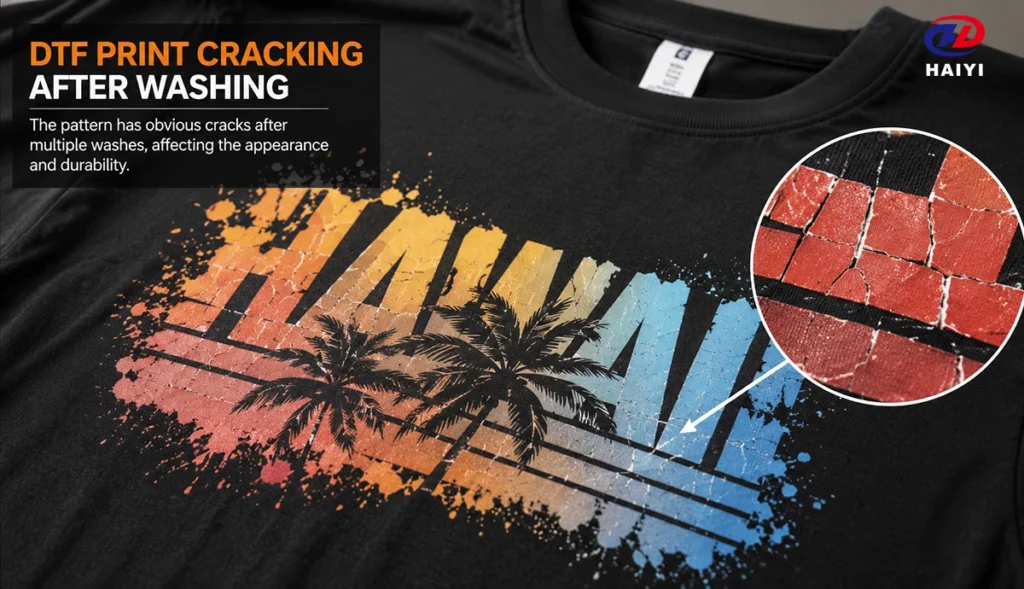
If you are asking, “Why is my DTF print cracking after washing?”, the reason is usually related to DTF film quality, ink layer, fabric type, heat press settings, or transfer process.
As an experienced DTF film manufacturer, Haiyi understands that stable printing results require the right combination of DTF film, ink, powder, machine settings, and application methods.
This article explains the main causes of DTF cracking and how to fix them.
Common Reasons Why DTF Prints Crack After Washing
1. The Fabric Has High Elasticity
One of the most common reasons for cracking is using DTF transfers on highly stretchable fabrics.
For example:
- 100% cotton knitted fabrics
- High-stretch polyester fabrics
- Coated fabrics
- Sportswear materials
When the fabric stretches but the transfer film layer cannot expand at the same speed, the printed design may crack.
Solution:
For elastic fabrics, choose a DTF transfer material with better flexibility and elasticity. A high-quality DTF film manufacturer can provide suitable film solutions for different fabric applications.
2. Insufficient White Ink Coverage
White ink plays an important role in DTF printing.
The higher the white ink coverage, the stronger the ink layer structure and adhesion. If white ink coverage is too low, the printed layer may become thin, weak, and easier to crack after washing.
Solution:
Check your white ink settings:
- Increase white ink density when necessary
- Ensure enough white ink coverage
- Maintain stable ink circulation
A complete and stable white ink layer helps improve durability during washing.
3. Incorrect Heat Press Settings
The heat press process is one of the key factors affecting DTF after washing performance.
Common problems include:
- Temperature too low
- Pressing time too short
- Insufficient pressure
- Poor hot melt powder bonding
Typical DTF transfer settings:
- Temperature: around 150°C
- Time: 8–10 seconds
- Medium pressure
However, different DTF films, fabrics, and powder types may require adjustment.
Solution:
Always test before mass production and adjust parameters according to:
- DTF film thickness
- Fabric material
- Adhesive powder type
- Machine conditions
4. Poor Adhesion Between DTF Film and Fabric
If the hot melt adhesive powder does not fully penetrate the fabric fibers, the transfer layer may have weak adhesion.
Symptoms include:
- Design peeling
- Cracking after washing
- Edges lifting
- Poor stretch resistance
Solution:
Improve the transfer process:
- Increase pressing pressure
- Adjust temperature properly
- Extend pressing time within recommended limits
A good DTF printing process requires proper bonding between the PET film coating, powder, ink, and fabric.
5. Low-Quality or Unmatched DTF Film
Not all DTF films have the same performance.
Different films have different:
- Ink absorption ability
- Release performance
- Coating formulas
- Elasticity
- Powder bonding performance
Using unmatched DTF film and ink combinations may cause:
- Ink cracking
- Poor transfer results
- Difficult peeling
- Washing failure
Solution:
Choose a reliable DTF film manufacturer that can provide stable coating technology and consistent batch quality.
Other Common DTF Printing Problems and Solutions
White Ink Separation, Gray Printing, or Print Head Blocking
Possible Causes:
- White ink was not fully mixed before use
- Printer has been unused for a long time
- Ink stayed in the cartridge too long
Solutions:
- Print a test pattern every day
- Keep white ink circulating
- Clean print heads regularly
- Use an ink circulation system when needed
Even high-quality DTF ink requires proper maintenance.
Ink Spreading on PET Film or Difficult Film Peeling
Ink spreading causes:
- Ink and PET film compatibility issue
- Low ink absorption capacity
- Poor film coating performance
Difficult peeling causes:
- Incorrect pressing temperature
- Insufficient pressing time
- PET film release force mismatch
Solutions:
Test different combinations:
- Keep ink, change DTF film
- Keep DTF film, change ink
Find the best matching system for stable DTF printing.
How to Prevent DTF Cracking After Washing
To improve DTF transfer durability:
1. Test Before Mass Production
Always make samples before large orders.
Test:
- Washing resistance
- Stretching performance
- Fabric compatibility
- Peel strength
2. Use Proper DTF Film
A professional DTF film manufacturer can provide different solutions for:
- Cotton garments
- Polyester clothing
- Stretch fabrics
- Industrial printing requirements
3. Maintain Your DTF Printer
Regular maintenance helps prevent:
- Ink blockage
- Color problems
- Uneven printing
Recommended maintenance:
- Clean print heads
- Check ink tubes
- Replace consumable parts regularly
Why Is My DTF Print Cracking After Washing?
If your DTF print cracks after washing, the problem is usually not caused by one single factor. It can come from:
- Wrong DTF film selection
- Incorrect heat press parameters
- Low white ink coverage
- Poor powder bonding
- Fabric stretching
- Poor maintenance
The best solution is to test every part of the DTF printing system and find the correct combination.
As a professional DTF film manufacturer, Haiyi focuses on providing reliable DTF film solutions to help customers achieve stable printing performance and reduce production problems.
Frequently Asked Questions (FAQ)
1. Why does my DTF print crack after washing?
The main reasons include poor film quality, insufficient bonding, incorrect heat press settings, low white ink coverage, or unsuitable fabric.
2. How can I prevent DTF after washing cracking problems?
Use suitable DTF film, optimize heat press settings, test materials before production, and maintain your printer properly.
3. Does fabric type affect DTF cracking?
Yes. High-stretch fabrics require flexible DTF transfer materials to prevent cracking.
4. What temperature should I use for DTF transfer?
Most DTF transfers work around 150°C, but settings should be adjusted according to the film, fabric, and adhesive powder.
5. Can changing DTF film solve cracking problems?
Yes. Different DTF films have different coating formulas and flexibility. A better matched film can improve washing durability.
6. How can I choose the right DTF film supplier?
Choose a professional DTF film manufacturer with stable quality control, customization capability, and technical support for your printing needs.