







How to Calculate DTF Printing Cost per Transfer
Calculate the real DTF printing cost per usable transfer, including yield and overhead.

DTF film price is only one part of the cost of a finished transfer. Distributors and print shops also need to account for ink, powder, labor, equipment, rejected output, packaging, and order handling. This guide shows how to calculate cost per usable transfer so quoting decisions are based on real production economics.
For supplier quotations, MOQ, landed cost, and wholesale film comparison, use the DTF film wholesale price guide. This page owns the separate task of converting production inputs into a transfer-level cost.
Define the Cost Unit First
Choose a unit that matches how the business sells: one transfer, one square unit of printed area, one gang sheet, or one completed garment. Do not mix units across estimates. A distributor selling blank film may track cost per square meter, while a transfer producer may need cost per accepted design.
Calculate Film Cost by Usable Area
Start with the landed cost of the roll, including freight and other directly attributable acquisition costs. Divide it by the roll area, then adjust for edge allowance, setup waste, damaged sections, and normal unused space. The result is cost per usable area, not theoretical area.
Usable film cost per area = landed roll cost / accepted printable area
Add Ink and Powder
Ink use changes with artwork coverage, white underbase, print mode, and maintenance losses. Powder use changes with image area and recovery practice. Use measured consumption over a representative job or production period instead of a generic estimate. Separate ink used in saleable output from ink lost to cleaning and maintenance.
Include Labor and Equipment
- Artwork preparation and nesting
- Printer loading and monitoring
- Powdering and curing
- Cutting, sorting, and packing
- Quality inspection and rework
- Equipment depreciation or lease
- Maintenance parts and planned service
- Electricity and production space where relevant
Account for Gang-Sheet Efficiency
Gang sheets lower cost when designs are nested efficiently, but unused gaps, margins, cut paths, and customer-specific sorting still consume area and labor. Calculate the total usable area and production time for the complete sheet, then allocate cost to each design using a consistent rule.
Adjust for Yield
A low film price can produce a high transfer cost if print defects, feeding problems, poor release, or inconsistent coating reduce accepted output. Measure the accepted yield:
Accepted yield = saleable transfers / total transfers produced
Then divide total job cost by saleable transfers, not by all transfers attempted. This makes quality loss visible instead of hiding it in overhead.
Build a Cost Worksheet
| Cost block | Measurement basis |
|---|---|
| Film | Landed cost per usable printed area |
| Ink | Measured color and white consumption |
| Powder | Net consumption after recovery policy |
| Labor | Minutes by production step |
| Equipment | Hourly burden based on realistic utilization |
| Packaging | Sheet, bag, label, carton, and handling |
| Quality loss | Adjustment from total output to accepted yield |
Separate Cost from Selling Price
Cost is the production baseline. Selling price must also cover sales work, customer service, payment costs, risk, inventory, taxes where applicable, and profit. Use different markups for standard repeat work, urgent work, complex sorting, low-volume customization, or private-label fulfillment when those jobs require different resources.
Review the Model with Real Jobs
Compare estimated and actual cost after production. Update yield, ink consumption, labor time, and waste assumptions. Review the model after material, equipment, labor, freight, packaging, or product-mix changes.
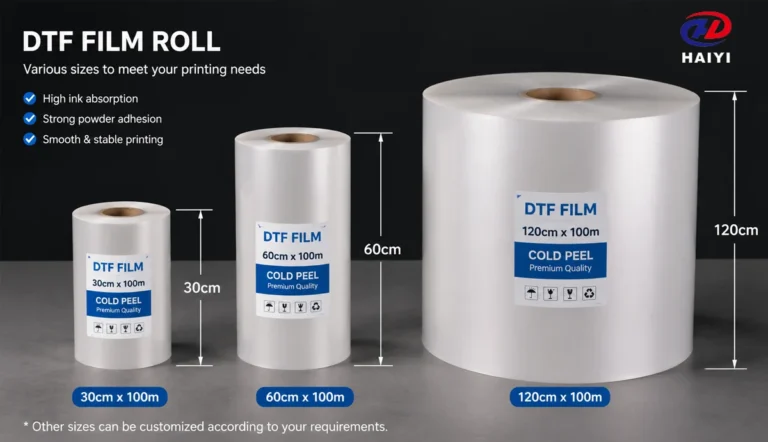
For material planning, compare Haiyi’s wholesale DTF film rolls by format and intended workflow rather than using roll price alone.
Wholesale Film for Predictable Production Cost
Haiyi provides wholesale and customized DTF film for print businesses, distributors, and private-label buyers. Contact Haiyi with your roll format, monthly usage, printer setup, destination, packaging requirements, and order volume to request a B2B quotation suitable for a cost-per-transfer model.
DTF Printing Cost Per Shirt: The Complete Breakdown
The DTF printing cost per shirt has four components: film, ink, powder, and labor. Equipment depreciation and maintenance are additional fixed costs that factor into total cost of ownership but are calculated separately.
Material Cost Per Shirt: Full-Front Print (12×16 inches)
| Material | Usage Per Print | Cost Per Unit | Cost Per Print |
|---|---|---|---|
| DTF film | 0.12 sqm (12×16 in) | $0.20/sqm | $0.024 – but see gang sheet note |
| DTF ink (CMYK + White) | 1.5-3ml per sqm | $0.10-$0.25/ml | $0.30-$0.75 |
| Adhesive powder | 15-25g per sqm | $0.02-$0.04/g | $0.20-$0.40 |
| Film (single print, no gang) | 1 A3 sheet | $0.45-$0.90/sheet | $0.45-$0.90 |
| Film (gang sheet, 6 designs) | 1/6 A3 sheet | $0.45-$0.90/sheet | $0.075-$0.15 |
With gang sheet optimization:
- Film cost per transfer: $0.07-$0.15
- Ink cost per transfer: $0.30-$0.75
- Powder cost per transfer: $0.20-$0.40
- Total materials per transfer: $0.57-$1.30
Without gang sheet optimization (single prints):
- Film cost per transfer: $0.45-$0.90
- Ink cost per transfer: $0.30-$0.75
- Powder cost per transfer: $0.20-$0.40
- Total materials per transfer: $0.95-$2.05
The film cost difference between gang-sheeted and single-printed transfers is 6x. This is why gang sheet discipline is the most important cost control in DTF production.
Adding Labor
At $15/hour labor cost and 30 prints per hour throughput (including setup, pressing, and second press):
- Labor cost per print: $0.50
At $25/hour and 30 prints per hour:
- Labor cost per print: $0.83
Adding Equipment Depreciation
A $1,500 A3 DTF setup depreciated over 3 years at 10 shirts per day, 250 production days per year:
- Total prints over 3 years: 7,500
- Equipment cost per print: $0.20
At 30 shirts per day:
- Equipment cost per print: $0.067
Total DTF Printing Cost Per Shirt Summary
| Scenario | Film | Ink + Powder | Labor | Equipment | Total |
|---|---|---|---|---|---|
| Budget gang-sheeted (home operation) | $0.08 | $0.50 | $0.30 | $0.20 | $1.08 |
| Standard gang-sheeted (small shop) | $0.12 | $0.65 | $0.50 | $0.10 | $1.37 |
| No gang sheet (inefficient) | $0.70 | $0.65 | $0.50 | $0.10 | $1.95 |
| Pre-made transfers, press only | $1.50-$2.50 (transfer cost) | – | $0.30 | $0.05 | $1.85-$2.85 |
The blank shirt is not included. Add $3 to $8 for a standard blank, making total cost per finished shirt $4 to $10 depending on blank quality and production efficiency.
DTF Printing Cost Per Square Inch
Calculating DTF printing cost per square inch is the most granular way to price variable-size orders and build a consistent pricing model.
In-House Production Cost Per Square Inch
| Component | Cost Per Square Inch |
|---|---|
| Film (gang-sheeted) | $0.004-$0.008 |
| Ink (average coverage) | $0.010-$0.025 |
| Powder | $0.003-$0.006 |
| Labor (allocated) | $0.005-$0.015 |
| Equipment depreciation | $0.002-$0.005 |
| Total in-house | $0.024-$0.059 |
This aligns with the industry benchmark of $0.02 to $0.05 per square inch for in-house DTF production.
Pre-Made Transfer Wholesale Cost Per Square Inch
Wholesale pre-made DTF transfers from suppliers typically price at:
- $0.04-$0.08 per square inch (standard designs)
- $0.06-$0.12 per square inch (specialty films, rush orders)
This means a 12×16 inch full-front transfer (192 square inches) wholesale costs:
- Standard: $7.68-$15.36 per transfer
- In-house production: $4.61-$11.33 per transfer
The in-house cost advantage scales significantly at volume – the breakeven point where in-house printing becomes cheaper than buying pre-made transfers is typically 20 to 30 shirts per day.
DTF Cost Per Print: Full Math by Design Size
Here is the complete DTF cost per print broken down by the most common design sizes, using in-house gang-sheeted production at standard quality film.
| Design Size | Square Inches | Film Cost | Ink + Powder | Labor | Total Cost |
|---|---|---|---|---|---|
| Hat/pocket logo (3×3″) | 9 sq in | $0.03 | $0.08 | $0.12 | $0.23 |
| Small chest (4×4″) | 16 sq in | $0.05 | $0.14 | $0.15 | $0.34 |
| Medium chest (6×6″) | 36 sq in | $0.11 | $0.32 | $0.20 | $0.63 |
| Standard front (10×12″) | 120 sq in | $0.36 | $1.06 | $0.35 | $1.77 |
| Full front (12×16″) | 192 sq in | $0.58 | $1.70 | $0.45 | $2.73 |
| Full back (14×18″) | 252 sq in | $0.76 | $2.23 | $0.50 | $3.49 |
These are production costs, not selling prices. See the pricing strategy section for how to build margins on top of these numbers.
Free DTF Pricing Guide: The Manual Calculator
Use this formula to calculate your own DTF cost per print for any design size.
Step 1 – Calculate Film Cost Per Transfer
Film cost per meter (from your supplier) ÷ roll width in meters = film cost per meter of linear length
Then: design height in meters × film cost per linear meter = film cost if printing one design per row
For gang-sheeted production: divide by the number of designs that fit across the roll width.
Example: 13-inch (0.33m) roll at $0.20/meter = $0.61 per meter of film length. A 12-inch design uses 0.30m of film length = $0.18 of film per design if printed alone. With 1 design per row (13-inch roll, 12-inch design width), film cost = $0.18. With 2 designs per row (two 6-inch designs), film cost = $0.09 each.
Step 2 – Calculate Ink Cost Per Transfer
Ink consumption per sqm × design area in sqm × ink price per ml
Industry average ink consumption: 1.5 to 3ml per square meter of printed area (varies by coverage density and white ink usage).
Example: 192 square inch design = 0.124 sqm. At 2ml per sqm consumption and $0.15/ml ink price: 0.124 × 2 × $0.15 = $0.037 per color layer. Full DTF print (white + 4 color channels): approximately $0.18 to $0.40 depending on design coverage.
Step 3 – Calculate Powder Cost Per Transfer
Powder cost per gram × grams used per transfer
Average powder consumption: 10 to 20 grams per 100 square inches of print area.
Example: 192 square inch design at 15g/100 sqin = 28.8g of powder. At $0.03/g: $0.86 per transfer. Note: This is higher than table above because powder is applied to film area, not just design area. Reduce with anti-static film that limits powder adhesion to printed areas only.
Step 4 – Add Labor
Hourly labor rate ÷ prints per hour = labor cost per print
Typical throughput: 20 to 40 transfers pressed per hour (including setup, pressing, peeling, second press, quality check).
Step 5 – Add Equipment Depreciation
Total equipment cost ÷ expected production lifetime in prints = equipment cost per print
A $1,500 setup producing 2,500 prints per month over 36 months = 90,000 lifetime prints = $0.017 per print equipment cost.
Step 6 – Your Total Cost Per Print
Film + Ink + Powder + Labor + Equipment = Total cost per print
Add 10 to 15% for waste, maintenance, and miscellaneous overhead.
Gang Sheet Printing: The Biggest Cost Lever
Gang sheet printing – arranging multiple designs on a single film sheet before printing – is the single most impactful cost reduction available in DTF production.
The math is straightforward. An A3 film sheet (approximately 11.7×16.5 inches) has 193 square inches of printable area. If you print one 10×12 inch design per sheet, you are using 120 square inches and wasting 73 – a 38% film waste rate.
If instead you nest 4 smaller designs (each 5×6 inches) on the same sheet, you use 120 square inches total – same total coverage, four transfers instead of one, and the film cost per transfer drops from $0.65 to $0.16.
Gang Sheet Efficiency Table
| Layout | Designs Per A3 Sheet | Film Cost Per Transfer | Film Efficiency |
|---|---|---|---|
| 1 full-front print | 1 | $0.65 | 62% |
| 2 half-front prints | 2 | $0.33 | 68% |
| 4 chest logos | 4 | $0.16 | 75% |
| 8 small logos | 8 | $0.08 | 85% |
| Optimized mix | 4-6 | $0.11-$0.16 | 80-90% |
The target gang sheet efficiency for production operations is 80% or higher. Below 75%, you are spending 25 cents of every dollar on film you throw away.
How to Maximize Gang Sheet Efficiency
Use RIP software with automatic nesting – most professional DTF RIP software can arrange designs to minimize whitespace. Manual arrangement in Photoshop or Illustrator works for simple layouts.
Maintain a bank of small designs ready to fill space around larger prints. A full-front design leaves irregular whitespace – small logos, hat designs, or sleeve prints fill this efficiently.
Rotate designs to use vertical space – a horizontal design may fit more efficiently rotated 90 degrees next to a vertical design.
DTF Prints: In-House vs. Buying Pre-Made Transfers
This is the most important financial decision for any new DTF business. Here is the actual math.
Pre-Made DTF Transfers (Heat Press Only)
Investment: $150 to $400 heat press. No printer required.
Transfer cost from wholesale supplier: $1.50 to $3.50 per standard full-front transfer (varies by supplier and volume).
Per-shirt material cost: $1.50-$3.50 (transfer) + $3-$8 (blank shirt) = $4.50-$11.50 per finished shirt
Sell at $20 to $25: margin of $8.50 to $20.50 per shirt.
In-House DTF Printing
Investment: $1,500 to $3,000 full setup.
Per-shirt material cost (in-house gang-sheeted): $0.57-$1.30 (materials) + $3-$8 (blank shirt) = $3.57-$9.30 per finished shirt
Sell at $20 to $25: margin of $10.70 to $21.43 per shirt.
The Breakeven Calculation
Additional margin per shirt from in-house printing versus pre-made transfers: approximately $1.00 to $2.20 (depending on transfer sourcing efficiency).
Equipment investment to recover: $1,500.
Breakeven shirts: $1,500 ÷ $1.60 average margin improvement = 938 shirts, or approximately 94 days at 10 shirts per day.
At 20 shirts per day, breakeven is reached in approximately 47 production days – 2 months.
The practical conclusion: If you are consistently pressing more than 10 shirts per day with a heat press, in-house DTF printing pays for itself in 2 to 4 months. Below 10 shirts per day, pre-made transfers remain the more cost-efficient option.
Best DTF Printer for Cost Efficiency
The best DTF printer for cost efficiency depends on your production volume. Here is how the major categories compare.
Desktop A3 DTF Printer ($600-$1,500)
Best for: 10 to 50 shirts per day. Home operations, small print shops, low-volume on-demand production.
Cost efficiency: At 20 shirts per day, cost per print is optimized. Below 5 shirts per day, the equipment cost per print becomes relatively high.
White ink maintenance: Lower cost per maintenance event but requires daily circulation to prevent clogging.
24-inch Roll-Fed DTF Printer ($3,000-$8,000)
Best for: 50 to 300 shirts per day. Production print shops with consistent order volume.
Cost efficiency: Gang sheet efficiency improves significantly at 24-inch width. Film cost per transfer drops 30 to 40% versus A3 desktop for equivalent design sizes.
Throughput: 24-inch printers with automated powder-shaker units can produce 100 to 300 transfers per hour.
Production-Grade DTF System ($8,000-$20,000)
Best for: 300+ shirts per day. High-volume commercial operations.
Cost efficiency: Lowest cost per transfer at scale. Integrated curing and roll handling reduce labor cost per print.
DTF Printer Cost Comparison
| Printer Type | Equipment Cost | Monthly Volume for Optimal CPP | Cost Per Print (Materials + Equipment) |
|---|---|---|---|
| Desktop A3 | $600-$1,500 | 500-1,500 transfers | $0.60-$1.20 |
| 24-inch roll-fed | $3,000-$8,000 | 2,000-8,000 transfers | $0.40-$0.85 |
| Production system | $8,000-$20,000 | 8,000+ transfers | $0.25-$0.55 |
How Film Quality Affects Your Real Cost Per Print
This is the most underestimated cost variable in DTF production.
Generic budget film at $0.10 per meter looks like the obvious cost-reduction choice versus premium film at $0.22 per meter. The 54% lower per-meter price seems compelling.
But here is the math that most operators miss.
Generic film with a 15% rework rate:
- Per-meter cost: $0.10
- 15 out of 100 transfers require reprinting
- Real cost per usable transfer: $0.10 ÷ 0.85 = $0.118 per meter equivalent
- Plus: reprinted transfers consume additional ink ($0.30 to $0.75 per reprint), powder, and labor
- Plus: customer complaints, replacements, and shipping for failed transfers
Premium film with a 2% rework rate:
- Per-meter cost: $0.22
- 2 out of 100 transfers require reprinting
- Real cost per usable transfer: $0.22 ÷ 0.98 = $0.224 per meter equivalent
- Minimal reprint ink and labor cost
At 100 transfers per day, the rework cost comparison:
- Generic film: 15 reprints × ($0.22 per meter of film + $0.50 ink + $0.50 labor) = $18.30 per day in rework
- Premium film: 2 reprints × ($0.22 + $0.50 + $0.50) = $2.44 per day in rework
- Daily rework cost difference: $15.86
- Annual rework cost difference: $3,967
The additional cost of premium film per meter ($0.12) is irrelevant compared to the rework cost differential. Operators who calculate DTF costs on per-meter film price alone systematically understate their actual cost per usable print.
The practical implication: source DTF film from a manufacturer that controls its own coating process. Consistent coating formula – like the in-house-developed coating on Haiyi’s dual-matte anti-static production rolls – eliminates the batch-to-batch variation that drives rework rates on generic film.
How to Set Profitable DTF Pricing
Knowing your cost per print is only half the equation. Here is how to build pricing that covers costs and generates sustainable profit.
The Minimum Viable Price Formula
Minimum price = (Total cost per print including overhead) × (1 + minimum margin)
Where total cost per print = materials + labor + equipment depreciation + overhead allocation.
For a full-front shirt transfer at $2.73 total production cost (from the table above) with 15% overhead:
Fully loaded cost = $2.73 × 1.15 = $3.14 per transfer (not including blank shirt)
At 50% gross margin: minimum transfer price = $3.14 ÷ 0.50 = $6.28 per transfer
Retail Pricing Benchmarks
| Product | Typical Market Price | Your Cost Range | Margin Range |
|---|---|---|---|
| Small logo shirt | $18-$25 | $4-$7 | 60-78% |
| Full-front shirt | $22-$35 | $5-$10 | 55-77% |
| Custom hoodie | $35-$55 | $12-$20 | 43-66% |
| Gang sheet (A3, 6 designs) | $12-$20 (wholesale) | $1.50-$3.50 | 71-88% |
| Rush single transfer | $8-$15 | $2-$4 | 50-75% |
Volume Discount Pricing
Bulk orders justify lower per-unit prices through reduced setup cost allocation. A tiered pricing structure:
- 1 to 5 shirts: full retail price
- 6 to 24 shirts: 10 to 15% discount
- 25 to 99 shirts: 20 to 25% discount
- 100+ shirts: 30 to 35% discount (still maintaining 40%+ gross margin)
The Gang Sheet Wholesale Model
Selling wholesale gang sheets – A3 sheets with multiple designs packed at high efficiency – to other print shops is one of the most margin-efficient DTF revenue streams.
A well-packed A3 gang sheet costs $1.50 to $3.00 to produce (film + ink + powder). Wholesale price to print shops: $12 to $20 per sheet. Gross margin: 80 to 85%.
At 50 gang sheets per day, this represents $525 to $850 in daily revenue at $10 average net profit per sheet – $500 per day in gross profit from a single desktop A3 printer.
FAQ
How much does DTF printing cost per shirt? DTF printing cost per shirt (materials only) ranges from $0.57 to $1.30 for in-house production with gang sheet optimization, or $1.50 to $2.85 for pre-made transfers. Adding a $3 to $8 blank shirt puts total cost per finished shirt at $4 to $10 depending on design size, film efficiency, and blank quality.
What is the DTF printing cost per square inch? In-house DTF printing costs $0.02 to $0.05 per square inch of printed design area, including film, ink, powder, labor, and equipment depreciation. Pre-made wholesale transfers cost $0.04 to $0.08 per square inch. These numbers assume gang sheet production at 80%+ film efficiency.
What does a free DTF pricing guide include? A DTF pricing guide covers: cost per square inch calculation, cost per design by size, gang sheet efficiency math, labor and equipment depreciation allocation, and selling price recommendations by product type. The manual calculator in this article provides all the formulas needed to build your own pricing model in a spreadsheet.
Where can I find a free DTF pricing guide PDF? The complete calculation framework in this article can be used to build your own DTF pricing spreadsheet. To create a PDF version, copy the pricing tables into Google Sheets, input your specific film, ink, and labor costs, and export to PDF. This produces a customized pricing guide accurate to your actual costs rather than industry averages.
What is the best DTF printer for cost efficiency? The best DTF printer for cost efficiency depends on volume. For 10 to 50 shirts per day: a desktop A3 DTF printer at $600 to $1,500. For 50 to 300 shirts per day: a 24-inch roll-fed printer at $3,000 to $8,000. For 300+ per day: a production-grade system at $8,000 to $20,000. The best printer is the one that matches your actual production volume – oversized equipment adds depreciation cost per print; undersized equipment limits throughput.
How much does bulk DTF film cost from a Chinese factory? Bulk DTF film from a Chinese manufacturer costs $0.08 to $0.28 per meter depending on coating quality and order volume. Premium factory-direct film with in-house coating from a manufacturer like Haiyi runs $0.18 to $0.28 per meter at wholesale volume – 20 to 40% below what the same quality film costs through distributors.
Is DTF printing profitable? Yes. Gross margins of 50 to 75% per shirt are realistic for established DTF operations with in-house printing and gang sheet optimization. The key variables are film efficiency (gang sheet discipline), film sourcing (factory-direct versus distributor), and labor efficiency (prints per hour). Operations that manage all three correctly consistently achieve 60%+ gross margins.
How does film quality affect DTF cost per print? Generic low-cost film with higher rework rates typically costs more in actual production than premium film, once reprint materials and labor are factored in. A 15% rework rate on cheap film at $0.10/meter generates approximately $15 to $20 per day in additional rework costs at 100 transfers per day. Premium film at $0.22/meter with a 2% rework rate generates only $2 to $3 per day in rework. The per-meter price difference is irrelevant compared to the rework cost differential at production volume.
What is a DTF price calculator? A DTF price calculator is a tool – spreadsheet, web app, or formula set – that combines your specific input costs (film per meter, ink per ml, powder per gram, labor rate, equipment cost) with design parameters (size, color coverage) to calculate your actual cost per print and recommended selling price. The manual calculator in Step 1 through Step 6 of this article provides everything needed to build one yourself.
Conclusion
DTF printing margins are real – but only when you know your actual cost per print.
The numbers that matter:
- Film cost per meter varies 3x between budget and premium quality – but rework-adjusted real cost narrows this gap significantly
- Gang sheet efficiency is the single most impactful variable in film cost per transfer – 38% film waste on single prints versus 10 to 20% on optimized gang sheets
- In-house printing breaks even versus pre-made transfers at approximately 20 to 30 shirts per day, after which every additional shirt generates pure margin advantage
- DTF printing cost per square inch runs $0.02 to $0.05 in-house with efficient production
- A full-front shirt (12×16 inches) costs $1.50 to $2.50 in materials with factory-direct film and gang-sheeted production
The operators who consistently achieve 60 to 70% gross margins do three things: they source film factory-direct at volume pricing, they run gang sheets at 80%+ efficiency on every production run, and they price based on fully loaded cost including labor and equipment depreciation rather than materials only.
Start with the manual calculator in this guide, input your actual costs, and build a pricing model around your specific operation. The formula is the same regardless of scale – the numbers are just different.
Haiyi manufactures DTF film with proprietary in-house coating technology – dual-matte anti-static rolls in 13-inch and 24-inch widths, available at factory-direct wholesale pricing with low MOQ. Consistent coating formula across every production batch delivers the low rework rates that determine real cost per usable print. 15 years of international export experience serving print shops and distributors worldwide.