





Heat Transfer Film Buying Guide
A process-first guide to choosing heat transfer film for DTF, HTV, sublimation, screen transfers, or UV DTF applications.

A heat transfer film buying decision should begin with the decoration process, substrate, artwork, equipment, and end-use requirement. The phrase 'heat transfer film' describes several different material systems, so a product that is correct for one workflow may be unusable in another. This guide helps commercial buyers identify the right category before comparing roll specifications, samples, suppliers, and landed cost.
This page is the technology-selection guide for the broader category. Buyers who already know they need textile DTF PET film should use the DTF film buying guide. Buyers who need cold-transfer decoration for hard goods should use the UV DTF A/B film buying guide.
What does 'heat transfer film' mean in a purchase order?
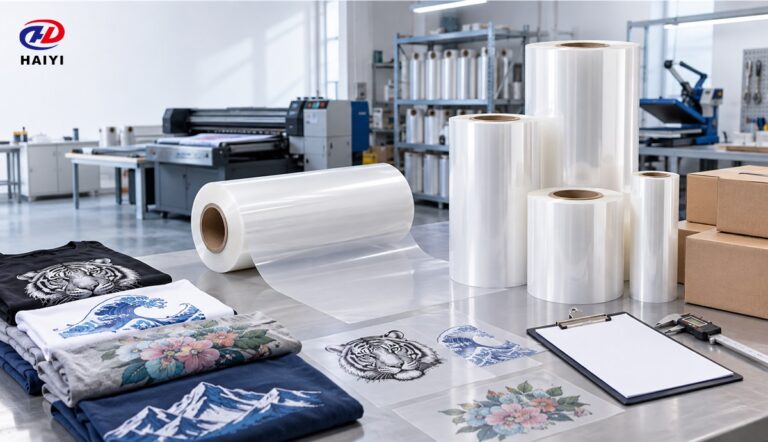
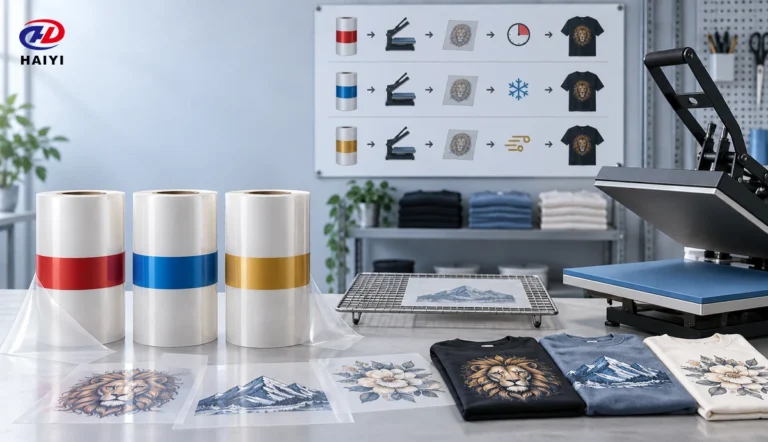
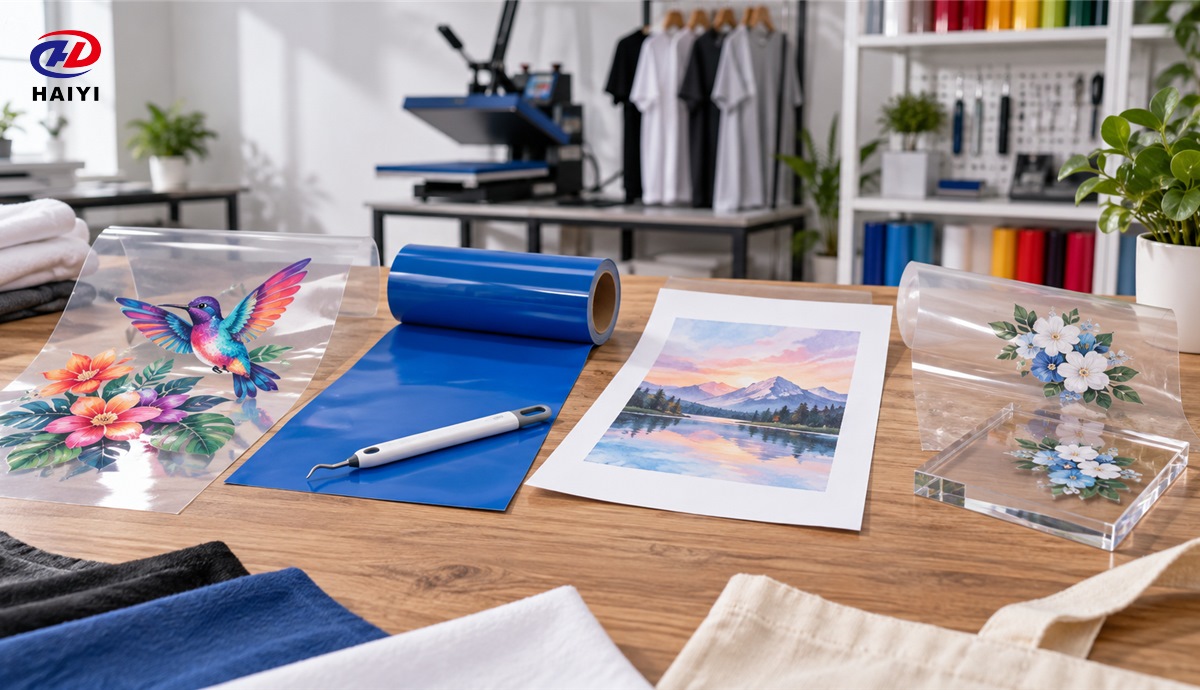
Heat transfer film is not one universally interchangeable product. In commercial purchasing, the term may refer to printable PET release film for textile DTF, cuttable heat transfer vinyl, printable transfer media, specialty reflective or effect films, or UV DTF carrier materials. Sublimation commonly uses coated transfer paper rather than film, although buyers may still group it with heat-applied transfer media.
A purchase order should name the process and material role, not only the broad category. 'DTF PET release film for textile printing' is more useful than 'transfer film.' 'Cuttable heat transfer vinyl for polyester sportswear' is more useful than 'vinyl roll.' Precise naming prevents a supplier from quoting a visually similar but technically incompatible material.
Which transfer technology fits the intended product?
| Technology | How the image is created | Typical target | Key purchasing risk |
|---|---|---|---|
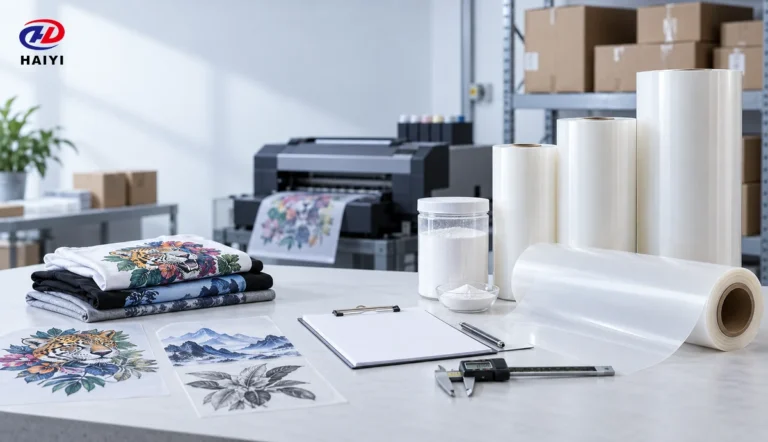
| Textile DTF PET film | Printed with compatible pigment inks, powdered, cured, and heat pressed | Cotton, polyester, blends, and other approved textiles | Film, ink, powder, cure, press, and fabric are not validated as one system |
| Heat transfer vinyl | Colored or printable material is cut, weeded or masked, and heat pressed | Approved garments, bags, sportswear, and specialty textiles | Adhesive and application temperature do not suit the fabric or coating |
| Sublimation transfer media | Sublimation ink is printed on coated paper and transferred by heat | Light-colored polyester or polymer-coated blanks | Buyer expects opacity on dark goods or performance on untreated cotton |
| Screen-printed transfer carrier | Ink system is printed on release media and later heat applied | Repeat textile designs produced under a controlled screen process | Carrier, ink, adhesive, cure, and press parameters are mismatched |
| UV DTF A/B film | UV layers are printed, cured, laminated, and pressure applied | Compatible hard, smooth surfaces | Buyer confuses a hard-goods cold-transfer system with textile DTF |
The best category is determined by elimination. The substrate removes incompatible processes first. Artwork complexity removes processes that cannot reproduce the required detail efficiently. Production volume, finish, hand feel, equipment, compliance, and end-use exposure then narrow the remaining choices.
How does the substrate change the decision?
Substrate fiber or surface chemistry controls what can bond successfully and what heat the item can tolerate. Cotton apparel, polyester performance wear, coated nylon, stretch blends, glass, acrylic, and painted metal should not share one generic approval standard. Each material may respond differently to temperature, pressure, dye migration, surface contamination, flexing, washing, or abrasion.
Dark textiles require an opaque image system when color accuracy is important. Textile DTF commonly creates opacity through a white ink layer, while HTV supplies an opaque colored layer. Standard sublimation ink is transparent and is therefore normally used on white or light polyester or a suitable polymer-coated blank.
Heat-sensitive or coated fabrics need a compatibility test because an adhesive can bond while the garment is still damaged by temperature, pressure, glossing, dye migration, or a press mark. The correct film is the material that produces an acceptable finished article within the substrate's safe operating window.
Hard, smooth goods should not be assigned to a textile transfer process by default. UV DTF A/B film offers a cold-transfer path for selected glass, acrylic, metal, ceramic, and rigid plastic items, but the target surface still requires cleaning and validation. A product name such as bottle or phone case does not define the coating chemistry.
How does artwork determine the right film?
Full-color artwork with gradients, photographs, and many isolated elements is usually more efficient in a digital print process than in a cut-film workflow. Textile DTF can reproduce complex digital artwork without manually weeding each color, while sublimation can reproduce continuous-tone designs on compatible light polyester or coated blanks.
Simple names, numbers, solid logos, and special-effect graphics can favor heat transfer vinyl. HTV allows buyers to select visual and tactile finishes that a standard digital print may not reproduce, but production labor rises when a design contains many small cut elements or multiple aligned layers.
Very small text and isolated dots should be included in sample testing because they reveal release, pickup, weeding, and application limits. A supplier sample that contains only large, forgiving shapes cannot prove that the material will reproduce the buyer's difficult artwork.
What equipment information should be sent to a supplier?
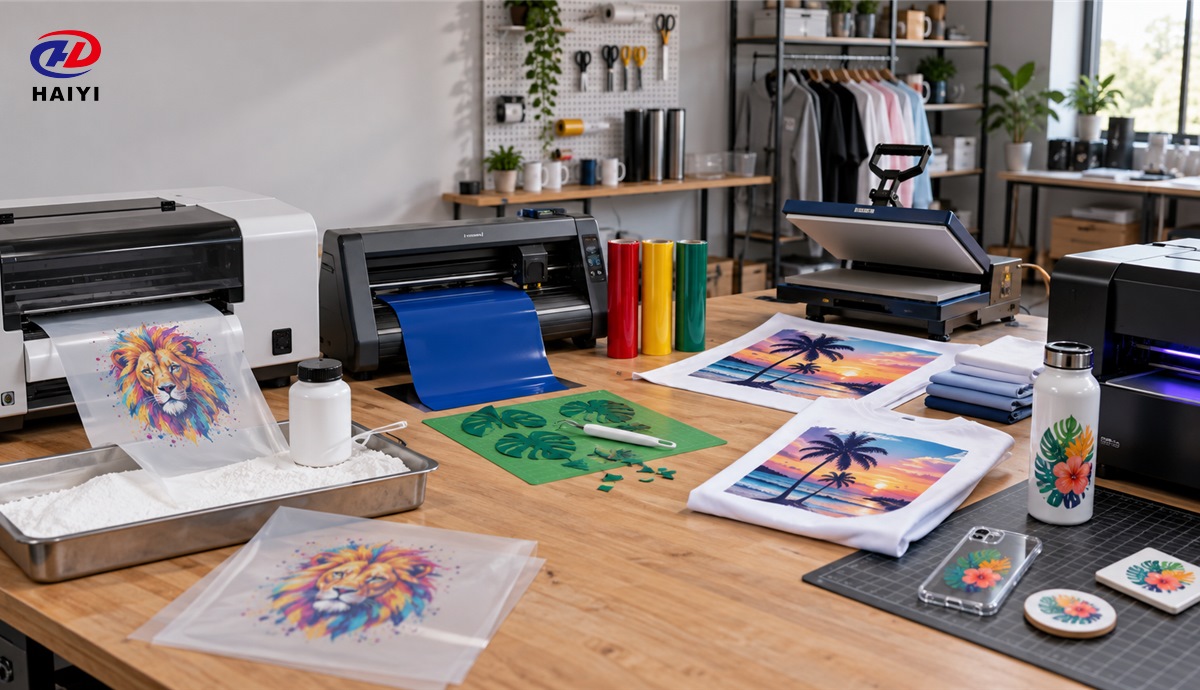
A technical RFQ should name the printer or cutter, usable width, ink type, RIP workflow, powder and curing method where applicable, laminator, heat press type, normal pressure-control method, roll core, winding direction, and maximum roll diameter. Equipment names alone may be insufficient when machines have been converted or configured differently.
Press settings should be treated as a starting window supplied for a specific material system, not as a universal recipe. Actual platen temperature, pressure distribution, substrate thickness, protective sheet, moisture, transfer size, and equipment calibration can change the result. Buyers should document their approved settings after testing.
A film that feeds correctly on a small sheet printer may not behave the same on a continuous production line. Long-run evaluation should check tracking, static, curl, roll tension, coating consistency, and changeover loss. Machine compatibility includes repeatability over the full roll, not only a successful first meter.
Which quality attributes should be compared?
Textile DTF film should be evaluated for feed stability, coating uniformity, ink laydown, powder behavior, cure response, release consistency, fine-detail retention, finished hand, stretch response where required, and wash performance under a defined method. Peel labels such as hot, warm, cold, or instant describe workflow intent but do not replace a compatibility test.
Heat transfer vinyl should be evaluated for cutting, weeding, carrier stability, opacity, adhesive activation, edge definition, stretch or recovery where required, and substrate-specific durability. The easiest film to weed is not automatically the best film after repeated flexing, washing, or exposure.
Sublimation transfer media should be evaluated for ink handling, drying, cockling, dimensional stability, transfer efficiency under a defined process, ghosting control, color result, and paper release. Transfer-rate claims are meaningful only when the ink load, printer, press, substrate, and measurement method are defined.
UV DTF film should be evaluated as an A/B pair for print stability, lamination, pickup, application, optical appearance, residue, edge behavior, and substrate adhesion. Buyers should avoid transferring textile-DTF assumptions about heat pressing or wash cycles to UV DTF hard-goods applications.
How should a buyer run a fair sample comparison?
A fair comparison changes one variable at a time. Use the same artwork, machine, operator, environment, substrate lot, application method, and inspection criteria for every film candidate. When settings must change for a candidate, record the change and include its effect on speed, energy, labor, and risk.
- Define the reader task as an acceptance standard. State what the finished product must look like and survive.
- Choose representative substrates. Include the normal material and the most difficult material sold to customers.
- Use a diagnostic artwork file. Include solids, gradients, fine lines, small text, isolated details, and high-ink areas where relevant.
- Record process settings. Document printing, cutting, powder, cure, lamination, pressing, peeling, and finishing steps that apply.
- Inspect immediate defects. Check feeding, registration, color, release, residue, edges, bubbles, press damage, and operator handling.
- Run end-use tests. Match washing, stretching, abrasion, moisture, temperature, outdoor exposure, or handling to the actual product.
- Repeat across batches. A supply decision requires evidence of consistency, not one successful sample.
How should usable cost be compared?
Usable cost is more informative than price per meter. The calculation should include landed material cost, setup waste, trim, failed prints, rejected transfers, damaged blanks, weeding or lamination labor, roll changes, cleaning, energy, downtime, customer replacements, and the inventory cost of slow-moving SKUs.
Yield should be measured in accepted saleable outputs. If one roll costs less but creates more rejected transfers, the apparent saving may disappear. Buyers can compare candidates by dividing the total cost of a controlled run by the number of units that meet the same acceptance standard.
Production volume changes the preferred method as well as the preferred material. HTV may be efficient for small personalized runs but labor-intensive for intricate repeated designs. Digital DTF can be efficient for mixed full-color orders, while screen-printed transfers can become attractive for stable repeat designs. No single process has the lowest cost for every artwork and order profile.
What documentation should accompany a wholesale order?
A practical specification should identify product type, approved construction, dimensions and tolerances, core and winding, coating or adhesive role, compatible process, storage conditions, shelf-life guidance, batch identification, inspection method, packaging, and change-notification expectations. Marketing adjectives should not replace measurable or observable requirements.
Safety or restricted-substance documentation should match the actual product, production site, market, and intended use. A certificate name alone does not prove that the shipped batch or finished decoration satisfies every legal or customer requirement. Buyers should verify scope, issuer, validity, sample identity, and whether downstream ink, adhesive, garment, or substrate components change the assessment.
Customs classification depends on material construction and local rules. A supplier can provide a description and commonly used classification, but the importer or customs professional should confirm the code and duty treatment for the destination. A broad online table should not be treated as a binding classification decision.
How can supplier capability be verified?
Supplier capability is demonstrated by traceable specifications, controlled samples, repeat-batch performance, technical responses, packaging discipline, complaint handling, and change control. A factory tour or video can provide context, but it does not replace product testing and document verification.
Buyers should ask who controls the coating or adhesive formulation, which steps are performed in-house, how incoming base material is approved, how coating weight and uniformity are monitored, how batches are identified, and how nonconforming material is contained. Specific answers are more useful than a general claim of factory-direct supply.
A trial order should reproduce the intended commercial workflow. The buyer should compare the trial with the approved sample and retain reference material. For textile DTF, the DTF consumables compatibility protocol provides a more detailed system test, while the two-batch comparison guide helps evaluate repeatability.
What should a complete heat transfer film RFQ contain?
- Exact process: textile DTF, HTV, sublimation, screen transfer, UV DTF, or another defined system
- Printer, cutter, ink, powder, curing, laminating, or heat-press configuration
- Target substrates, colors, coatings, shapes, and heat sensitivity
- Artwork type, fine-detail requirement, finish, hand feel, and opacity requirement
- Width, length, sheets or rolls, core, winding, diameter, and packaging
- Peel or release workflow and expected production speed
- End-use tests, acceptance criteria, and sample quantity
- Monthly volume, SKU plan, forecast, destination, and delivery schedule
- Private label, carton marks, technical documents, batch codes, and change control
Frequently asked questions
Is DTF film the same as heat transfer vinyl?
No. Textile DTF film is a printable carrier used with compatible inks, powder, curing, and heat pressing. HTV is a cuttable or printable material with its own adhesive and carrier construction. The equipment, artwork preparation, labor, and finished feel differ.
Is sublimation film the same as sublimation paper?
Commercial dye-sublimation workflows commonly use coated transfer paper, although specialized media exist. A buyer should specify the printer, ink, substrate, and media construction rather than assuming that film and paper are interchangeable terms.
Can one heat transfer material work on every fabric?
No material should be approved for every fabric without testing. Fiber content, dyes, coatings, stretch, texture, moisture, and heat sensitivity can change adhesion and appearance. The approved material is the one validated on the actual garment family.
Should buyers select film by thickness alone?
No. Thickness affects handling and thermal behavior, but coating, release, adhesive, dimensional stability, and system compatibility can be more important. Thickness should be one controlled specification within a complete sample test.
Source the right DTF film after the technology decision
Haiyi supplies wholesale and customized DTF film for B2B buyers. The fastest route to a useful recommendation is to send the exact textile DTF workflow, printer and ink system, powder and cure method, target fabrics, roll format, current failure mode, monthly volume, packaging needs, and sample acceptance criteria.
Contact Haiyi for DTF film samples, wholesale terms, customized specifications, or private-label packaging. If the project uses UV DTF for hard goods rather than textile DTF, identify that process clearly so the correct A/B film discussion can begin.