





How to Start a T-Shirt Business at Home Using DTF Film

Introduction
The global custom t-shirt market is worth over $6.8 billion and growing at 11.5% per year. People want shirts that feel personal — and someone has to print them.
That someone could be you, working from a spare bedroom or garage, with equipment that fits on a folding table.
Here is what changed: DTF printing — Direct to Film — made it possible to produce professional-quality DTF shirts from home without the expensive setup that screen printing requires, without the fabric limitations of sublimation, and without the maintenance headaches of DTG printers.
This guide covers how to start a t-shirt business at home using DTF film — from the first equipment purchase to your first paid order. Whether you want to know what equipment is needed, what the real startup costs look like, how to start with no money, or how to build a clothing brand — it is all here, in the order you actually need it.
Key Takeaways
- DTF printing is the best method for starting a home t-shirt business — it works on every fabric color and type, requires no pretreatment, and produces wash-durable prints with margins of 40 to 70% per shirt
- The minimum viable setup is a heat press for DTF transfers plus pre-made transfers ordered online — total investment under $300
- A full home DTF setup — DTF printer, powder shaker, curing system, and heat press — costs $2,000 to $5,000 and can pay for itself in 2 to 3 months at 10 shirts per day
- DTF film quality directly affects print quality and wash durability — cheap generic film produces inconsistent results; factory-direct film from an established manufacturer eliminates that variable
- You can start a t-shirt business without inventory using print-on-demand for online sales and made-to-order DTF for local customers
- A 6×8 foot workspace — spare room, garage corner, or home office — is all you need
- Your first customers are closer than you think: local sports teams, schools, businesses, and community groups are your fastest path to revenue before online sales ramp up
Why DTF Is the Best Method for a Home T-Shirt Business
Before spending money, understand why DTF beats every other method for starting a t-shirt printing business at home.
DTF vs. Every Other Method
| Method | Works on Dark Shirts | Min. Order | Startup Cost | Best Use Case |
|---|---|---|---|---|
| DTF | Yes | 1 shirt | $300–$5,000 | Everything — best all-around |
| Screen Printing | Yes | 12–24 | $3,000–$30,000 | High-volume same design |
| Sublimation | No (polyester only) | 1 | $500–$2,000 | White/light polyester only |
| DTG | Yes | 1 | $15,000–$30,000 | High detail, low volume |
| HTV (Vinyl) | Yes | 1 | $200–$800 | Simple designs, low volume |
DTF wins for home startups because:
No fabric restrictions. Cotton, polyester, blends, nylon, denim, leather — one workflow handles everything. You never have to turn down an order because the customer wants a black cotton hoodie.
No minimum orders. Print one shirt. Print a hundred. The cost-per-print stays consistent and profitable either way.
No pretreatment. DTG requires expensive pretreatment on dark garments. DTF does not. Load the shirt, press, done.
Wash durability that customers notice. A properly applied DTF transfer survives 50+ wash cycles without cracking or fading. That is what turns a first-time buyer into a repeat customer.
The real cost advantage. A 12×12 inch DTF shirt transfer costs roughly $1.50 to $2.50 in materials. Sell the finished shirt for $20 to $35. That is a 40 to 70% margin on every piece.
What Equipment Is Needed to Start a T-Shirt Business?
There are two ways to set up a DTF shirt printing operation at home. The path you choose depends on your budget and how quickly you want to scale.
Path A: Heat Press Only (Lowest Cost Entry)
You do not need a DTF printer to start a t-shirt business from home. You can buy pre-made DTF transfers from a wholesale transfer supplier, then press them onto shirts yourself with a heat press.
Equipment needed:
- Heat press (15×15 inch) — $150 to $400
- Computer for submitting designs
- Design software (free options available)
- Blank shirts
- Pre-made DTF transfers
Total investment: $300 to $600
This is the fastest and cheapest way to start. You handle the customer relationship, design, and pressing. The transfer supplier handles printing. Margins are lower than printing yourself, but the barrier to entry is almost zero.
Path B: Full DTF Home Setup (Print Everything Yourself)
Once you are ready to print your own DTF shirts, you need four pieces of equipment working together.
1. DTF Printer for T-Shirt Production
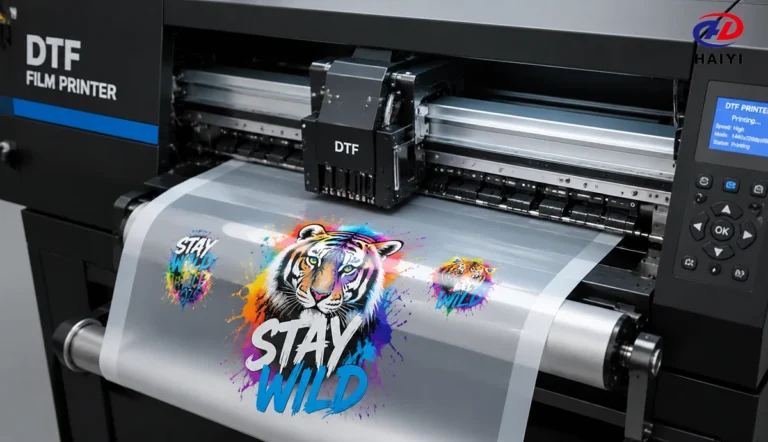
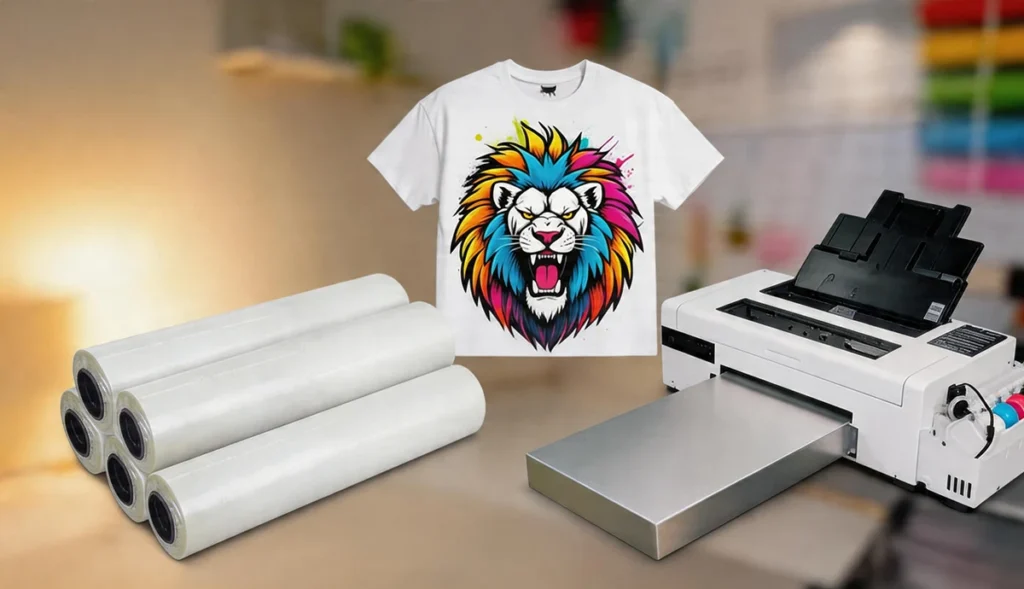
The DTF printer for t-shirt printing deposits white ink, CMYK color layers, and sometimes a varnish layer onto DTF film (PET transfer film). A desktop A3 printer handles shirts up to approximately 13×19 inches per sheet.
- Desktop A3 DTF printer: $600 to $1,500
- Mid-range 24-inch roll-fed printer: $3,000 to $8,000
For a home startup, a desktop A3 unit is the right starting point.
2. DTF Film (PET Transfer Film)
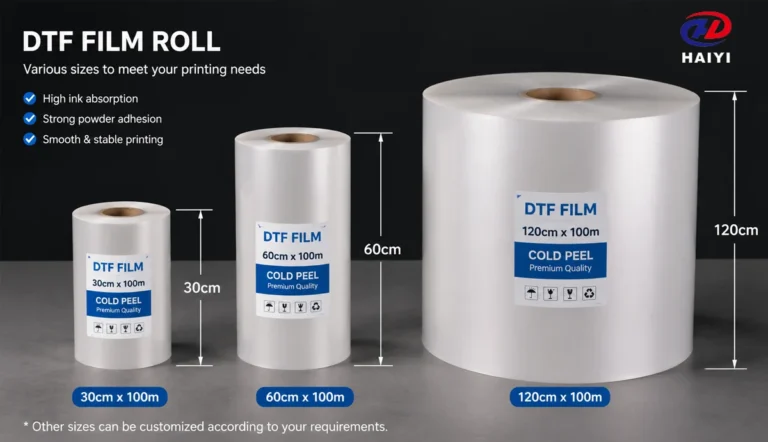
DTF film is the consumable the design is printed onto before transfer. It is a coated PET substrate that holds the ink, accepts the powder, and releases cleanly during heat pressing.
Film quality matters more than most beginners realize. Cheap generic film causes powder adhesion problems, inconsistent ink absorption, and edge curl that wastes material. Factory-direct film from a manufacturer that develops its own coating formula — rather than reselling pre-coated generic PET — produces consistent results roll to roll.
Key specs to look for:
- Dual-matte anti-static coating (reduces powder adhesion issues)
- Available in 13-inch rolls for A3 desktop printers
- 100m roll format for production efficiency
3. Powder Shaker and Curing System
After printing, hot-melt adhesive powder is applied to the wet ink surface and then cured with heat to bond the powder to the ink layer.
- Manual powder shaking (for very low volume): Free — use a tray
- Desktop powder shaker: $200 to $600
- Combined powder shaker + curing oven unit: $500 to $1,500
For startup volume, a desktop powder shaker with a separate heat gun or curing oven is the standard entry-level setup. At higher volume, an integrated unit saves time and produces more consistent powder coverage.
4. Heat Press for DTF Transfers
The heat press for DTF transfers bonds the cured film to the garment. Standard pressing parameters for most DTF film: 320–340°F (160–170°C), 10–15 seconds, medium-firm pressure.
- Entry-level clamshell press (15×15 inch): $150 to $300
- Mid-range swing-away press: $300 to $600
- Auto-open press: $400 to $800
A swing-away press is worth the extra cost — it reduces the risk of smearing during placement.
Complete Home DTF Equipment List
| Item | Budget Option | Mid-Range |
|---|---|---|
| A3 DTF printer | $600–$800 | $1,000–$1,500 |
| DTF film (100m roll) | Generic: $25–$40 | Factory-direct: $45–$70 |
| DTF ink set | $60–$100 | $100–$180 |
| Adhesive powder (1kg) | $15–$25 | $20–$40 |
| Desktop powder shaker | $200–$350 | $400–$600 |
| Heat press (15×15) | $150–$250 | $300–$500 |
| Total | $1,100–$1,600 | $2,000–$3,400 |
T-Shirt Business Startup Costs: Three Real Scenarios
Scenario 1: Side Hustle Starter ($300–$600)
Heat press only. Buy pre-made transfers. Press and ship yourself.
Best for testing the market before investing in printing equipment. You can be taking orders and delivering shirts within a week of buying a heat press.
Monthly capacity: 20 to 50 shirts per week depending on time invested. Margin per shirt: $5 to $12 (lower than printing yourself, but zero equipment risk).
Scenario 2: Home Print Shop ($2,000–$3,500)
Full desktop DTF setup — A3 printer, powder shaker, curing system, heat press. Print everything in-house from a spare room or garage.
This is the t-shirt business starter kit that most home operators land on. It fits in a 6×8 foot workspace and can handle 30 to 80 shirts per day at full production.
Monthly capacity: 600 to 1,600 shirts per month at 8-hour production days. Margin per shirt: $8 to $18 depending on shirt cost and sell price. Payback period: 2 to 4 months at consistent 10-shirt-per-day output.
Scenario 3: Small Production Studio ($5,000–$15,000)
24-inch roll-fed DTF printer with automated powder-shaker-curing unit and commercial-grade heat press. Produces gang sheets efficiently for higher volume.
For operators who have validated demand and want to scale beyond home hobby volume.
Monthly capacity: 2,000 to 5,000+ shirts per month. Margin per shirt: $10 to $20 at scale. Payback period: 3 to 6 months at target volume.
How to Start a T-Shirt Business With No Money
“No money” is relative, but the minimum viable path to a real t-shirt business from home looks like this:
Step 1: Create designs using free software (Canva, GIMP, or Inkscape — all free).
Step 2: Set up an Etsy or Instagram shop. Free.
Step 3: Get your first order. Take payment upfront.
Step 4: Use that payment to buy a pre-made DTF transfer from a wholesale supplier and a blank shirt from a local store.
Step 5: Buy a heat press. A used entry-level unit can be found for $80 to $150 on Facebook Marketplace or eBay.
Step 6: Press the shirt. Deliver it. Repeat.
This is not theoretical — it is exactly how many successful home print businesses started. The first 10 to 20 orders fund the next equipment purchase. The business pays for itself before you invest your own savings.
The key constraint at this stage is design quality and customer acquisition, not equipment. Focus on finding customers who want something specific — a local sports team, a family reunion, a small business that needs branded shirts — and deliver quality on those first orders.
How to Start a T-Shirt Business Without Inventory
Carrying blank shirt inventory before you have orders is a cash flow mistake most beginners make. Here is how to avoid it.
For Online Sales: Print-on-Demand
For your online store — Etsy, Shopify, Amazon — integrate a print-on-demand (POD) partner. When a customer orders, the POD partner prints and ships. You never touch the shirt. Margins are lower, but there is zero inventory risk.
This model is ideal for testing designs and niches before investing in your own equipment.
For Local Orders: Made-to-Order DTF
For local customers — sports teams, schools, businesses — operate made-to-order. Get the order and payment first. Buy blank shirts in exactly the quantity needed. Print and deliver.
With DTF, there are no minimum quantities. One shirt or one hundred — the workflow is the same. You never need to pre-buy inventory to offer a full range of styles and colors.
The Hybrid Model
Most successful home t-shirt businesses use both: POD for online sales to test demand, and in-house DTF printing for local bulk orders where margins justify the equipment investment. As online designs prove out, move successful ones to in-house production for better margins.
Step-by-Step: How to Print T-Shirts at Home with DTF
This is the complete DTF shirt printing workflow — from design file to finished shirt.
Step 1 — Create or Source Your Design
Design software options:
- Free: Canva (browser-based), GIMP (Photoshop alternative), Inkscape (vector)
- Paid: Adobe Illustrator ($21/month), Photoshop ($21/month)
- Pre-made: Purchase designs from Creative Market, Etsy, or Creative Fabrica
File requirements for DTF printing: PNG with transparent background, 300 DPI minimum, RGB color mode.
Step 2 — Set Up RIP Software
RIP (Raster Image Processor) software controls how the DTF printer layers ink — white base, CMYK colors, and varnish. Most DTF printers come with compatible RIP software. Load your PNG, set the white underbase for dark shirts, and arrange multiple designs on a gang sheet to minimize film waste.
Gang sheeting tip: Fitting 4 to 8 designs on a single A3 film sheet is the single most effective way to reduce cost per transfer.
Step 3 — Load DTF Film and Print
Load your DTF film into the printer with the coated printable side facing the print heads. The printer deposits ink layers onto the film surface. Print time for an A3 sheet: 2 to 8 minutes depending on printer speed and resolution setting.
Film loading note: Anti-static dual-matte film feeds more consistently than single-matte film — powder adhesion problems in Step 4 are almost always caused by poor film coating, not printer settings.
Step 4 — Apply Adhesive Powder
While the ink is still wet, apply hot-melt adhesive powder evenly across the printed surface. The powder adheres only to wet ink — not to the unprinted film surface — when using properly coated anti-static film.
Shake off excess powder. Uneven powder coverage at this step causes weak adhesion and print failures after pressing.
Step 5 — Cure the Powder
Heat the powder-coated film to 250–280°F (120–140°C) until the powder melts and bonds with the ink layer. Methods:
- Heat gun: Slow, manual, uneven — acceptable for very low volume only
- Curing oven: Even heat, consistent results, faster throughput
- Heat press: Possible but not ideal — can flatten the powder layer
Correct curing produces a shiny, smooth powder surface. Under-cured powder is dull and flaky — transfers will peel.
Step 6 — Create the DTF Transfer
Allow the cured film to cool. Cut each design from the sheet, leaving a small border. Your DTF transfer is ready to press.
Step 7 — Press onto the Shirt
Settings for most DTF film (verify with your specific film supplier):
- Temperature: 320–340°F (160–170°C)
- Time: 10–15 seconds
- Pressure: Medium to firm
Place the shirt on the heat press platen. Position the transfer face-down on the shirt. Press. Peel the film — hot peel or cold peel depending on your film type. The design is now permanently bonded to the shirt.
Step 8 — Wash Test Before Selling
Before selling to customers, wash a test shirt inside-out in cold water, tumble dry on low. Inspect after washing. A correctly pressed DTF transfer will show no cracking, peeling, or color loss.
If the transfer peels after washing, check in order: press temperature, press time, press pressure. Nine times out of ten, under-pressing is the cause — not the film or ink.
How to Choose the Right DTF Film for Your Setup
The DTF film you use determines print quality, transfer consistency, and how often you deal with rework. This is not the place to buy the cheapest option on the market.
What to Look for in DTF Film
Dual-matte anti-static coating. Anti-static surface prevents powder from clinging to non-printed areas during Step 4. If you are getting powder contamination outside the print area, your film is the most likely cause.
Consistent ink absorption. The coating must hold ink precisely without bleeding at design edges. Fine text and thin lines are the test — if those look sharp, the coating is doing its job.
Clean release. Film must peel away from the transfer cleanly after pressing without lifting ink at edges or leaving adhesive residue on the shirt.
Roll consistency. Meter 50 of a 100m roll must perform identically to meter 1. Manufacturers who develop their own coating formula in-house — rather than buying pre-coated generic PET substrate — can control this. Those who resell commodity film cannot.
Film Formats for Home Setups
| Format | Size | Best For |
|---|---|---|
| A3 sheets (pack of 100) | 13×19 inch | Testing, very low volume |
| 13-inch roll (50m) | 13″ wide × 50m | Small home setup, A3 printer |
| 13-inch roll (100m) | 13″ wide × 100m | Standard home production |
For a home setup with a desktop A3 printer, a 13-inch 100m roll is the right format. At 10 shirts per day, a 100m roll lasts approximately 2 to 3 weeks, depending on design size and gang sheet efficiency.
Factory-Direct vs. Distributor Film
DTF film purchased through local distributors carries a 25 to 40% markup over factory cost. For a home business running 10 to 30 shirts per day, sourcing DTF film factory-direct from a manufacturer like Haiyi — which produces film with in-house coating technology and ships internationally with low MOQ — reduces cost-per-transfer and eliminates the batch-to-batch quality variation that plagues generic distributor-sourced film.
How to Start Your Own Clothing Brand: Branding That Sells
Most people starting a t-shirt business think about printing first and branding last. That is backwards.
Your brand is what justifies charging $30 for a shirt instead of $15. Here is how to build one that actually works.
Pick a Niche First
The biggest mistake in starting a clothing brand is trying to sell to everyone. The most profitable home t-shirt businesses own a niche:
- Local sports teams and leagues
- Specific occupations (nurses, teachers, firefighters)
- Hobbies (fishing, hiking, motorcycles)
- Fandoms (specific TV shows, music genres)
- Local pride (city, state, regional identity)
- Humor around specific life stages (new parents, retirees)
A niche gives you a defined customer, a clear design direction, and a reason for people to recommend you to others who share the same identity.
Build a Simple Brand Identity
You do not need an expensive designer to start. You need:
- A name that is memorable and searchable
- A logo created with Canva (free) or commissioned on Fiverr ($20–$50)
- A consistent visual style — 2 to 3 colors, a font, a tone
- A short tagline that communicates who you serve
Apply this consistently across your Etsy shop, Instagram, packaging, and any business cards. Consistency is what makes a brand feel legitimate.
Packaging Makes the Difference
When a customer receives a business t-shirt in a poly bag with a thank-you card inside, they tell people about it. When they receive the same shirt in a plastic bag with no branding, they do not. The shirt is identical — the experience is not.
Minimum brand packaging for a home t-shirt business:
- Poly mailer bags with your logo ($30 for 100)
- Thank-you card insert (print at home on cardstock — $10)
- Size sticker or label ($15 for 100)
Total packaging cost: under $0.60 per order. Return on investment in customer experience: significant.
Where to Sell Your DTF T-Shirts
Local Sales: The Fastest Path to Cash
Local customers — people who can see and touch your product before buying — are your fastest path to early revenue. They do not require shipping. They pay immediately. And they refer you to others.
Fastest local channels:
- Facebook Marketplace and Facebook Groups (local community, school, and sports groups)
- Instagram with location tags and local hashtags
- Direct outreach to local sports leagues, schools, churches, and small businesses
- Craft fairs and local markets
- Word of mouth from friends, family, and the first 10 customers you serve well
The local business opportunity: A restaurant needing 20 staff shirts, a school sports team needing 50 practice tees, a corporate event needing 100 branded business t-shirts — these orders pay better than individual consumer sales and repeat annually.
Online Sales
Once local sales are established, online channels extend your reach.
Etsy: Best starting platform for custom and personalized shirts. High organic search traffic for custom apparel. Transaction fees apply but setup is free.
Shopify: More control, better branding, requires paid subscription ($29/month). Right move once you are generating consistent monthly revenue.
Instagram/TikTok: Visual content of your printing process generates organic reach. Videos of the DTF printing workflow — film loading, pressing, peeling — consistently perform well.
How to Start a T-Shirt Business on Amazon
Amazon is the largest e-commerce platform, but it requires a specific approach for t-shirt sellers.
Merch by Amazon (Print-on-Demand): Amazon’s built-in POD program. You upload designs; Amazon prints and ships on demand. No inventory, no shipping. You earn a royalty per sale. Highly competitive — success requires strong design and keyword research. Apply at merch.amazon.com (approval process required).
Amazon Seller + DTF: Sell your own shirts through Amazon Seller Central. You print with DTF, ship yourself or use Amazon FBA (Fulfillment by Amazon). More work than Merch by Amazon, but you control the brand and margins are higher.
Practical recommendation: Start with Etsy for handmade and custom shirts — the audience is better matched to small-batch custom printing. Add Amazon once you have proven designs and consistent production capacity.
How to Scale from Side Hustle to Full Business
Phase 1: Validation (Month 1–2)
Goal: Get 20 to 30 paying customers and validate that people will pay your price for your product.
- Use pre-made transfers and a heat press — keep investment minimal
- Sell locally: friends, family, direct outreach to local businesses
- Document everything: what sells, what customers ask for, what price they pay without hesitation
- Do not invest in a full DTF printer until you have consistent orders
Phase 2: Own Your Production (Month 3–6)
Goal: Replace pre-made transfers with in-house printing to improve margins and turnaround time.
- Buy a desktop A3 DTF printer for t-shirt production
- Invest in quality DTF film — this is not where to cut corners
- Learn gang-sheet optimization — filling each film sheet is the most important efficiency skill in DTF printing
- Target 10 shirts per day as your consistent production goal
Phase 3: Scale to Demand (Month 6–18)
Goal: Build reliable recurring revenue channels.
- Identify your 3 to 5 highest-value customer types and focus marketing on them
- Build relationships with local recurring buyers (sports leagues, schools, businesses)
- Set up an Etsy shop or Shopify store for online sales
- Consider a 24-inch roll-fed printer when monthly volume justifies the investment
- Hire part-time help for pressing and packing before hiring for anything else
FAQ
How much does it cost to start a t-shirt printing business at home? The minimum viable setup — heat press plus pre-made transfers — costs $300 to $600. A full home DTF setup with printer, powder shaker, curing system, and heat press runs $2,000 to $3,500. A commercial-scale home studio is $5,000 to $15,000. Most people start with the heat-press-only model and upgrade after validating demand.
What equipment is needed to start a t-shirt business? At minimum: a heat press ($150–$400) and a source for pre-made DTF transfers. For in-house printing: a DTF printer ($600–$1,500 for desktop), DTF film, DTF ink, hot-melt adhesive powder, a powder shaker/curing system ($200–$600), and a heat press. Design software (free options available) and blank shirts complete the setup.
Can I start a t-shirt business at home with no money? The lowest-cost entry is creating designs using free software (Canva, GIMP), taking a paid order upfront, buying one pre-made DTF transfer and one blank shirt with that payment, and pressing it with a borrowed or secondhand heat press. Many successful home print businesses started exactly this way and used early revenue to fund equipment purchases.
What is a DTF transfer and how does it work? A DTF transfer is a pre-printed, powder-coated design on PET film, ready to be heat-pressed onto fabric. The design is printed onto DTF film using DTF ink, coated with hot-melt adhesive powder, and cured. During heat pressing, the powder bonds the ink to the fabric. The film is then peeled away, leaving a vibrant, durable design on the garment.
How do I create a DTF transfer? To create a DTF transfer: (1) design your image as a 300 DPI PNG with transparent background; (2) send it to a DTF printer via RIP software; (3) print onto DTF film; (4) apply hot-melt powder while ink is wet; (5) cure in a heat oven or with a heat gun; (6) cool and cut to size. The resulting transfer is ready to press onto any fabric.
What is the best DTF film for a home setup? For a home A3 printer setup, a dual-matte anti-static 13-inch roll in 100m length is the standard recommendation. The anti-static coating prevents powder contamination outside print areas. The most important quality indicator is whether the manufacturer develops its own coating formula — consistent ink absorption and release behavior requires coating control that generic pre-coated PET substrate cannot guarantee.
How long does a DTF print last on a shirt? A properly applied DTF transfer on a correctly pressed shirt will last 50+ wash cycles without cracking, peeling, or significant fading. Wash inside-out in cold water, tumble dry on low. Failure after just a few washes is almost always caused by insufficient heat press temperature, time, or pressure — not the transfer itself.
Can I start a t-shirt business on Amazon? Yes. Two routes: Merch by Amazon (apply at merch.amazon.com — POD program, no equipment needed) or Amazon Seller Central (sell your own DTF-printed shirts, ship yourself or via FBA). Merch by Amazon is competitive but free to start. Amazon Seller gives more brand control at the cost of more operational work. Most home DTF operators start on Etsy and add Amazon after proving their designs.
How do I start a t-shirt business without inventory? For online sales: use print-on-demand. For local sales: operate made-to-order — take payment upfront, buy blanks, print, and deliver. DTF has no minimum orders, so one-shirt orders are fully viable without holding pre-purchased inventory.
How profitable is a home t-shirt business using DTF? Margins of 40 to 70% per shirt are realistic for a home DTF operation. A blank shirt costs $3 to $6. DTF film, ink, and powder per shirt costs $1.50 to $2.50. At a $25 sell price, profit per shirt is $15 to $20 before overhead. At 10 shirts per day, 5 days a week, that is $750 to $1,000 gross profit per week. A $2,500 equipment investment can pay for itself within 2 to 3 months at this volume.
How long does it take to start a t-shirt business from home? You can be operational — taking orders, pressing shirts, and delivering — within 24 to 48 hours of buying a heat press and ordering your first pre-made transfers. Adding your own printing capability takes 1 to 2 weeks to set up and learn. Most people are producing quality DTF shirts independently within 2 to 3 weeks of receiving their first printer.
Conclusion
Starting a t-shirt business at home has never been more accessible than it is right now. The combination of DTF printing technology, low-cost equipment, and online selling platforms removes every barrier that used to make apparel printing an expensive, high-risk venture.
Here is the path, simplified:
- Start with a heat press — test demand before investing in a printer
- Find local customers first — sports teams, schools, businesses pay faster than online shoppers
- Invest in your own DTF setup once you have consistent orders
- Use quality DTF film — cheap generic film costs you more in rework than it saves on price
- Build a brand around a specific niche — it is the difference between charging $15 and $30 for the same shirt
- Scale online after validating what sells locally
The biggest mistake people make is waiting until everything is perfect before starting. It does not need to be perfect. It needs to be started.
A heat press, a clear niche, and the willingness to talk to 10 potential customers this week is enough to build a real business. The equipment gets better over time. The knowledge compounds. The customer base grows.
What does not grow on its own is the first step.
Haiyi manufactures DTF film with in-house coating technology — dual-matte anti-static rolls in 13-inch and 24-inch widths, A3/A4 sheets, and full DTF ink systems. Factory-direct wholesale pricing with low MOQ, available for home print businesses and distributors worldwide. 15 years of production and export experience.