







Heat Transfer Film Buying Guide
Heat transfer film buying guide 2026 — all film types, printing methods, machines, HS codes, factory sourcing from China, and how to choose the right film fast.

Read time: 16 minutes
Introduction
Heat transfer film is the consumable that sits between your design and the finished product. Get it right and you get vibrant, durable prints that survive hundreds of wash cycles or years of outdoor use. Get it wrong and you get peeling, cracking, faded transfers, and rework costs that erode every margin you built.
The problem is that “heat transfer film” is not one product. It is a category that includes PET release film for DTF printing, heat transfer vinyl, sublimation transfer paper, glitter film, reflective film, and more — each with different substrates, coating chemistries, printing requirements, and end-use applications.
This guide covers every type of heat transfer film in one place. What each type is, how it works, which machines and inks it requires, what the HS code is for importing it, where China fits in the global supply chain, and what to look for when evaluating a manufacturer. By the end, you will know exactly which film type fits your application — and how to source it reliably.
Key Takeaways
- “Heat transfer film” covers multiple distinct product categories — PET release film (DTF), HTV vinyl, sublimation paper, reflective film, glitter film, and crystal label film — each requiring different equipment and ink types
- China produces over 79% of the world’s heat transfer film under HS code 3920 — factory-direct sourcing is available for any product type
- Heat transfer film HS code is primarily 3920.62 (PET-based films) or 3919 (self-adhesive film), with specific sub-codes varying by country — your freight forwarder confirms the applicable code
- The heat transfer film coefficient (thermal conductivity of the film layer) affects pressing time and temperature requirements — thicker films require longer press dwell time
- DTF PET release film is the fastest-growing segment — factory-direct pricing from a Chinese manufacturer with in-house coating saves 20 to 40% versus distributor sourcing
- Heat transfer film printing machines range from desktop inkjet printers for sublimation to industrial DTF printers and wide-format plotters for vinyl — equipment must match film type
- A manufacturer that develops its own coating formula in-house delivers batch-to-batch quality consistency that resellers of generic substrate cannot
What Is Heat Transfer Film?
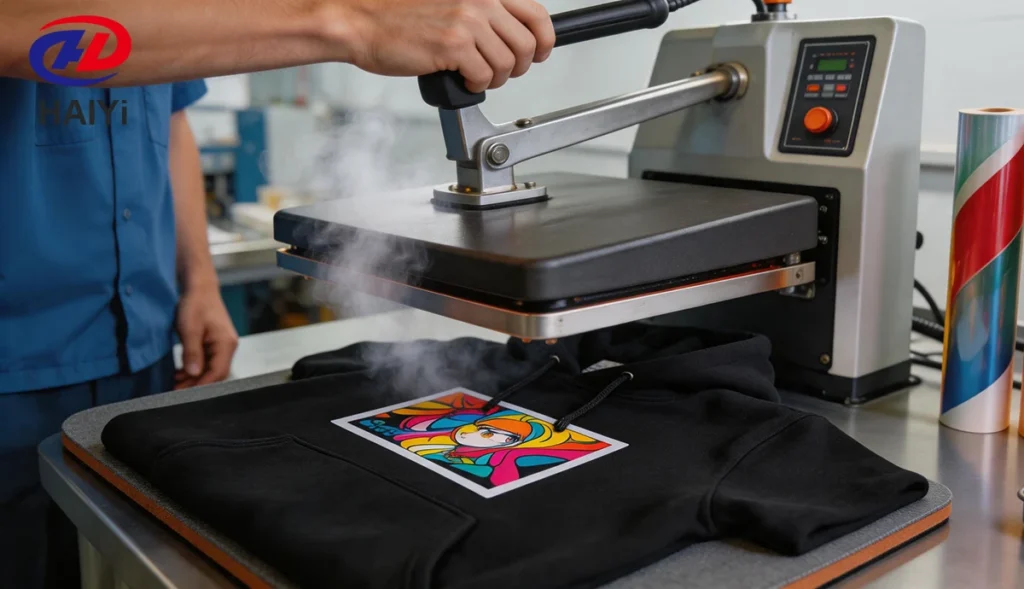
Heat transfer film is any flexible substrate used to carry a design from a printing or cutting process to a final surface — fabric, glass, metal, ceramic, or other materials — using heat and pressure.
The term covers a wide range of products that share one characteristic: the design is created on the film first, then transferred to the final substrate in a separate heat application step. This distinguishes heat transfer film from direct printing methods (DTG, screen printing, inkjet on fabric) where ink is applied directly to the final surface.
Why Heat Transfer Film Exists
Heat transfer film solves two problems that direct printing cannot:
Surface reach. A heat press can apply a design to any flat or semi-flat surface — cotton, polyester, denim, nylon, leather, mugs, phone cases, metal nameplates — regardless of whether that surface can pass through a printer.
Design storage and logistics. Heat transfer films — particularly pre-printed DTF transfers and heat transfer vinyl cuts — can be produced in advance, stored, shipped, and applied on demand. This separates the printing and finishing steps, which enables distributed production models.
The Common Thread
All heat transfer films share a release mechanism: under heat and pressure, the design separates from the film carrier and bonds to the final surface. How this release works — whether through adhesive melt, dye sublimation, or pressure-sensitive adhesion — defines the film category and determines what it can and cannot be applied to.
Types of Heat Transfer Film: Complete Breakdown
1. DTF PET Release Film (Direct to Film)
The fastest-growing heat transfer film category. A coated PET (polyethylene terephthalate) substrate onto which DTF ink is printed, followed by hot-melt adhesive powder application and curing. The cured film is heat-pressed to any fabric type.
Key characteristics:
- Works on cotton, polyester, blends, nylon, denim, leather
- Works on light and dark fabrics without pretreatment
- Available as hot peel, cold peel, and instant peel variants
- Dual-matte anti-static coating is the production standard
- Roll format: 13-inch (A3) and 24-inch rolls, 100m standard length
Applications: Custom apparel, garment decoration, promotional merchandise, sportswear, workwear
Required equipment: DTF printer, powder shaker, curing oven, heat press
2. Heat Transfer Vinyl (HTV)
A vinyl film with a heat-activated adhesive backing, cut to shape using a vinyl cutter and pressed to fabric. Available in solid colors, patterns (glitter, metallic, holographic), and specialty finishes.
Key characteristics:
- Cut-only process — no printing required
- Works on most fabrics
- Strong, flexible adhesive layer
- Sold in rolls or pre-cut sheets
- Design complexity limited by cutting capability
Applications: Custom apparel, team uniforms, sports jerseys, personalized gifts
Required equipment: Vinyl cutter (plotter), weeding tools, heat press
3. Sublimation Transfer Paper (Sublimation Film)
A coated paper or film used to transfer sublimation dye onto polyester fabrics or poly-coated hard goods. The dye sublimes (converts to gas) under heat at approximately 375 to 400°F and bonds permanently with polyester fibers.
Key characteristics:
- Works only on polyester (minimum 65% polyester) or poly-coated substrates
- Cannot print on dark or colored backgrounds (no white sublimation ink)
- Zero surface feel — design becomes part of the fabric
- Permanent durability — will not peel or crack
Applications: Polyester sportswear, all-over print apparel, mugs, mousepads, phone cases, promotional hard goods
Required equipment: Sublimation printer (modified inkjet or dedicated), heat press or mug press
4. Reflective Heat Transfer Film
A multi-layer film incorporating a retroreflective element — typically aluminum-coated glass beads or microprismatic layers — that reflects light back to its source. Applied to fabric using a heat press.
Key characteristics:
- Available in silver (standard) and colored reflective variants
- Wash-resistant — certified to EN ISO 20471 and ANSI/ISEA standards for high-visibility workwear
- Can be combined with DTF printing for patterned reflective designs
- Cut-to-shape for logo application or printed for complex reflective designs
Applications: Safety workwear, high-visibility vests, sportswear, cycling apparel, outdoor gear
Required equipment: Heat press; vinyl cutter for custom shapes
5. Glitter and Metallic Heat Transfer Film
A specialty film with glitter particles, metallic foil surfaces, or holographic effects embedded in the adhesive layer. Applied by cutting and heat pressing, or as a laminate over printed designs.
Key characteristics:
- Available in hundreds of color and effect combinations
- Adds dimensional texture to finished designs
- Cut-only or over-print lamination application
- Higher unit cost than standard vinyl but commands premium retail pricing
Applications: Fashion apparel, activewear, cheerleading uniforms, promotional products, custom gifts
Required equipment: Vinyl cutter, heat press; laminator for over-print applications
6. Crystal Label Film
A specialty heat transfer film used to create transparent, three-dimensional crystal-effect labels and logos. Applied to fabric or hard goods using heat. The finished label has a raised, glossy, jewel-like appearance.
Key characteristics:
- Transparent or colored base for dimensional logo effects
- High-gloss surface finish
- Applied to fabric or smooth rigid surfaces
- Specialty application — not interchangeable with standard DTF film
Applications: Luxury apparel branding, premium labels, garment hang tags, shoe labels, accessories
Required equipment: Specialized printing and forming equipment; heat press for application
7. UV DTF Film (A/B System)
A two-film system (A film + B film) used with UV printers to transfer designs to hard, rigid surfaces. UV-curable ink is printed on A film, laminated with B film, and applied by pressure to glass, acrylic, metal, wood, plastic, or ceramic.
Key characteristics:
- No heat press required — cold pressure application
- Works on hard surfaces that standard DTF cannot
- A film (print layer) + B film (transfer carrier) used in sequence
- Available in clear, white ground, gold, silver, and matte variants
Applications: Glass tumblers, phone cases, branded merchandise, wood panels, ceramic tiles, metal nameplates
Required equipment: UV flatbed or roll-to-roll UV printer, cold laminator
Heat Transfer Film Printing: How Each Method Works
DTF Printing (Direct to Film Printing)
Heat transfer film printing in the DTF context involves:
- Printing CMYK + white ink layers onto coated PET film using a DTF printer
- Applying hot-melt adhesive powder while ink is wet
- Curing powder in an oven at 250 to 280°F
- Heat-pressing the cured film to fabric at 305 to 325°F
DTF is the most versatile heat transfer film printing method — it works on any fabric color and type, requires no fabric pretreatment, and produces wash-durable transfers with 50+ wash cycle durability.
Sublimation Printing
Sublimation printers deposit dye-based sublimation ink onto transfer paper or film. Under heat (375 to 400°F), the dye converts to gas and bonds permanently with polyester fibers. The result is a zero-surface-feel print with permanent color fastness. Limited to polyester and light-colored substrates.
Vinyl Cutting
HTV vinyl requires no printing — designs are cut from pre-colored vinyl rolls using a plotter cutter, then weeded (excess material removed) and heat-pressed to fabric. Color is inherent to the vinyl material. Limited to solid-color, vector designs.
Screen Printing Transfer
Screen-printed heat transfers use plastisol or water-based inks applied through screens onto release paper, then cured and heat-pressed to fabric. Requires screen setup for each color — economical for high-volume identical designs, not practical for short runs or design variety.
Heat Transfer Film vs Heat Transfer Paper
The terms “heat transfer film” and “heat transfer paper” are sometimes used interchangeably — particularly for DTF products — but there are meaningful differences.
| Feature | Heat Transfer Film | Heat Transfer Paper |
|---|---|---|
| Substrate | PET plastic (polyester film) | Coated paper or tissue paper |
| Durability | Higher — more dimensionally stable | Lower — moisture-sensitive |
| Surface feel | Smooth, consistent | Varies by paper type |
| Ink compatibility | Matched to specific coating chemistry | Broader compatibility |
| Roll format | Standard (100m rolls) | Standard for industrial; sheets for consumer |
| Typical use | DTF, release film, specialty transfers | Sublimation, iron-on inkjet transfers |
| Primary term | “DTF film,” “PET film,” “release film” | “Sublimation paper,” “transfer paper” |
For DTF printing specifically: the correct product is PET transfer film, not paper. Despite the colloquial use of “DTF paper” in many markets, the substrate is plastic film, not paper. Using actual paper in a DTF printer damages print heads and produces unusable transfers.
For sublimation: the correct product is sublimation paper — a coated paper that absorbs and releases sublimation dye efficiently. Sublimation film exists as an alternative (particularly for polyester fabric printing where paper-to-fabric marking is a concern), but sublimation paper is the production standard.
Heat Transfer Film Printing Machine: What You Need
The heat transfer film printing machine varies completely by film type. Using the wrong machine for a given film type produces unusable output.
DTF Film Printer
A dedicated heat transfer film printer for DTF applications uses water-based pigment ink with white ink capability, piezo print heads, and a film feeding mechanism for PET roll or sheet film.
- Desktop A3 DTF printer: $600 to $1,500 — for 10 to 50 shirts per day
- 24-inch roll-fed DTF printer: $3,000 to $8,000 — for 50 to 300 shirts per day
- Production-grade DTF system: $8,000 to $20,000 — for 300+ shirts per day
Sublimation Printer
Modified consumer inkjet printers or dedicated sublimation printers using dye-based sublimation ink and sublimation paper.
- Entry-level desktop sublimation printer: $200 to $500
- Wide-format sublimation printer (for fabric and large format): $2,000 to $15,000
Vinyl Cutter / Plotter
For HTV vinyl cutting — a blade-based plotter that cuts pre-colored vinyl to shape from vector design files.
- Desktop vinyl cutter (12-inch): $200 to $600
- Professional wide-format cutter (24-inch+): $800 to $3,000
Heat Transfer Film Machine (Heat Press)
All heat transfer films require a heat transfer film machine for the final application step — the heat press.
- 15×15 inch clamshell press: $150 to $400
- Swing-away press: $300 to $700
- Industrial conveyor press: $3,000 to $15,000
Combined Powder Shaker and Curing Unit
For DTF production, a powder shaker with integrated curing handles powder application and curing in one automated pass:
- Desktop powder shaker with curing: $200 to $600
- Production integrated unit: $1,500 to $5,000
Heat Transfer Film Coefficient: What It Means in Practice
The “heat transfer film coefficient” (also called thermal conductivity or heat transfer coefficient) is a materials science term that describes how efficiently the film transmits heat from the press platen to the adhesive layer and fabric interface.
For practical pressing purposes, the relevant metric is film thickness and thermal resistance — how much resistance the film adds to heat transfer from the press surface to the adhesive bond point.
Why Film Thickness Affects Pressing Parameters
A thicker film has higher thermal resistance. More heat energy must transfer through the film before the adhesive layer reaches its activation temperature. This means:
- Thicker films require slightly higher press temperature or longer press time for equivalent adhesion
- Inconsistent film thickness within a roll produces inconsistent adhesion results
- Industrial production standards specify film thickness tolerance at ±3 to ±5 microns for high-quality DTF film
Standard Film Thicknesses
| Film Type | Typical Thickness | Pressing Implication |
|---|---|---|
| DTF PET release film | 75–100 microns | Standard DTF settings apply |
| HTV vinyl | 80–150 microns | Standard HTV settings |
| Sublimation paper | 90–120 g/sqm (paper weight) | Standard sublimation settings |
| Reflective film | 150–300 microns | Increase press time by 2–4 seconds |
| Crystal label film | 200–500 microns | Longer press time, confirm with supplier |
Practical Application
For most print shop operators, “heat transfer film coefficient” is relevant primarily when:
- Switching to a significantly different film thickness from the same supplier
- Troubleshooting adhesion failures that correlate with specific film batches
- Setting press parameters for new film types not previously used
The actionable takeaway: always confirm pressing parameters with your film supplier when switching film types, and verify actual press platen temperature with a contact thermometer rather than relying on the display reading.
Heat Transfer Film HS Code: Import and Export Classification
Correct HS code classification is essential for international heat transfer film imports — it determines import duty rates, VAT treatment, and which certifications are required at customs.
Primary HS Codes for Heat Transfer Film
| Product Type | Primary HS Code | Chapter Description |
|---|---|---|
| DTF PET release film | 3920.62 | Other plates, sheets, film of polyesters |
| Self-adhesive HTV vinyl | 3919.90 | Self-adhesive plates, sheets, film of plastics |
| Sublimation transfer paper | 4811.90 | Coated or treated paper, other |
| Reflective heat transfer film | 3920.99 / 3921.90 | Other plastics plates, sheets, film |
| Crystal label film | 3919.10 / 3920.62 | Depends on base material and adhesive |
| UV DTF film | 3920.62 | PET-based plastic film |
The HS Code 3920 Context
China accounts for approximately 79% of global heat transfer film imports classified under HS 3920 (Other Plates, Sheets, Film, Foil and Strip of Plastics). This chapter covers PET-based transfer films — the most commercially significant category for DTF, reflective, and specialty transfer applications.
A secondary classification, HS 3919 (Self-Adhesive Film), covers HTV vinyl and self-adhesive transfer products.
Country-Specific Variations
HS codes are harmonized at the 6-digit level globally, but countries add national subheadings (7th to 10th digits) that determine specific duty rates:
- US: 3920.62.00 (DTF PET film) — verify with your customs broker for current tariff rates under applicable trade provisions
- EU: 3920.62.19 (polyester film, other) — REACH and OEKO-TEX compliance documentation may be required
- Brazil: NCM 3920.62.19 — import duties apply, verify with local freight forwarder
- Mexico: 3920.62.XX — NAFTA/USMCA provisions may affect duty rates depending on country of origin documentation
Important: HS code classification for heat transfer film can vary based on specific product construction (laminated vs. non-laminated, coated vs. uncoated) and adhesive type. Always confirm the applicable code with your freight forwarder or customs broker before import — incorrect classification can result in duty assessment errors or customs delays.
Documentation Required for Import
For most heat transfer film imports from China, the standard documentation package includes:
- Commercial invoice with unit price, quantity, and HS code
- Packing list
- Certificate of origin (Form A for developing countries, CO for others)
- Bill of lading (sea) or airway bill (air)
- For EU imports: REACH compliance documentation, OEKO-TEX certificate if required
Heat Transfer Film from China: What Buyers Need to Know
China dominates global heat transfer film production for measurable reasons: vertically integrated PET substrate manufacturing, decades of coating chemistry expertise, and export logistics infrastructure that no other country has matched at equivalent scale.
China’s Market Position
- HS 3920 heat transfer film: China accounts for approximately 79% of global production
- HS 3919 self-adhesive film: China is the leading producer
- Key manufacturing provinces: Guangdong (DTF, specialty film), Zhejiang (PET substrate, sublimation paper), Jiangsu (full-line consumables), Shanghai (export-oriented suppliers)
What Factory-Direct China Sourcing Delivers
Price advantage: Factory-direct pricing from Chinese manufacturers undercuts distributor pricing by 20 to 40% for equivalent quality film. For a buyer purchasing 20 rolls of DTF film per month, this translates to $1,500 to $2,500 in annual savings.
OEM capability: Custom packaging with your brand, custom roll widths, custom core sizes, and private label documentation — standard services from established manufacturers, not available from most distributors.
Product range: Chinese factories producing heat transfer film cover the full range — DTF PET film, reflective film, crystal label film, sublimation paper, HTV vinyl — often from a single supplier relationship.
Supply continuity: Manufacturers with fixed monthly production capacity reserved for established wholesale accounts provide supply continuity that spot-market distributors cannot guarantee.
The Factory vs. Trading Company Issue
Not every Chinese “manufacturer” listed on B2B platforms actually manufactures. Trading companies represent a significant portion of Chinese heat transfer film suppliers — they purchase finished film from factories and resell it, sometimes under their own brand.
The practical difference: a factory controls coating specifications and can guarantee batch-to-batch consistency. A trading company cannot — it is entirely dependent on which factory supplied which shipment.
The diagnostic question: “Do you develop your coating formula in-house, or do you source pre-coated PET substrate from an external supplier?” A factory answers specifically. A trading company either deflects or provides a vague answer.
How to Choose a Heat Transfer Film Manufacturer
Step 1 — Match the Manufacturer to Your Film Type
Not every heat transfer film factory produces every film type. A sublimation paper specialist is not the same business as a DTF PET film manufacturer. Confirm the supplier’s primary production focus before requesting samples.
Step 2 — Verify In-House Coating Capability
The most important quality criterion for any coated heat transfer film. Ask specifically whether the coating is applied in-house on the manufacturer’s own coating lines, or whether the manufacturer purchases pre-coated substrate.
In-house coating means:
- Full control over coating specifications
- Consistent batch-to-batch performance
- Technical support based on actual production knowledge
- OEM customization at the coating level (not just packaging)
Haiyi, for example, operates with in-house coating technology developed over 15 years, an R&D team with 20+ registered patents, and 60,000 sqm/day production capacity — concrete indicators of genuine manufacturing capability rather than resale operation.
Step 3 — Review Certifications
ISO 9001: Quality management system documentation. Baseline certification for serious manufacturers.
OEKO-TEX Standard 100: Chemical safety testing — confirms the film does not contain harmful substances above threshold limits. Essential for EU market imports and garment applications.
SGS / Bureau Veritas test reports: Third-party product specification verification.
Verify all certificates with the issuing body directly — do not rely on supplier-provided copies alone.
Step 4 — Test Multi-Batch Samples
Request samples from two separate production batches. Run both through your complete workflow including wash or durability testing. Consistency between batches reveals production control; single-sample quality proves nothing about ongoing supply.
Step 5 — Assess Export Experience
A manufacturer shipping to your region for 10 or more years has navigated every logistics, documentation, and customs challenge you will encounter. Export experience is a commercial asset — not just a nice-to-have.
Ask: how many years have you been exporting to (your market)? What freight routes do you use? Can you recommend freight forwarders with experience in our destination?
Heat Transfer Film Price Guide
DTF PET Release Film (Wholesale, Factory-Direct)
| Tier | Price Per Meter | Roll Width | Notes |
|---|---|---|---|
| Budget (generic) | $0.08–$0.14 | 13″/24″ | Pre-coated generic PET, inconsistent batches |
| Mid-range | $0.15–$0.22 | 13″/24″ | Acceptable consistency |
| Premium (in-house coating) | $0.18–$0.28 | 13″/24″ | Proprietary coating, certified, OEM available |
HTV Vinyl (Wholesale per Roll)
| Type | Price Per Meter | Standard Width |
|---|---|---|
| Standard matte/gloss HTV | $0.80–$2.00 | 20″/24″ |
| Glitter HTV | $1.50–$3.50 | 20″ |
| Reflective HTV | $2.00–$5.00 | 20″ |
| Metallic/holographic HTV | $2.00–$4.00 | 20″ |
Sublimation Paper (Wholesale)
| Format | Price Per Meter | Notes |
|---|---|---|
| Standard sublimation paper | $0.05–$0.12 | 44″/60″ rolls |
| Sticky sublimation paper | $0.10–$0.20 | Prevents ghosting on nylon |
Reflective Heat Transfer Film (Wholesale)
| Type | Price Per Meter | Standard Width |
|---|---|---|
| Silver reflective film | $1.50–$3.50 | 50cm/1m |
| Colored reflective film | $2.00–$5.00 | 50cm/1m |
| Prismatic reflective film | $3.00–$7.00 | 50cm/1m |
Crystal Label Film (水晶标)
| Application | Price Per Sheet / Meter | Notes |
|---|---|---|
| Standard crystal label | $0.50–$2.00/sheet | Custom quotes for volume |
The Buying Checklist: 6 Questions Before You Order
Before placing a first order with any heat transfer film supplier, get clear answers to these questions:
1. Is the coating applied at your factory or sourced from an external supplier? This is the most important question. An in-house coating answer with specific details means factory control. A vague or deflected answer means resale risk.
2. What are the specific pressing parameters for your film? Temperature range, time, pressure, peel type (hot/cold), and recommended second press. A manufacturer that provides these specifically understands their product. One that provides only generic ranges does not.
3. What certifications does the product and facility hold? Request ISO 9001, OEKO-TEX Standard 100 (if applicable), and SGS test reports. Verify each with the issuing body.
4. Can I receive samples from two separate production batches? This tests batch-to-batch consistency — the real measure of production quality. Single-sample quality is not meaningful for production decision-making.
5. What is the minimum order quantity and tiered pricing structure? Understand the volume breakpoints and how much you need to order to reach each pricing tier.
6. What is your export experience in my market? Years of export to your specific region, freight options, and documentation support capability. This determines how smooth the import process will be.
FAQ
What is heat transfer film? Heat transfer film is any flexible substrate — PET plastic, vinyl, coated paper — used to carry a design from a printing or cutting process to a final surface using heat and pressure. The term covers DTF PET release film, heat transfer vinyl, sublimation transfer paper, reflective film, glitter film, and crystal label film. Each type requires different equipment, inks, and pressing parameters.
What is the HS code for heat transfer film? The primary HS code for PET-based heat transfer film (DTF and specialty transfer film) is 3920.62. Self-adhesive heat transfer vinyl is typically classified under 3919.90. Sublimation paper falls under 4811.90. Country-specific subheadings add digits 7 to 10 and determine actual duty rates. Always confirm with your customs broker before importing.
What is the heat transfer film coefficient? The heat transfer film coefficient describes how efficiently the film transmits heat from the press platen to the adhesive layer. In practical terms, thicker films have higher thermal resistance and require slightly longer pressing time or higher temperature for equivalent adhesion. Standard DTF PET film (75 to 100 microns) works at normal DTF pressing settings. Specialty films 150 microns and above typically require increased press time of 2 to 4 seconds.
How is heat transfer film different from heat transfer paper? Heat transfer film uses a PET plastic substrate — more dimensionally stable, moisture-resistant, and suitable for DTF and specialty applications. Heat transfer paper uses a coated paper substrate — standard for sublimation printing. Despite the colloquial use of “DTF paper,” DTF printing uses film, not paper. Using actual paper in a DTF printer damages print heads and produces unusable output.
Where is heat transfer film manufactured? China accounts for approximately 79% of global heat transfer film production under HS code 3920, and is also the primary producer of self-adhesive transfer vinyl (HS 3919). Key production provinces include Guangdong (DTF and specialty film), Zhejiang (PET substrate and sublimation paper), and Jiangsu (full-line consumables). Factory-direct purchasing from Chinese manufacturers delivers 20 to 40% savings versus distributor pricing for equivalent quality.
What machines are needed for heat transfer film printing? Required machines vary by film type. DTF PET film requires a DTF printer, powder shaker, curing oven, and heat press. HTV vinyl requires a vinyl cutter and heat press. Sublimation paper requires a sublimation printer and heat press. UV DTF film requires a UV printer and cold laminator. A heat press is common to all heat transfer film application methods.
What is the difference between DTF film and HTV vinyl? DTF PET release film works with inkjet printing and produces full-color, photo-quality designs with no minimum order. HTV vinyl is a pre-colored film cut to shape using a plotter cutter — limited to solid-color vector designs but requires no printing equipment. DTF is more versatile for complex full-color artwork; HTV is simpler and cheaper for single-color text and logo applications.
How do I source heat transfer film from China? Identify manufacturers (not trading companies) through Alibaba, Made-in-China, or direct web search. Verify factory status by asking about in-house coating capability and requesting a facility video call. Request multi-batch samples. Verify certifications with issuing bodies. Place a trial production order (5 to 10 rolls) before committing to a full supply agreement. Work with a licensed freight forwarder in your destination country for customs clearance.
What certifications should a heat transfer film manufacturer have? ISO 9001 (quality management system) is the baseline. OEKO-TEX Standard 100 is essential for garment applications and EU market imports — it confirms the film has been tested for harmful substances. SGS or Bureau Veritas test reports provide third-party product specification verification. Verify all certificates directly with the issuing body.
What is crystal label film? Crystal label film is a specialty heat transfer film used to produce transparent, three-dimensional, jewel-like labels and logos applied to fabric or hard goods using heat. The finished label has a raised glossy appearance that is popular for premium garment branding, shoe labels, and accessories. It requires specialized production equipment and is distinct from standard DTF or HTV products.
Conclusion
Heat transfer film is not one product — it is a category of manufacturing materials that spans multiple distinct technologies, substrates, and applications.
The five decisions that determine whether you buy the right film:
- Film type — DTF PET, HTV vinyl, sublimation paper, reflective, glitter, crystal label, or UV DTF. Each serves different surfaces, design types, and production workflows.
- Equipment match — every heat transfer film type requires specific equipment. Confirm printer, cutter, curing, and pressing requirements before ordering film.
- Coating quality — for any coated film (DTF PET, sublimation paper, specialty films), the coating manufacturer controls quality. In-house coating from a manufacturer like Haiyi that has developed its own formula over 15 years delivers consistency that generic pre-coated substrate cannot.
- HS code and import classification — confirm the applicable HS code with your customs broker before import. Incorrect classification creates duty errors and customs delays.
- Supplier verification — factory or trading company? Multi-batch sample testing before production commitment? Export experience in your market? These three questions determine whether your supply chain is reliable or fragile.
China produces the majority of the world’s heat transfer film, and factory-direct sourcing at wholesale pricing is accessible to any buyer with sufficient monthly volume. The combination of coating technology, production scale, and export infrastructure makes Chinese manufacturers the standard sourcing destination for every heat transfer film category covered in this guide.
The work is in selecting the right factory — not in working with it.
Haiyi manufactures heat transfer film with proprietary in-house coating technology — including DTF PET release film (dual-matte anti-static, instant hot-peel, stretch-grade, UV DTF), reflective heat transfer film, crystal label film, and sublimation paper. Factory-direct wholesale pricing, OEM packaging, low MOQ, and 15 years of international export experience. Contact us for a quote.