





DTF Film Roll Buying Guide

Introduction
If you run a print shop, manage garment decoration production, or are scaling your DTF transfer business, the film roll you choose affects everything — ink adhesion, transfer clarity, wash durability, and how many times your team has to reprint a job.
The DTF film roll market has expanded rapidly. Dozens of suppliers now offer rolls in every width and price range, making it harder — not easier — to find a reliable source. This guide breaks down every variable that matters: what DTF film is, the types available, how to read specs, what sizes work for which printers, and how to evaluate price against real production value.
Whether you are searching for a DTF film roll near me, comparing DTF film roll price across suppliers, or trying to understand the difference between a UV DTF film roll and a standard PET film roll for DTF, this guide covers it all.
Key Takeaways
- DTF film rolls come in multiple widths (12, 13, 24 inch and beyond) — match the roll size to your printer model
- Matte and glossy coatings serve different end-use applications — choose based on fabric type and finish requirement
- PET film is the standard substrate; UV DTF film is used for rigid surfaces like wood, acrylic, and phone cases
- Price per meter varies significantly by coating quality, width, and order volume — factory-direct pricing saves 20–40%
- Consistent batch-to-batch quality depends on the manufacturer’s proprietary coating formula, not just raw material grade
- Low MOQ wholesale options exist — ideal for print shops scaling from sheets to rolls
What Is DTF Film?
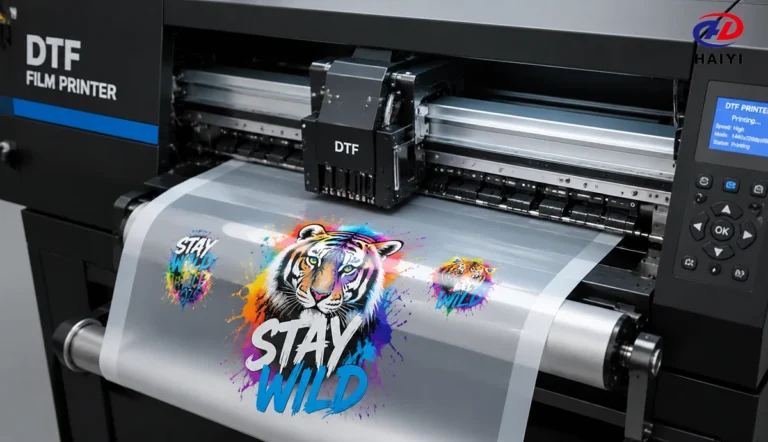
DTF stands for Direct to Film — a printing process where designs are printed onto a special transfer film using DTF ink, coated with hot-melt powder, cured, and then heat-pressed onto fabric.
The film itself — also called DTF transfer film, DTF PET film roll, or simply DTF paper roll — is a polyethylene terephthalate (PET) substrate coated with a special release layer that allows ink to sit precisely on the surface and transfer cleanly under heat and pressure.
Unlike sublimation or screen printing, DTF works on virtually any fabric — cotton, polyester, blends, nylon, leather — without pretreatment.
Why the Film Matters More Than Most People Think
Most print shops focus on ink and printer settings. The film is often an afterthought — until jobs start failing.
The coating on a DTF film roll determines:
- How evenly white ink lays down
- Whether fine details bleed or stay sharp
- How cleanly the film releases from the transfer after pressing
- Whether the adhesion holds through 30, 50, or 80 wash cycles
A film with an inconsistent or low-grade coating introduces variables your printer settings cannot compensate for.
Types of DTF Film
Understanding the types of DTF film available helps you match the right product to your application.
1. Standard PET DTF Film (Hot Peel / Cold Peel)
The most widely used format. Printed with DTF ink, powdered, cured, and transferred to fabric via heat press.
- Hot peel — film is peeled immediately after pressing while still warm. Faster production cycle.
- Cold peel — film is peeled after cooling. Generally produces softer hand feel and higher wash durability.
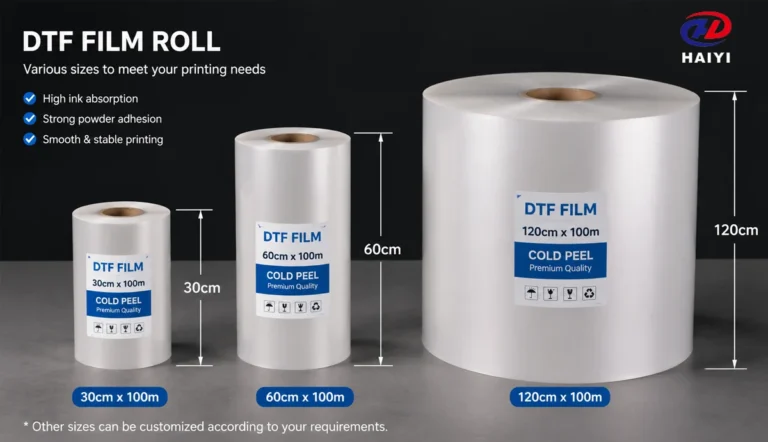
Available as DTF film sheets (cut to A3/A4) or DTF film rolls (typically 100m length).
2. Matte DTF Film
Features a dual-matte coating on both sides. Reduces static buildup, prevents powder from sticking to the non-print surface, and produces a flat, premium finish on the final transfer.
Preferred by high-volume production shops running continuous roll-fed DTF printers. The anti-static surface reduces clogging and reprints significantly.
3. Glossy DTF Film
Produces a shinier surface finish. Used for specific aesthetic applications — sportswear, promotional items, and designs where a high-gloss look is part of the brief.
4. UV DTF Film Roll
A fundamentally different application. UV DTF film is used with UV printers to transfer designs onto hard, rigid surfaces — phone cases, mugs, wood panels, acrylic, glass, and metal.
No powder, no heat press. The UV-cured ink transfers via pressure adhesion. Increasingly popular for product customization and promotional merchandise.
5. DTF Reflective Film
DTF reflective film incorporates a reflective layer that activates under light — used for safety workwear, sportswear, cycling apparel, and high-visibility garments. Specialty application with growing demand in the workwear and outdoor apparel sectors.
6. Stretch DTF Film
Engineered with higher elasticity for athletic and performance apparel. The film flexes with the fabric through movement and repeated washing without cracking or peeling. Essential for sportswear, yoga wear, and compression garments.
DTF Film Roll Sizes Explained
Choosing the right size is not just about what fits your printer — it affects waste, cost per transfer, and workflow efficiency.
Standard Roll Widths
| Width | Common Use | Compatible Printer Type |
|---|---|---|
| 12 inch (30cm) | Small desktop DTF printers | Entry-level A3 DTF printers |
| 13 inch (33cm) | Most popular width | A3+ and mid-range DTF printers |
| 24 inch (60cm) | Production-level shops | Industrial roll-fed DTF printers |
| 30 inch+ | Large-format industrial | High-capacity production lines |
DTF Film Roll 13 Inch
The DTF film roll 13 inch is the most widely used size globally. It fits the majority of desktop and semi-industrial DTF printers sold to print shops. If you are upgrading from DTF film sheets (A3/A4) to roll-fed production, 13 inch is typically the first roll size.
DTF Film Roll 12 Inch
The DTF film roll 12 inch suits smaller desktop printers and is common in markets where entry-level A3 printers are the standard. Slightly narrower than 13 inch — verify your printer’s feed mechanism before ordering.
Roll Length
100 meter rolls are the industry standard for wholesale purchasing. Some suppliers offer 50m rolls for trial orders. For high-volume shops, 100m rolls reduce changeover time and cost per meter.
DTF Film Sheets vs. DTF Film Rolls
| DTF Film Sheets | DTF Film Rolls | |
|---|---|---|
| Format | Pre-cut A3 / A4 | 100m continuous roll |
| Best for | Low volume, white ink shops, sampling | High-volume continuous production |
| Waste | Minimal per sheet | Requires proper roll holder setup |
| Cost per unit | Higher | Lower — bulk pricing advantage |
| Setup | No special feeding mechanism needed | Requires DTF film roll holder |
| Consistency | Batch variation possible | Higher consistency across long runs |
For shops running more than 200 transfers per day, rolls deliver significantly lower cost per transfer than sheets.
DTF Film Roll Holder
A DTF film roll holder keeps the roll feeding smoothly into the printer without tension inconsistencies that cause misalignment or banding. For 100m rolls, a proper holder is not optional — it directly affects print registration and ink laydown uniformity.
When purchasing rolls, confirm whether your printer manufacturer offers a compatible holder or whether a third-party holder fits your setup.
How to Evaluate DTF Film Quality
1. Coating Consistency
The coating is the most critical variable. Haiyi uses its proprietary coating formulation (rather than generic OEM film) to better control ink absorption, adhesion, and surface release properties. This directly translates into consistent product performance per roll and per meter.
2. Anti-Static Performance
Static buildup causes powder to cling to areas of the film it should not. On a dual-matte anti-static film, powder releases cleanly from the non-print surface every time, reducing rework and material waste.
3. Dimensional Stability
Roll curl, edge lifting, and film expansion under heat are signs of poor substrate quality. A stable roll lays flat through the printer, through the powder curing oven, and onto the heat press without distortion.
4. Batch-to-Batch Color Accuracy
For shops running large orders across multiple rolls, color consistency between batches is critical. This requires tight manufacturing tolerances — only achievable with controlled coating processes and systematic quality inspection.
5. Tensile Strength
Film that tears or stretches unevenly during feeding wastes material and disrupts production. Tensile strength testing on every production batch is a sign of a serious manufacturer.
DTF Film Price: What to Expect
DTF film roll price varies based on:
- Roll width and length
- Coating type (standard vs. dual matte vs. specialty)
- Order volume (MOQ and per-roll pricing tiers)
- Supplier type (factory direct vs. distributor)
General Price Range
| Tier | Price Per Meter (approx.) | Profile |
|---|---|---|
| Entry-level | $0.08 – $0.14 | Generic coating, inconsistent batches |
| Mid-range | $0.15 – $0.22 | Decent stability, limited specialty options |
| Premium factory-direct | $0.18 – $0.28 | Proprietary coating, certified, OEM available |
Factory-direct purchasing from a manufacturer eliminates distributor markup — typically 20 to 40% of the retail price. For shops ordering 10+ rolls per month, this difference compounds significantly over a year.
DTF Film Roll Price in Bangladesh
The DTF film roll price in Bangladesh follows import pricing — rolls sourced directly from Chinese manufacturers via sea freight offer the most competitive landed cost. Import duties and local logistics add to the base price, but factory-direct sourcing remains substantially cheaper than purchasing through regional distributors.
DTF Paper for Inkjet Printer
The term DTF paper for inkjet printer is sometimes used interchangeably with DTF film — though technically the substrate is PET film, not paper. The confusion comes from early DTF workflows that used modified inkjet printers.
Modern DTF printers use dedicated DTF ink (not standard inkjet ink) and require PET film specifically coated for DTF. Standard inkjet paper does not work for DTF transfers.
If you are running a modified desktop printer for DTF, verify that the film you source is compatible with your ink type (water-based DTF ink) and print head specifications.
DTF Ink Compatibility
DTF ink is a water-based pigment ink formulated to work with the PET film coating. The ink-film relationship is critical — the coating must be matched to the ink’s viscosity and pigment particle size for proper absorption without bleeding.
When sourcing film from a manufacturer, confirm:
- Ink brand compatibility (or open-system compatibility)
- Recommended white ink laydown settings for that specific film
- Whether the film has been tested with your printer model
How to Find DTF Film Roll Near Me
Searching for DTF film roll near me typically returns local distributors or printing supply shops. For small trial orders, local purchasing makes sense — faster delivery, no import process.
For regular wholesale purchasing, however, local distributors are rarely the most cost-efficient option. Most carry a limited range of widths and coating types, and their pricing includes significant markup over factory cost.
The alternative is importing directly from a manufacturer — which, for buyers in Latin America, Southeast Asia, and other markets, becomes straightforward once the initial import process is understood. Experienced export manufacturers handle documentation, shipping coordination, and customs guidance as part of the service.
Why Manufacturer Experience Matters
The DTF film market has attracted many new entrants selling generic, unbranded film at low prices. The risk with unverified suppliers is not just quality inconsistency — it is the unpredictability of supply, spec changes without notice, and no technical support when production issues arise.
A manufacturer with a long track record in DTF consumables brings:
- A tested, refined coating formula rather than off-the-shelf components
- Established quality management systems with documented inspection processes
- Export experience — understanding of international shipping, documentation, and compliance requirements
- Technical support based on real production data, not generic spec sheets
Haiyi has manufactured DTF film and heat transfer consumables for 15 years. The coating formula is developed and produced in-house — giving full control over the variables that determine print quality. Every roll passes multi-stage quality inspection before shipment. For wholesale buyers and distributors who run at scale, consistent supply and consistent quality are the non-negotiables. That is what 15 years of manufacturing experience is built to deliver.
Choosing the Right DTF Film: Quick Decision Guide
You run a small shop with an A3 desktop DTF printer → Start with A3/A4 DTF film sheets or a 13 inch roll. Prioritize hot-peel film for faster production.
You run high-volume continuous production → 100m dual-matte anti-static rolls in your printer’s width. Cold-peel for better wash durability. Invest in a proper roll holder.
Your clients are in sportswear or athletic apparel → Stretch-grade DTF film with tested wash durability (50+ cycles minimum).
You print on hard surfaces (cases, wood, acrylic) → UV DTF film roll — completely different process from fabric DTF.
You need safety/visibility apparel → DTF reflective film — specialty product, verify supplier has this in stock.
You are scaling and want to reduce cost per transfer → Move to roll purchasing, increase order volume, and source factory-direct.
FAQ
What is DTF film made of? DTF film is made from a PET (polyethylene terephthalate) substrate coated with a proprietary release and ink-reception layer. The coating quality determines adhesion, ink sharpness, and transfer durability.
What is the difference between hot peel and cold peel DTF film? Hot peel film is removed from the garment immediately after heat pressing while still warm — faster workflow. Cold peel is removed after cooling and generally produces a softer hand feel with better wash resistance.
What size DTF film roll do I need? Match the roll width to your printer’s maximum print width. The 13 inch DTF film roll fits most A3+ desktop and semi-industrial DTF printers. Larger production printers typically use 24 inch or wider rolls.
Can I use DTF film with a regular inkjet printer? Standard inkjet printers are not designed for DTF film. DTF requires a dedicated DTF printer or a properly modified printer using DTF-specific ink. Using standard inkjet ink on DTF film will not produce usable transfers.
What is UV DTF film? UV DTF film is used with UV printers to transfer designs onto hard surfaces — phone cases, mugs, wood, acrylic, and metal. It does not require powder or heat pressing. It is a different process from standard fabric DTF.
Why does my DTF film curl or lift at the edges? Edge curl is typically caused by poor dimensional stability in the film substrate, incorrect storage (humidity and temperature fluctuations), or mismatched film and printer settings. High-quality film with proper substrate control and flat storage conditions eliminates this issue.
How do I store DTF film rolls? Store rolls horizontally in a cool, dry environment away from direct sunlight. Avoid high humidity. Reseal opened rolls in their original packaging between uses.
What is the minimum order quantity for wholesale DTF film rolls? MOQ varies by manufacturer. Factory-direct suppliers typically offer lower MOQs than distributors — some as low as 5 to 10 rolls per order for new buyers, with better pricing at higher volumes.
Is DTF film the same as DTF paper? They refer to the same product. “DTF paper” is a colloquial term — the actual substrate is PET film, not paper. Both terms describe the transfer film used in the DTF printing process.
How many transfers can I get from a 100m DTF film roll? It depends on design size and layout efficiency. A 13 inch wide, 100m roll used for standard A4-sized gang sheets can yield approximately 200 to 400 individual transfers depending on nesting efficiency.
Conclusion
The DTF film roll you choose is not a commodity decision — it is a production infrastructure decision. The wrong film introduces waste, rework, and inconsistency that no printer setting or ink adjustment can fix. The right film, from a manufacturer with real control over the coating process and a track record of consistent supply, removes one of the largest variables from your production workflow.
Key points to take away:
- Match roll width and peel type to your printer and end-use application
- Evaluate coating quality, anti-static performance, and dimensional stability — not just price per meter
- For sportswear, use stretch-grade film; for hard surfaces, use UV DTF film; for high-visibility, use reflective film
- Factory-direct purchasing from an experienced manufacturer delivers both cost savings and supply consistency
- A supplier with 15+ years of manufacturing experience and a proprietary coating formula is a fundamentally different proposition from a generic reseller
Whether you are searching for a DTF film roll near me for a quick trial or building a reliable import supply chain for monthly wholesale volumes, the decision framework is the same: prioritize coating quality, production consistency, and supplier reliability over the lowest price per meter.
Haiyi is a DTF film and heat transfer consumables manufacturer with 15 years of production and export experience. All film is manufactured using a proprietary in-house coating formula and passes multi-stage quality inspection before shipment. Wholesale pricing, OEM packaging, and low MOQ options available.