

What Is UV DTF Film? The Complete Guide to UV Transfer Stickers for Products and Branding
What is crystal label? Complete guide to UV transfer stickers — structure, process, durability, surfaces, and applications for packaging and branding.

Read time: 10 minutes
Introduction
A beverage brand wants their logo to glow with depth on a frosted glass bottle. A cosmetics company needs product labels that survive humidity, handling, and occasional splashes without peeling. A gift packaging manufacturer wants dimensional, high-clarity decoration on a tin box — without the setup cost of traditional embossing dies.
UV DTF Film solves all three.
UV DTF Film — known in Chinese manufacturing as, and in technical terms as UV transfer sticker or transparent AB film — is a high-transparency, pressure-adhesive decorative label produced through UV printing on a specialty polymer film. The result is a label with optical clarity, raised visual depth, scratch resistance, and waterproof adhesion that conventional paper or vinyl stickers cannot match.
This guide covers everything: what UV DTF Film is, how it is made, how long it lasts on different surfaces, where it is used, and why it is increasingly the preferred label format for premium product packaging and brand merchandise.
What Is UV DTF Film?
UV DTF Film is a specialty label product that combines the optical properties of crystal-clear polymer film with UV-printed design and a pressure-sensitive adhesive backing.
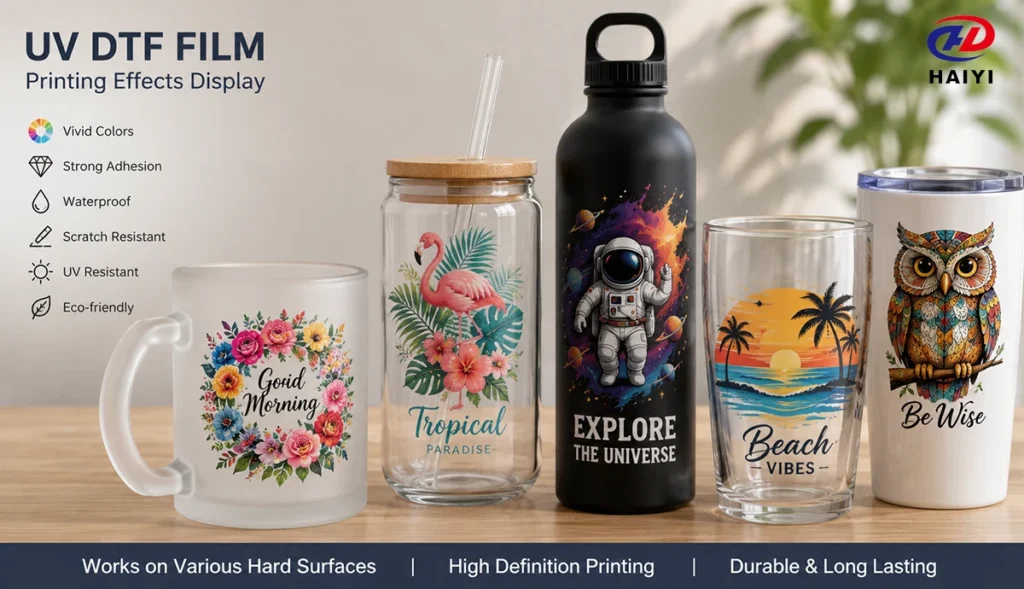
The name comes from its appearance: when applied to a surface, the UV-printed design appears to float within a clear, glass-like layer. The label does not look like a sticker — it looks like part of the product surface, with the design appearing to be directly on or embedded in the object.
Two naming conventions for the same product:
UV DTF Film: The Chinese manufacturing industry term. Literally translates as “UV DTF Film” or “crystal mark.”
UV Transfer Sticker / Transparent AB Film: Technical English-language terms used in the packaging and printing industry.
Crystal AB Film: Also used, referencing the A film (carrier) and B film (transfer) structure that is characteristic of UV transfer products.
The defining characteristic that separates UV DTF Film from regular stickers: the label is structurally transparent. The design is embedded within a clear polymer layer, not printed on top of an opaque substrate. When applied, the design appears as if it is part of the object surface, with the surrounding clear area completely invisible on glossy surfaces.
How UV DTF Film Is Structured: Three Layers
Understanding the three-layer structure explains both the application process and the performance properties.
Layer 1 — Surface Protective Film (Top)
A thin protective layer on the outermost surface of the UV DTF Film before application. This film:
- Protects the UV-printed design during handling, cutting, and transport
- Is removed during application — it is the layer you peel away to expose the design
- Provides temporary surface protection against fingerprints and environmental contamination before use
This layer is typically a PET or PP release film. It is discarded after application and is not part of the finished label.
Layer 2 — Crystal / UV-Printed Polymer Layer (Middle)
The core functional layer. This is a high-transparency polymer film onto which the design is UV-printed.
UV printing deposits UV-curable inks (CMYK plus white for opaque areas, plus varnish for surface effects) onto the film surface. UV LED or UV lamp exposure cures each ink layer instantly — producing fully dry, hard, vibrant color before the next layer is deposited.
Properties of this layer:
- Optical transparency: 95%+ in unprinted clear areas
- UV ink color saturation: vivid, photographic-quality reproduction
- Surface hardness: scratch-resistant (typical pencil hardness 2H to 4H after UV curing)
- Dimensional stability: does not stretch or deform under normal handling
Layer 3 — Backing Paper (Bottom)
The backing layer that protects the adhesive and provides the substrate for cutting and handling before application. Available in two variants:
Clear backing paper: Allows positioning of the label precisely by seeing through to the target surface. Used for precision applications where alignment with existing design elements is required.
White backing paper: Standard for most applications. Provides clear contrast for visual inspection of the label before application.
The backing paper is peeled away during application — exposing the pressure-sensitive adhesive that bonds the label to the target surface.
The Manufacturing Process: Design to Application
UV DTF Film production follows four stages.
Stage 1 — Design
The design file is prepared for UV printing: typically vector artwork or high-resolution raster at 300 DPI minimum. Unlike conventional label printing, UV DTF Film design should account for transparency — areas not covered by opaque ink will be see-through on the final label, which is often the intended effect on glossy surfaces.
Design considerations:
- White ink layer placement for opacity where required (particularly for dark surface applications)
- Clear areas where the target surface shows through the label
- Varnish or spot-gloss layer for surface texture effects
- Bleed area for cutting registration
Stage 2 — UV Printing
Designs are printed on the crystal film using a UV printer. The printing sequence:
- White ink layer first (where opacity is required)
- CMYK color layers
- Varnish/clear coat (optional — for gloss, matte, or texture effects)
Each layer cures under UV light immediately after deposition — no drying time required. This enables full-color printing with precise layer registration and immediate handling after printing.
One of the most practical advantages: print-on-demand production with no minimum runs. Unlike offset or flexo label printing that requires plate setup, UV printing produces one label as efficiently as one thousand. This makes UV DTF Film ideal for short-run personalization, seasonal packaging, and prototype quantities.
Stage 3 — Cutting
After printing, the label sheet is cut to the final label shape using:
- Digital flatbed cutter: Laser or knife cutting for complex shapes, variable data, or short runs without cutting dies
- Die cutting: Steel-rule dies for high-volume production of consistent shapes
- Laser cutting: For the cleanest edge quality on complex curves
Cutting must maintain label integrity — clean edges without delamination of the polymer layers.
Stage 4 — Application (Peel and Stick)
UV DTF Film application is a one-step peel-and-stick process:
- Peel the backing paper to expose the adhesive
- Position the label on the clean target surface
- Press firmly across the full label area — squeegee or fingertip application
- Peel the surface protective film (the design remains on the target surface)
- Done
The entire application takes under 60 seconds per label. No heat press. No UV light at the application site. No special equipment.
UV DTF Film Properties: Why It Outperforms Regular Stickers
UV DTF Film’s performance characteristics derive from UV printing technology and polymer film substrate — a fundamentally different material system from conventional paper or vinyl stickers.
High Transparency (95%+ Optical Clarity)
Clear areas of the UV DTF Film are optically clear — not the milky or slightly hazy transparency of vinyl stickers. On glossy surfaces (glass bottles, lacquered tin, polished stainless steel), the clear areas of the label are essentially invisible. Only the design is visible — creating the impression that the design is printed directly on the surface.
High Hardness and Scratch Resistance
UV-cured ink and polymer coating achieve pencil hardness of 2H to 4H. The label surface resists scratching from keys, other product surfaces during shipping, and normal handling. Conventional paper labels develop visible scuffs; UV DTF Films maintain appearance under similar conditions.
Strong Adhesion
The pressure-sensitive adhesive system provides immediate, strong bonding to hard surfaces without heat or solvents. Adhesion improves over 24 to 48 hours as the adhesive fully flows into surface micro-features. Once fully adhered, the label cannot be cleanly removed without damaging the label — this permanence is a feature for brand protection and product authentication applications.
Waterproof and Humidity Resistant
UV-cured inks are inherently water-resistant — the cured polymer is non-porous and hydrophobic. The adhesive layer maintains bond strength when the label surface is exposed to water, condensation, or moderate humidity. Appropriate for beverage containers, personal care products, and outdoor promotional items.
Heat Resistance
UV DTF Films withstand moderate heat exposure — suitable for products that encounter typical shipping, storage, and retail temperature ranges. Not suitable for surfaces that reach above 80 to 100°C in normal use (hot oven cookware, direct flame exposure).
Immediate Usability After Production
UV printing produces fully cured labels immediately after printing. Unlike solvent-based or water-based inks that require drying or curing time, UV labels can be handled, cut, and applied immediately. This enables same-day turnaround from design to finished label.
Eco-Safe Materials
Quality UV DTF Film production uses UV inks without organic solvents and adhesive systems that comply with international safety standards. Labels produced with OEKO-TEX compliant materials are safe for food-adjacent packaging (external packaging only — not direct food contact) and children’s product applications.
How Long Does UV DTF Film Last?
UV DTF Film longevity depends on surface type and environmental conditions. Here are realistic durability expectations.
Hard, Non-Porous Surfaces (Glass, Ceramics, Glazed Surfaces)
Glass bottles, ceramic mugs, glazed tile, crystal glassware — months to several years under typical conditions. The combination of strong adhesive bonding to smooth, non-porous surfaces and UV-resistant ink chemistry produces excellent long-term adhesion.
Key factor: Surface cleanliness at application time. Oil, fingerprints, or residues dramatically reduce adhesion durability. Apply only to clean, dry surfaces wiped with isopropyl alcohol.
Metal Surfaces (Stainless Steel, Aluminum, Tin, Iron)
Non-oxidizing metals (stainless steel, anodized aluminum): months to years. The stable surface provides consistent adhesion.
Oxidizing metals (bare iron, untreated copper, some aluminum alloys): shorter durability as surface oxidation creates a layer between the metal and the adhesive.
Powder-coated metal: good adhesion when the coating is fully cured and undamaged. Test adhesion before production application on new powder coat formulations.
Plastic Surfaces (ABS, PC, PET, PP)
Variable depending on plastic type and surface treatment. Hard engineering plastics (ABS, PC) provide excellent adhesion. Polyolefins (PP, PE) are naturally low-adhesion surfaces — test before committing to production.
Surface cleanliness is critical on plastics — mold release agents from manufacturing can remain on plastic surfaces and severely reduce label adhesion. Wipe with isopropyl alcohol before application.
Paper and Cardboard Packaging
UV DTF Films on packaging boxes and cardboard: months under dry storage and retail conditions. Not suitable for packaging exposed to moisture — paper and cardboard absorb moisture and delaminate from adhesive.
Durability-Reducing Factors
- Moisture: Prolonged water immersion weakens adhesive bonds on any surface type
- Chemical exposure: Strong solvents, cleaning agents, or UV-degrading chemicals accelerate label aging
- UV exposure: Direct long-term sunlight fades UV inks more quickly than indoor conditions — specify UV-stabilized inks for outdoor applications
- Extreme temperature cycling: Repeated freeze-thaw or hot-cold cycles stress the adhesive-surface interface
Compatible Surfaces: Where UV DTF Film Works Best
| Surface Type | Adhesion | Notes |
|---|---|---|
| Clear glass | Excellent | Label appears nearly invisible — design floats |
| Frosted glass | Excellent | Contrast between clear label and frosted surface is distinctive |
| Glazed ceramic | Excellent | Popular for mugs, pottery, promotional ceramics |
| Stainless steel | Excellent | Ideal for tumblers, water bottles, kitchenware |
| Anodized aluminum | Very Good | Clean anodized surface essential |
| Tin/iron packaging | Good | Common for tea canisters, gift tins, cosmetic packaging |
| ABS / PC plastic | Good | Clean and degrease before application |
| Acrylic (PMMA) | Good | Crystal-clear result on clear acrylic |
| Lacquered / varnished surfaces | Good | Lacquer must be fully cured before application |
| Packaging boxes (coated) | Acceptable | For retail display use — not moisture exposure |
| PP / PE plastic | Requires testing | Low surface energy — adhesion promoter may be needed |
Not recommended: Fabric, silicone, heavily textured surfaces, surfaces with active oxidation or corrosion, or any surface that cannot be cleaned to remove oils and residue.
Applications: Industries and Use Cases
Wine, Spirits, and Beverage Packaging
UV DTF Film is widely used for premium alcohol brands where the label must communicate luxury. The optical clarity allows the label to appear as if the design is on the glass itself — particularly effective on dark-glass wine bottles and crystal decanters. UV printing enables photographic-quality label design at any quantity, including limited-edition runs that would not justify conventional plate-based printing.
Cosmetics and Personal Care
Serums, perfume bottles, skincare packaging, and personal care products frequently use UV DTF Film for primary product labels and secondary decoration. The waterproof, humidity-resistant properties are essential — personal care products encounter moisture in bathrooms, where conventional paper labels fail.
Tea, Coffee, and Food Packaging Tins
Tea canisters, coffee tins, and specialty food tins use UV DTF Film for brand marks, flavor identification, and decorative elements. The adhesion to painted tin and lacquered metal is strong, and the design quality achievable with UV printing exceeds what screen printing produces at comparable cost for short runs.
Gift Packaging and Promotional Products
Gift boxes, ribbon packaging, premium candles, and promotional merchandise use UV DTF Film to add high-perceived-value decoration without tooling investment. A gift tin with a UV DTF Film brand mark looks custom-manufactured. The instant print-on-demand capability enables personalized gift packaging at one-unit quantity.
Branded Merchandise and Corporate Gifts
Tumblers, water bottles, tech accessories, and corporate gift items use UV DTF Film for logo application. The scratch resistance and waterproofing make UV DTF Film more durable than standard decal application on frequently handled items.
Temporary Marking and Event Identification
Events, trade shows, and temporary displays use UV DTF Film for quick-turnaround name badges, product tagging, and event branding. The ease of application and removal on smooth surfaces (with reduced adhesive variants) makes it practical for temporary identification applications.
UV DTF Film vs Regular Labels vs Hot Stamping: Comparison
| Feature | UV DTF Film | Regular Paper Label | Hot Stamping / Foil |
|---|---|---|---|
| Transparency | High — optically clear | Opaque substrate | Opaque (foil layer) |
| Color quality | Full photographic color via UV | Full color via digital or offset | Single color per foil |
| Minimum quantity | 1 unit (print-on-demand) | Low for digital, high for offset | High — die setup required |
| Setup cost | None (UV printing, no plates) | Low to high (depends on method) | High (die tooling) |
| Scratch resistance | High (UV-cured surface) | Low-medium | High (foil layer) |
| Waterproofing | Excellent | Requires lamination | Good |
| Surface compatibility | Hard smooth surfaces | Paper, some plastic | Metal, plastic, packaging |
| Dimensional effect | Slight depth perception | Flat | Embossed (with die) |
| Application method | Peel and stick | Peel and stick or glue | Heat press or stamping machine |
| Cost per unit (short run) | Low-medium | Low-medium | High |
UV DTF Film occupies a unique position: it provides the visual quality of hot stamping or metallic foil treatment at a fraction of the setup cost, with the color flexibility of digital printing, on short runs that conventional decorative methods cannot serve economically.
How to Apply UV DTF Film Correctly
Correct application is the difference between a UV DTF Film that lasts years and one that starts peeling within weeks.
Step 1 — Prepare the Surface
Clean the application surface thoroughly with isopropyl alcohol (70% or higher concentration). This removes oils, fingerprints, dust, and manufacturing residues. Allow 30 to 60 seconds for the IPA to fully evaporate before proceeding.
Do not touch the cleaned surface with bare hands after cleaning. A single fingerprint deposits enough oil to cause localized adhesion failure.
Step 2 — Peel the Backing Paper
Peel the backing paper from the UV DTF Film to expose the pressure-sensitive adhesive. Work quickly after peeling — exposed adhesive attracts dust from the air within minutes.
Step 3 — Position and Press
Place the label on the target surface. Once the adhesive contacts the surface, repositioning disturbs the adhesive surface — aim for correct placement on first contact.
Press firmly from center to edges using a squeegee or fingertip. Apply firm, even pressure across the entire label area to ensure complete contact between adhesive and surface.
Step 4 — Peel the Surface Film
Peel the surface protective film slowly at a flat, low angle. The design remains on the surface. The clear film is discarded.
If any edge of the design starts to lift with the film, press it back down firmly and allow 30 seconds before attempting to peel again.
Step 5 — Allow 24 to 48 Hours for Full Adhesion
The adhesive achieves its full bond strength over 24 to 48 hours as it flows into surface micro-features. Avoid exposing the label to moisture, chemicals, or mechanical stress during this initial curing period.
About Haiyi: UV DTF Film Film Manufacturer
Haiyi Material Technology Co., Ltd. manufactures UV DTF Film film as part of its full heat transfer and specialty film product range.
Our UV DTF Film film uses high-transparency polymer substrate with UV-printable surface coating — engineered for optical clarity, strong adhesive performance, and UV ink compatibility across the full CMYK plus white printing system.
UV DTF Film is one of several specialty transfer film products in the Haiyi range:
Full product range:
- DTF film (30 cm × 100 m, 60 cm × 100 m, 1200 mm × 4000 m jumbo rolls)
- UV DTF AB film (A film + B film for hard surface UV DTF)
- UV DTF Film film ( UV transfer sticker)
- Reflective heat transfer film
- DTF printers, sublimation printers, UV printers
ISO 9001 certified. OEKO-TEX Standard 100 certified for chemical safety.
For UV DTF Film film, wholesale pricing, OEM/ODM inquiries, or full product catalog:
FAQ
What is UV DTF Film? UV DTF Film ( also called UV transfer sticker or transparent AB film) is a three-layer specialty decorative label: a surface protective film, a UV-printed transparent polymer layer, and an adhesive backing paper. After application, the surface film is peeled away, leaving the UV-printed design permanently bonded to the target surface with high optical clarity — the design appears to float on or within the product surface.
What surfaces does UV DTF Film work on? UV DTF Film adheres best to hard, smooth, non-porous surfaces: glass, glazed ceramic, stainless steel, aluminum, tin, acrylic, and coated hard plastics. It does not adhere reliably to fabric, silicone, low-energy plastics (PP, PE) without adhesion promoter, or porous surfaces. Surface cleanliness with isopropyl alcohol before application is essential for maximum durability.
How long does UV DTF Film last? On properly prepared hard surfaces: months to several years depending on environment. Glass, ceramic, and stainless steel provide the best durability — months to years under typical conditions. Durability is reduced by prolonged moisture immersion, chemical exposure, direct UV sunlight, and extreme temperature cycling. The most important durability factor is surface preparation at application time.
Is UV DTF Film waterproof? Yes. UV-cured inks are inherently water-resistant and the polymer substrate is non-porous. UV DTF Films resist water, condensation, and moderate humidity. They are suitable for product packaging exposed to bathroom environments, beverage condensation, and typical outdoor humidity. They are not designed for continuous submersion.
What is the minimum order quantity for UV DTF Film? Because UV DTF Film is produced by UV printing, minimum quantities can be as low as one label for digital production. There are no plate or die setup costs. OEM UV DTF Film film in roll format is available at wholesale quantities — contact your UV DTF Film film manufacturer for pricing on unprinted crystal film for in-house UV printing.
How is UV DTF Film different from regular stickers? UV DTF Film provides high optical transparency (95%+ clear areas), UV-printed photographic color quality, scratch-resistant surface hardness, and waterproofing — properties that conventional paper, vinyl, or polyester stickers cannot match simultaneously. The application process (peel-press-peel) is similar, but the visual result and durability are significantly superior.
Can UV DTF Film be used for food packaging? UV DTF Film is suitable for external surfaces of food packaging containers — tin cans, glass jars, bottle exteriors, packaging boxes. It is not suitable for direct food contact applications. Material safety should be verified with your supplier (OEKO-TEX certified materials comply with textile and packaging chemical safety standards).
Conclusion
UV DTF Film is not a premium version of a regular sticker. It is a different category of product — one that solves decoration problems that conventional labels cannot.
On a frosted glass bottle, UV DTF Film creates the impression that the design is etched into the glass. On a matte tin canister, it adds a dimension of depth that screen printing cannot replicate. On a personalized gift tumbler, it produces photographic quality at any quantity, without tooling, with same-day production.
The combination of properties — optical clarity, UV print quality, scratch resistance, waterproofing, pressure-sensitive adhesion to smooth hard surfaces, and zero minimum quantities — makes UV DTF Film one of the most flexible label formats available to packaging designers, brand teams, and product decorators.
For businesses sourcing UV DTF Film film for in-house UV printing, the same criteria apply as for any specialty film: look for a manufacturer that controls the film substrate and coating chemistry, can provide certified material safety documentation, and has export experience for your market.