




The Ink-Absorbing Coating on DTF Film: The Hidden Layer That Decides Everything About Print Quality

The Layer Nobody Talks About
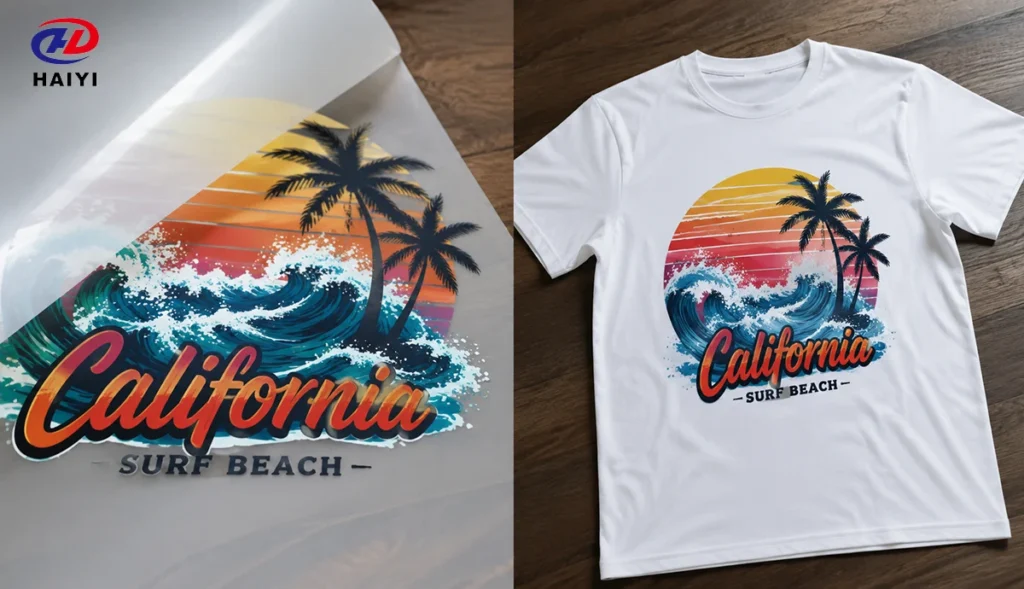
A custom T-shirt survives fifty washes without the design fading. The print stretches across the chest when you pull the shirt on and snaps back without cracking. The colors on a black cotton hoodie are as vivid as a print on a white polyester jersey.
People credit the printer. They credit the ink. They credit the heat press.
Very few people think to credit the thin coating applied to the surface of the PET film — the layer measured in micrograms per square centimeter that makes all of it possible.
In DTF (Direct to Film) printing, the ink-absorbing coating is the decisive variable. Not because it is the most expensive component. Not because it is the most complex piece of equipment. But because it sits at the intersection of every other variable in the process: it receives the ink, holds the powder, controls the release, and ultimately determines whether the finished design holds up for decades or fails at the first wash.
This article explains what the ink-absorbing coating is, how it works, what its chemistry does, how it ages, and why the manufacturer who develops it in-house produces a fundamentally different product from one who does not.
What Is the Ink-Absorbing Coating on DTF Film?
DTF film is not a simple plastic sheet. The base material — BOPET (biaxially oriented polyethylene terephthalate) — is an inert, hydrophobic substrate. Left uncoated, water-based DTF ink would bead up and slide off its surface immediately.
The ink-absorbing coating transforms this inert plastic into a precision printing medium.
Applied at 3.5 to 6 grams per square meter on the print side of the PET film, the coating is a polymer composite system containing:
- Resin matrix: Provides the structural film that adheres to the PET base and holds the coating together. Aliphatic waterborne polyurethane (PU) resin is the preferred matrix for high-performance applications — it delivers the flexibility and chemical resistance that define premium coating behavior.
- Nano-scale fillers: Fumed alumina (Al₂O₃) or fumed silica (SiO₂) particles with diameter below 500 nanometers create a microporous network within the coating. These micropores adsorb ink droplets, fixing them in place within milliseconds of contact.
- Functional additives: Surface tension modifiers, leveling agents, anti-static compounds (in dual-matte coatings), and release chemistry. Each additive serves a specific performance function.
The coating weight of 3.5 to 6 g/sqm sounds minimal. But within this thin layer, the complete ink-reception and transfer-release mechanism operates.
Three Core Functions the Coating Must Perform
The ink-absorbing coating must execute three functions simultaneously — and each one can fail independently.
Function 1 — Ink Anchoring: Fast Fixation, Zero Spread
When a DTF printer deposits ink droplets onto the film surface, the coating must absorb them instantly. The droplet must spread slightly — enough to achieve complete coverage of the intended print area — but not so much that adjacent droplets merge and blur detail edges.
This is a precision balance. The coating’s microporous structure creates surface tension gradients that control droplet spread to within the designed parameters. At 100% ink coverage, the coating must hold every ink channel — white, cyan, magenta, yellow, and black — without any channel bleeding into adjacent areas.
The consequence of failure: Ink bleeding at fine detail edges. Small text becomes illegible. Thin lines merge. Gradients develop visible artifacts. No printer setting change can correct coating porosity failure — the problem is in the film, not the machine.
Function 2 — Release Behavior: Clean Separation at the Right Moment
After the design is pressed to fabric, the PET film must separate cleanly from the bonded design. The ink and adhesive have transferred to the garment. The coating must release from this structure without pulling ink back, without leaving residue on the fabric, and without tearing at fine detail edges.
This release behavior is engineered into the coating chemistry — not accidental. The release layer chemistry creates specific adhesion values between the coating and the cured ink: low enough to release at pressing temperature, high enough to hold during printing and powdering.
The consequence of failure: Ink lifts from the design surface during peeling. Fine details are incomplete. The film tears at design edges. Film residue appears on the fabric surface.
Function 3 — Flexibility and Wash Durability
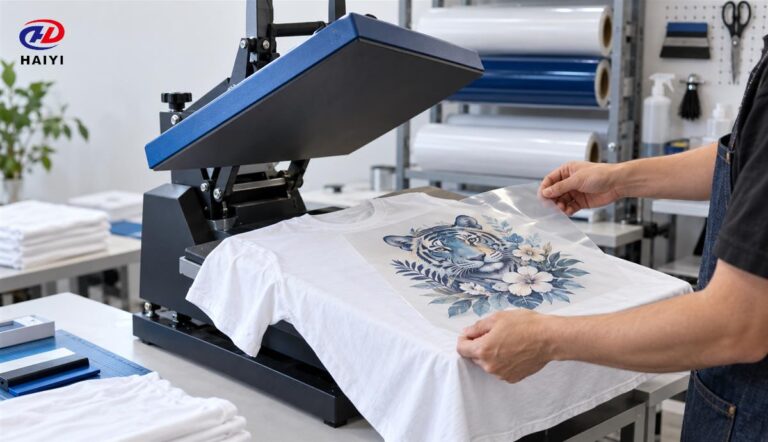
The coating is not removed during transfer — it remains at the interface between the ink layer and the PET film during pressing, then separates as the film is peeled. What matters for the finished garment is the behavior of the ink-adhesive layer that was held in place by the coating.
But the coating’s physical properties during transfer directly affect this. A coating that is brittle transfers a design that behaves brittlely. A coating formulated with the correct polyurethane chemistry — particularly aliphatic waterborne PU resin — produces a flexible adhesive interface that stretches with the fabric.
The consequence of failure: Crack lines in the design when the garment is stretched. Design fracture during the mechanical action of machine washing. Premature edge lifting after 3 to 5 wash cycles rather than the 30 to 50+ that quality coatings achieve.
The Chemistry Behind the Coating
The coating formula that makes DTF film work is not guesswork — it is precision chemistry applied to a specific set of physical requirements.
Polyurethane Resin Matrix
Two resin types are used in DTF film coatings, each suited to different market positions.
Aliphatic waterborne polyurethane: The performance choice for high-end applications. Aliphatic PU chains are more resistant to UV degradation, more flexible under repeated strain, and more resistant to hydrolysis (the chemical breakdown from water and detergent exposure in washing). This resin system is required for sportswear, children’s clothing, and any application where wash durability is measured in tens of cycles rather than a handful.
Hybrid resin systems: A balance between performance and cost. Hybrid formulations combine PU with acrylic or polyester components to achieve adequate wash durability at lower raw material cost. Appropriate for everyday casual garments and promotional merchandise where 20 to 25 wash cycles is sufficient.
Nano-Scale Fillers: The Microporous Engine
The ink-absorbing mechanism depends on nano-scale filler particles suspended in the resin matrix:
Fumed alumina (Al₂O₃): Creates a network of micropores 20 to 200nm in diameter. These pores adsorb water-based ink droplets by capillary action — drawing ink into the structure and holding it against lateral spread. Fumed alumina also improves coating surface hardness and abrasion resistance.
Fumed silica (SiO₂): Provides additional micropore structure and improves coating surface smoothness. Used in combination with alumina or as a primary filler depending on the specific ink system being served.
Particle size control (below 500nm): This is critical. Particles above 500nm create visible surface roughness that affects print quality and release behavior. Particles below 500nm integrate into the polymer matrix without disrupting surface smoothness while providing maximum surface area for ink adsorption.
Water-Based Chemistry and Environmental Compliance
Modern DTF film coatings are water-based — the coating materials are dispersed in water rather than organic solvents. This shift serves two purposes:
Environmental compliance: Water-based coatings contain no VOCs (volatile organic compounds) and comply with EU textile environmental standards. The finished film is safe for garment applications and meets OEKO-TEX Standard 100 chemical safety requirements.
Process efficiency: Water-based systems can be applied on coating lines without explosion-proof infrastructure and dried in standard hot-air ovens without solvent recovery equipment.
How the Coating Interacts with DTF Ink
The relationship between the coating and the ink is the most performance-sensitive interaction in the entire DTF system.
DTF inks are water-based pigment formulations. The white ink contains titanium dioxide (TiO₂) as the opacity pigment — suspended in a water-based binder. CMYK inks use organic pigments in similar binder systems.
When these inks hit the coating surface, three things happen in rapid sequence:
Wetting: The ink droplet contacts the coating surface and begins to spread. The coating’s surface energy determines how fast and how far. A coating optimized for DTF ink has surface energy tuned to allow controlled wetting without over-spreading.
Adsorption: The microporous structure draws ink into the coating layer. The pigment particles (too large to enter the micropores) concentrate at the coating surface. The ink binder penetrates the micropore structure. This creates a stratified structure: pigment layer at the surface for color visibility, binder layer anchored in the micropore network for mechanical stability.
Fixation: As the ink binder dries and cross-links, the pigment particles are permanently anchored to the coating surface. The design is now fixed — ready for powder application.
The quality of this three-stage process directly determines print sharpness, color density, and the mechanical integrity of the ink layer during subsequent pressing and washing.
How the Coating Interacts with Hot-Melt Powder
Immediately after printing, hot-melt adhesive powder is applied to the wet ink surface. The coating’s role in this step is to be completely passive — to have no interaction with the powder in non-printed areas.
This is where anti-static coating quality becomes critical.
Plain PET substrate accumulates static charge during printing and powder application. This static attracts powder particles to non-printed film areas, creating contamination that melts onto the garment during pressing. The result: visible haze or adhesive contamination around the design on finished garments.
The anti-static coating on the back of dual-matte DTF film dissipates this charge before it attracts powder. The coating formulation includes ionic or non-ionic anti-static compounds that maintain surface resistivity below 10^10 ohms — the threshold below which powder contamination is effectively eliminated.
In the printed areas, the coating serves the opposite function: it ensures the wet ink surface presents an ideal surface for powder adhesion. The powder must adhere uniformly — including at fine detail edges and in thin lines where ink deposit is minimal.
A coating that maintains appropriate surface chemistry in printed areas while controlling static in non-printed areas is executing simultaneous and opposing requirements. This is one reason why coating formula complexity is underappreciated outside of the manufacturing context.
How Coating Quality Determines Wash Durability
The connection between coating formulation and wash durability is direct — not theoretical.
After transfer, the ink-adhesive layer on the garment was shaped by the coating. The flexibility, density, and cross-link structure of this layer was determined during printing and pressing. The coating chemistry that held the ink during those steps also determined how the transferred layer will behave under mechanical stress.
Aliphatic PU-based coatings produce transferred designs that:
- Elongate with the fabric under stretching without cracking
- Resist hydrolysis — the chemical attack of hot water and detergent on the polymer chain structure
- Maintain adhesion to fabric fibers through the flexing and abrasion of machine washing
Test standard: AATCC 61 (American Association of Textile Chemists and Colorists) — the international standard for color fastness to laundering. Quality DTF film with properly formulated coating enables designs to meet AATCC 61 after 30 to 50 machine wash cycles at 40°C. Some premium coating systems achieve compliance after 50+ cycles.
The failure mode of inadequate coating: A coating formulated with lower-grade resin produces transferred designs that begin cracking under fabric stretch after 5 to 10 wash cycles. The failure starts at the design edges — where coating coverage was thinnest and where fabric flex stress is highest.
The Generation-by-Generation Evolution of DTF Coating Technology
DTF film coating technology has gone through four identifiable generations since DTF printing emerged as a commercial process.
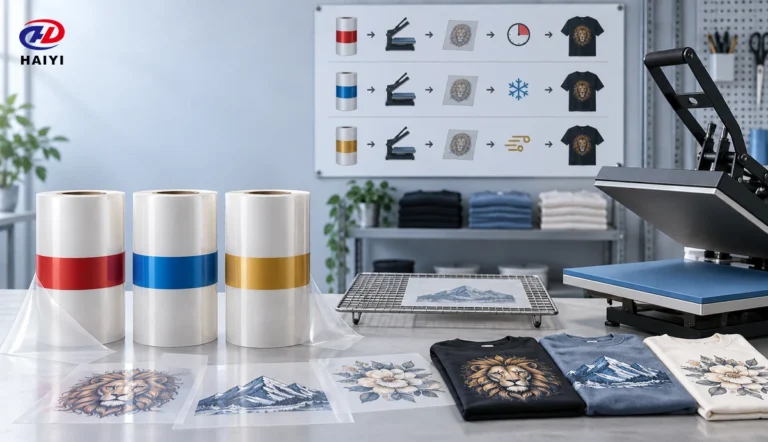
Generation 1 — Separate-Layer Architecture
Early DTF film used a multi-layer coating structure: the ink-absorbing layer applied first, then a separate release layer on top. The two layers had to be applied in sequential coating passes, then dried between passes. This added production time, introduced inter-layer adhesion risk, and made quality control more complex.
Limitation: Two-pass coating was slow, costly, and produced inconsistent layer interface quality.
Generation 2 — Combined Ink-Absorbing and Release Layers
Second-generation coatings integrated the ink-absorbing function and the release chemistry into a single coating layer. One coating pass replaced two, dramatically improving throughput and reducing interface adhesion variability.
Limitation: The single layer had to compromise between ink absorption optimization and release optimization — two properties that are not always aligned.
Generation 3 — Three-in-One Function
Third-generation coatings added anti-static function to the combined ink-absorbing and release chemistry. A single coating pass on the print side, plus a single anti-static pass on the back, replaced the multiple-layer approach entirely. The “three-in-one” terminology describes this consolidation.
Advancement: Higher production efficiency, more consistent anti-static performance across the roll, improved release force consistency.
Generation 4 — Fine-Formulation and Environmentally Compliant Chemistry
Current state of the art. Generation 4 coatings use refined resin composite and nano-filler dispersion technology to achieve higher uniformity at lower coating weights. The coating-to-substrate adhesion is stronger. Release force for peeling is lighter and more consistent.
Critically, Generation 4 formulations are entirely water-based, eliminating organic solvents and achieving compliance with EU textile environmental standards. These coatings can be certified under OEKO-TEX Standard 100 and REACH regulations.
Haiyi’s HY-203H represents this generation — developed for the specific ink systems used in modern DTF printing, with technical parameters optimized for the application requirements described throughout this article.
How to Evaluate Ink-Absorbing Coating Quality
Most buyers evaluate DTF film by print test results. That is necessary but insufficient. A good test result from a single batch says nothing about batch consistency or long-term performance.
Here is how to evaluate coating quality properly.
Ask About Coating Chemistry
A DTF film manufacturer with in-house coating development answers technical coating questions specifically:
- What resin system is used in the coating? (PU, acrylic, hybrid — and which specific type)
- What filler materials and particle size range?
- What coating weight and tolerance?
- What anti-static specification?
A reseller of pre-coated substrate cannot answer these questions. They do not know the coating chemistry — only the finished film’s surface appearance.
Request Coating Specification Documentation
Technical data sheets with specific numerical values: coating weight (g/sqm with tolerance), tensile strength (N/15mm), peel force (g/cm), anti-static surface resistivity (ohms), and pH and viscosity of the coating liquid if sourcing for in-house coating production.
Test Wash Durability Specifically
Do not test only print quality. Test wash durability:
- Press transfer to fabric
- Wash inside-out at 40°C for 30 cycles
- Inspect design center and edges for cracking, adhesion loss, and color change
This test reveals coating quality more clearly than any visual print assessment.
Compare Batch Results
Request samples from two production batches. Print and wash test both. Consistent results = controlled coating. Variable results = coating not controlled by the supplier.
The Application: What Different End Markets Require
Not all DTF printing requires the same coating performance level. Match the coating quality to the end-use requirements.
High-End Sportswear and Activewear
Requirements: Maximum flexibility for stretch fabrics, 50+ wash cycles at 40 to 60°C, resistance to perspiration and athletic cleaning agents.
Coating specification: Aliphatic waterborne PU resin system, high nano-filler loading for maximum ink adsorption uniformity, full AATCC 61 compliance.
Best represented by: Generation 4 coatings like Haiyi HY-203H — formulated specifically for flexibility and wash resistance in demanding application environments.
Children’s Clothing
Requirements: Chemical safety (no heavy metals, phthalates, or allergenic substances), wash durability (children’s clothing is washed frequently at high temperature), flexibility (children’s garments are subjected to rough handling).
Coating specification: OEKO-TEX Standard 100 certified coating chemistry, aliphatic PU resin for durability, water-based and solvent-free formulation.
Fast Fashion and Everyday Casual
Requirements: Adequate wash durability (20 to 30 cycles), competitive cost, fast production throughput.
Coating specification: Hybrid resin systems (PU-acrylic blend) that balance performance and raw material cost. Slightly lower wash durability than premium PU systems, but sufficient for typical casual garment use patterns.
Promotional and Event Merchandise
Requirements: Acceptable initial quality, cost optimization, wash durability of 10 to 15 cycles is typically sufficient.
Coating specification: Standard coating systems without premium resin chemistry. Lower coating weight is acceptable when long-term durability is not a requirement.
Why Coating Formula Ownership Is the Most Important Supplier Criterion
The ink-absorbing coating is a formulation product. Like any formulation — pharmaceutical, food, cosmetic — its performance is entirely a function of what is in it and how it is applied.
A DTF film manufacturer that develops its own coating formula owns the performance characteristics of the film. When you specify a performance requirement — 50 wash cycles, AATCC 61 compliance, 6-point text resolution — the manufacturer can engineer the coating to meet it. When you have a production problem, the manufacturer can analyze it at the chemistry level.
A reseller of pre-coated PET substrate owns nothing. The coating formula belongs to the substrate manufacturer — and the film brand has no visibility into its composition, its stability, or its response to different ink and powder combinations. When you call with a production problem, the reseller can only suggest adjusting your press settings.
This distinction is not academic. It determines:
- Whether batch-to-batch performance is controlled or random
- Whether the supplier can specify accurate shelf life
- Whether the supplier can support you when production problems occur
- Whether the product can be certified (OEKO-TEX, AATCC compliance) with documented chemical data
The question that reveals this immediately: “Do you develop your coating formula in-house, or do you source pre-coated PET from an external supplier?” A manufacturer answers specifically. A reseller deflects.
About Haiyi: Proprietary Ink-Absorbing Coating for DTF Film
Haiyi Material Technology Co., Ltd. develops and manufactures its own ink-absorbing coating materials for DTF film production. The HY-203H coating material represents the company’s fourth-generation formulation, developed specifically for the white-ink DTF ink system.
HY-203H Technical Profile
| Parameter | Value |
|---|---|
| Appearance | Milky white liquid |
| Solid content | 30% |
| pH value | 5.5 |
| Viscosity | 300 cPs |
| Coating weight | 3.5–6 g/sqm (application-dependent) |
| Resin system | Aliphatic waterborne PU composite |
| Filler | Nano-scale alumina/silica, particle size <500nm |
| Solvent | None — water-based only |
| Environmental compliance | No organic solvents, EU textile standard compliant |
Performance Characteristics
- Excellent flexibility: Transferred designs stretch and recover with fabric without cracking — suitable for sportswear, yoga wear, and high-elasticity knit fabrics
- Superior wash resistance: 40°C machine wash 30 to 50+ cycles without adhesion loss or color degradation; compatible with AATCC 61 wash fastness test requirements
- High transparency: No background interference on light-colored fabrics; accurate color reproduction
- Chemical resistance: Stable against common detergents and washing agents
- High transfer rate: Complete ink transfer from PET film to fabric with minimal residue — clean design edges and no coating artifacts on the finished garment
How This Applies to Film Buyers
When you purchase DTF film from Haiyi, the coating applied to that film is HY-203H or an equivalent proprietary formulation — not a coating purchased from a third-party substrate supplier. The performance specifications above are the actual specifications of the coating your film uses. When we specify 50 wash cycles, it is based on our own testing of our own formulation.
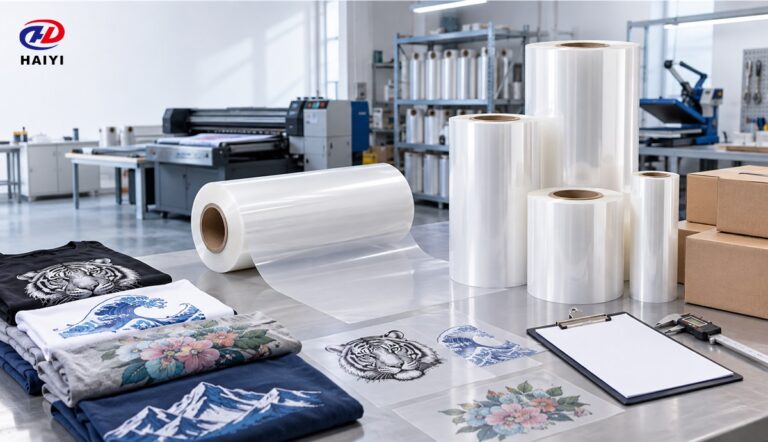
Haiyi produces DTF film using this coating at 60,000 sqm per day:
- 30 cm × 100 m rolls (A3 desktop printers)
- 60 cm × 100 m rolls (24-inch production printers)
- 1200 mm × 4000 m jumbo rolls (converters and distributors)
- A3/A4 sheet format
We also manufacture DTF printers, sublimation printers, and UV printers.
ISO 9001 certified. OEKO-TEX Standard 100 certified.
Contact Haiyi → https://www.haiyidtf.com/contact-us/
FAQ
What is the ink-absorbing coating on DTF film? The ink-absorbing coating is a polymer composite layer applied to the print side of DTF PET film at 3.5 to 6 grams per square meter. It contains polyurethane resin matrix and nano-scale filler particles (fumed alumina or silica below 500nm) that create a microporous structure. This structure adsorbs DTF ink droplets rapidly, fixing them in place without lateral spread — enabling sharp detail and accurate color reproduction.
Why does the coating matter for DTF print quality? The coating controls three critical functions simultaneously: ink fixation (precision absorption without bleeding), release behavior (clean separation from the transferred design after pressing), and flexibility (the polymer chemistry that determines whether the transferred design cracks or stretches with the fabric). A coating that fails in any of these three functions produces defects that no printer setting, ink choice, or press parameter can correct.
What coating chemistry produces the best wash durability? Aliphatic waterborne polyurethane resin systems produce the best wash durability for DTF film applications. Aliphatic PU chains are more resistant to hydrolysis (water and detergent attack) and maintain flexibility under repeated mechanical stress better than acrylic or hybrid alternatives. This resin system enables designs to meet AATCC 61 wash fastness standards after 30 to 50+ machine wash cycles at 40°C.
What is Generation 4 DTF film coating? Generation 4 coating technology integrates ink-absorbing, release, and anti-static functions in a single coating pass using water-based, solvent-free chemistry. It uses refined resin composites and nano-filler dispersion technology for higher uniformity at lower coating weights, stronger coating-to-substrate adhesion, and lighter peel force. Generation 4 coatings comply with EU textile environmental standards and can be certified under OEKO-TEX Standard 100.
How does the coating affect powder adhesion in DTF printing? The coating must simultaneously ensure complete powder adhesion on printed (wet ink) areas and zero powder adhesion on non-printed areas. The anti-static coating on the film back achieves the latter by dissipating static charge below the threshold that attracts powder particles. The front coating surface chemistry ensures uniform powder coverage in printed areas, including at fine detail edges and thin lines where ink deposit is minimal.
Why is in-house coating formula ownership important for a DTF film manufacturer? A manufacturer that develops its own coating formula controls all performance variables: resin chemistry, filler type and loading, anti-static specification, coating weight, and drying profile. This enables accurate performance specifications, batch-to-batch consistency, and technical support when production problems occur. A reseller of pre-coated substrate cannot specify performance, guarantee batch consistency, or diagnose coating-related problems — they do not know what is in the coating.
Conclusion
The custom T-shirt that survives fifty washes. The design that stretches and recovers without cracking. The vivid print on a black cotton hoodie.
None of it happens by accident. Every one of these outcomes is engineered — primarily in the coating layer that most buyers never think about.
The ink-absorbing coating is the first and most critical point of contact in the DTF printing process. It receives the ink, controls how it spreads and fixes, manages the adhesive powder interaction, determines the transfer release, and ultimately shapes the physical properties of the design that will live on the garment for the next several years of washes.
A coating that works — properly formulated, properly applied, properly tested — enables professional print quality across thousands of production runs. A coating that is not controlled by the manufacturer who sells the film produces the kind of variability that cannot be diagnosed or corrected, only managed by reducing expectations.
The question worth asking every film supplier: “Did you develop this coating, or did you buy film that someone else coated?”
The answer tells you whether you have a manufacturer or a label on a box.