Why Cheap DTF Film Sometimes Outperforms Premium Brands

Read time: 12 minutes
The Story That Started This Question
Sarah runs a small custom apparel shop out of her garage in Texas.
For two years, she bought the expensive stuff. The premium brand. The one with the beautiful packaging, the confident marketing, and the price tag that made her wince every time she hit reorder.
Then one month, cash was tight. She ordered a cheaper roll from a Chinese supplier she found on Alibaba, half-expecting disaster.
The shirts looked identical. The wash test was fine. Her customers noticed nothing.
She felt confused. Then relieved. Then suspicious. Was she being ripped off all along?
The short answer is: maybe. But not in the way she thought.
The longer answer is what this article is about. Because the question “why does cheap DTF film sometimes outperform premium brands?” contains a hidden assumption that almost everyone in the DTF printing world gets wrong — and getting it right will change how you source film for good.
Key Takeaways
- “Premium brand” and “premium quality” are not the same thing in the DTF film market — many expensive branded films are resold generic substrate at a significant markup
- Cheap DTF film can outperform branded alternatives when the cheap film happens to come from a DTF film manufacturer with genuine in-house coating technology and the expensive brand is just a reseller
- The price you pay for DTF film does not predict the coating quality — the coating formula ownership does
- Budget film genuinely underperforms in three specific situations: high-volume production (rework costs exceed film savings), fine detail printing (coating porosity inconsistency causes bleeding), and batch-sensitive jobs (coatings vary between rolls)
- The correct question is never “cheap or expensive?” — it is “does this manufacturer own and control their coating formula?”
- A mid-tier price from a genuine in-house coating manufacturer consistently outperforms an expensive brand from a reseller — and an inexpensive film from that same manufacturer does too
- Sarah was not being ripped off. She was accidentally finding out that her “premium” brand was just better marketing, not better film
The Uncomfortable Reality About “Premium” DTF Film Brands
Let us say something that most DTF film sellers do not want you to know.
The majority of branded DTF film — including many of the expensive, well-marketed “premium” brands — is not manufactured by the company whose name is on the box.
They buy pre-coated PET substrate from Chinese factories. They put their label on it. They charge a premium. And because they have good Instagram content and clean packaging, buyers assume the price reflects the film quality.
Sometimes it does. Often it does not.
Here is how this works in practice. A film “brand” sources rolls from whatever factory offers the best price that month. The coating formula belongs to the factory, not the brand. When the factory changes their substrate supplier or tweaks the coating chemistry, the brand does not even know — until buyers start calling with complaints about peeling edges or powder contamination.
Meanwhile, a Chinese coating manufacturer with 15 years of in-house coating development and a proprietary formula — the kind that has tested ink absorption rates, anti-static dissipation values, and release force specifications on every production batch for over a decade — might be selling rolls at half the price. Not because the quality is lower. Because there is no marketing budget, no warehouse in Texas, and no influencer partnerships to pay for.
This is exactly why cheap film sometimes outperforms premium brands. The “cheap” film came from a real manufacturer. The “premium” brand came from a skilled reseller.
When Cheap DTF Film Actually Works
Not all budget film is bad. Here is when lower-cost film delivers perfectly acceptable results.
Low-Volume Operations with Simple Designs
If you are pressing 10 to 20 shirts per week with bold logos and solid color designs, the coating precision required is relatively low. A cheap film with adequate (if inconsistent) coating will produce acceptable results on most jobs.
The failure modes of cheap film — inconsistent ink absorption, variable release force, powder contamination — are less likely to appear at low volume and low design complexity. You might get 95 good shirts out of 100. A rework rate of 5% costs you very little at low volume.
Short-Run Jobs Where Consistency Across Batches Does Not Matter
If you are printing a one-off batch of 50 shirts for a single client and you never need to reproduce that design exactly, batch-to-batch coating variation does not affect you. The roll either works or it does not — and if it works for this job, that is all you need.
Jobs Where the Customer Is Not the End Consumer
Screen-printing shops using DTF for short-run add-ons, promotional goods companies doing event giveaways, and businesses producing internal branded merchandise often have lower wash durability requirements than direct-to-consumer apparel. “Passes 15 wash cycles” is perfectly adequate when the garment is used 12 times per year.
When You Get Lucky With a Good Factory’s Cheap Line
Here is the kicker. Some of the lowest-priced DTF film on the market comes from genuine coating manufacturers who are clearing older inventory, selling off-spec rolls at discount, or offering an economy line alongside their premium product. In these cases, “cheap” genuinely reflects a lower price, not lower quality — just a different tier of the same manufacturer’s output.
This is the scenario Sarah stumbled into. Her Alibaba find happened to be a real manufacturer’s product at factory-direct pricing. Lucky her.
When Cheap DTF Film Will Absolutely Let You Down
The DTF printing industry has a graveyard full of print shops that tried to scale on budget film and discovered — too late — that the economics did not work.
High-Volume Production
At 100 transfers per day, a 15% rework rate on cheap film costs you:
15 reprints × ($0.25 film + $0.50 ink + $0.50 labor) = $18.75 per day in wasted material and time
That is $5,625 per year in rework.
The price difference between cheap film ($0.08/meter) and quality film ($0.18/meter) at 100 sheets per day? Roughly $1,400 per year.
You are losing $4,225 net to save $1,400. The “cheap” option is costing you more. This is the math that most print shops never do until after they have been doing it wrong for a year.
Fine Detail and Small Text
Cheap film with variable coating porosity causes ink bleeding at fine detail edges. The coating is supposed to absorb ink at a controlled rate — just enough to hold the pigment precisely in place without allowing lateral spread.
Variable porosity means some areas of the coating absorb faster and some areas absorb slower. At fine detail, this difference between adjacent print areas shows up as blurred edges, merged thin lines, and illegible small text.
If your designs include 8-point text, intricate illustrations, or photographic gradients — cheap film will not hold the detail. Premium results require consistent coating, and consistent coating requires a manufacturer who controls the formula.
Production Runs That Must Match Across Multiple Batches
Corporate uniforms. Sports team kits. Seasonal collections. Any job where multiple production runs must look identical.
Generic film changes between batches because the coating formula is not controlled by the reseller. Roll 1 and roll 10 of the same “product” may have meaningfully different ink absorption characteristics. The colors shift. The detail changes slightly. The client notices.
For batch-sensitive production, inconsistency is not a quality issue — it is a client relationship issue.
The Real Difference Is Not Price — It Is Coating Ownership
Here is the thing about DTF film that most marketing material will never tell you directly.
The PET substrate — the plastic base of the film — is a commodity. You can buy BOPET (biaxially oriented polyester film) from dozens of factories at roughly similar prices. It is not where the quality differentiation lives.
The coating is where everything happens.
The ink-absorbing coating on the print side determines ink precision, color density, and detail reproduction. The anti-static coating on the back determines whether powder contaminates non-print areas. The release chemistry determines whether the film separates cleanly or tears your design edges when you peel.
A manufacturer who develops their own coating formula — who has a chemistry team, coating lines, and production QC testing — controls all of this. Roll to roll, batch to batch, month to month.
A reseller who buys pre-coated PET from whichever factory offered the best price last quarter controls none of it.
This is why the question “cheap or premium?” is the wrong question. The right question is:
“Does this supplier own and control their coating formula, or are they reselling someone else’s product?”
A genuine coating manufacturer selling at $0.18/meter is a better supplier than a reseller selling the same generic substrate at $0.35/meter under a premium brand name.
How to Tell If You Are Paying for Quality or Paying for Marketing
Ask these questions to any DTF film supplier. The answers tell you exactly what you are paying for.
“Do you develop your coating formula in-house, or do you source pre-coated PET from an external supplier?”
A manufacturer with genuine in-house coating capability answers this specifically. They describe the coating type, the application method, the key performance specifications. A reseller gives a vague answer, changes the subject, or tells you their “quality control team” ensures consistency — without explaining what they are actually testing.
“Can you provide batch QC test reports with specific numerical values?”
Coating weight (g/sqm with tolerance), tensile strength (N/15mm), release force (g/cm), anti-static dissipation (surface resistance in ohms) — these are the measurements a manufacturer takes on every production batch. A reseller cannot provide them because they do not test what they do not make.
“What specific harmonized standard is your anti-static coating tested against?”
A coating manufacturer who actually specifies and tests anti-static performance can answer this. A reseller cannot.
“What is your production capacity and daily output in square meters?”
A genuine coating manufacturer running industrial-scale production answers in tens of thousands of square meters per day. An operation assembling rolls from purchased substrate answers vaguely or gives implausibly small numbers.
The Five Tests That Reveal True DTF Film Quality
Words are cheap. Tests are not.
Before committing to any film supplier — cheap or expensive — run these five tests. The results will tell you more about the film than any marketing material.
Test 1 — The Water Drop Test
Place a drop of water on each side of the film. On the printable (coated) side, the drop should spread slightly or be absorbed within 5 to 10 seconds. On the back, it should bead up and hold its shape.
If the drop beads on both sides, the coating is inadequate or absent on the front. If the drop spreads on both sides, the anti-static back coating is missing or inadequate.
Test 2 — The Fine Detail Print Test
Print a design that includes 6-point text, 0.5mm lines, and a gradient from 100% to 5% coverage on the same sheet.
Quality film holds all three cleanly. Budget film with variable porosity will show bleeding at the 6-point text and loss of the finest gradient steps.
Test 3 — The Multi-Batch Consistency Test
Request samples from two different production batches. Print the same design at the same settings on both. Compare color density, edge sharpness, and powder adhesion in non-print areas.
Consistent results across batches = manufacturer controls the coating. Variable results = reseller, batch quality unknown.
Test 4 — The Wash Test
Press a test transfer to your most commonly used cotton garment. Wash inside-out five times at 40°C. Inspect edge adhesion, detail integrity, and color.
This is the only test that matters for your customers. Film that fails here fails your business.
Test 5 — The Long-Run Test
Print 50 consecutive sheets at your production settings. Compare sheets 1 through 5 with sheets 45 through 50 for color consistency and ink density.
Cheap film with inconsistent coating often shows drift across a production run as the coating characteristics vary along the roll length. Quality film from a controlled coating process produces identical results from meter 1 to meter 100.
What “Premium” Should Actually Mean for a DTF Film Manufacturer
Let us redefine this term because the industry is using it wrong.
“Premium” should mean: a film produced by a manufacturer with proprietary in-house coating technology, batch QC testing with documented numerical specifications, verifiable certifications (ISO 9001, OEKO-TEX), and enough production scale to guarantee supply continuity.
It should not mean: a film with nice packaging, a well-designed website, and an influencer deal.
When you evaluate a supplier by the right criteria — coating ownership, batch documentation, certifications, production scale — some of the most “premium”-priced brands in the market reveal themselves as resellers, and some of the most accessible-priced factory-direct suppliers reveal themselves as genuine manufacturers.
The market has been confusing packaging design with product quality for years. You do not have to.
The Smart Buyer’s Framework: Value, Not Price
Stop asking “how cheap is this film?” Start asking “does this manufacturer control their coating?”
The framework:
Step 1: Ask the coating ownership question. Eliminate resellers before price matters.
Step 2: Request batch QC documentation with specific numbers. Eliminate suppliers who cannot provide it.
Step 3: Test samples from two production batches. Verify consistency, not just quality.
Step 4: Run the five tests above on the samples that pass steps 1 through 3.
Step 5: Among the suppliers who pass all four gates, choose based on price, format options, MOQ, and supply continuity.
Done this way, you will often find that the best value is neither the cheapest option nor the most expensive brand. It is a genuine manufacturer selling at factory-direct prices — because they have no distribution chain to subsidize.
About Haiyi: Where Factory Pricing Meets Real Coating Technology
There is a reason this article exists.
Most DTF film buying guides avoid naming the actual problem in the market: that many “premium” brands are resellers, and many factory-direct options from genuine manufacturers outperform them at lower cost.
Haiyi Material Technology Co., Ltd. is a real example of what a genuine DTF film manufacturer looks like.
We develop our own coating formula in-house — no purchased pre-coated substrate, no outsourced coating chemistry. Our coating has been refined over 15+ years of production, backed by an R&D team with more than 20 registered patents.
We test every production batch. Coating uniformity, tensile strength, release force, anti-static performance — specific numbers, documented records, available to wholesale accounts.
We are ISO 9001 certified and OEKO-TEX Standard 100 certified. Not self-declared. Verified by third-party certification bodies.
We run 60,000 sqm of DTF film production per day. That is not a small operation pretending to be a factory — that is industrial-scale coating capability.
We also manufacture DTF printers, sublimation printers, and UV printers. Because understanding how film performs inside a printer requires knowing how printers actually work — something a reseller will never have.
And our pricing? Factory-direct. No distribution markup. No premium brand tax. Just the actual cost of genuinely good film plus a reasonable margin.
Production formats:
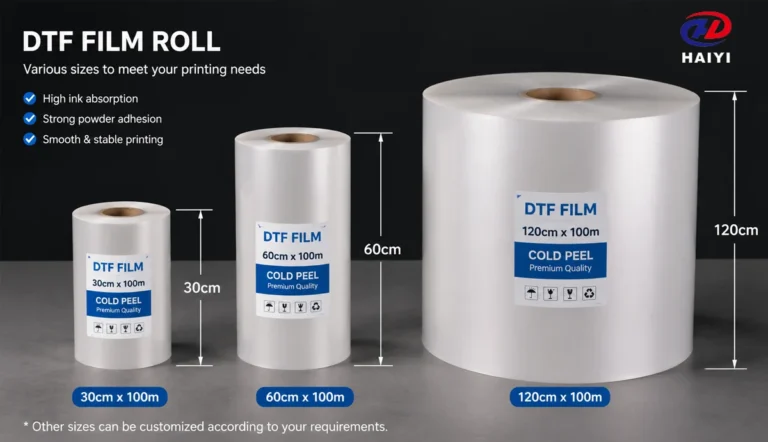
- 30 cm × 100 m rolls — for A3 desktop DTF printers
- 60 cm × 100 m rolls — for 24-inch production printers
- 1200 mm × 4000 m jumbo rolls — for distributors and industrial converters
Variants: Hot peel, cold peel, instant hot peel — all with dual-matte anti-static coating standard.
If you are a distributor, print shop, or clothing manufacturer who wants to stop overpaying for film that is no better than what you can get factory-direct — this is the conversation worth having.
FAQ
Why does cheap DTF film sometimes produce results as good as premium brands? Because many “premium” DTF film brands are not manufacturers — they are resellers of generic pre-coated PET substrate, often from the same Chinese factories that supply the cheaper alternatives. When a genuine in-house coating manufacturer sells at factory-direct pricing, their product can outperform expensive branded alternatives simply because the actual coating quality is higher, despite the lower price. The brand name adds cost, not quality.
When is cheap DTF film a bad choice? Budget DTF film underperforms in three situations: high-volume production (where the rework rate from inconsistent coating costs more than the price savings), fine detail designs (where coating porosity variation causes ink bleeding at small text and thin lines), and jobs requiring batch-to-batch consistency (where variable coating from uncontrolled generic substrate creates color and quality drift between orders).
How do I know if a DTF film supplier is a real manufacturer or a reseller? Ask directly: “Do you develop your coating formula in-house, or do you purchase pre-coated PET from an external supplier?” Request batch QC test reports with specific numerical values (coating weight g/sqm, tensile strength N/15mm, release force g/cm). A genuine manufacturer answers specifically and can provide documentation. A reseller deflects or provides vague quality assurances without data.
Is Haiyi a manufacturer or a trading company? Haiyi is a genuine manufacturer. We develop and apply our own coating formula on in-house production lines in Foshan, Guangdong, China. We also produce DTF printers, sublimation printers, and UV printers. We can provide live facility tours, batch QC documentation with specific numerical data, ISO 9001 and OEKO-TEX certification, and patent documentation for our coating technology.
What formats does Haiyi DTF film come in? 30 cm × 100 m rolls for A3 desktop printers, 60 cm × 100 m rolls for 24-inch production printers, and 1200 mm × 4000 m jumbo rolls for distributors and industrial converters. Hot peel, cold peel, and instant hot peel variants. Dual-matte anti-static coating standard.
How can I contact Haiyi for wholesale DTF film or OEM/ODM inquiries? Visit https://www.haiyidtf.com/contact-us/ for wholesale DTF film pricing, OEM/ODM packaging inquiries, and sample requests. Tell us your printer model, monthly volume, preferred roll format, and peel type. We respond to qualified wholesale inquiries within 4 business hours.
Conclusion
Sarah’s story is not unusual. Across the custom apparel world, print shop owners are quietly discovering that the expensive brand they trusted for years is not necessarily the best film — it is just the best-marketed film.
The DTF film market has a branding problem. “Premium” has come to mean “expensive and well-packaged” rather than “manufactured with genuine coating technology and documented quality control.” That confusion costs buyers real money every month.
The correction is simple, if counterintuitive.
Stop evaluating film by price. Evaluate it by whether the manufacturer controls the coating formula. A film from a genuine in-house coating manufacturer at mid-range pricing will outperform a reseller’s premium-priced product on every metric that matters: print consistency, wash durability, batch-to-batch reliability.
That is why cheap DTF film sometimes outperforms premium brands. Not because cheap film is secretly good. Because some “premium” brands are secretly cheap — just with better packaging.
Do the tests. Ask the questions. Find the real manufacturers.
And if you want to know you have already found one:
Contact Haiyi → https://www.haiyidtf.com/contact-us/
For wholesale DTF film, OEM/ODM packaging, or DTF printer inquiries — we are the manufacturer on the other side of the conversation.