







Cold Peel vs Hot Peel DTF Film: Which Is Better?

Read time: 11 minutes
Introduction
Hot peel or cold peel — it sounds like a simple choice. Peel now or peel later.
In practice, the peel method you choose affects edge quality, wash durability, production speed, and how forgiving your process is when settings are slightly off. Getting it right means understanding what is actually happening to the adhesive layer during the seconds between pressing and peeling.
This guide covers everything: what each method does, what happens at a physical level during peeling, which produces better results under specific conditions, and which is the right default for most production environments. There is no single correct answer — but there is a clearer answer for your specific situation.
Key Takeaways
- Hot peel means removing the carrier film within 10 to 15 seconds of pressing while the transfer is still warm — the adhesive is partially fluid, enabling fast workflow
- Cold peel means waiting until the transfer has cooled completely — 60 to 90 seconds minimum — before removing the carrier film — the adhesive has fully solidified
- Instant hot peel (also called warm peel) is engineered to peel cleanly at any temperature — a third category distinct from both standard hot and cold peel films
- Cold peel generally produces better wash durability and cleaner edge definition than hot peel — but requires more cooling time per garment
- Hot peel is faster but less forgiving — a 5-second delay cooling the film before peeling increases peel force significantly and risks edge lifting
- For fine-detail designs, cold peel produces more consistent results — the fully-set adhesive separates more cleanly at fine detail edges than partially-fluid hot peel adhesive
- The peel type is determined by the film’s release coating — not by user preference — always check which type your film requires and match your timing accordingly
- If you cannot identify your film’s peel type, test both methods on a sample: the correct method releases with light, consistent force; the wrong method either resists strongly or lifts ink with the film
What Is Hot Peel in DTF?
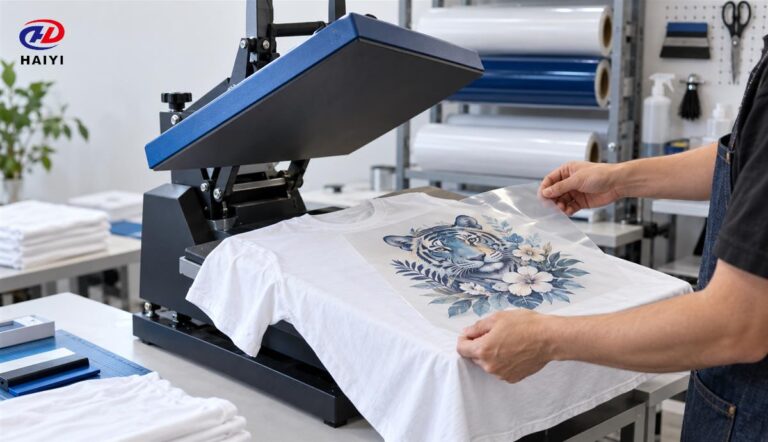
Hot peel is the method where the carrier film is removed immediately after pressing — while the transfer is still at or near pressing temperature.
The window for hot peel is typically 5 to 15 seconds after the press opens. During this window, the hot-melt adhesive layer is still partially fluid — warm enough that the release coating on the film can separate from the adhesive without significant resistance.
What Happens Physically During Hot Peel
When you press a DTF transfer, the heat melts the adhesive powder and drives it into the fabric fiber weave. The adhesive creates bonds with the fabric fibers while simultaneously remaining in contact with the film’s release coating.
During hot peel, the adhesive is still partially molten — it has not yet fully transitioned from fluid to solid. The release coating separates from the still-fluid adhesive relatively easily, but the adhesive’s grip on the fabric fibers is also not yet at maximum strength. The design is bonded to the fabric but the bond is still developing.
This is why hot peel has two characteristics: it is easier to remove the film in the correct window, and the finished result can have slightly less edge precision because the adhesive was still mobile when the film was separated.
Hot Peel Timing Is Critical
The hot peel window is narrow. As the adhesive cools below its release temperature, peeling force increases sharply. Hot peel film that has fully cooled before peeling requires significantly more force than cold peel film at room temperature — because it is neither in its release state (warm and fluid) nor in its designed final state (cold and set).
The practical consequence: If you miss the hot peel window by even 30 seconds, peeling becomes difficult and risks lifting ink from design edges. This is one of the most common causes of hot peel failures in production — operators get interrupted between the press and the peel step.
What Is Cold Peel in DTF?
Cold peel is the method where the carrier film is not removed until the transfer has cooled completely to room temperature — typically 60 to 90 seconds after pressing.
During cooling, the adhesive transitions fully from molten to solid state. The adhesive bonds with the fabric fibers crystallize and reach maximum strength. By the time the film is peeled, the adhesive is in its designed final condition.
What Happens Physically During Cold Peel
The release coating on cold peel film is engineered to maintain lower adhesion to the ink and adhesive layers once the system has cooled. When you peel the film at room temperature, the release coating separates cleanly from the fully-set adhesive — the design stays on the fabric, the film separates completely.
Because the adhesive is fully set before film removal, the design edges are sharper — there is no residual mobility in the adhesive layer during peeling that could cause slight smearing or lifting at fine detail perimeters.
Cold Peel Timing Is Forgiving
Unlike hot peel, cold peel has a wide acceptable window. Once the transfer has fully cooled, it can be peeled at any point — in 60 seconds or in 60 minutes. The adhesive is stable at room temperature. There is no urgency.
This makes cold peel significantly more forgiving in production environments where operators handle multiple garments simultaneously or where interruptions between press and peel are common.
Instant Hot Peel: The Third Option
Instant hot peel — also called warm peel or all-temperature peel — is a distinct film engineering category.
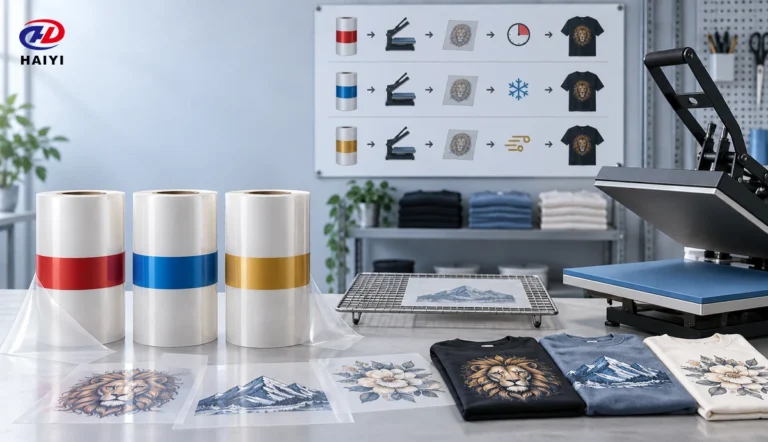
Standard hot peel film requires peeling while warm. Standard cold peel film requires full cooling. Instant hot peel film is engineered to release cleanly at any temperature — immediately after pressing while still hot, after partial cooling, or after full cooling to room temperature.
How Instant Hot Peel Works
The release coating on instant hot peel film is formulated to maintain consistent, low adhesion to the ink layer across the full temperature range from pressing temperature down to room temperature. The film does not resist peeling when hot, does not become progressively harder to peel as it cools, and does not require the operator to wait for any specific temperature.
When Instant Hot Peel Is Valuable
In high-volume production environments where multiple operators are pressing garments in a continuous flow, timing consistency is difficult to maintain. Instant hot peel removes the timing variable entirely — peel when the garment is ready to handle, regardless of how long it has been cooling.
For shops that have experienced failures with both standard hot peel (missed timing) and cold peel (insufficient cooling time), instant hot peel is worth testing as a process simplification.
Cold Peel vs Hot Peel: Side-by-Side Comparison
| Feature | Hot Peel | Cold Peel | Instant Hot Peel |
|---|---|---|---|
| Peel timing | 5–15 sec after pressing (while warm) | 60–90 sec after pressing (fully cooled) | Any time — no timing requirement |
| Timing window | Narrow — 10 to 20 seconds | Wide — once cooled, peel anytime | No window — peel at any temperature |
| Production speed | Fastest — no cooling wait | Slower — 60–90 sec cooling required | Fast — no waiting required |
| Edge definition | Good | Better — fully set adhesive separates more cleanly | Good to excellent |
| Wash durability | Good (50+ cycles when done correctly) | Generally better on equivalent settings | Good to excellent |
| Margin for timing error | Low — missed window means hard peel | High — timing is not critical | Very high — no timing to miss |
| Best for | High-volume production with trained team | Fine detail, performance fabrics, beginners | Any volume, mixed team skill levels |
| Beginner-friendly | Less forgiving | More forgiving | Most forgiving |
| If peeled incorrectly | Ink lifts or edge damage | Film resists strongly — not easy to force | Rarely fails |
Which Produces Better Wash Durability?
The most common question in this comparison — and the answer is more nuanced than most guides suggest.
The Short Answer
Cold peel, on average, produces better wash durability than hot peel — particularly at the design edges.
The Mechanism
When hot peel film is removed, the adhesive is still partially fluid. The act of peeling applies mechanical stress to an adhesive layer that has not yet fully bonded to the fabric fiber structure. This can create micro-separations at the design perimeter — very small gaps between the adhesive and the fabric where the design edge was disturbed during peeling.
Over washing cycles, these micro-separations grow. Hot peel edge peeling begins at the perimeter, where the adhesive bond was disrupted, not at the center where the bond was undisturbed.
Cold peel removes the film after the adhesive is fully set. The bond between adhesive and fiber is at maximum strength before the film applies any mechanical stress. Edge peeling failures are significantly less common.
The Practical Caveat
Both methods achieve 50+ wash cycle durability when:
- The film’s specific peel type is used correctly
- The second press is performed after peeling (5 to 10 seconds through parchment paper)
- Press settings (temperature, time, pressure) are correct for the fabric
The second press is the single most impactful durability step — it applies significant additional bonding that compensates for minor edge disturbance during hot peel. Hot peel with a second press consistently outperforms cold peel without a second press.
Bottom line: Cold peel has a slight inherent advantage in wash durability. Second press after either method is more important than the choice of peel type.
Which Is Better for Fine Detail Designs?
For designs with fine text, thin lines, and intricate detail — cold peel or instant hot peel produce more consistent results.
Here is why:
At fine detail edges, the adhesive layer is thinnest. During hot peel, the thin adhesive at fine detail perimeters is still partially fluid. The mechanical action of film removal can cause the finest details to shift or lift slightly — particularly on text below 10 points and lines thinner than 2mm.
Cold peel eliminates this variable. By the time the film is removed, fine detail edges are fully set. The release happens cleanly at a solid interface rather than a partially-fluid one.
Practical test: If you are consistently losing fine text edges or thin lines with hot peel at correct settings, switch to cold peel on those specific designs and compare. Most operators who make this switch notice immediate improvement on fine-detail work.
Which Is Better for Different Fabrics?
The fabric type interacts with peel method in two meaningful ways: moisture content and fiber structure.
Polyester and Synthetic Fabrics
Polyester holds heat longer than cotton — it is a better thermal insulator. A polyester garment stays warm for longer after pressing, which extends the hot peel window but also slows cooling for cold peel.
Polyester is also pressed at lower temperatures (280 to 300°F versus 315 to 325°F for cotton) — less heat input means the adhesive does not reach as high a temperature during pressing, which can affect hot peel release behavior.
Recommendation for polyester: Cold peel or instant hot peel. The lower pressing temperature makes hot peel timing more critical on polyester — there is less heat available to maintain the release window.
Performance and Moisture-Wicking Fabrics
Performance fabrics often have chemical coatings that affect adhesive bonding. Cold peel allows maximum adhesive set time — important when the fabric surface chemistry makes bonding more challenging.
Recommendation: Cold peel, with 90 seconds minimum cooling before peeling.
100% Cotton
Cotton is the most forgiving fabric for both peel methods. It presses at higher temperatures, cools relatively quickly, and has fiber structure that bonds reliably with DTF adhesive.
Both methods work well on cotton. Hot peel is viable for high-volume cotton production. Cold peel produces slightly better edge quality on fine-detail designs.
Fleece and Heavy Fabrics
Heavy fabrics retain heat longer and have uneven surface topography. Cold peel is recommended — the additional cooling time allows full adhesive set across both the raised and recessed areas of the fabric surface.
Which Is Better for High-Volume Production?
This is where hot peel has a clear advantage — but with conditions.
Hot Peel Speed Advantage
Cold peel requires 60 to 90 seconds of cooling per garment. At 10 garments per hour, this adds 10 to 15 minutes of waiting time — 15 to 25% of production time spent waiting for cooling.
At 50 garments per hour, the cooling wait either forces a larger garment buffer (more shirts in rotation simultaneously) or becomes a production bottleneck.
Hot peel eliminates this wait. Peel immediately, load the next shirt, press again. At equivalent throughput, hot peel produces 15 to 25% higher garments per hour.
The Production Quality Trade-Off
Hot peel speed advantage requires operator consistency. Every operator must peel within the correct window on every garment. In high-volume production with multiple operators and different experience levels, timing variation is inevitable — and hot peel failures in that environment can be significant.
Instant hot peel is the best solution for high-volume mixed-skill production: the speed of hot peel without the timing requirement that causes hot peel failures.
Volume Recommendation
| Production Volume | Recommendation |
|---|---|
| Under 20 shirts/day | Cold peel — quality and consistency over speed |
| 20–100 shirts/day | Cold peel or instant hot peel — balance quality and throughput |
| 100+ shirts/day, trained team | Hot peel or instant hot peel — maximize throughput |
| 100+ shirts/day, mixed team | Instant hot peel — remove timing variable entirely |
How to Tell Which Peel Type Your Film Requires
The peel type is a property of the film’s release coating — not a user setting. Using the wrong method for your film produces predictable failures.
Method 1 — Check the Packaging Label
Quality film manufacturers label rolls as hot peel, cold peel, or instant hot peel on the roll label and box. This is the most reliable identification method. If the packaging is unavailable or unlabeled, proceed to Method 2.
Method 2 — Test with a Sample
Press a small test transfer onto a scrap piece of fabric. Then test both peel timings:
Hot peel test: Open the press and immediately try to peel the film. Grade the resistance: 1 (releases easily) to 5 (significant force required, ink starts lifting).
Cold peel test: Allow full cooling (90 seconds), then peel. Grade resistance the same way.
The correct method will score 1 to 2 — light, consistent resistance with clean release. The incorrect method will score 4 to 5 — significant resistance, possible design lifting.
Method 3 — Contact Your Film Supplier
Ask directly: “Is this film hot peel, cold peel, or instant peel?” Any legitimate film supplier can answer this immediately. If they cannot, source from a supplier who can.
The Most Common Peel Mistakes and How to Fix Them
Mistake 1: Peeling Hot Peel Film After It Has Cooled
What happens: Film resists strongly. Design edges lift or ink transfers to the film rather than staying on the fabric.
Fix: Re-press the garment for 3 to 5 seconds to re-activate the release coating. Immediately peel within 5 to 10 seconds of removing from the press. Set up your workflow to ensure peeling happens without interruption.
Mistake 2: Peeling Cold Peel Film Before Full Cooling
What happens: Film resists peeling while warm. If forced, the design lifts partially with the film.
Fix: Do not force it. Allow more cooling time — up to 2 minutes in warm production environments. Peel angle matters especially for cold peel — 15 to 30 degrees flat is significantly easier than perpendicular to the fabric.
Mistake 3: Peeling at the Wrong Angle (Both Methods)
What happens: Excess force required regardless of timing. Design edges lift at the peel front.
Fix: Always peel at a flat angle — 15 to 30 degrees from the fabric surface. Roll the film back rather than pulling it perpendicular to the garment. Flat-angle peeling works with the release coating; perpendicular pulling works against it.
Mistake 4: Peeling Too Fast
What happens: Mechanical shock at the peel front lifts ink at fine detail edges regardless of correct temperature.
Fix: Peel slowly and evenly. The pace should feel controlled, not rushed. 3 to 5 seconds for a standard full-front transfer is appropriate.
Mistake 5: Skipping the Second Press
What happens: Edge peeling develops after 5 to 15 wash cycles regardless of which peel method was used.
Fix: Always second-press 5 to 10 seconds through parchment paper or Teflon sheet after film removal. This is the most important durability step.
DTF Film Coating: Why It Determines Your Peel Type
The peel type of a DTF film is not arbitrary — it is determined by the chemistry of the release coating applied to the film’s printable side.
The release coating must accomplish two competing requirements: it must hold the ink firmly during printing, powder application, and curing — and it must release cleanly from the cured adhesive during the peel step.
For hot peel films, the release coating is formulated to have low adhesion to the cured adhesive specifically at elevated temperatures — when the adhesive is warm and partially fluid, the release coating separates easily. As temperature drops, the release coating’s adhesion to the adhesive increases.
For cold peel films, the release coating is formulated differently — it maintains low adhesion to the cured adhesive at room temperature specifically, allowing clean separation after full cooling.
Instant hot peel films use a release coating formulated to maintain consistent low adhesion across the full temperature range.
This is why manufacturers that develop their own coating formula in-house matter. The peel type is a designed property of the coating chemistry — it cannot be approximated with generic pre-coated PET substrate. A manufacturer like Haiyi, which develops proprietary in-house coating formulas, produces hot peel and cold peel variants with specific, consistent release behavior that is tested on every production batch. Generic film’s peel behavior varies between rolls because the coating formula is not controlled by the brand.
The Practical Recommendation: Which Should You Use?
After everything above, here is the direct recommendation for different situations:
You are new to DTF → Cold peel The wider timing window and more forgiving process produce more consistent results while you are learning. Switch to hot peel or instant peel when you have production experience.
You run a small shop with one press and mixed order types → Cold peel Cold peel handles all fabric types well, produces excellent wash durability, and requires no timing precision. The 60 to 90 second cooling time is not a bottleneck at low volume.
You run fine-detail work (small text, intricate graphics) → Cold peel The fully-set adhesive at peeling time produces cleaner fine-detail edges consistently.
You run high-volume production with a trained team → Hot peel The throughput advantage is real at production scale. Team training on consistent peel timing within the window is manageable with experienced operators.
You run high-volume production with a mixed-skill team → Instant hot peel Eliminates the timing variable. Produces hot peel speed without hot peel failures from missed windows.
Your fabric mix includes a lot of polyester or performance fabrics → Cold peel Lower pressing temperatures and coating-treated surfaces make cold peel the more reliable choice.
FAQ
What is the difference between hot peel and cold peel in DTF? Hot peel means removing the carrier film within 10 to 15 seconds of pressing while the transfer is still warm — the adhesive is partially fluid and the release coating separates easily in this window. Cold peel means waiting until the transfer has fully cooled (60 to 90 seconds) before peeling — the adhesive is fully set and the film separates cleanly at room temperature.
Which is better for wash durability: hot peel or cold peel? Cold peel generally produces better wash durability, particularly at design edges — because the adhesive is fully bonded to fabric fibers before any mechanical stress is applied during peeling. However, the second press (5 to 10 seconds through parchment paper after film removal) has a larger impact on wash durability than the choice of peel method. Either method achieves 50+ wash cycle durability when executed correctly with a second press.
Can I use cold peel on hot peel film? Technically yes, but it will be significantly harder to peel — hot peel film’s release coating is engineered for separation at warm temperatures, not at room temperature. As the film cools, peel force increases sharply. Attempting cold peel on hot peel film requires excessive force that risks lifting design edges. Re-press the garment for 3 to 5 seconds and peel immediately within 10 seconds.
Can I use hot peel on cold peel film? Peeling cold peel film before full cooling produces resistance — the adhesive is still fluid and the design can partially lift with the film if forced. Allow full cooling (90 seconds) before attempting to peel cold peel film. If you peeled too early and the design lifted, press back down firmly, allow full cooling, and try again slowly at a flat angle.
What is instant hot peel DTF film? Instant hot peel (also called warm peel or all-temperature peel) is a film engineered to release cleanly at any temperature — immediately after pressing while still hot, partially cooled, or fully cooled. It eliminates the timing requirement of standard hot peel and the waiting requirement of cold peel. Best for high-volume or mixed-skill production where timing consistency is difficult to maintain.
How do I know if my DTF film is hot peel or cold peel? Check the packaging label first — quality manufacturers label the peel type clearly. If unlabeled, test with a sample: try peeling immediately after pressing and after full cooling. The correct method releases with light, consistent force. The incorrect method either resists strongly or lifts ink with the film.
Does peel method affect the feel of the finished transfer? Slightly. Cold peel produces a marginally softer, smoother surface texture because the adhesive fully sets before film separation — the surface is more regular and flat. Hot peel can produce a very slightly more textured surface because the adhesive was still mobile during peeling. In practice, the difference is minor and most people cannot distinguish between correctly executed hot peel and cold peel by touch.
Which peel method is faster in production? Hot peel is faster — no cooling wait between shirts. Cold peel requires 60 to 90 seconds of cooling, which adds 15 to 25% waiting time at production volume. Instant hot peel matches hot peel speed without the timing requirement.
Conclusion
Hot peel and cold peel are not interchangeable choices — they are different processes that suit different priorities.
Cold peel is the more forgiving method. It produces better edge definition on fine-detail designs, slightly better wash durability, and a wide timing window that does not punish interruptions. For most print operations and especially for beginners, cold peel is the right default.
Hot peel is the faster method. For high-volume production with a trained team operating consistently within the 10 to 15 second peel window, the throughput advantage is real. Missing that window reliably is what creates hot peel failures — not the method itself.
Instant hot peel is the best of both: fast throughput without timing dependency. For shops that run high volume with mixed operator experience, it is worth sourcing and testing as the primary production film.
The choice that matters more than peel type: the second press. Five to ten seconds through parchment paper after film removal, regardless of which peel method you use, produces more improvement in wash durability than any other single step. Every shop should be doing this on every garment, every time.
Haiyi manufactures DTF film in hot peel, cold peel, and instant hot peel variants — dual-matte anti-static coating in 13-inch and 24-inch rolls, A3/A4 sheets, with consistent release force tested on every production batch. Factory-direct wholesale pricing, low MOQ, and 15 years of export experience.