
How UV DTF Printing Is Disrupting Industry Standards

Read time: 14 minutes
Introduction
In every industry where printing matters — advertising, packaging, manufacturing, luxury goods — the same conversation is happening.
Traditional printing methods are hitting their limits. Setup costs are too high for short runs. Drying time is too long for same-day delivery. Material restrictions are too narrow for modern product designs. And environmental regulations are tightening around solvent-based inks that have been the industry standard for decades.
UV printing is the answer that keeps winning the argument.
The global UV hybrid printer market was valued at USD 354 million in 2025 and is projected to reach USD 487 million by 2034 — a 4.8% compound annual growth rate driven by the advertising, packaging, and consumer goods industries demanding what UV printing uniquely provides: instant curing, all-material compatibility, embossed tactile effects, curved surface printing, and zero volatile organic compound emissions.
This guide covers every industry where UV printing is disrupting established methods — what it can do that traditional printing cannot, why the disruption is accelerating, and what it means for businesses on both sides of the equipment.
Key Takeaways
- UV printing uses ultraviolet light to cure ink instantly on contact — eliminating the 48 to 72-hour drying cycle of traditional solvent-based printing and enabling same-day delivery
- UV printing works on virtually any material without pretreatment — plastic, metal, glass, ceramic, acrylic, leather, wood, fabric — breaking the material restriction that limits every other printing method
- The embossed 3D effect unique to UV printing — created by layering UV-cured ink to build physical texture — cannot be replicated by any other digital printing technology
- UV printing on curved and cylindrical surfaces (360° printing on bottles, tubes, cans, and irregular shapes) eliminates the need for transfer labels, adhesive wraps, and screen printing setups
- UV inks contain no volatile organic compounds (VOCs) — curing is a photochemical reaction, not an evaporation process, making UV printing compliant with international environmental standards where solvent printing is restricted
- The advertising industry’s adoption of UV printing is driven by client demand for same-day delivery and high-precision output that traditional large-format printing cannot match
- UV DTF printing combines UV ink technology with transfer film, enabling hard surface decoration without a UV printer at the application site
- Cosmetic packaging demand grew 12% year-over-year in 2025, with UV printing driving the short-run personalization trend in beauty and luxury goods
What Is UV Printing? The Technology Explained
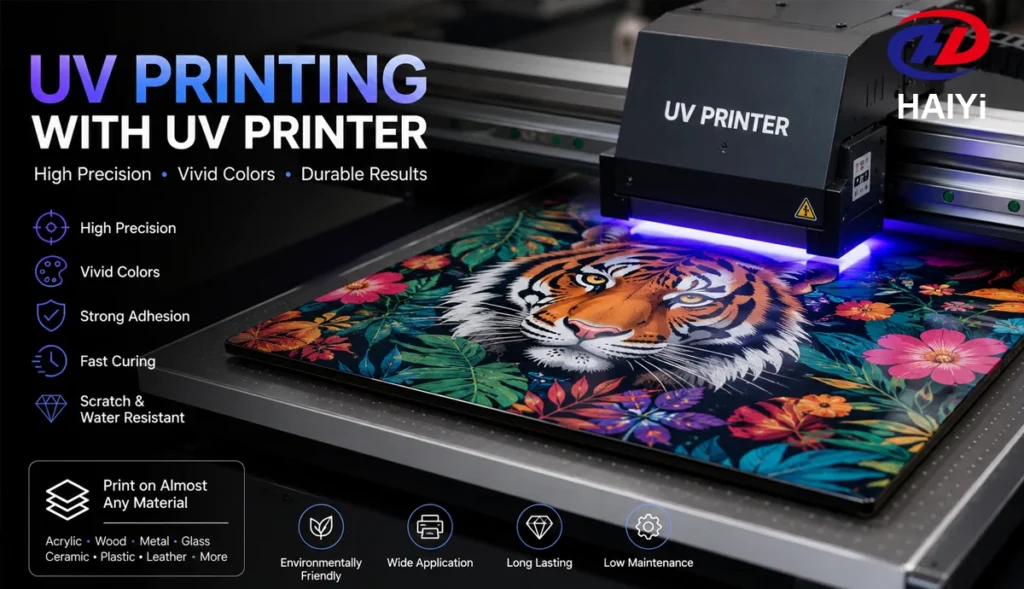
UV printing is a digital inkjet printing method where UV-curable inks are used in place of traditional solvent or water-based inks.
Standard inkjet inks dry through evaporation or absorption — the carrier solvent or water evaporates from the ink, leaving the pigment behind. This takes time: industrial solvent prints require 48 to 72 hours of drying before lamination or finishing. Water-based large-format prints require hours in controlled environments.
UV inks work differently. They contain photoinitiators — chemical compounds that react to ultraviolet light. When UV light hits the wet ink, the photoinitiators trigger rapid polymerization: the liquid ink monomers cross-link into a solid polymer network in fractions of a second.
The result: ink that is fully cured — dry, hard, and bonded to the substrate — the moment it leaves the print zone. There is no waiting. No drying rack. No 72-hour cycle. Print it, handle it, ship it.
The Components of a UV Printing System
UV-curable inks: Specially formulated ink sets including CMYK (cyan, magenta, yellow, key/black) color inks, white ink for opacity on dark or transparent substrates, and varnish/clear coat for gloss, matte, or textured effects.
UV LED lamps: Mounted alongside or behind the print heads, UV LED lamps emit concentrated ultraviolet light that cures each ink layer as it is deposited. Modern UV printers use LED-based curing, which produces less heat than traditional mercury UV lamps — enabling printing on heat-sensitive materials that older UV systems could not handle.
Flatbed or hybrid platform: UV printers operate on flatbed platforms (for rigid sheets and objects) or hybrid platforms (for both rigid substrates and roll media). The flatbed format is what enables direct printing on three-dimensional objects — bottles, phone cases, and curved panels — that a roll-to-roll printer cannot accommodate.
White ink capability: White UV ink is the enabler for printing on dark, transparent, or metallic substrates. Printed as a base layer beneath color inks, white creates an opaque foundation that makes CMYK colors appear correctly regardless of the substrate’s own color or transparency.
How UV Printing Works: The Instant-Cure Advantage
The instant-cure mechanism is the technical root of nearly every competitive advantage UV printing has over traditional methods. Understanding it explains why the disruption is structural, not incremental.
Traditional Printing Drying: A Time Problem
Solvent-based large-format printing (the dominant method for outdoor advertising and signage before UV) deposits ink that dries through solvent evaporation. The solvent must fully escape from the ink layer before the print can be handled, finished, or laminated. In humid environments, this takes 48 to 72 hours. Attempting to roll, cut, or laminate before full drying causes ink smearing, cracking, and adhesion failure between the ink and any applied laminate.
This 72-hour window is not a minor inconvenience — it is a production scheduling constraint that determines how many jobs a print shop can handle simultaneously, how much floor space is needed for drying racks, and whether same-day client delivery is physically possible.
UV Printing Curing: Instant by Design
UV ink polymerizes in under one second when exposed to UV LED light. The printer head deposits a layer of ink — the UV lamp passes over it — the ink is solid. No waiting. The print exits the machine ready for finishing, cutting, packaging, or delivery.
This single change — instant cure versus 72-hour dry — removes the largest bottleneck in commercial printing production:
- A UV print shop can process rush orders without dedicated fast-track workflows
- Floor space previously used for drying racks is eliminated
- Same-day client pickup is standard, not a premium service
- Multiple finishing operations (cutting, lamination, assembly) can begin immediately after printing
Layered Printing: The Embossed Effect
The instant cure also enables something no traditional printing method can do: physical three-dimensional texture built through successive print passes.
Each layer of UV ink is cured instantly and creates a solid raised surface. Print another layer on top — cured instantly — adds more height. Continue the process and you build a raised texture that is physically tactile: a logo that can be felt, a Braille label, a simulated leather grain, a luxury packaging embossment that is indistinguishable from traditional embossing dies.
This embossed UV effect costs nothing in additional setup. No embossing die. No separate tooling process. The design is digital — modify it, test it, and produce one piece without setup cost. A raised UV logo on luxury packaging increases perceived value by up to 40% according to industry research. That perception shift is generated by digital printing, not traditional manufacturing.
Industry 1 — Advertising and Signage: Same-Day Delivery Becomes Standard
The advertising industry runs on deadlines. Events happen on specific dates. Store promotions launch on specific days. Outdoor campaigns have installation schedules. In this environment, the traditional large-format printing workflow — design approval, print, 72-hour dry, laminate, cut, deliver — creates a production timeline that leaves very little margin for client changes or late orders.
UV printing removes the timing constraint that makes this workflow rigid.
What UV Printing Changed in Advertising
From days to hours. A UV flatbed print of an exhibition backwall panel, a retail lightbox insert, or a PVC promotional board is complete — cured, cut, ready to ship — within hours of the file arriving. The 72-hour drying cycle is simply gone.
No lamination required. Traditional large-format solvent prints require lamination for durability and scratch resistance. UV ink cures to a hard, scratch-resistant surface directly. The lamination step is optional — used only when specific surface finishes are required — rather than mandatory for every print.
Direct printing on advertising substrates. UV printers print directly onto PVC board, acrylic, KT board (foam board), aluminum composite panel (ACP), glass, and MDF. There is no print-and-apply process: the design is applied to the final substrate in a single operation.
Advertising Applications
Exhibition and trade show displays: Backwall panels, pop-up displays, and branded graphics printed directly onto rigid substrates. Vibrant, backlit-compatible when printed on transparent acrylic, and structurally complete without additional finishing.
Retail lightboxes and acrylic signage: UV printing on the reverse side of acrylic creates backlit displays with exceptional color saturation. Light transmits through the acrylic and illuminates the cured ink from behind — producing the glowing, saturated appearance of professional retail lighting systems.
Outdoor billboards and building signage: UV inks formulated for outdoor use contain UV-stabilizing compounds that prevent fading and degradation from solar UV exposure. Outdoor UV prints achieve 3 or more years of service life without color shift — essential for permanent building signage and long-term outdoor campaigns.
Personalized advertising products: UV printing supports one-off production without setup cost. Personalized gifts, POP displays, and custom advertising materials can be produced at single-unit quantities as efficiently as at volume. This enables the personalization economy that traditional advertising production methods cannot serve.
Industry 2 — Luxury Packaging and Premium Labels
Luxury packaging is where UV printing’s embossed effect capability directly translates into commercial value.
A raised logo on a cosmetics jar. Tactile typography on a wine label. A three-dimensional brand emblem on a premium gift box. These effects traditionally required embossing dies — expensive tooling that makes short runs economically unviable and lead times long.
UV printing produces these effects digitally: no dies, no tooling, no setup cost.
The Short-Run Revolution in Luxury
The global cosmetic packaging printing market grew 12% year-over-year in 2025, driven by small-batch personalization — independent beauty brands launching limited-edition lines, seasonal packaging variants, and direct-to-consumer collections that require 100 to 500 units rather than 10,000.
Traditional offset and screen printing demand minimum orders that price these brands out of premium packaging. UV printing eliminates minimum orders: the cost structure is the same for 100 units as for 10,000 — there is no setup amortization to spread across a run.
Premium Label Applications
Luxury cosmetics and personal care: Gradients, high-resolution photography, and tactile brand marks applied directly to PET, glass, and aluminum packaging without adhesive labels. The design is part of the substrate surface.
Wine, spirits, and beverage labels: UV spot gloss on matt-finish labels creates contrasting surface effects — gloss logos against matte backgrounds — that are a signature of premium positioning. Applied digitally with no additional tooling.
High-end packaging with Braille: UV printing is the only digital method that produces tactile Braille labels that meet European Packaging Directive requirements for pharmaceutical and luxury products — each dot built from stacked UV ink layers to the precise height specification.
Anti-counterfeiting applications: UV printing can apply microtext, invisible UV-reactive fluorescent elements, and variable data (serial numbers, QR codes) in a single pass — security features that traditional printing methods require separate processes to achieve.
Industry 3 — Curved and Cylindrical Surfaces: 360° Printing Without Limits
Traditional printing is fundamentally a flat-to-flat process: ink transfers from a flat plate or screen to a flat substrate. Curved surfaces require workarounds — adhesive labels, heat-shrink sleeves, pad printing — each adding process steps, cost, and quality compromise.
UV flatbed and rotary UV printers eliminate this constraint.
How UV Printers Handle Curves
Modern UV flatbed printers include height-sensing technology that maps the surface profile of three-dimensional objects. The print head adjusts its vertical position continuously as it traverses the object, maintaining a consistent ink drop distance across curved surfaces. This maintains the ink drop geometry — and therefore print sharpness and color density — that would be lost if the head distance varied with the surface curvature.
Rotary UV attachments allow cylindrical objects to be rotated beneath a fixed print head, achieving full circumferential coverage without the seam lines that adhesive label wraps produce.
360° Printing Applications
Cosmetics and personal care packaging: Lipstick tubes, perfume bottles, lotion pumps, and mascara wands printed with high-definition brand graphics, gradients, and metallic effects directly on the curved substrate. No labels, no screen setup, no minimum order.
Drinkware and beverage containers: Custom branded stainless steel tumblers, glass bottles, and aluminum cans printed with full-color designs including white ink for dark substrates. The direct-to-object approach eliminates adhesive label inventory and application labor.
Electronics housings and accessories: Phone cases, laptop covers, earphone casings, and electronic device housings printed with brand markings, decorative graphics, or functional markings (labels, icons) directly on the curved plastic or metal surface.
Industrial components and tools: Part numbers, safety warnings, maintenance schedules, and identification codes printed directly on tools, machinery parts, and industrial components — permanent, durable, and resistant to the solvents and mechanical abrasion encountered in industrial environments.
Promotional merchandise: Pens, keychains, bottle openers, USB drives, and other curved promotional objects printed with brand graphics at any quantity. A UV printer with the appropriate jig system handles these objects without custom tooling for each shape.
Industry 4 — Industrial and Electronic Manufacturing
Industrial applications represent one of the fastest-growing segments for UV printing, driven by the need for permanent, chemically resistant marking on manufactured components.
Traditional methods for industrial component marking — laser engraving, chemical etching, pad printing — involve either material removal (which weakens the substrate) or multiple-step processes with limited color capability. UV printing deposits permanent, full-color marks on any material without material removal and without setup tooling.
PCB marking: Printed circuit boards require component identification, polarity marking, and compliance labels that must survive wave soldering, conformal coating, and years of operational thermal cycling. UV inks formulated for electronic applications bond permanently to PCB substrates and resist the chemical environments encountered in electronics manufacturing.
Automotive and aerospace component identification: Part numbers, assembly instructions, and compliance markings on plastic, metal, and composite components. UV printing meets the traceability requirements of automotive and aerospace quality systems while eliminating the reliability failures associated with adhesive labels in high-temperature environments.
Medical device labeling: ISO 15223 medical device symbols, UDI (Unique Device Identification) codes, and sterilization compatibility markings applied directly to device housings and packaging. UV printing supports the variable data printing required for individual device serialization.
Industry 5 — Fine Art and High-End Interior Decoration
UV printing’s ability to reproduce photographic detail at high resolution on virtually any surface has created a category of applications that did not exist before the technology was available.
Fine art reproduction on canvas and wood: Museum-quality reproductions of paintings and photographs printed on stretched canvas, wood panels, or metal sheets. UV inks provide a color gamut and resolution that matches or exceeds photographic printing, with the durability of a UV-cured surface that does not require varnishing or lamination.
Custom wall panels and interior surfaces: Architectural glass, stone tiles, ceramic tiles, and MDF panels printed with custom designs for hotel interiors, corporate lobbies, retail environments, and residential installations. The design is applied in a single UV printing pass — no tile printing setups, no screen printing minimum quantities.
Personalized luxury items: Custom-designed art pieces, decorative objects, and personalized gifts produced at one-off quantities with no setup cost. The digital workflow from design to finished object is continuous and scalable — from a single piece to a production run — without the tooling investment that traditional decorative manufacturing requires.
The 3 Core Advantages That Are Rewriting the Rules
1. Universal Material Compatibility
UV printing works on any material that can withstand the temperature of UV LED exposure (typically below 50°C with LED curing systems). Plastic, metal, glass, ceramic, leather, wood, fabric, rubber, stone — all printable without pretreatment using UV inks formulated for each substrate category.
This is the most commercially significant disruption to traditional printing. Every other printing method — offset, screen, flexo, sublimation, digital solvent — has a defined substrate range that it serves and materials it cannot handle. UV printing has no such limitation. A single UV flatbed printer can handle the full range of substrates that would require four to six different printing systems using traditional methods.
2. Environmental Compliance at Scale
UV inks contain no VOCs (volatile organic compounds) because there is no solvent to evaporate — curing is a photochemical reaction. The ink goes from liquid to solid without releasing any airborne compounds.
Solvent-based printing is under increasing regulatory pressure in the US, EU, and markets across Asia. VOC emission limits for print shops are tightening in multiple jurisdictions. UV printing is not affected by these restrictions because there are no solvent emissions to regulate.
LED-based UV curing consumes significantly less energy than traditional UV mercury lamp systems and requires no warm-up time. For production environments running continuous shifts, the energy efficiency difference versus mercury UV is substantial.
3. Long-Term Durability Without Overlamination
UV-cured ink forms a hard polymer surface that is inherently:
- Scratch-resistant: the cured polymer is harder than the substrate in most applications
- UV-stable: formulated with UV absorbers that prevent fading from solar exposure
- Waterproof: the solid polymer does not absorb water or allow moisture penetration
- Chemically resistant: resistant to cleaning agents, industrial solvents, and common chemicals at concentrations encountered in normal use
Outdoor UV prints achieve 3 or more years of service life without additional protective lamination. Traditional solvent prints without lamination degrade significantly faster. This durability difference eliminates lamination as a mandatory finishing step — reducing material cost, labor cost, and production time for every job.
UV Printing vs Traditional Printing: Side-by-Side Comparison
| Feature | UV Printing | Solvent Large-Format | Offset Printing | Screen Printing |
|---|---|---|---|---|
| Drying/curing time | Instant (under 1 second) | 48–72 hours | Hours | 24+ hours |
| Minimum order | 1 piece | 1 piece | 500–5,000 pieces | 12–48 pieces |
| Setup cost | None | None | High (plates) | High (screens) |
| Material compatibility | Virtually unlimited | Limited (flexible media) | Paper and board | Fabric, flat substrates |
| Curved surfaces | Yes | No | No | Limited |
| Embossed 3D effect | Yes (layered UV) | No | No | Yes (specialty inks) |
| VOC emissions | Zero | High | Medium | Medium |
| Outdoor durability | 3+ years | 1–2 years (laminated) | N/A | Varies |
| White ink capability | Yes | Yes | Limited | Yes |
| Same-day delivery | Yes (standard) | No | No | No |
UV DTF: Where UV Printing Meets Transfer Technology
UV DTF (UV Direct to Film) is the technology that extends UV printing’s hard-surface capability to application sites that do not have a UV printer.
The process: a UV printer prints a design onto a specialized A film coated for UV ink adhesion. The printed A film is cold-laminated with a pressure-sensitive B film. The A film is peeled, leaving the UV-cured design on the B film’s adhesive surface. The B film is then applied by hand pressure to any hard, smooth surface — glass, acrylic, metal, ceramic, wood, plastic — without heat pressing.
The result is a UV-quality print on any surface, applied with no special equipment beyond a squeegee or fingertip.
UV DTF was highlighted as a major trend at PRINTING United Expo 2025, where industry commentators described it as enabling “prime-quality products that are unique and very desirable right now” — particularly for short runs and rush orders on drinkware, promotional products, and branded merchandise.
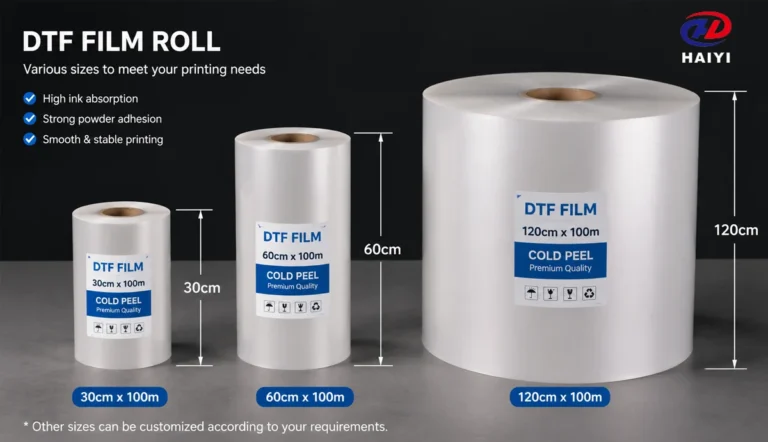
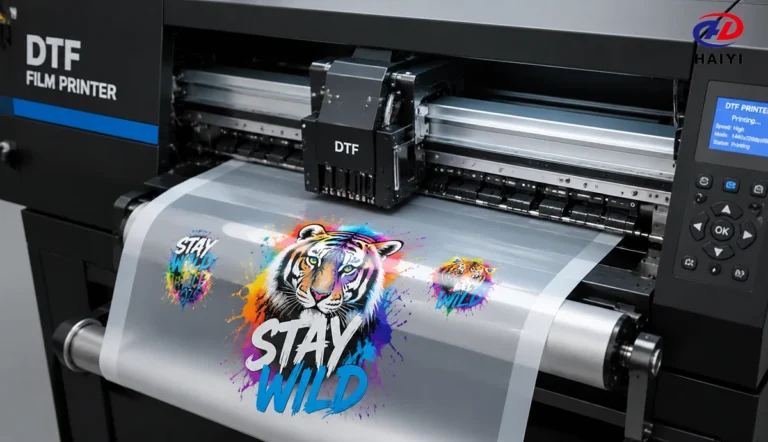
UV DTF film — specifically the A and B film set — is manufactured by heat transfer film producers alongside standard DTF film. Haiyi produces UV DTF film rolls as part of its full heat transfer consumables range, with the same in-house coating technology that governs quality in its standard DTF film line.
The Environmental Case for UV Printing
The environmental advantages of UV printing versus traditional alternatives are quantifiable and commercially relevant as environmental regulations tighten globally.
Zero VOC Emissions
Solvent-based printing releases volatile organic compounds as the solvent evaporates. VOCs are regulated as air pollutants in the US (EPA Clean Air Act), the EU (Industrial Emissions Directive), and increasingly in Asian markets. Print shops using solvent-based systems must install VOC abatement equipment, maintain emissions monitoring, and operate within permitted emission limits.
UV printing eliminates this compliance burden entirely. There are no solvents to evaporate, therefore no VOC emissions to regulate. A UV print shop can operate under the same air quality regulations as an office — not an industrial facility.
LED Curing Energy Efficiency
Traditional UV mercury lamps produce UV light across a broad spectrum and require significant warm-up time. LED UV curing produces UV light at the specific wavelengths that activate photoinitiators — converting nearly all electrical energy to useful curing energy rather than wasting it as heat.
LED UV curing uses 50 to 70% less energy than equivalent mercury UV systems. For a production facility running multiple UV printers across extended shifts, this energy reduction is significant in both operating cost and carbon footprint.
Reduced Material Waste
UV printing’s no-minimum-order capability enables print-on-demand production that eliminates the inventory waste inherent in traditional minimum-run printing. Small brands printing 100 labels instead of 10,000 minimum-order labels avoid the 9,900 surplus units that typically end up in landfill when packaging designs are updated.
Market Data: How Fast Is UV Printing Growing?
The quantitative case for UV printing’s industry disruption:
The global UV hybrid printer market was valued at USD 354 million in 2025, projected to reach USD 487 million by 2034 at a 4.8% CAGR. The advertising and signage segment leads adoption, followed by packaging and consumer goods.
Cosmetic packaging printing demand grew 12% year-over-year in 2025 — the fastest-growing application segment — driven by short-run personalization enabled by UV’s no-minimum-order economics.
Direct-to-object UV printing has moved from specialist to mainstream. According to industry analysis, two of the largest market segments for direct-to-object UV printing in 2025 are promotional products and signage — markets previously dominated by pad printing and adhesive label application respectively.
UV printing is projected to capture 18% additional market share in the e-commerce packaging segment by 2028, driven by demand for vibrant, durable prints on rigid packaging that can be produced in small batches economically.
By 2027, industry forecasts project that 75% of cosmetic packaging printing will shift to digital UV methods, from approximately 40% today — the most aggressive adoption curve of any printing technology transition in the packaging sector.
FAQ
What is UV printing and how does it differ from traditional printing? UV printing uses ultraviolet light to cure ink instantly the moment it is deposited, rather than relying on solvent evaporation or heat drying. The result is zero drying time, universal material compatibility (any substrate that tolerates UV LED heat exposure), and zero VOC emissions. Traditional solvent printing requires 48 to 72 hours drying, is limited to specific substrates, and emits VOCs during the drying process.
What materials can UV printing print on? UV printing works on virtually any material: plastic (ABS, PVC, acrylic, PE, PP), metal (aluminum, stainless steel, coated metals), glass, ceramic, wood, leather, fabric, rubber, and stone. The practical limit is materials that cannot withstand the temperature of UV LED curing (typically under 50°C) — most production materials are well within this tolerance.
What is the embossed effect in UV printing? The embossed or raised effect is created by printing multiple successive layers of UV ink on the same area of a design. Each layer cures instantly and creates a solid elevated surface. By stacking 5 to 20 or more layers, a physically tactile raised texture is built — similar in appearance and feel to traditional embossing, but created digitally without tooling or dies.
Can UV printing be used for outdoor advertising? Yes. UV inks formulated for outdoor applications contain UV stabilizers that prevent fading and surface degradation from solar UV exposure. Outdoor UV prints on appropriately formulated inks achieve 3 or more years of service life without additional lamination — comparable to or better than traditional solvent prints with lamination.
What is UV DTF printing? UV DTF (UV Direct to Film) combines UV printing technology with a transfer film system. A UV printer prints on a specialized A film, which is then cold-laminated with a pressure-sensitive B film carrier. After peeling the A film, the design on the B film is applied by hand pressure to any hard surface — glass, metal, acrylic, ceramic — without a heat press. UV DTF enables UV-quality decoration on hard surfaces at remote application sites.
How does UV printing reduce environmental impact? UV printing produces zero VOC emissions because curing is a photochemical reaction with no solvent evaporation. UV LED systems use 50 to 70% less energy than traditional UV mercury lamp systems. Print-on-demand capability eliminates minimum-order overproduction waste. These three factors position UV printing as the environmentally preferred alternative to solvent-based large-format and offset printing.
Is UV printing cost-effective for short runs? Yes — UV printing has no setup costs (no plates, no screens, no minimum quantities). The cost structure for 1 unit is the same as for 1,000 units. This makes UV printing the most cost-effective digital printing method for short runs, one-offs, and personalized production that would be economically unviable with traditional minimum-order methods.
How does UV printing handle curved surfaces? Modern UV flatbed printers include height-sensing systems that map the surface profile of three-dimensional objects and adjust the print head distance accordingly. This maintains consistent ink drop geometry across curved surfaces, producing sharp, accurate prints on cylinders, bottles, and irregular shapes. Rotary UV attachments enable full 360° printing on cylindrical objects without seam lines.
Conclusion
UV printing is not incrementally better than traditional printing. It is structurally different — and that structural difference is what makes it disruptive rather than merely competitive.
The 72-hour drying cycle is gone. The material restriction is gone. The minimum order requirement is gone. The embossed tactile effect is available without tooling. The curved surface problem is solved. And the VOC compliance burden is eliminated.
Each of these was a constraint that shaped how industries built their printing production, priced their services, and served their customers. UV printing removes all of them simultaneously.
The industries responding fastest are the ones where these constraints were most commercially painful: advertising (same-day delivery), luxury packaging (short-run premium effects), curved surface decoration (cosmetics, drinkware, electronics), and industrial marking (permanent, chemical-resistant identification on any surface).
The market data confirms what the technology suggests: the UV printing market is growing at 4.8% annually, cosmetic packaging is shifting to digital UV at 75% adoption by 2027, and direct-to-object UV printing has moved from specialist technology to mainstream production tool.
For businesses still relying on traditional methods that require drying time, minimum orders, or material-specific equipment, the competitive pressure from UV-capable competitors is not future speculation — it is already present in every market where customization, speed, and premium visual effects determine who wins the order.
Haiyi manufactures UV DTF film as part of its full heat transfer consumables product range — A film, B film, and matched UV-curable ink systems for hard surface transfer applications. Factory-direct wholesale pricing, OEM packaging, and 15 years of international export experience. Haiyi also produces standard DTF film, sublimation paper, reflective heat transfer film, and crystal label film.