







DTF Print Parameter Test Matrix for New Film Batches
A controlled test matrix for qualifying new DTF film batches before production.

A new film batch should not go directly from receiving to a large customer order. A small print parameter matrix can show whether the approved settings remain suitable and can reveal interactions between ink load, curing, pressing, and peeling. The goal is not to test every possible setting, but to find a stable production window with controlled evidence.
For the full production workflow, use the complete guide to printing DTF transfers. This page explains the batch qualification matrix.
Start with an Approved Baseline
Use the current approved film, artwork, RIP preset, ink, powder, curing, press, fabric, and peel procedure as the control. If there is no baseline, create one before comparing materials. A test without a control cannot show whether a result comes from the new film or from the shared process.
Choose a Small Number of Variables
Prioritize settings that can realistically change the result: ink load, curing condition, first-press condition, and peel timing. Test one variable at several controlled levels while other factors remain fixed. Avoid a large grid that produces many samples but no clear conclusion.
Use Diagnostic Artwork
- Fine text and thin lines for detail retention
- A solid block for heavy ink and curing behavior
- A gradient for dot and color transitions
- Sharp corners for edge release
- A larger shape for pressure and cooling uniformity
Example Test Matrix Structure
| Sample | Variable changed | Other conditions | Decision |
|---|---|---|---|
| Control | None | Approved baseline | Confirms system stability |
| A | Lower selected variable | Same as control | Checks lower boundary |
| B | Baseline selected variable | Same as control | Checks repeatability |
| C | Higher selected variable | Same as control | Checks upper boundary |
Score the Entire Transfer
Record print definition, wet-film stability, powder coverage, cure appearance, release force, fine-detail retention, surface finish, edge adhesion, stretch, and wash performance. A setting that looks excellent before pressing may create a weak finished transfer, so approval must include the final application.
Test Repeatability
Repeat the preferred condition on multiple samples and, when practical, at different positions across the roll or printer width. One successful sample does not define a stable operating window. Record film lot, roll position, operator, equipment, and environmental conditions.
Decide Whether to Accept, Adjust, or Quarantine
- Accept: the batch performs within the approved window and passes final checks.
- Adjust: a small documented setting change produces repeatable acceptable results.
- Quarantine: the batch requires an unusually narrow window, shows repeating coating patterns, or cannot meet the defined criteria.
Release the Settings to Production
Save the selected RIP preset and publish a work instruction with film lot, printer, ink, powder, curing, pressing, peeling, and inspection requirements. Keep a physical or photographed control sample. If the batch changes, do not assume the previous adjustment is still correct.
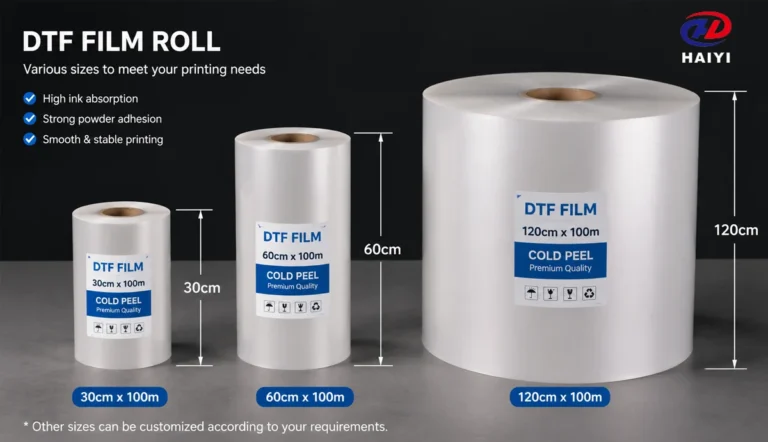
Production buyers can compare suitable DTF PET film roll formats before requesting a batch sample.
Wholesale Sample and Batch Qualification
Haiyi supports wholesale and custom DTF film supply for B2B customers. Contact Haiyi with your printer width, ink and powder system, release method, target fabrics, and order volume to discuss samples and batch qualification requirements.