







DTF Film Moisture Control: Storage, Condensation, and Humidity
Prevent and diagnose DTF film moisture problems with controlled storage, sealed acclimation, receiving checks, traceability, and systematic testing.

Reading time: 8 minutes
DTF moisture control protects the film coating, adhesive powder, ink behavior, curing process, and final garment. When a transfer looks oily, wet, cloudy, bubbled, or inconsistent, high humidity may be involved, but moisture is not the only possible cause. A reliable diagnosis separates storage exposure, condensation, ink load, powder condition, curing, film quality, and garment moisture before changing the process.
This guide explains how print shops and wholesale buyers can prevent condensation, control storage and receiving, isolate moisture-related defects, and document a practical response. It does not prescribe one universal relative-humidity number because equipment and consumable suppliers may specify different operating windows.
Why does moisture matter in DTF production?
Moisture matters because DTF printing uses water-based ink, a coated film, thermoplastic adhesive powder, heat, and a textile substrate in one connected system. Excess water or condensation can change ink reception, powder flow, curing, film handling, adhesion, and the appearance of the finished transfer.
Moisture can enter through several paths: humid room air, an unsealed film roll, powder exposed to air, a cold roll opened before acclimation, a damp garment, incomplete drying, or packaging damaged during transport. The visible symptom may appear at printing, curing, pressing, peeling, or washing, so the point where the defect appears is not always the point where it began.
What is the difference between humidity and condensation?
Humidity describes water vapor in the surrounding air. Condensation occurs when a surface is cold enough for that vapor to become liquid water. A film roll moved from a cool warehouse or vehicle into a warm humid production room can collect moisture if it is opened before the roll reaches room condition.
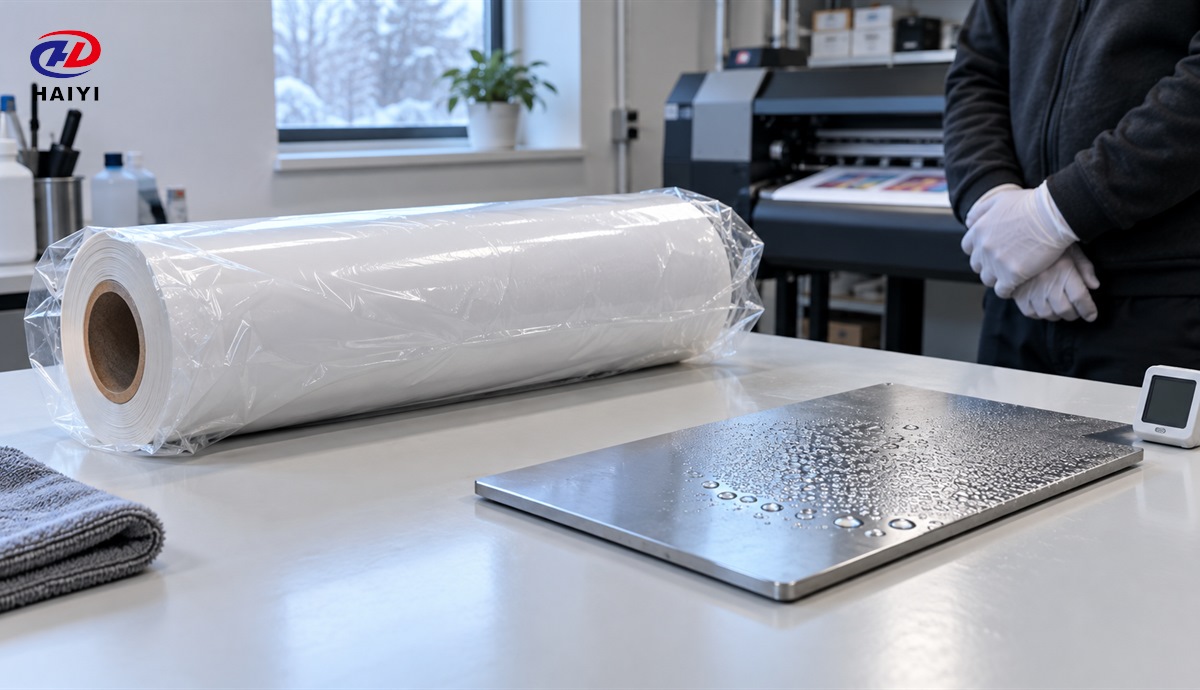
The safe principle is simple: keep a cold roll sealed during acclimation. The sealed package limits contact between the cold film and humid room air. The required waiting time depends on roll mass, temperature difference, packaging, and room conditions, so define it from measured experience and supplier guidance rather than an arbitrary clock value.
What symptoms can moisture create?
Possible moisture-related symptoms include uneven ink wetting, blurred detail, mottled white underbase, sticky or oily-looking surfaces, powder clumping, inconsistent powder pickup, bubbles during cure, haze, weak local adhesion, difficult release, and variable results between the start and end of a roll.
These symptoms are not proof of moisture by themselves. Excess ink, incorrect printing side, damaged coating, contaminated film, poor powder quality, excessive or incomplete curing, a cold platen, wrong pressure, and garment finishes can produce similar evidence. Treat moisture as a hypothesis that must be tested.
How should DTF film be stored?
DTF film should be stored in its protective packaging, away from direct sunlight, heaters, exterior walls, open doors, water sources, and rapid temperature swings. Keep rolls clean, supported, and protected from crushing or edge damage. Follow the film supplier’s stated temperature and humidity limits, and record actual conditions instead of assuming an air-conditioned room is stable.
After opening, reseal the unused roll with appropriate protective packaging and desiccant when the supplier specifies it. Apply first-in, first-out inventory control while preserving lot identity. Film age alone does not prove usability; packaging integrity, exposure history, coating condition, and sample performance also matter. See Haiyi’s guide to DTF film shelf life for a broader storage decision.
How should DTF powder and ink be protected?
Adhesive powder should remain sealed when not in use because absorbed moisture can encourage clumping and irregular application. Do not return contaminated or visibly wet powder to the main container. Use clean tools, close containers promptly, and follow the powder supplier’s storage and safety instructions.
DTF ink should be stored and handled within the ink supplier’s range. Ink behavior can change with temperature, agitation, circulation, age, and exposure. A wet-looking print is not necessarily caused by ambient humidity; excessive ink density, white ink instability, or incomplete curing may be more important. Keep each consumable within its own control plan.
Can garments introduce moisture?
Yes. Cotton and other textiles can absorb water from storage and transport conditions. A damp garment may release vapor during pressing, producing haze, temporary darkening, bubbles, or inconsistent adhesion. Garments stored near loading doors, floors, exterior walls, or unconditioned areas deserve extra attention.
A controlled pre-press can remove wrinkles and some surface moisture when it is compatible with the garment, but excessive pre-pressing can create shine, flatten texture, or begin dye migration. Define the pre-press as part of the approved recipe rather than using it as an unlimited correction.
How can a moisture-related DTF defect be diagnosed?
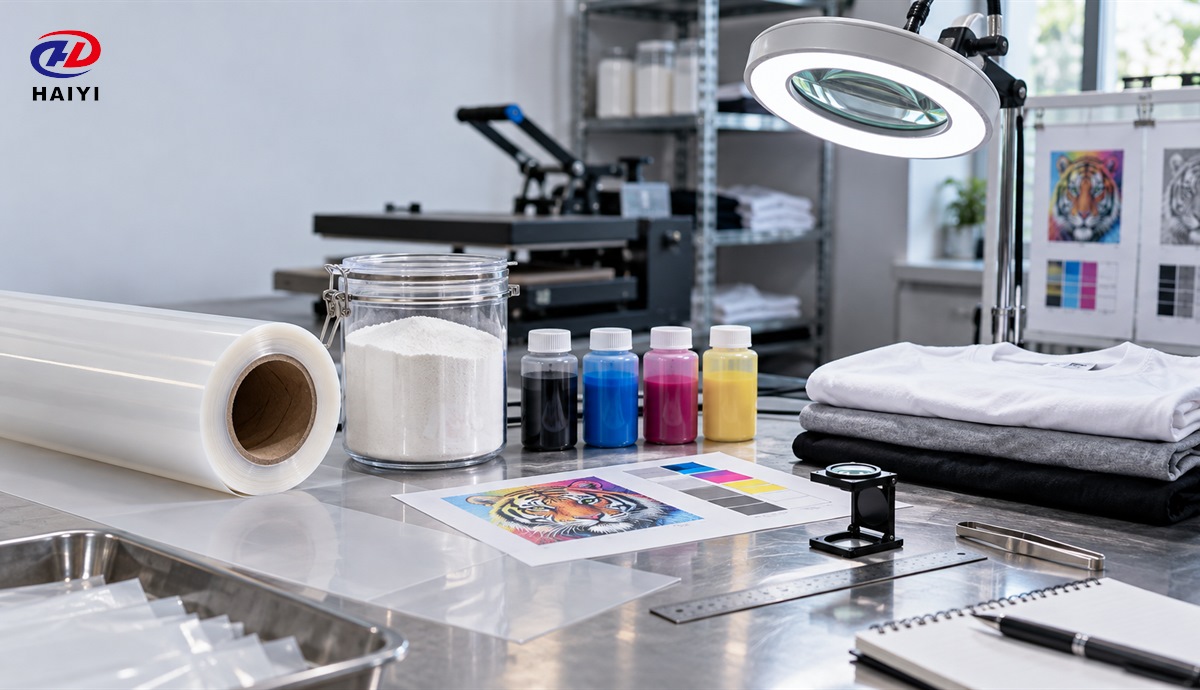
- Stop mixing affected stock. Isolate the film, powder, ink, and garments used in the failed job and preserve their lot information.
- Record the environment. Note room conditions, storage conditions, transport exposure, package state, and whether the roll was acclimated while sealed.
- Identify the first failed stage. Determine whether the defect starts during printing, powder application, curing, pressing, peeling, or later washing.
- Run a controlled reference. Compare the affected material with a known-good sealed sample while holding printer, file, ink, powder, cure, press, and garment constant.
- Change one source at a time. Replace film, then powder, then garment or another controlled component so the improvement has meaning.
- Confirm the correction. Repeat the selected condition across more than one position and sample, then perform the required wash or end-use test.
If the primary symptom is oiliness or bubbling, compare the evidence with Haiyi’s guide to oily, wet, or bubbled DTF film. That article covers cure and consumable causes that may resemble humidity exposure.
What should a DTF storage SOP include?
A DTF storage SOP should define the supplier-approved environmental range, monitoring location, alarm or response limits, packaging rules, sealed acclimation procedure, opened-roll handling, powder handling, lot traceability, stock rotation, quarantine criteria, and the person responsible for each check.
| Control point | Required evidence | Action when outside control |
|---|---|---|
| Room condition | Dated temperature and humidity record at the material location | Protect stock, correct the environment, and assess exposure duration |
| Package integrity | Seals, bags, cartons, and labels intact | Quarantine damaged units and run a controlled sample |
| Acclimation | Roll remains sealed until the approved condition is reached | Do not open a cold roll; extend controlled acclimation |
| Opened stock | Resealed, identified, and exposure time controlled | Test before production when history is uncertain |
| Powder | Free-flowing condition and closed container | Isolate clumped or contaminated material |
| Traceability | Supplier lot linked to receipt and production job | Stop use if the affected scope cannot be identified |
How should wholesale film be inspected on receipt?
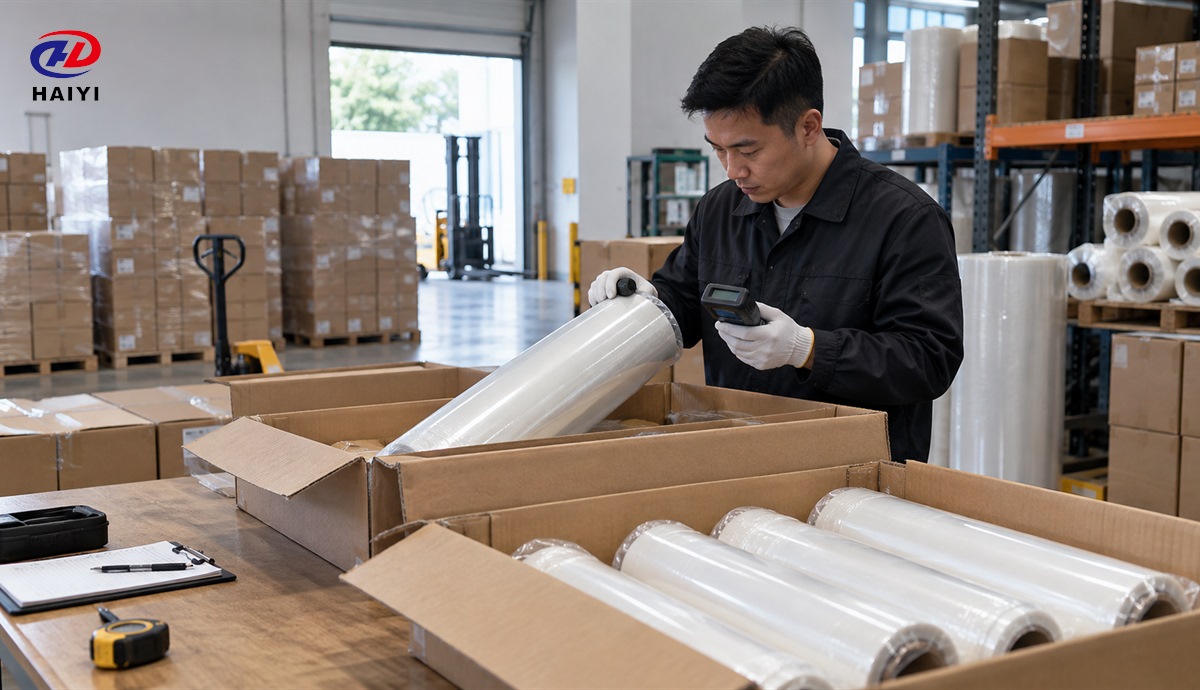
Receiving inspection should record shipment condition, carton damage, wet exposure, seal integrity, roll edges, core damage, label and lot information, and any temperature shock that requires sealed acclimation. Do not move damaged packaging directly into unrestricted inventory.
For bulk purchasing, request a lot-linked certificate or inspection record that identifies the product and relevant test results. Haiyi’s DTF film certificate of analysis checklist explains what evidence is useful. Buyers comparing repeat lots can also apply the two-batch quality comparison method.
What should be done after a humidity excursion?
After an excursion, protect unopened stock, identify the affected time and lots, restore the controlled environment, and avoid opening cold or questionable packages. Do not assume that every exposed roll is unusable, and do not release every roll without evidence. Select representative samples, condition them correctly, and run the approved compatibility and durability test.
If a failure is confirmed, preserve samples and production records before contacting the supplier. A useful complaint includes lot number, packaging photographs, storage and room records, printer and consumable details, cure and press settings, defect stage, and comparison results against known-good material.
Frequently asked questions about DTF moisture control
What relative humidity is best for DTF film?
Use the operating and storage range specified for the exact printer, ink, film, and powder system. A single number cannot safely replace those requirements. The important control is a stable, monitored environment and a documented response when it leaves the approved range.
Can wet DTF film be dried and reused?
Do not apply uncontrolled heat to a roll. If exposure is suspected, isolate the material, condition it according to supplier guidance, and test representative samples. Replace the roll when coating damage or unstable performance remains.
Why does a DTF transfer look oily after curing?
Possible causes include retained moisture or humectants, high humidity, excessive ink, incomplete cure, incompatible consumables, or material quality. Compare controlled samples before increasing cure energy because excessive heat can create a different failure.
Should DTF film be stored with desiccant?
Use desiccant when the packaging and supplier instructions call for it. Desiccant supports sealed-package control but cannot compensate for an open roll left in an uncontrolled room.
Build a controlled wholesale DTF film supply program
Haiyi supplies wholesale and customizable DTF film for distributors, print shops, and private-label buyers. B2B customers can request lot-traceable samples, packaging options, and compatibility testing for their printer and consumable system. Review Haiyi’s DTF film buying guide, then contact Haiyi with your roll format, storage environment, monthly volume, peel requirement, and current moisture-control concern.