





DTF Peel-Test SOP: Hot, Warm, and Cold Peel Film
Use this repeatable DTF peel-test SOP to qualify hot, warm, and cold peel film, define an operating window, and document acceptance criteria.

A reliable DTF peel-test SOP does not ask whether hot peel or cold peel is universally better. It identifies the peel temperature and timing window that produces complete release, clean edges, stable color, and repeatable wash performance with a specific film, ink, powder, press, artwork, and fabric. The practical goal is to define an operating range that production teams can reproduce, not a single perfect second.
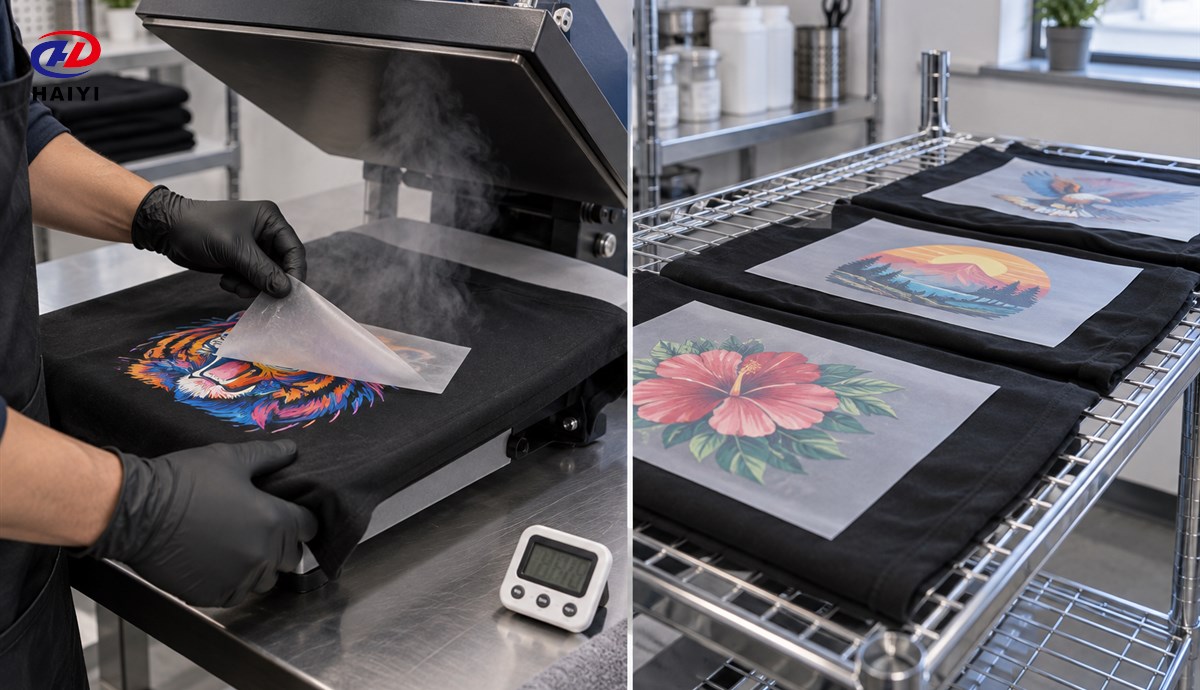
Hot-peel film is normally removed immediately or within a short time after pressing, cold-peel film is removed only after the transfer has cooled, and warm-peel film is removed between those conditions. Those names describe release behavior, but they do not replace a controlled qualification test. Two films carrying the same peel label can still require different time, temperature, pressure, and handling.
What should a DTF peel test prove?
A useful peel test must prove three things. First, the carrier releases without lifting ink or adhesive from the fabric. Second, the transferred image retains fine detail, smooth solids, and clean edges. Third, the result remains acceptable after the specified finishing press and durability tests. A transfer that peels easily but fails washing is not an approved result.
| Peel mode | Typical production objective | Main control risk | Best use of the test |
|---|---|---|---|
| Hot peel | Short cycle time and fast handling | Peeling outside a narrow temperature window | Confirm that operators can release consistently at line speed |
| Warm peel | Balance between speed and handling tolerance | Inconsistent waiting time between operators | Define a measurable delay or surface-temperature range |
| Cold peel | Stable release after full cooling | Stacking, bending, or peeling before the sample is cool | Confirm complete cooling and predictable release |
Which variables must remain constant?
Change only one factor at a time. Record the film batch, printer, print mode, ink batch, white-ink density, powder type, cure condition, fabric composition, fabric color, press model, platen temperature, pressure setting, dwell time, peel delay, peel direction, and finishing press. Pre-press every fabric sample with the same procedure so moisture and wrinkles do not distort the comparison.
Verify actual platen temperature with a suitable measuring method instead of relying only on the press display. Pressure should also be defined operationally. A vague instruction such as “medium pressure” cannot support repeatable approval across multiple presses or factories.
How should the test artwork be designed?
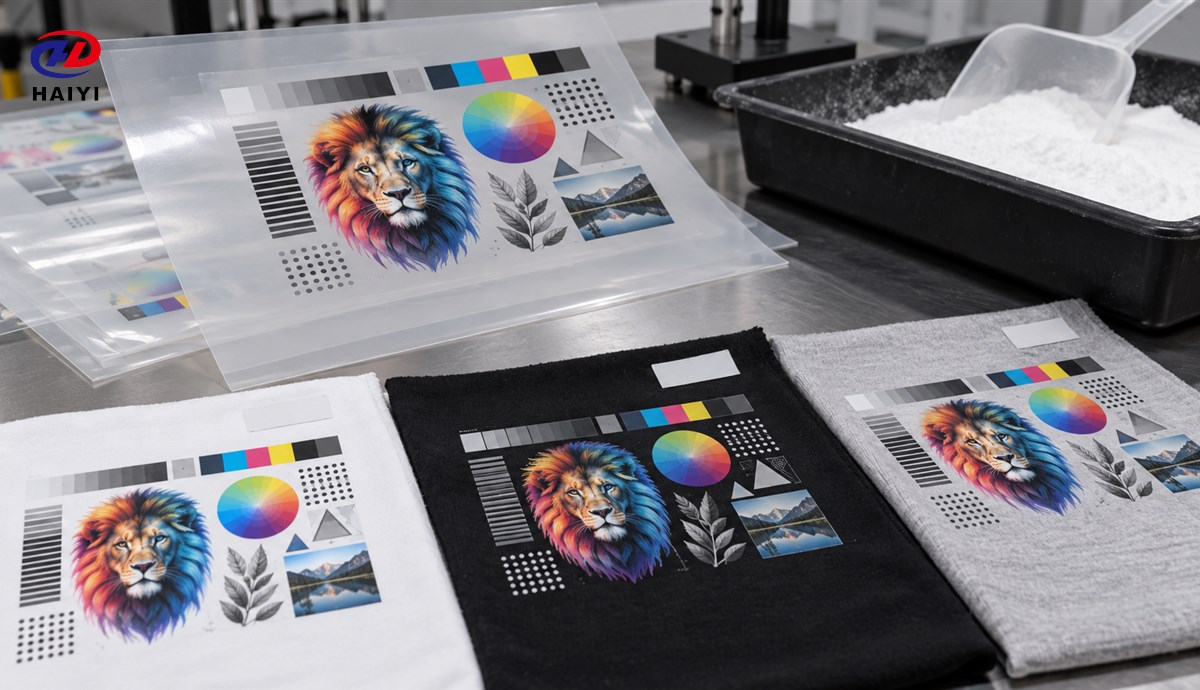
A standardized test file should contain solid colors, a dense white-underbase area, fine positive and negative lines, small isolated details, gradients, sharp corners, and large continuous areas. These elements expose different failure modes. Fine lines reveal edge lift, solid blocks reveal incomplete adhesion or texture variation, and gradients reveal color or curing changes.
Step-by-step DTF peel-test procedure
- Condition the materials. Store film, powder, ink, and fabric in the production environment long enough to stabilize. Record room temperature and humidity when they can affect results.
- Prepare identical specimens. Print the same artwork with the same settings and cure every transfer under the same verified conditions.
- Pre-press the fabric. Use one defined pre-press time for every specimen.
- Build a controlled test matrix. Start with the supplier’s recommended temperature, pressure, and time. Test small, practical variations around that center point rather than changing all settings randomly.
- Apply the transfer. Keep placement, press loading, and protective sheet consistent.
- Peel by the assigned method. For hot peel, remove the carrier immediately using a consistent direction and speed. For warm peel, use a timed delay or measured surface temperature. For cold peel, place the sample flat and do not peel until it reaches the defined condition.
- Finish consistently. If a second press is part of the production specification, apply the same cover sheet, time, and pressure to every sample.
- Inspect and test. Score release, edges, surface, stretch response, color, hand feel, and wash durability.
How should peel quality be scored?
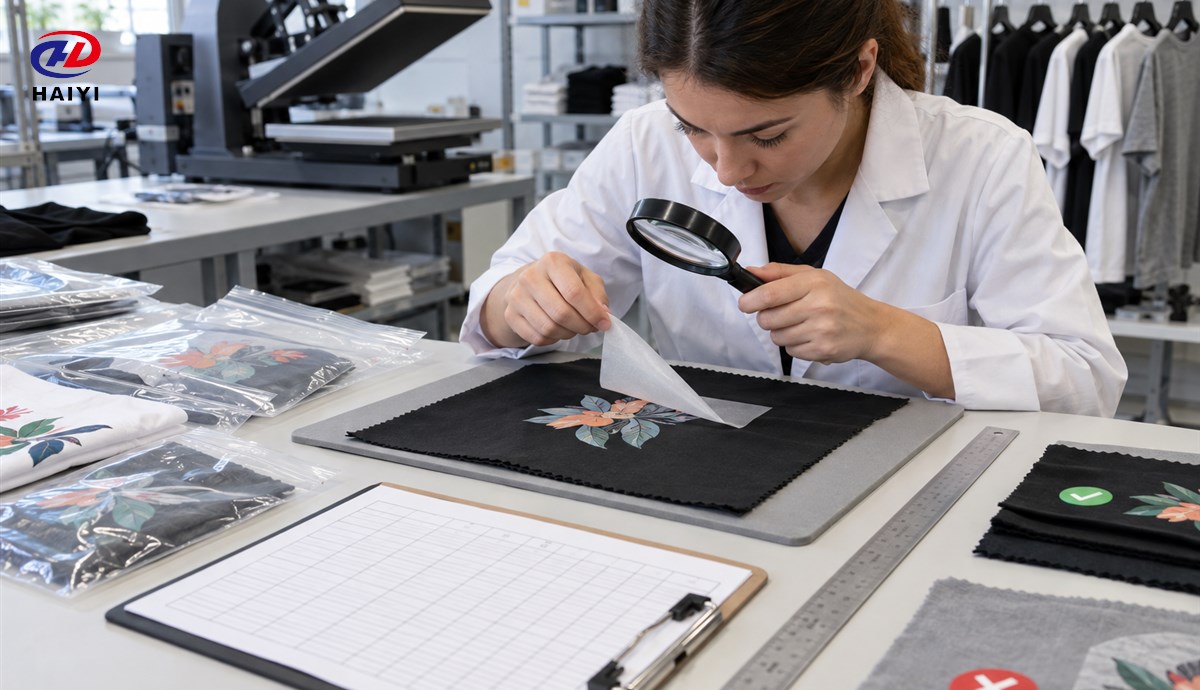
Use a written scorecard rather than memory. A simple 0-to-5 scale can work if every score has a definition. Record whether ink remains on the carrier, whether small details lift, whether adhesive extends beyond the print, whether the image distorts during peeling, and whether the surface becomes glossy, cracked, or uneven. Photograph each sample under the same lighting.
What acceptance criteria should a buyer use?
An acceptable operating window should produce complete carrier release, no visible edge lift, no missing fine details, consistent surface appearance, and no unacceptable color shift. The image should also pass the buyer’s stretch and laundering requirements after the defined rest period. Approval should be based on repeated specimens, not one successful transfer.
A robust film gives operators a practical window. For example, if acceptable results appear only at one exact time and fail with a small normal variation, the process may be too fragile for bulk production. A wider acceptable window usually reduces training difficulty, rework, and scrap.
How many repetitions are enough?
Run at least three identical specimens at each candidate condition during initial screening, then confirm the selected setting on a larger pilot batch and on every important fabric family. Repeat the test when the film, ink, powder, printer profile, curing equipment, heat press, garment supplier, or environmental conditions change. Buyers comparing production lots can also use the method in our guide to comparing DTF film quality across two batches.
Common peel-test mistakes
- Calling a film “hot peel” without defining the actual peel delay or surface condition.
- Comparing films with different ink density, powder coverage, or cure level.
- Testing only one cotton shirt and assuming the result applies to polyester, blends, and coated fabrics.
- Judging release immediately but skipping the finishing press and wash test.
- Approving a single sample without checking repeatability or lot traceability.
How does this SOP fit a full compatibility program?
Peel behavior is one part of the consumables system. A complete qualification plan also checks printing, powder pickup, curing, transfer, color, fabric interaction, storage, and durability. Use our DTF consumables compatibility test protocol for the broader program. Buyers who still need a product-level comparison can review cold peel versus hot peel DTF film and our guide to choosing hot, cold, or instant peel film.
Request a DTF film sample for your production line
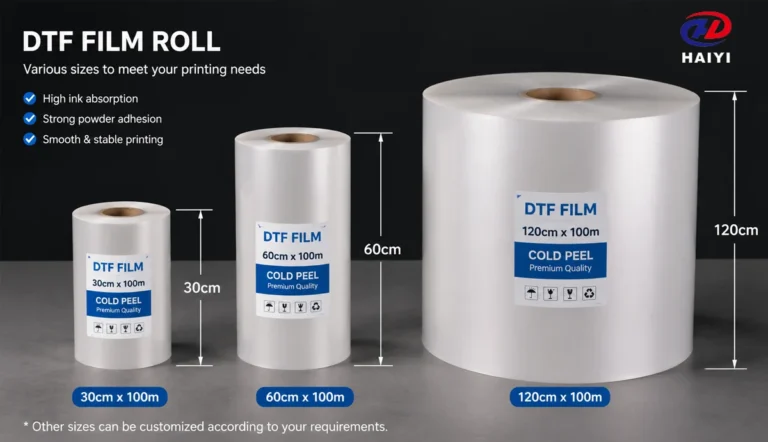
Haiyi supplies wholesale and customized DTF film for distributors, print operations, and private-label programs. Share your printer model, ink and powder system, roll size, target fabric, press settings, peel preference, monthly volume, and acceptance tests. We can prepare samples for a controlled trial so your team approves a repeatable process before bulk ordering. Contact Haiyi to discuss DTF film samples and wholesale customization.