







How to Compare DTF Film Quality Across Two Production Batches
A practical method for comparing DTF film quality across two production batches with matched sampling, controlled testing, paired analysis, and release decisions.

Estimated reading time: 14 minutes
To compare DTF film quality across two production batches, test matched samples under the same conditioning, printer, ink, powder, curing, pressing, artwork, and fabric conditions. Compare both the average result and the variation within each batch. A batch should not be judged from one attractive transfer or one isolated laboratory number. The decision should combine incoming material checks, measurable film properties, printing behavior, transfer performance, and predefined acceptance rules.
The purpose of a two-batch comparison is to answer a practical question: can the new batch replace the approved batch without creating a meaningful change in production or customer results? That question is narrower than a general quality inspection. It requires a paired design that removes as many unrelated variables as possible.
This guide gives distributors, importers, print operations, and private label buyers a repeatable comparison framework. It does not assign universal limits because acceptable values depend on the film specification, peel type, printer configuration, ink and powder system, curing method, fabric, application, and customer tolerance. Buyers should establish limits from validated production evidence and qualified technical review.
What counts as a meaningful difference between DTF film batches?
A meaningful difference is a repeatable change that can affect print stability, usable yield, transfer appearance, handling, durability, customer instructions, or operating settings. A small numerical difference may be harmless when both batches remain stable and within the approved process window. A visually small change may be important when it increases feeding errors, static, powder contamination, difficult peeling, edge lift, or rework.
Separate three questions before testing:
- Conformance: Does each batch meet the written specification?
- Equivalence: Is the new batch sufficiently close to the approved reference for the intended process?
- Capability: Does each batch remain consistent across roll positions and repeated runs?
A batch can meet broad specifications yet behave differently from the reference. It can also produce a similar average while showing greater variation. Therefore, comparison should examine level, spread, location, and practical effect rather than a single pass or fail line.
Choose the correct reference batch
The reference should be a documented production batch that performed acceptably in normal use. Keep its batch identity, receipt date, storage history, roll size, product specification, packaging condition, and test history. A convenient leftover roll is not a useful reference if it has unknown exposure to heat, humidity, dust, pressure, or extended storage.
Use a retained sample when possible, but confirm that the retained material still represents the original approved condition. If the reference has aged or was stored differently, the comparison may measure storage history instead of manufacturing variation. When no valid retain exists, establish a fresh control through a documented production run and state that limitation in the report.
The reference and candidate must represent the same intended product. Do not compare different peel types, thicknesses, coating constructions, or product grades and call the result a batch study. Such work can be useful for product selection, but it answers a different question.
Freeze the comparison conditions before opening the rolls
Write a short protocol before testing. Record the film identities, sample locations, conditioning period, room conditions, equipment, calibration status, printer settings, ink set, powder, curing conditions, heat press settings, artwork, fabric, operator sequence, replicates, evaluation method, and decision rules.
Use the same consumable lots where practical. If ink, powder, or fabric changes between batches, the result becomes difficult to attribute. Confirm actual platen or oven conditions with suitable instruments where needed rather than relying only on a displayed setting. Record any unavoidable difference and interpret the result cautiously.
Randomize or alternate the run order. Testing every reference sample first and every candidate sample later can confuse warm-up drift, room changes, nozzle condition, or operator learning with a film effect. An alternating sequence such as reference, candidate, candidate, reference can reduce order bias. Blind sample codes can further reduce visual scoring bias.
Build a matched sampling plan
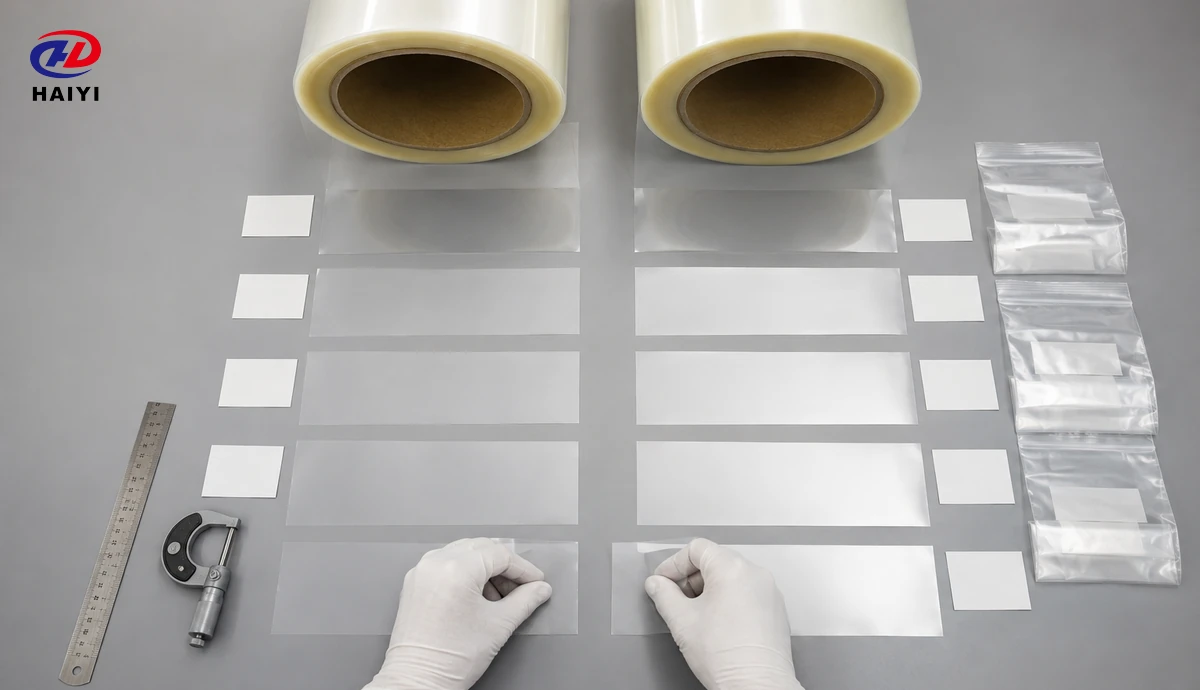
Sampling should represent variation within each batch. Take specimens from more than one roll when the batch contains multiple rolls. Within a roll, sample comparable positions such as near the beginning, middle, and later section. Across the web, include left, center, and right positions when width-related uniformity matters.
Pair equivalent locations between the two batches. A candidate specimen from the left edge should be compared with a reference specimen from a similar location, not only with a reference center specimen. Record machine direction and transverse direction when orientation can affect dimensional behavior.
Do not cut all replicates from one small adjacent area. Closely neighboring pieces can underestimate real variation. The sampling plan should balance test cost with the risk of missing local or roll-to-roll differences. Increase coverage for large orders, new suppliers, process changes, previous complaints, or high-consequence applications.
Condition and identify every sample
Bring both batches into the same controlled environment before measurement and printing. Film temperature and moisture history can affect curl, static behavior, handling, and process response. Keep the conditioning period consistent and protect the printable surface from dust, fingerprints, abrasion, and unintended contact.
Assign a sample code that preserves traceability without revealing the batch during subjective review. The code should connect to batch, roll, position, direction, time, and replicate in a controlled worksheet. Keep the key separate until scoring is complete.
Inspect packaging before removing material. Record crushed cores, loose winding, edge damage, telescoping, contamination, moisture concerns, and label errors. Packaging damage should not automatically be treated as a coating defect, but it can affect usable yield and must remain part of the commercial decision.
Start with incoming physical inspection
Measure roll width, length verification method where applicable, thickness according to the agreed method, core condition, winding alignment, edge quality, surface cleanliness, flatness, and curl. Compare the same measurement locations and tools for both batches.
Visual inspection should use controlled lighting and a defined viewing distance. Look for coating streaks, spots, scratches, gels, haze differences, blocking, uneven winding, wrinkles, and edge damage. Photograph findings with a scale and sample code. Avoid vague notes such as looks worse. Describe the defect, location, size, frequency, and affected area.
Physical checks are screening tools. A film that looks uniform may still behave differently during printing or peeling, while a minor visual difference may have no process effect. Continue to functional testing unless a critical defect or agreed rejection condition makes further work unnecessary.
Compare coating weight and cross-web uniformity
Coating behavior can influence ink reception, powder interaction, drying, release, and transfer consistency. Use the same validated method, coupon area, balance, conditioning, and calculation for both batches. Collect matched specimens across the web and roll positions rather than relying on one average.
Compare the mean coating weight, range, standard deviation, and location pattern. A similar mean can hide edge-to-center variation. A stable cross-web profile can be more useful than one isolated value near the target. Review the full method in the guide to measure DTF film coating weight and uniformity.
Interpret coating data with functional results. Do not assume that a higher or lower coating weight is automatically better. The relevant question is whether the construction remains within the approved specification and supports the required print and release behavior.
Compare release behavior with controlled peel testing
Peel performance should be tested after matched printing, powdering, curing, pressing, cooling, and peel timing. Use a fixed peel direction, angle, speed, specimen width, substrate, and evaluation sequence. Record both force behavior and visible transfer outcome.
Compare average force, variation, force spikes, smoothness, residue, incomplete transfer, edge lift, and sensitivity to the allowed peel window. Two batches can show similar average force but different variability or peak behavior. For a detailed procedure, see DTF film release force testing methods.
A batch should not be rejected merely because its numerical force differs slightly from the reference. Apply the predefined specification and practical process window. If operators must slow down, wait longer, change temperature, or use unusual technique to obtain an acceptable result, document that operational change.
Compare static and feeding behavior
Static performance can affect sheet separation, dust attraction, powder contamination, tracking, and handling. Measure surface resistance or another agreed indicator under controlled conditioning, using the same electrode arrangement, dwell time, equipment, and test surface. Humidity and handling history should be recorded because they can influence results.
Also observe actual feeding. Record skew, head-contact risk, edge lift, slippage, take-up behavior, dust attraction, and intervention frequency during matched runs. A laboratory value is most useful when it helps explain observed production behavior. The article on DTF film anti-static surface resistance testing explains how to control the measurement conditions.
Do not combine static observations with every feeding problem. Misaligned rollers, incorrect tension, damaged cores, printer cleanliness, and environmental conditions can produce similar symptoms. Confirm the equipment state before assigning the cause to film.
Compare heat shrinkage and dimensional stability
Dimensional change can affect registration, fine details, borders, and layer alignment. Cut specimens in known machine and transverse orientations, mark or measure the defined gauge length, expose both batches under the same validated thermal conditions, cool them consistently, and calculate dimensional change with the same formula.
Compare direction-specific averages and variability. A balanced result across positions may matter more than one central coupon. Link laboratory shrinkage to the actual artwork and curing process. The guide to DTF PET film heat shrinkage testing provides a focused dimensional method.
Temperature uniformity, specimen restraint, measurement technique, and conditioning can affect the result. If a difference appears, repeat the test after checking these sources before concluding that the batch changed.
Run a paired printing trial
The printing trial should use one controlled artwork that exposes relevant behavior. Include solid colors, gradients, fine lines, small reversed areas, white ink regions, dense coverage, low coverage, edges, and repeated shapes. Use the same RIP settings, resolution, passes, ink limits, printer state, and maintenance condition.
Print enough replicates to observe repeatability. Alternate batches during the run and record start time, sequence, room condition, nozzle check, feeding events, visible wet ink behavior, spreading, mottling, banding, powder pickup, and handling. If a parameter must be changed, stop the direct comparison and document a separate optimization trial.
The existing DTF print parameter test matrix for new film batches can help organize printer settings. In a two-batch comparison, the main objective is different: keep the approved settings fixed first, then determine whether the candidate behaves like the reference.
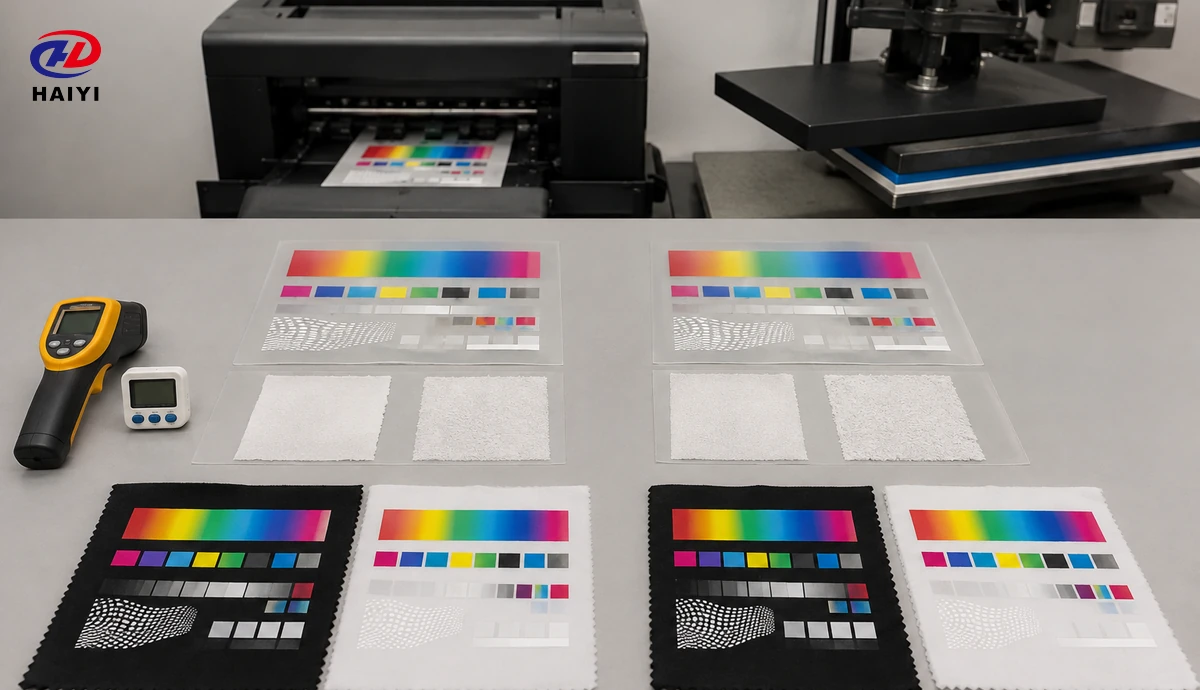
Evaluate cured film and transferred fabric separately
Inspect the cured film before pressing. Compare powder coverage, unwanted powder retention, surface dryness, tack, oiliness, blocking, edge behavior, film deformation, and handling. This stage can reveal differences that disappear or become harder to diagnose after transfer.
Press matched samples on fabric cut from the same lot and area where practical. Control temperature, time, pressure, platen location, peel timing, and post-press treatment. Evaluate transfer completeness, edge definition, color appearance, white coverage, surface texture, stretch response, feel, gloss, residue, staining, and any visible distortion.
Use objective measurements when suitable, but keep practical visual and handling criteria. A numerical color or force result cannot capture every commercial defect. At the same time, subjective scoring should use reference examples, defined lighting, blinded reviewers, and consistent rating descriptions.
Add durability checks when the application requires them
Short-term appearance does not prove long-term performance. Use the same fabric, transfer process, cure state, wash method, detergent, load, drying method, cycle count, and evaluation criteria for both batches. Compare cracking, peeling, edge lift, color change, surface change, and adhesive failure.
The DTF wash-test protocol offers a structured approach for diagnosing cracking, peeling, and shedding. Select durability tests that match the intended product claim and customer use. Do not claim broader durability than the tested method supports.
How should the two sets of data be compared?
Build one table with paired rows for equivalent sample locations and runs. For each metric, show the reference result, candidate result, difference, acceptance limit, observation, and disposition. Keep raw data available rather than reporting only rounded averages.
| Comparison view | What it reveals | Why it matters |
|---|---|---|
| Mean or median | Typical level for each batch | Shows possible process shift |
| Range and standard deviation | Within-batch spread | Shows consistency and risk |
| Paired difference | Change at matched positions | Reduces location bias |
| Position pattern | Edge, center, start, or later variation | Locates possible process effects |
| Defect rate | Frequency per defined area or run | Connects quality to usable yield |
| Production event rate | Stops, skew, cleaning, or rework | Connects film to operating cost |
Do not treat statistical significance as automatic business importance. A small difference can appear statistically clear with many measurements yet have no practical effect. The reverse can also occur when limited samples fail to detect a costly intermittent defect. Combine statistics, specifications, process knowledge, and risk.
Plot results by roll and position when possible. Averages can hide a weak edge, one unstable roll, or drift through the roll. Review outliers, but do not delete them only to improve the result. Investigate whether an outlier reflects measurement error, sample damage, or a real local defect.
Set decision rules before reviewing the result
Use a four-part decision. First, verify that critical specification requirements are met. Second, assess whether the candidate differs materially from the reference. Third, confirm that the candidate remains stable within itself. Fourth, decide whether any difference affects customer use or requires a documented process change.
A practical disposition can be:
- Release: All critical requirements pass, variation is controlled, and no meaningful operational change appears.
- Conditional release: The batch meets requirements, but a bounded use condition, monitoring plan, or customer-specific restriction is documented and approved.
- Hold and investigate: Results conflict, variation is high, or the cause is uncertain.
- Reject or rework: A critical requirement fails or the batch creates an unacceptable production or customer risk.
Conditional release should not become a way to avoid resolving recurring problems. State the quantity, customers, process settings, monitoring frequency, owner, and expiration of the condition. A hold decision should define the next test or evidence needed.
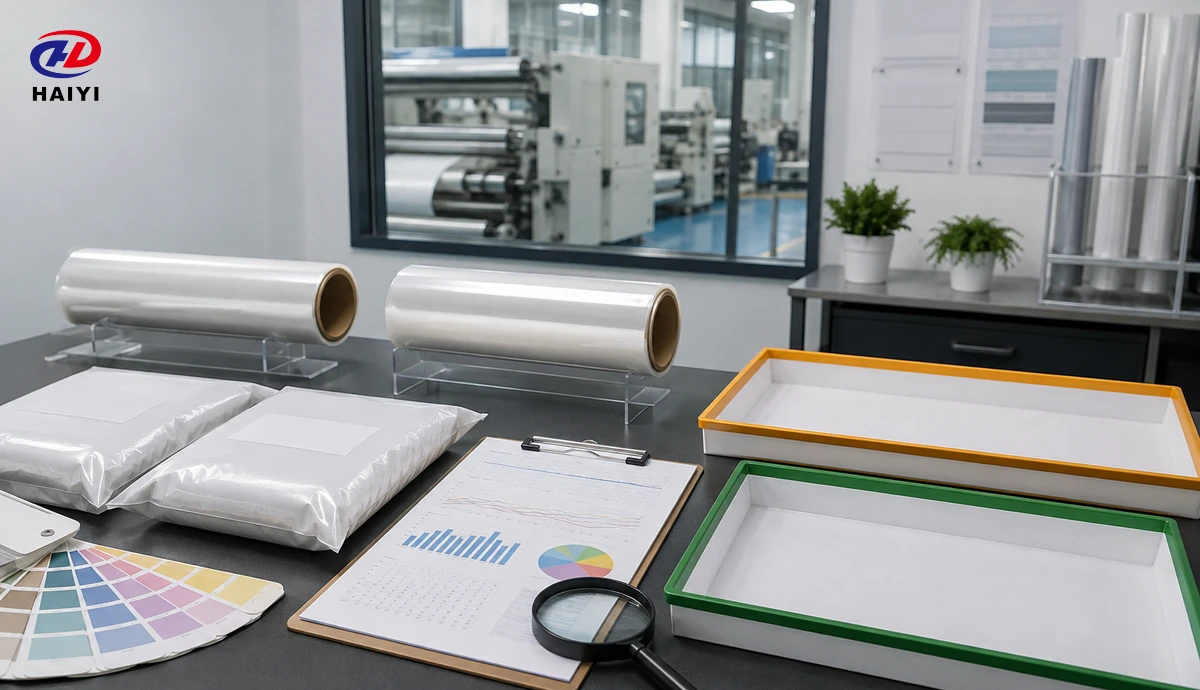
Investigate differences without changing several variables at once
When a difference appears, first confirm sample identity, equipment condition, method execution, conditioning, consumable lots, and data entry. Repeat the relevant comparison with retained specimens. Change one factor at a time during follow-up work.
Group possible causes by raw material, coating formulation, coating application, drying or curing, winding, slitting, packaging, storage, and transport. Ask for traceable production information rather than a general assurance. A supplier investigation should connect the observed symptom with batch records and corrective action evidence.
The DTF film supplier audit checklist explains how to review process control, traceability, testing, and corrective-action closure. Batch comparison data can strengthen that audit because it shows exactly where performance changed.
Keep a comparison record that supports future orders
The final report should include objective, batch identities, sample map, conditioning, equipment, consumables, methods, raw results, calculations, images, deviations, decision, approver, retain-sample location, and follow-up action. Link the report to the purchase order and complaint or change record where relevant.
Retain representative material from both batches under controlled storage. A useful retain has enough film for confirmation testing and includes roll position, direction, date, storage conditions, and chain of custody. Set a retention period based on product life, sales cycle, complaint risk, and customer agreements.
Trend the same metrics across more than two batches. A two-batch study answers whether a candidate differs from one reference. A longer control history reveals gradual drift, recurring roll-position effects, seasonal patterns, and changes in variation. That history also helps establish realistic acceptance limits based on proven performance.
Common mistakes in two-batch DTF film comparisons
- Testing one sheet from each batch: The result cannot represent roll or batch variation.
- Using different consumables: Ink, powder, fabric, or settings become confounding variables.
- Comparing unmatched positions: Edge or roll-location effects can look like a batch change.
- Optimizing only the candidate: The test no longer measures drop-in equivalence.
- Looking only at averages: Greater variation and intermittent defects remain hidden.
- Changing acceptance limits after seeing data: The decision becomes vulnerable to bias.
- Ignoring packaging and storage: Damage history is confused with production quality.
- Discarding retain samples: Later complaints cannot be compared with original evidence.
Frequently asked questions
How many samples are needed from each DTF film batch?
No single quantity fits every order. The plan should cover multiple rolls and representative positions within each roll, with enough replicates to estimate normal variation. Increase sampling when the order is large, the supplier or process changed, prior failures exist, or the application carries greater cost or customer risk.
Can a test print alone approve a new batch?
A test print is useful but incomplete. It may not reveal variation across rolls, coating differences, static sensitivity, dimensional instability, peel-window changes, or durability risk. Combine print results with incoming checks, relevant measurements, replicated transfers, and documented criteria.
Should the new batch match every number from the reference?
Exact numerical identity is unrealistic. The candidate should meet the approved specification, remain consistent, and avoid a meaningful change in process or customer outcome. Define acceptable difference by method precision, historical capability, application risk, and validated process windows.
What if both batches fail the same test?
Do not approve the candidate merely because it resembles the reference. Investigate the method, equipment, specification, storage, and process. The reference may no longer be suitable, or the test may not reflect the approved operating condition.
When should the printer settings be changed?
First test the candidate at the approved reference settings to evaluate drop-in behavior. If it does not perform adequately, a separate optimization study can determine whether a safe and stable setting change is acceptable. Document any new window and consider the effect on customer instructions and mixed inventory.
Compare batches with evidence that supports a purchasing decision
A reliable comparison begins with matched samples and controlled conditions. It then combines physical inspection, coating data, release behavior, static performance, dimensional stability, printing, transfer results, durability where relevant, and within-batch variation. The final decision should follow rules written before the results are known.
Haiyi supports wholesale and customized DTF film supply for B2B customers. To discuss batch consistency, qualification samples, private label requirements, or repeat supply, send the film type, width and length, peel behavior, printer and ink system, powder, curing method, press conditions, target fabrics, order volume, packaging needs, destination, and current acceptance concerns. The Haiyi team can review the requested specification and help organize a practical sample and batch-comparison plan. Distributors developing their own brand can also review how private label DTF film works before preparing an inquiry.