







When Double-Sided DTF Film Improves Printer Feeding Stability
Test whether double-sided DTF film improves feeding, tracking, static, and take-up stability.

Double-sided DTF film is often described as a premium alternative, but its most useful production question is more specific: can the back-side treatment improve feeding stability on your printer and workflow? The answer depends on transport design, static, take-up behavior, environment, roll format, and the actual coating system.
For a broad comparison of construction, handling, cost, and applications, read single-sided vs double-sided DTF film. This guide focuses only on feeding stability.
What the Back-Side Treatment May Do
Depending on the product specification, a back-side treatment may increase friction, reduce slip, help manage static, or improve contact with feed rollers. It does not automatically solve every transport problem, and it does not mean both sides are printable.
Signs That Feeding Stability Needs Attention
- The film shifts sideways during longer jobs.
- Take-up tension causes telescoping or uneven winding.
- Static attracts dust or changes how the film tracks.
- Fine registration changes from the start to the end of a roll.
- The printer produces intermittent head contact or wrinkles.
- Problems increase under specific seasonal conditions.
Check the Printer Before Changing Film
Clean and inspect feed rollers, guides, take-up alignment, vacuum or platen surfaces, and tension settings. Confirm the roll is centered and the core fits correctly. A double-sided treatment cannot compensate for damaged rollers, incorrect loading, excessive tension, or a misaligned take-up system.
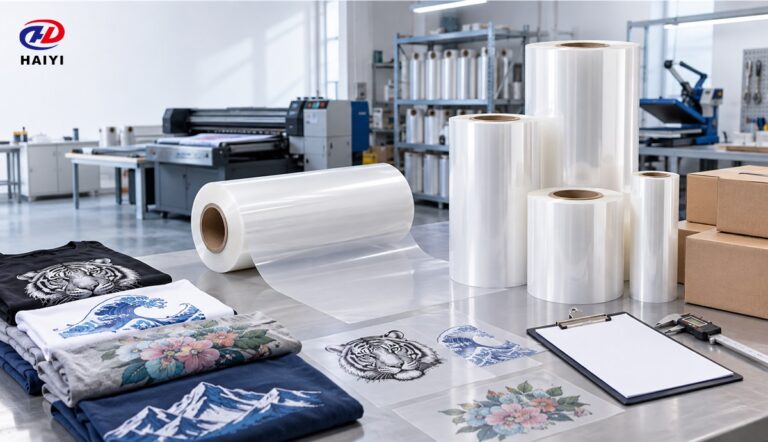
Run a Side-by-Side Feed Test
- Use single- and double-sided samples of comparable width and format.
- Condition both materials in the same production environment.
- Use the same printer, loading method, artwork, speed, and take-up settings.
- Mark the starting edge position and monitor lateral movement.
- Record static, dust attraction, wrinkles, head contact, and winding quality.
- Continue long enough to reveal drift that a short test may miss.
- Also compare printing, curing, peel, and transfer quality before approval.
Measure the Business Result
A higher material price may be justified when it reduces setup time, misfeeds, head-cleaning interruptions, damaged length, or operator supervision. Compare usable output, not only roll price. If feeding is already stable, the additional back-side function may provide little operational value.
When Double-Sided Film Is More Likely to Help
It may be useful on equipment sensitive to slip or static, on longer unattended runs, in environments with recurring static issues, or where take-up consistency is a documented loss. It should still be validated on the actual printer because transport systems respond differently.
When Single-Sided Film May Be Enough
A well-maintained printer with stable feeding and a controlled environment may perform consistently with single-sided film. Standardizing the simpler material can reduce inventory complexity when the back-side treatment does not create measurable improvement.
Write an Incoming Feed Check
For approved material, record roll width, core, winding direction, edge condition, loading method, tension, environmental limits, and a short feed test. Compare new lots against the approved sample before a large run. Review Haiyi’s DTF film rolls when choosing formats for production testing.
B2B Film Selection Support
Haiyi provides wholesale and customizable single- and double-sided DTF film. Contact Haiyi with your printer model, roll width, feeding symptoms, production volume, and packaging needs to discuss suitable samples for a controlled comparison.