
DTF vs Sublimation: Which Is Better for Your Business?

Read time: 16 minutes
Introduction
You are about to invest in printing equipment. You have narrowed it down to two methods: DTF and sublimation. Both produce professional results. Both are used by successful print businesses. Both keep showing up in every comparison article you read.
So which one is actually right for your business?
The answer depends on three things: what you are printing on, what your customers are buying, and what you can spend to get started. This guide breaks down every meaningful difference between DTF and sublimation printing — not just the standard pros and cons lists, but the specific business decisions that follow from each one.
By the end, you will know exactly which method fits your product line, your customer base, and your growth plan.
Key Takeaways
- The single most important deciding factor is fabric: DTF works on cotton, polyester, blends, and dark garments; sublimation only works on white or light-colored polyester (minimum 65% polyester content)
- Sublimation has lower startup cost ($300 to $800) versus DTF full setup ($1,500 to $5,000), but DTF offers higher revenue versatility
- Sublimation produces zero surface feel — the ink becomes part of the fabric; DTF produces a thin surface layer that is soft but detectable
- For mugs, tumblers, and hard-coated products, sublimation is the clear winner — DTF does not work on hard surfaces (UV DTF is a separate product for hard surfaces)
- For cotton t-shirts, hoodies, denim, and dark garments, DTF is the only option between the two
- Over 60% of new custom apparel startups in 2025 chose DTF as their primary method — a reflection of its versatility advantage
- The most profitable approach for scaling businesses is running both methods — DTF for apparel, sublimation for hard goods and polyester
- DTF film quality directly affects print durability and wash resistance — factory-direct film from a manufacturer with in-house coating technology eliminates the most common quality failures
Quick Answer: DTF vs Sublimation at a Glance
| Feature | DTF Printing | Sublimation Printing |
|---|---|---|
| Works on cotton | Yes | No |
| Works on dark fabrics | Yes | No (light colors only) |
| Works on polyester | Yes | Yes (best performance) |
| Works on mugs and hard goods | No (use UV DTF instead) | Yes |
| All-over print capability | Limited | Excellent |
| Surface feel | Thin layer (soft) | Zero feel |
| Startup cost | $1,500 to $5,000 | $300 to $800 |
| Wash durability | 50+ cycles | Permanent |
| Color on dark backgrounds | Excellent (white ink base) | Impossible |
| Maintenance required | High (white ink circulation) | Low |
| Min. polyester for sublimation | N/A | 65% (100% for best results) |
If your customers want cotton shirts, blended fabrics, dark garments, or custom apparel across any fabric type: DTF is the answer.
If your customers want white or light polyester sportswear, all-over prints, and branded hard goods like mugs and tumblers: sublimation is the answer.
If your customers want both: you need both methods — more on that in the section on running dual setups.
What Is DTF Printing?
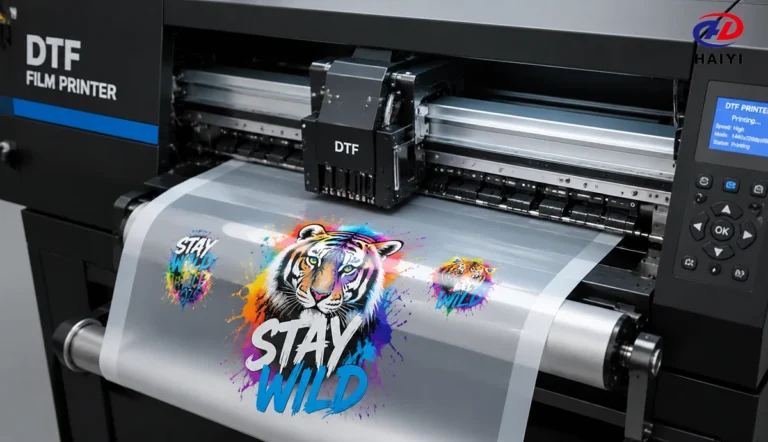
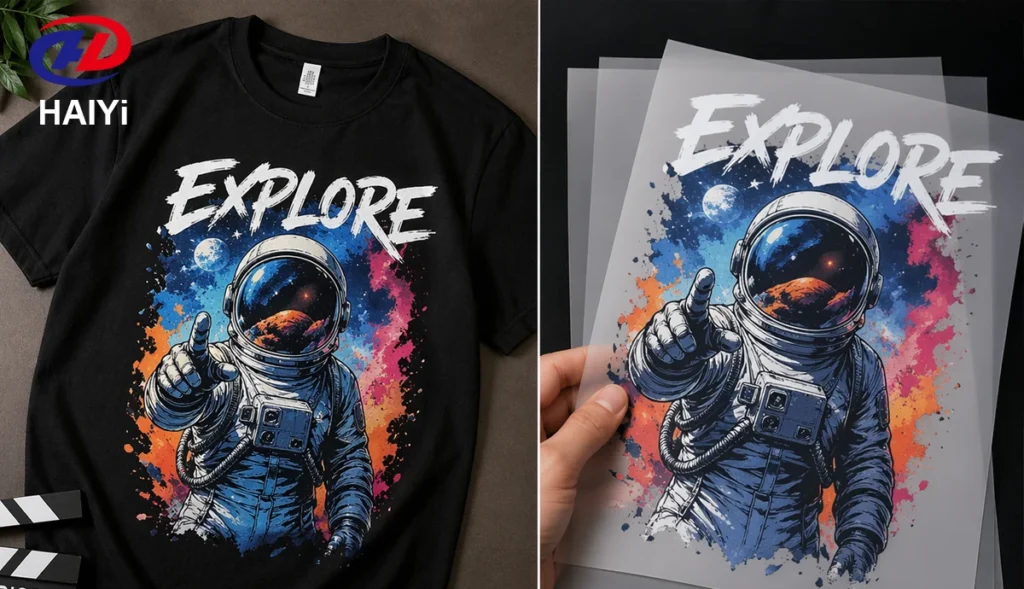
DTF stands for Direct to Film. The process prints a design onto a coated PET transfer film using water-based pigment inks, applies hot-melt adhesive powder while the ink is wet, cures the powder with heat, and then heat-presses the transfer onto fabric.
The adhesive layer is what makes DTF work on any fabric type and any color. Unlike sublimation — which is a chemical dyeing process — DTF bonds to the fabric surface through the adhesive. The white ink layer in DTF printing creates opacity, meaning colors appear vivid on black fabric the same way they appear on white fabric.
The DTF workflow:
- Print design onto DTF film (white ink first, then CMYK)
- Apply hot-melt adhesive powder while ink is wet
- Cure powder in an oven or heat gun at 250 to 280°F
- Heat-press cured transfer to garment at 305 to 325°F for 10 to 15 seconds
- Peel film, second-press through parchment paper
What DTF works on: Cotton, polyester, cotton-poly blends, nylon, denim, canvas, leather, faux leather. Any color. No pretreatment.
What DTF does not work on: Hard surfaces like mugs, glass, metal, and ceramics. For hard surface transfers, UV DTF is the correct product — a completely separate process using UV-curable ink.
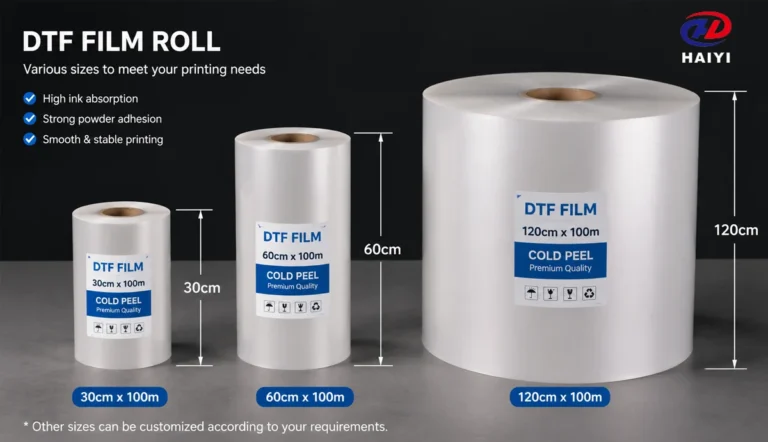
DTF film matters. The coated PET film is the consumable that determines print quality. Film with a proprietary in-house coating formula — like Haiyi’s dual-matte anti-static film — holds ink precisely, accepts powder evenly, and releases cleanly after pressing. Generic film with inconsistent coating produces patchy powder adhesion and inconsistent wash durability.
What Is Sublimation Printing?
Sublimation printing is a chemical dyeing process. Sublimation ink is printed onto transfer paper, then transferred to polyester fabric or poly-coated hard goods using heat. At approximately 380 to 400°F, the ink converts to gas (sublimes) and bonds permanently with polyester fibers at a molecular level.
The result: the design becomes part of the fabric. No surface layer. No texture. Zero hand feel. The print will never peel, crack, or fade because it is not sitting on top of the fabric — it is inside it.
The sublimation workflow:
- Print design onto sublimation transfer paper using sublimation ink
- Place transfer paper face-down on polyester surface
- Heat-press at 380 to 400°F for 45 to 60 seconds (fabric) or 3 to 5 minutes (hard goods)
- Remove paper — design is permanently embedded
What sublimation works on: White or light-colored polyester fabric (minimum 65% polyester), polymer-coated mugs, tumblers, phone cases, mousepads, photo panels, keychains, coasters, and other poly-coated hard goods.
What sublimation absolutely does not work on: Cotton or natural fiber fabrics (ink has no polyester fiber to bond with and washes out), dark or heavily colored fabrics (sublimation is a dyeing process — there is no white sublimation ink, so the fabric’s base color shows through the design).
The no-white-ink constraint is critical for business planning. If a customer asks for a design on a black hoodie, sublimation cannot do it — period. No workaround produces an acceptable result on dark cotton. DTF has no such limitation.
DTF vs Sublimation: 10-Point Comparison
1. Fabric Compatibility
DTF works on virtually any fabric. Cotton, polyester, poly-cotton blends, nylon, denim, leather. Any color, light or dark. No pretreatment.
Sublimation requires minimum 65% polyester content. Works only on white or very light-colored substrates. On cotton, the ink washes out within one or two laundry cycles because there are no polyester fibers for the dye to bond with.
Winner: DTF — by a wide margin if your product range includes cotton or dark garments.
2. Print Quality and Color
Both methods produce excellent print quality with full-color photographic detail.
Sublimation generally produces slightly more vibrant colors on white polyester — the dye-based inks and fiber bonding create a depth and saturation that is hard to match. Colors appear to glow from within the fabric rather than sitting on top.
DTF produces vibrant, accurate color on any fabric including dark garments. The white ink base layer ensures consistent color across all background colors. Fine details, gradients, and complex artwork all transfer with high accuracy.
Winner: Tie — sublimation has a slight vibrancy edge on white polyester; DTF wins on dark fabrics and cotton where sublimation cannot compete.
3. Surface Feel
Sublimation: zero surface feel. Run your hand across a sublimated design and you feel only the fabric. For performance apparel — athletic jerseys, sportswear, swimwear — this is a meaningful advantage. Breathability is unaffected because the design is not a separate layer.
DTF: a thin, flexible surface layer is present. Modern high-quality DTF transfers are extremely soft and thin, and most customers describe the feel as acceptable to undetectable for standard designs. For large solid-color fills covering most of a garment, the surface layer can affect breathability slightly.
Winner: Sublimation for zero-feel performance apparel. For most standard apparel applications, the DTF surface feel is not a meaningful disadvantage.
4. Durability and Wash Resistance
Sublimation: the print is permanent. It cannot peel or crack because it has no surface layer to separate from. Color fastness is exceptional — designs on polyester survive the garment’s entire lifetime without fading. A sublimated jersey worn and washed weekly for five years will still look vibrant.
DTF: a correctly applied DTF transfer survives 50 or more wash cycles without peeling, cracking, or significant color loss. This is the industry target, and quality film with correct pressing settings achieves it consistently. DTF durability is excellent — just not quite as permanent as sublimation on polyester.
Winner: Sublimation on polyester for absolute longevity. For most business applications, DTF’s 50+ cycle durability is more than adequate.
5. All-Over Printing
Sublimation excels at all-over print coverage. Fabric panels are sublimated before cutting and sewing, allowing designs to run edge-to-edge and across seams without any practical limitation. Sports jersey manufacturers, swimwear brands, and all-over print apparel companies rely on sublimation precisely because of this capability.
DTF can technically produce large designs, but all-over coverage requires large-format equipment and adds production complexity. Most DTF setups are optimized for standard chest, back, and sleeve placements rather than edge-to-edge garment coverage.
Winner: Sublimation for all-over print requirements.
6. Product Range
DTF: apparel and accessories — t-shirts, hoodies, hats, tote bags, denim jackets, leather goods. Cannot be used on hard goods.
Sublimation: polyester apparel plus a wide range of hard goods — mugs, tumblers, phone cases, mousepads, photo panels, coasters, keychains, ceramics, puzzles, and any item with a polymer coating. The hard goods product range is what makes sublimation attractive for gifting, promotional merchandise, and product diversification.
Winner: Sublimation for product range breadth, particularly for hard goods. DTF wins for apparel versatility across fabric types.
7. Setup Cost
Sublimation setup (entry level):
- Sublimation printer: $200 to $500
- Heat press: $150 to $400
- Sublimation paper and ink: $50 to $150
- Total: $400 to $1,000
DTF setup (entry level):
- A3 DTF printer: $600 to $1,500
- Powder shaker and curing system: $200 to $600
- Heat press: $150 to $400
- DTF film, ink, powder: $100 to $200
- Total: $1,050 to $2,700
For in-house printing, sublimation has a significantly lower barrier to entry. However, starting a DTF operation without owning a printer is also possible — purchase pre-made DTF transfers from a wholesale supplier and apply with a heat press for $150 to $400 total initial investment.
Winner: Sublimation for lowest in-house setup cost. DTF via pre-made transfers can match or beat sublimation’s startup cost.
8. Maintenance
Sublimation printers have very low maintenance requirements. Sublimation inks do not clog print heads the way DTF white ink does. A sublimation printer used weekly requires minimal routine maintenance.
DTF printers require regular maintenance — white ink must be circulated regularly to prevent sedimentation and head clogging. A DTF printer that sits unused for days without proper maintenance will develop clogs that can cost $100 to $500 in repairs or head replacements. DTF is a commercial-grade process that rewards consistent daily use.
Winner: Sublimation for low-maintenance operation. DTF maintenance demands are real and should be factored into total cost of ownership.
9. Production Speed
Both methods produce individual garments quickly. A sublimation press takes 45 to 60 seconds for a shirt. A DTF press takes 10 to 15 seconds — though the total workflow including powdering and curing adds time before pressing.
For large volume production, sublimation benefits from the ability to press multiple items simultaneously on large-format heat presses. DTF can pre-print gang sheets of many designs and press them sequentially.
Winner: Comparable for most production volumes. DTF has a slight speed advantage per press cycle; sublimation has an advantage for large hard-goods batches.
10. Eco-Friendliness
Sublimation uses dye-based inks with transfer paper — less material waste overall. The inks bond permanently with no discarded adhesive layers.
DTF uses more consumables — PET film, adhesive powder, and separate ink components — and produces more waste per print. The plastic film and powder disposal are ongoing material costs and environmental considerations.
Winner: Sublimation for lower material waste and environmental footprint.
DTF vs Sublimation Cost
Cost comparison varies significantly depending on whether you calculate startup cost, per-print cost, or total cost of ownership over 12 months.
Startup Cost
| Item | DTF (Full Setup) | Sublimation (Full Setup) |
|---|---|---|
| Printer | $600–$1,500 | $200–$500 |
| Heat press | $150–$400 | $150–$400 |
| Powder shaker + curing | $200–$600 | Not required |
| Consumables (starter) | $100–$200 | $50–$150 |
| Total | $1,050–$2,700 | $400–$1,000 |
Per-Print Cost (Shirt)
| Cost Factor | DTF | Sublimation |
|---|---|---|
| Film/paper per print | $0.30–$0.60 | $0.10–$0.25 |
| Ink per print | $0.50–$1.00 | $0.30–$0.60 |
| Powder per print | $0.15–$0.30 | None |
| Total per print | $0.95–$1.90 | $0.40–$0.85 |
DTF has a higher per-print cost due to film and powder consumption. Sublimation’s lower per-print cost can partially offset the higher printer cost over time on high-volume polyester production.
Revenue Potential
The cost advantage of sublimation narrows when considering revenue potential. DTF’s ability to serve cotton and dark garment customers — which represents the majority of the casual apparel market — creates a larger addressable customer base and higher potential revenue per equipment dollar spent.
A $1,500 DTF setup can produce custom cotton hoodies, dark t-shirts, and any fabric blend. A $500 sublimation setup can only produce white and light polyester apparel and hard goods. For apparel-focused businesses, the DTF revenue ceiling is significantly higher despite the higher upfront cost.
Is DTF Better Than Sublimation for Shirts?
It depends entirely on which shirts.
For cotton or cotton-blend shirts: DTF is the only option. Sublimation does not work on cotton — the ink washes out. If your customers want Gildan 5000s, Comfort Colors, or any standard cotton t-shirt, DTF is the answer.
For dark-colored shirts in any fabric: DTF is the only option. Sublimation requires a light base color because there is no white sublimation ink. A black shirt cannot be sublimated.
For white or light-colored 100% polyester shirts: Sublimation wins for feel and permanence. The design is embedded in the fiber with zero surface texture and will never peel or crack.
For polyester performance shirts (athletic, moisture-wicking): Sublimation wins for breathability and feel. Athletes wearing performance jerseys notice DTF surface layers during activity; sublimated designs are undetectable.
Market reality: The majority of consumer t-shirt sales are cotton or cotton-blend garments. If your business serves a general apparel market, DTF serves more of your customers more of the time. Sublimation is excellent for the polyester segment, but that segment is smaller in casual apparel than in athletic and promotional product categories.
Sublimation vs DTF for Mugs and Tumblers
For mugs and tumblers, sublimation wins clearly — standard DTF does not work on hard surfaces.
Sublimation on coated ceramic mugs and polymer-coated tumblers produces vibrant, permanent, dishwasher-safe results. The design wraps 360 degrees and integrates fully with the coating. Colors are vivid and will not fade with normal use.
DTF film requires fabric to bond with — the adhesive powder has no mechanism to adhere to a hard, non-porous surface. Standard DTF on a mug simply does not work.
The product that does work on hard surfaces is UV DTF — a completely different technology using UV-curable inks and a two-film (A/B) system. UV DTF applies pressure-sensitive transfers to glass, acrylic, metal, ceramics, wood, and plastic without heat pressing. However, UV DTF is a distinct process from standard DTF, requiring a UV printer and different consumables.
For building a product line that includes mugs, tumblers, and other hard goods alongside apparel:
- Sublimation for polymer-coated hard goods (mugs, tumblers, phone cases, mousepads)
- Standard DTF for cotton and dark fabric apparel
- UV DTF for non-coated hard surfaces (glass, plain metal, uncoated ceramics)
Sublimation vs DTF Heat Press Settings
Both methods require a heat press, but the settings differ significantly.
DTF Heat Press Settings
| Fabric | Temperature | Time | Pressure |
|---|---|---|---|
| 100% Cotton | 315–325°F (157–163°C) | 10–12 sec | Medium-High |
| Cotton/Poly Blend | 305–315°F (152–157°C) | 10–12 sec | Medium-High |
| 100% Polyester | 280–300°F (138–149°C) | 10–12 sec | Medium |
| Performance Fabric | 300–315°F (149–157°C) | 12–15 sec | Medium-High |
Note: Always verify actual platen temperature with a contact thermometer. Heat press displays are frequently inaccurate by 10 to 30 degrees.
Sublimation Heat Press Settings
| Surface | Temperature | Time | Pressure |
|---|---|---|---|
| Polyester fabric | 380–400°F (193–204°C) | 45–60 sec | Medium |
| Ceramic mugs | 375–400°F (191–204°C) | 3–5 min | Firm |
| Aluminum tumblers | 375–400°F (191–204°C) | 50–70 sec | Firm |
| Mousepads / coasters | 385–400°F (196–204°C) | 50–60 sec | Medium |
| Phone cases (coated) | 380°F (193°C) | 45–60 sec | Medium |
Key difference: sublimation requires significantly higher temperature and longer press time than DTF. A standard DTF press runs 15 seconds at 315°F; sublimation requires 45 to 60 seconds at 380 to 400°F for fabric.
Both require a second press for DTF (5 to 10 seconds after film peeling). Sublimation does not require a second press — once the paper is removed, the design is permanent.
DTF vs Sublimation vs Screen Printing vs Vinyl
Many buyers compare more than two methods. Here is the complete picture.
| Method | Best For | Startup Cost | Per-Print Cost | Min. Order | Fabric Limits |
|---|---|---|---|---|---|
| DTF | Any fabric, any color, small to mid-volume | $1,050–$2,700 | $0.95–$1.90 | 1 piece | None |
| Sublimation | White/light polyester, hard goods | $400–$1,000 | $0.40–$0.85 | 1 piece | Polyester only |
| Screen Printing | High-volume same design, bulk orders | $3,000–$30,000 | $0.50–$2.00 (at scale) | 12–48 pieces | Few |
| HTV Vinyl | Simple designs, text, low volume | $200–$800 | $0.50–$2.00 | 1 piece | Most fabrics |
Sublimation vs DTF vs Vinyl
HTV vinyl is the simplest and cheapest entry point but is labor-intensive for complex designs and does not scale well. Vinyl excels for simple text, numbers, and single-color designs — custom sports jersey names and numbers, for example.
DTF and sublimation both handle complex multi-color designs efficiently at any quantity. The choice between them comes down to fabric type and surface type, as covered throughout this guide.
When Screen Printing Still Wins
Screen printing remains the cost-optimal method for very high volume production of the same design — 100 or more pieces in identical artwork. The per-piece cost at scale is lower than DTF or sublimation, and plastisol ink on cotton produces extremely durable results that have been the industry standard for decades.
For quantities below 48 pieces, or for on-demand production with frequent design changes, DTF is more cost-effective than screen printing.
Which Business Model Fits Each Method?
DTF Is Right for Your Business If:
- You want to print on cotton, cotton-blend, or dark garments — the majority of consumer apparel
- Your customers request custom designs on Gildan, Comfort Colors, or similar 100% cotton blanks
- You handle diverse orders: one customer wants a black hoodie, the next wants a white polyester shirt, the next wants a nylon jacket
- You want to build a brand on on-demand production with no minimum quantities
- You plan to scale volume over time and want a method that grows with your business
- You can commit to daily or near-daily printing and the maintenance that DTF requires
Sublimation Is Right for Your Business If:
- Your primary product line is white or light-colored polyester sportswear — athletic jerseys, performance shirts, swimwear, leggings
- You want to offer branded hard goods — custom mugs, photo panels, tumblers, mousepads, phone cases
- You prefer low-maintenance equipment and infrequent printing without clogging concerns
- You are a hobbyist or part-time seller who cannot commit to daily printing volume
- You want all-over print capability for cut-and-sew production
- Your startup budget is limited to $500 to $800
The Hybrid Approach (Most Scalable)
Many successful print businesses run both methods:
- DTF for cotton and dark apparel
- Sublimation for polyester sportswear and branded hard goods
This combination covers virtually every custom printing request without gaps. A customer wanting a custom cotton tee gets DTF. A customer wanting a branded coffee mug gets sublimation. A sports team wanting all-over print polyester jerseys gets sublimation. A school wanting dark hoodies with a logo gets DTF.
The upfront cost of running both setups is $1,500 to $3,500 — a realistic investment for a business that has validated demand.
Can You Use Both?
Yes, and most growing print businesses do.
The two methods complement each other almost perfectly:
- Sublimation covers the product categories where it excels — hard goods and all-over polyester
- DTF covers everything sublimation cannot do — cotton, dark fabrics, blended materials
The heat press is shared between both setups — a single swing-away press handles DTF at 315°F and sublimation at 385°F. This reduces the total dual-setup investment.
A practical scaling path:
Stage 1: Start with sublimation if your initial focus is hard goods and polyester products. Low entry cost, low maintenance, validates demand before larger investment.
Stage 2: Add a DTF setup (or buy pre-made DTF transfers) when customers start requesting cotton and dark garment printing. The DTF revenue opportunity in cotton apparel is significant.
Stage 3: Add in-house DTF printing as volume justifies the equipment investment. At 20 or more shirts per day, in-house DTF is more cost-effective than buying pre-made transfers.
FAQ
Is DTF the same as sublimation? No. DTF and sublimation are fundamentally different processes. DTF uses adhesive powder to bond a printed transfer to any fabric surface. Sublimation uses heat to convert dye into gas that bonds chemically with polyester fibers. They require different inks, different temperatures, work on different materials, and produce different results.
Which is better, DTF or sublimation? Neither is universally better — they serve different purposes. DTF is better for cotton, dark garments, and fabric versatility. Sublimation is better for white polyester, all-over prints, zero surface feel, and hard goods like mugs and tumblers. The best choice depends on your specific product line and customer base.
Is DTF better than sublimation for shirts? DTF is better for cotton and dark-colored shirts, which represent the majority of the casual apparel market. Sublimation is better for white or light-colored 100% polyester shirts, particularly athletic and performance wear. If your shirt business serves a general consumer market on cotton blanks, DTF serves more of your customers.
What is the difference between DTF and sublimation? The core difference is how the design bonds to the substrate. DTF uses a heat-activated adhesive powder that bonds a printed transfer to the fabric surface — this works on any fabric. Sublimation converts dye to gas that permanently bonds with polyester fibers — this only works on polyester or poly-coated surfaces and cannot produce designs on dark backgrounds.
Can sublimation be used on mugs and DTF cannot? Correct. Standard DTF requires fabric and does not work on hard surfaces. Sublimation works on polymer-coated mugs, tumblers, phone cases, and other poly-coated hard goods. For non-coated hard surfaces like plain glass or metal, UV DTF is the correct product — a separate technology from both standard DTF and sublimation.
What is a DTF sublimation printer? This term is sometimes used to describe a sublimation printer being used to print designs onto DTF film — a workaround some hobbyists use rather than investing in a dedicated DTF printer. However, a standard sublimation printer is not optimized for DTF inks and film, and results are less consistent than using a purpose-built DTF printer. A dedicated DTF printer is the correct equipment for professional DTF production.
How does DTF vs sublimation compare on tumblers? Sublimation is the standard and correct method for polymer-coated tumblers. The design wraps 360 degrees, is dishwasher-safe, and bonds permanently with the coating. Standard DTF does not work on tumblers. UV DTF is the alternative for applying designs to non-coated tumblers and stainless steel without polymer coating.
Which has lower startup cost, DTF or sublimation? Sublimation has lower in-house setup cost — approximately $400 to $1,000 for a complete starter setup versus $1,050 to $2,700 for DTF. However, DTF startup cost can be reduced to $150 to $400 by purchasing pre-made DTF transfers from wholesale suppliers instead of printing in-house.
Is DTF or sublimation better for polyester? Sublimation is technically superior on polyester — the design bonds permanently with zero surface feel and lifetime color fastness. DTF works on polyester but has a slight surface layer and shorter durability. For 100% polyester sportswear and performance apparel, sublimation is the preferred method.
Does sublimation printing vs DTF make a difference for durability? Sublimation on polyester has superior longevity — the design is permanently part of the fiber and will not peel or crack over the garment’s lifetime. DTF transfers on correctly pressed quality film last 50 or more wash cycles. For most business applications, both are commercially durable. For performance apparel washed weekly for years, sublimation maintains better long-term appearance.
Conclusion
DTF and sublimation are not competitors — they serve different market segments, and the most successful print businesses use both.
Here is the decision, simplified:
Choose DTF if: Your customers want cotton, dark fabrics, or mixed-fabric orders. You want versatility across any garment type. You plan to serve a general apparel market.
Choose sublimation if: Your customers want white or light polyester, performance sportswear, all-over prints, or branded hard goods like mugs and tumblers. You want low maintenance and lower startup cost.
Consider both if: You are building a diversified print business and want to serve every customer request without gaps.
The underlying economics are clear. The custom apparel market runs primarily on cotton. DTF is the only method between these two that handles cotton. That is why over 60% of new custom apparel businesses chose DTF as their primary method in 2024, and why sublimation is increasingly positioned as the complement rather than the alternative.
Start with whichever method matches your immediate product focus. Add the other when customer demand justifies the investment. The two methods together — with a shared heat press — cover virtually every custom printing use case in the market today.
One variable that applies to both: the quality of your consumables determines the quality of your output. For DTF, that means DTF film from a manufacturer that controls its own coating process. Consistent coating means consistent ink absorption, consistent powder adhesion, and consistent wash durability — the three factors that determine whether your prints satisfy customers or generate complaints.
Haiyi manufactures DTF film with in-house coating technology — dual-matte anti-static rolls in 13-inch and 24-inch widths, A3/A4 sheets, and matched DTF ink systems. Factory-direct wholesale pricing, low MOQ, and 15 years of international export experience. For DTF film wholesale sourcing, Haiyi provides stable supply and consistent quality across every production batch.