


UV DTF Film vs Traditional Sticker Printing: Why Businesses Are Switching to the Next Generation of Custom Labels
Compare UV DTF film and traditional sticker printing to discover differences in durability, application, production process, cost, and customization. Learn which solution is better for branding, product decoration, and commercial printing.

Read Time: 14 min read
No Cutting, No Weeding: How UV DTF Film Is Rewriting the Rules of Sticker Production
Traditional stickers have served product labeling, packaging, advertising, and branding for decades, and for plenty of applications they still do the job well. But businesses are increasingly asking for more than a flat adhesive label — better durability, a wider range of surfaces to decorate, a more premium appearance, and easier customization at smaller batch sizes than traditional sticker production comfortably supports.
UV DTF film is the transfer technology that’s emerged to meet that demand: it allows high-resolution graphics to be applied directly onto a wide range of hard surfaces without the cutting, weeding, or complicated installation traditional stickers require. Comparing the two technologies properly means looking past surface-level similarity and evaluating printing technology, material structure, surface compatibility, durability, production efficiency, and business profitability side by side — which is exactly what this guide does.
What Is UV DTF Film and How Does It Work?
Understanding the Structure of UV DTF Film
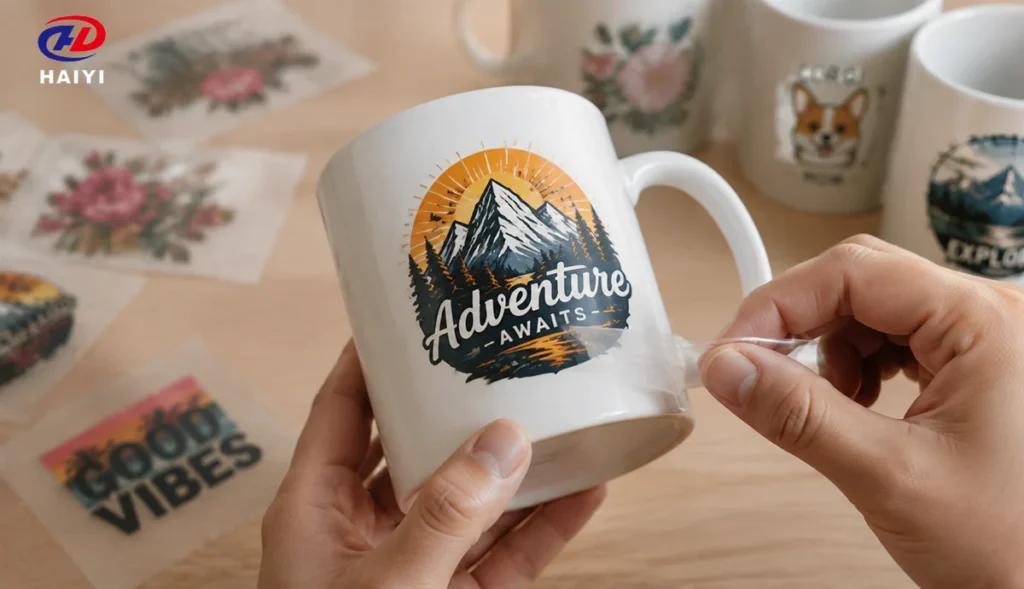
UV DTF transfer is built on a two-film system, commonly referred to as A film and B film, each with a distinct function. A film receives the printed UV ink, holds the adhesive layer, and protects the design before final transfer. B film carries the finished printed design and helps it release cleanly onto the target product surface during application. Together, this two-layer structure creates a ready-to-apply transfer that doesn’t rely on the traditional adhesive sticker backing most people are used to.
How Is UV DTF Transfer Applied?
The production sequence runs through five stages: UV printing directly onto A film, applying an adhesive layer over the printed design, laminating with B film, removing the backing film, and finally applying the finished transfer onto the product surface. Because the design is fully formed on the film before application, this process allows highly detailed graphics — fine text, complex shapes, gradients — without any cutting or manual weeding step, which is a structural difference from how traditional stickers are produced.
What Is Traditional Sticker Printing?
Common Types of Traditional Stickers
Traditional sticker production covers several material types: vinyl stickers, paper stickers, die-cut labels, and waterproof adhesive labels. These are commonly used across packaging labels, promotional materials, general product decoration, and outdoor signage — applications where a flat, adhesive-backed label has been the standard solution for a long time.
How Does Traditional Sticker Production Work?
The typical workflow runs through printing the artwork, laminating a protective layer over it, cutting the design to its final shape, removing excess surrounding material, and applying the adhesive-backed sticker to the product or surface. The cutting and material-removal steps in particular add production time and complexity that scale directly with design intricacy — a simple circular label cuts quickly, while a highly detailed custom shape adds meaningful production time.
UV DTF Film vs Traditional Stickers: What Are the Main Differences?
| Feature | UV DTF Film | Traditional Sticker Printing |
|---|---|---|
| Printing Method | UV transfer technology | Direct adhesive printing |
| Cutting Required | No | Usually required |
| Surface Application | Wide range of hard surfaces | Depends on adhesive material |
| Texture | Raised 3D effect possible | Mostly flat |
| Durability | High resistance | Depends on material |
| Installation | Simple transfer process | Requires positioning and sticking |
| Small-Quantity Customization | Excellent | Good |
| Complex Designs | Excellent | Limited by cutting |
Which Provides Better Print Quality: UV DTF Film or Stickers?
Color Vibrancy and Detail Reproduction
UV DTF printing delivers high-resolution graphics with bright, accurate color and fine detail reproduction, including small text that stays legible at production scale. Traditional stickers can achieve strong color output as well, but complex designs are constrained by the cutting process itself — intricate shapes or fine details near a cut edge are harder to reproduce cleanly than the same detail printed directly through UV DTF.
3D Texture and Premium Appearance
UV DTF film supports a raised texture effect and a glossy finish that traditional flat stickers generally can’t replicate, giving finished products a more tactile, professional appearance. That distinction matters most for premium packaging, brand logos, and customized products, where the physical feel of the decoration contributes to perceived product value in a way flat printing doesn’t.
Which Technology Offers Better Durability?
UV DTF Film Durability Advantages
UV DTF transfers offer strong resistance to scratches, water exposure, sunlight, and general daily handling, making them well suited to electronic products, glass items, metal products, and plastic surfaces — categories where a label needs to survive real-world wear rather than just look good on day one.
Limitations of Traditional Stickers
Traditional stickers commonly face edge lifting over time, adhesive aging that weakens the bond, color fading from UV exposure, and surface compatibility problems on certain materials. Performance here depends heavily on the specific sticker material and adhesive quality used, which means durability can vary significantly between one traditional sticker product and another in a way that’s harder to predict upfront.
Which Surfaces Can UV DTF Film and Stickers Be Applied To?
UV DTF Film Application Range
UV DTF film applies effectively across a notably wide range of surfaces: glass, ceramic, metal, acrylic, wood, plastic, leather, and hard packaging materials. That breadth is one of UV DTF’s core advantages over adhesive stickers, since it removes the need to source a different label technology for each different product material.
Traditional Sticker Surface Limitations
Traditional stickers face real challenges on uneven surfaces, low-surface-energy plastics, textured materials, and curved products, where adhesive bonding becomes less reliable and the flat sticker format struggles to conform cleanly. These limitations are exactly where UV DTF’s more flexible, texture-capable transfer tends to outperform a standard adhesive label.
Is UV DTF Printing More Efficient Than Traditional Sticker Production?
Advantages of UV DTF Production
Removing the cutting and weeding steps entirely from the workflow means faster customization turnaround and less material waste per order, since there’s no excess material to trim away and discard. This efficiency profile makes UV DTF particularly well suited to on-demand production, small batch orders, and personalized products — exactly the order types that traditional cutting-based production handles least efficiently.
Traditional Sticker Production Challenges
Traditional sticker production carries cutting preparation time, material waste from trimmed excess, manual labor for weeding and positioning, and storage requirements for finished stickers awaiting shipment or application. These overheads scale with order complexity and don’t disappear even for smaller custom orders, which is part of why very small custom sticker runs are often less profitable than the equivalent UV DTF order.
Which Method Is More Cost-Effective for Businesses?
UV DTF Cost Advantages
UV DTF production generally requires lower labor input per unit, reduced setup time between different designs, and better profitability on small-batch orders specifically — the order size where traditional cutting-based sticker production carries the most overhead relative to output.
When Traditional Stickers May Still Be More Economical
Traditional stickers remain genuinely competitive for very large simple label orders, basic packaging applications, and low-cost promotional campaigns, where the design is straightforward enough that cutting overhead is minimal and the scale is large enough to amortize setup costs effectively.
UV DTF Film vs Traditional Stickers for Different Industries
For Promotional Product Businesses
UV DTF suits decoration on bottles, gifts, electronics, and corporate products — items where a premium, durable finish matters. Traditional stickers remain a practical fit for flyers, general packaging, and simple branding labels where flat, low-cost decoration is sufficient.
For Brand Owners and Manufacturers
UV DTF helps create a more premium product appearance, supports highly customized designs, and fits limited-edition product runs well, since small-batch customization is one of its structural strengths rather than a workaround.
For Printing Companies
Adding UV DTF capability lets a printing business expand its product category offering, provide higher-value decoration services beyond flat labels, and serve a broader range of industries — particularly hard-goods categories that traditional sticker printing serves less effectively.
What Are the Limitations of UV DTF Film?
Requires UV Printing Equipment
Initial equipment investment for UV DTF production is generally higher than what’s needed for traditional sticker printing, which is a real consideration for businesses evaluating the technology for the first time.
Not Designed for Fabric Applications
UV DTF film is engineered primarily for hard surfaces; textile and garment decoration requires different transfer technologies designed specifically for fabric — the two shouldn’t be treated as interchangeable despite the shared “DTF” terminology.
Requires Proper Material Matching
Surface cleanliness, transfer pressure, and film quality all directly influence the final result, meaning UV DTF still requires correct process control rather than being a guaranteed-perfect result regardless of application technique.
How to Choose Between UV DTF Film and Traditional Sticker Printing?
Choose UV DTF film when you need: a premium appearance, complex graphic detail, small-batch customization, application across multiple hard-surface materials, or high durability under real-world wear.
Choose traditional stickers when you need: simple label designs, large-volume low-cost production, or paper and general packaging applications where flat adhesive labeling is sufficient.
How to Select a Reliable UV DTF Film Supplier for Business Growth
Evaluate UV DTF Film Quality
Check film transparency, adhesive strength, ink compatibility, and overall transfer performance directly through sample testing before committing to bulk volume.
Check Manufacturing Capability
Confirm actual production capacity, a documented quality control system, demonstrated batch-to-batch consistency, and export experience — these together indicate whether a supplier can scale with your order volume reliably.
Consider OEM and Private Label Services
Evaluate whether the supplier supports customized packaging, brand development, multiple roll specifications, and general distributor support, particularly relevant if you’re building a differentiated product line rather than reselling generic film.
About Haiyi Materials: Haiyi Materials is a professional manufacturer of DTF and UV DTF film materials, based in the Pearl River region of Foshan, Guangdong — one of China’s most developed manufacturing hubs. With more than 10 years of professional experience in the coating industry, Haiyi Materials supplies UV DTF A/B film with the transparency, adhesive strength, and batch consistency distributors and printing businesses need to expand into premium hard-surface decoration.
Frequently Asked Questions About UV DTF Film vs Stickers
Is UV DTF better than vinyl stickers? UV DTF provides more flexibility for premium decoration and complex designs, while vinyl stickers remain a practical, cost-effective choice for simpler applications — the better option depends on the specific product and appearance requirements.
How long does UV DTF transfer last? Durability depends on film quality, the specific application surface, and the usage environment, but UV DTF transfers are generally engineered for strong resistance to scratches, water, and sunlight exposure over time.
Can UV DTF film be applied to curved surfaces? Yes, UV DTF film works well on many curved hard surfaces when applied with correct technique and adequate surface preparation.
Does UV DTF require cutting like stickers? No. UV DTF transfers are printed as a complete, ready-to-apply design and typically don’t require cutting or weeding the way traditional stickers do.
Is UV DTF film suitable for wholesale business? Yes. Growing demand for personalized, premium product decoration creates real opportunity for distributors and printing suppliers positioned to offer UV DTF alongside or instead of traditional sticker products.
Conclusion: UV DTF Film Creates New Opportunities Beyond Traditional Stickers
Traditional stickers remain a practical, cost-effective choice for simple labeling and high-volume, straightforward applications. UV DTF film opens up higher-value decoration, stronger customization capability, and a meaningfully broader range of hard-surface applications that flat adhesive stickers can’t match. Choosing between the two comes down to target market, specific product requirements, production volume, and long-term growth strategy — not simply which technology is newer.
For printing companies, distributors, and importers, UV DTF film represents a genuine opportunity to offer premium decoration solutions with higher customer value and stronger market differentiation. Haiyi Materials, with over a decade of coating industry experience from its Foshan production base, supplies UV DTF film built for exactly that kind of business expansion. Contact us to discuss specifications, sample testing, and how UV DTF can fit into your product lineup.