






DTF Film Types Explained: Cold Peel vs Hot Peel vs Warm Peel Transfer Film Guide

Cold Peel, Hot Peel, or Warm Peel? The DTF Film Decision That Shapes Your Whole Production Line
DTF film selection has quietly become one of the highest-impact decisions in professional garment printing. Unlike older transfer methods where the film was a fairly interchangeable consumable, DTF technology depends on a tight interaction between PET coating, ink, adhesive powder, heat pressing, and — critically — how and when the film is peeled away from the finished design.
That last variable is what splits DTF film into three distinct categories: cold peel, hot peel, and warm peel. Each one trades production speed against transfer control in a different way, and each fits a different type of operation. For B2B buyers, distributors, and printing factories, picking the wrong type doesn’t just create a minor inconvenience — it directly affects production efficiency, transfer durability, customer satisfaction, and material cost control. This guide breaks down exactly how each film type works and how to match one to your production reality.
What Is DTF Transfer Film, and Why Do Different Types Exist?
The Role of Film in the DTF Transfer Process
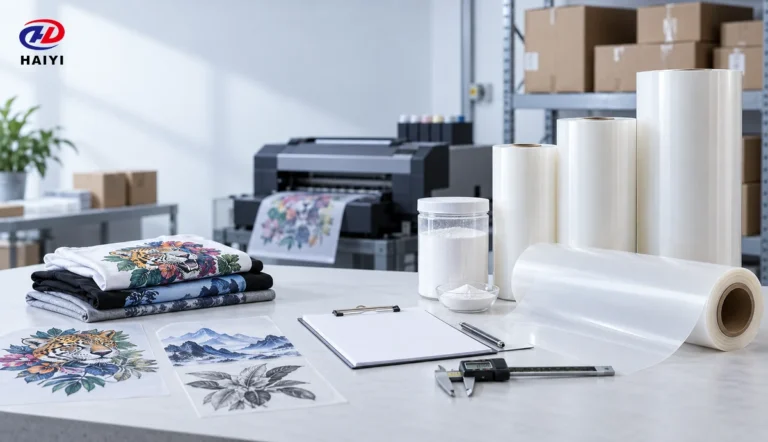
DTF film is a specially coated PET carrier film that temporarily holds a printed design before it’s transferred onto fabric. The full workflow runs through five stages: printing CMYK plus white ink onto the film, applying hot-melt adhesive powder, curing that powder, heat pressing the film onto fabric, and finally removing the film to reveal the finished transfer.
That last stage — removing the film — is exactly where film types diverge. The temperature and timing at which the film separates from the fabric determines which category a given film belongs to, which is why “DTF film type” is really shorthand for “peeling behavior.”
Why Different Peeling Methods Require Different Film Technologies
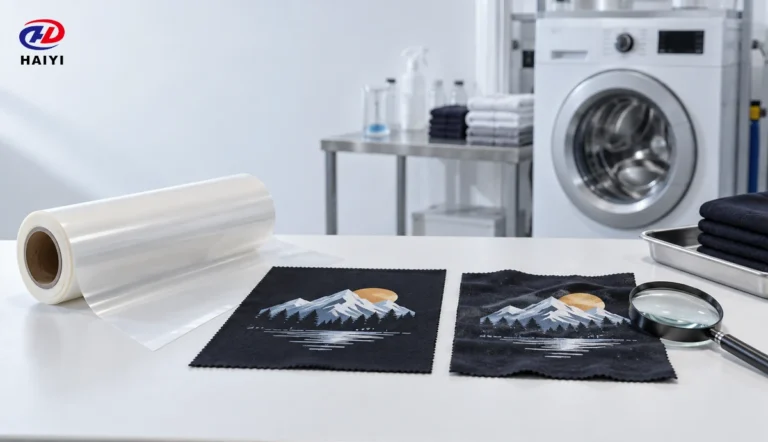
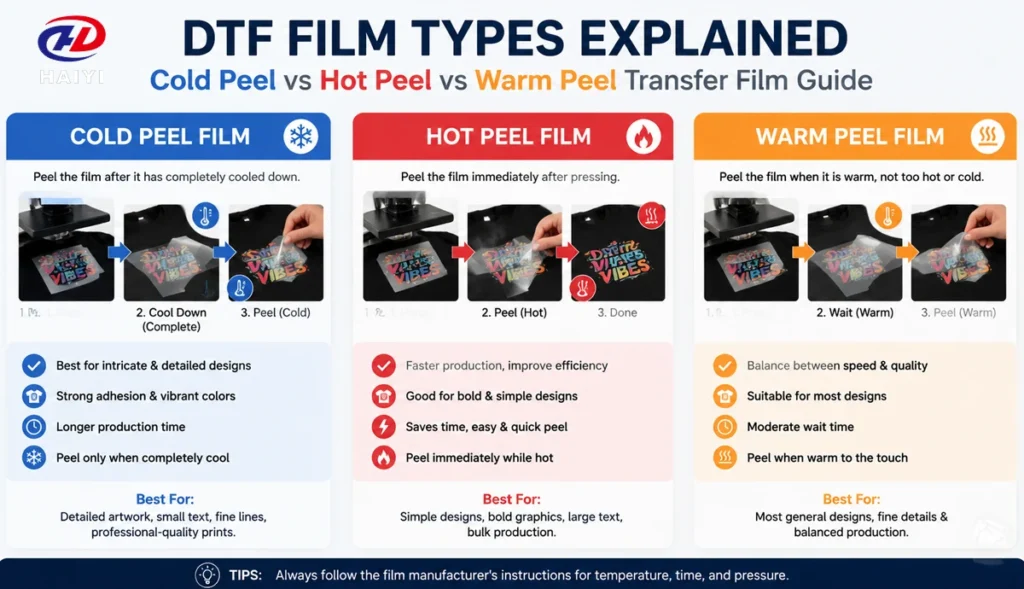
The release coating on a DTF film controls exactly when the PET layer separates cleanly from the adhesive layer underneath. Hot peel films use a fast-release coating engineered to let go the moment pressing finishes, while still hot. Cold peel films use a stronger-holding coating that keeps the PET layer bonded until the adhesive has fully cooled and stabilized. Warm peel films sit between the two, using a balanced release coating tuned for a short cooling window rather than either extreme.
This single design choice — how “eager” the coating is to release — cascades into everything else: how smooth the peel feels, how well the ink layer is protected during separation, what surface finish the final print has, and ultimately how fast a production line can move.
What Is Hot Peel DTF Film?
How Hot Peel Film Works
Hot peel film is designed to be removed immediately after heat pressing, while the transfer is still hot. The release layer is engineered to let go quickly and cleanly at pressing temperature, so the finished design stays fully bonded to the fabric even as the film comes off within seconds of the press opening.
Why Businesses Choose Hot Peel Film
The core advantage is speed. Because there’s no waiting period before peeling, hot peel film removes an entire step from the production cycle — operators press, peel, and move immediately to the next garment. This makes it the standard choice for large-volume printing operations, commercial garment factories, and express-turnaround customization businesses, where thousands of transfers may run through a line in a single day. Removing labor waiting time at scale compounds into a meaningful efficiency gain that smaller shops may not notice but factory-scale operations depend on.
Where Hot Peel Film Falls Short
The tradeoff for that speed is precision. Hot peel film requires accurate, consistent temperature control — if the press runs even slightly cool, peeling too soon can lift part of the design before the adhesive has fully bonded. It also demands operator experience, since the timing window for a clean peel is narrower than with cooling-based film types. For that reason, hot peel isn’t automatically the right choice for every fabric or every design; it performs best in controlled, high-repetition production environments rather than one-off or highly detailed jobs.
What Is Cold Peel DTF Film?
How Cold Peel Film Works
Cold peel film takes the opposite approach: the transfer is pressed onto fabric, then left to cool completely before the film is removed. That cooling period allows the adhesive layer to fully stabilize and harden before any peeling force is applied, which is what gives cold peel its characteristic reliability.
Why Businesses Choose Cold Peel Film
Because the adhesive has already set by the time peeling happens, cold peel film offers strong transfer stability — there’s meaningfully less risk of the design lifting mid-peel compared to a hot-release film. This makes it well suited to detailed artwork: fine lines, small text, complex multi-color graphics, and high-density designs all benefit from an adhesive layer that’s fully locked in place before any mechanical stress is applied during peeling. Cold peel is also considered the most beginner-friendly option, since the cooling stage builds in a wide tolerance window — there’s no narrow timing target to hit, which is exactly why small print shops and new DTF operators frequently start here.
Where Cold Peel Film Falls Short
The obvious cost is time. Every transfer has to wait for a full cooling cycle before it can be peeled, which slows total production throughput compared to hot peel’s near-instant workflow. For a shop running a handful of custom orders a day, that wait is negligible. For a factory targeting thousands of units, it becomes a real bottleneck — which is exactly the scenario where hot peel or warm peel film tends to replace it.
What Is Warm Peel DTF Film?
How Warm Peel Film Works
Warm peel film is peeled after a short cooling period — not immediately, like hot peel, and not after full cooling, like cold peel. The film is removed once it has dropped to a temperature lower than hot-peel range but still noticeably warmer than a fully cooled cold-peel transfer, positioning it as a deliberate middle ground.
Why Businesses Choose Warm Peel Film
Warm peel’s core value is balance. It runs faster than cold peel while offering more forgiving process control than immediate hot peeling, which makes it a practical fit for growing businesses that have outgrown a pure cold-peel workflow but aren’t yet running factory-scale hot-peel volume. It also handles a flexible range of applications well — mixed fabric types and varied artwork styles — without requiring the tight temperature discipline that hot peel demands. In practice, this also reduces common process risks like film sticking, transfer damage from premature peeling, or timing-related lifting, since the process tolerance sits wider than hot peel’s narrow window.
Hot Peel vs Cold Peel vs Warm Peel: Complete Comparison
| Feature | Hot Peel Film | Warm Peel Film | Cold Peel Film |
|---|---|---|---|
| Peeling Time | Immediately after pressing | Short cooling period | After full cooling |
| Production Speed | Highest | Medium-high | Lowest |
| Operation Difficulty | Requires experience | Easy | Beginner-friendly |
| Mass Production Fit | Excellent | Good | Moderate |
| Transfer Stability | Good | Excellent | Excellent |
| Best Suited For | Large factories | Growing businesses | Small shops |
| Workflow Efficiency | Very high | High | Medium |
Which DTF Film Type Provides the Best Transfer Quality?
There is no single “best” DTF film type in absolute terms — the right choice depends on fabric type, printing volume, artwork complexity, heat press settings, and operator experience working together. What “best” means changes depending on which of those variables matters most for a given order.
Choose hot peel film when speed is the top priority, production volume is high, and workflow efficiency directly affects profitability at scale.
Choose cold peel film when transfer reliability matters more than speed, the artwork involves complex or fine detail, and production volume is small enough that the extra cooling time doesn’t create a bottleneck.
Choose warm peel film when you need a genuine balance between speed and stability, you’re running multiple product types through the same line, or you’re actively scaling production capacity and don’t want to be locked into either extreme.
How Does DTF Film Quality Affect Peel Performance?
Peeling performance isn’t determined by film type alone — manufacturing quality plays an equally large role, regardless of which category of film is in use. Three factors matter most:
Coating uniformity. A consistently applied coating ensures even ink absorption across the full film surface, stable release performance from batch to batch, and reliable transfer results that don’t vary unpredictably within the same roll.
PET film thickness. Thickness directly affects how stably the film feeds through the printer, how well it resists heat distortion during curing and pressing, and how easily it handles through the full production workflow without curling or jamming.
Release layer technology. The specific engineering of the release coating determines how smooth the peel feels, whether any adhesive residue is left behind on the fabric, and how clean the final transfer appears at the edges.
A hot peel film with inconsistent coating, for example, can still fail even when the peeling technique and timing are executed perfectly — which is why film manufacturing quality and peel-type selection have to be evaluated together, not separately.
Common Problems When Choosing the Wrong DTF Film Type
Film peels too early. This usually traces back to incorrect peel timing relative to the film’s designed release point, or an incompatibility between the film and the adhesive powder in use. The fix is matching peeling method precisely to the film’s recommended processing conditions rather than applying a generic timing rule across different film types.
Transfer lifts during peeling. This typically results from insufficient heat during pressing, incorrect pressure, or simply using a film type unsuited to the job — for example, using hot peel film for a detailed design better suited to cold peel’s stability. The fix is optimizing heat press parameters to match both the fabric and the specific film type.
Slow production efficiency. This is most often the result of running high-volume orders through cold peel film, where the required cooling time becomes a bottleneck at scale. The fix is shifting that order type to hot peel or warm peel film, which removes or shortens the cooling wait without sacrificing acceptable transfer quality.
How to Choose the Right DTF Film for Your Business
For garment printing factories: hot peel DTF film is generally the strongest fit, given the priority on high-speed production capability and the need for stable batch quality across large volumes.
For DTF film distributors and wholesalers: the priority shifts toward supplier-side factors — consistent quality across batches, availability of multiple film types to serve different customer segments, OEM packaging capability, and reliable supply capacity that can support recurring bulk orders.
For small printing businesses: cold peel or warm peel film is typically the more practical choice, given the easier operation and lower learning curve compared to the tighter timing discipline hot peel requires.
Wholesale Buying Guide: What to Check Before Importing DTF Film
Material specifications. Confirm PET quality, film thickness, roll size, and surface treatment match your production requirements before committing to a bulk order.
Production capability. Evaluate the manufacturer’s production experience, quality inspection system, actual production capacity, and export experience — these determine whether supply will stay consistent as order volume grows.
Customization options. Check whether the supplier offers private label packaging, custom roll sizes, and other customized specifications, particularly important for distributors building their own branded product line.
Frequently Asked Questions About DTF Film Types
Is hot peel DTF film better than cold peel film? Neither is universally better — hot peel is faster and suited to high-volume production, while cold peel offers easier handling and greater transfer stability. The right choice depends on your production volume and quality priorities.
Can warm peel film replace hot peel and cold peel film entirely? Warm peel offers balanced performance that works well across a range of applications, but it may not fully replace specialized films at the extremes — very high-speed mass production or highly detailed cold-peel-dependent artwork still often perform best on their purpose-built film type.
Which DTF film is best for beginners? Cold peel and warm peel films are generally easier for beginners, since both offer more tolerance in peeling timing compared to hot peel’s narrow, temperature-sensitive window.
Which DTF film is best for mass production? Hot peel film is the standard choice for mass production, since it removes the cooling wait time from the workflow and maximizes throughput when speed and efficiency are the main priorities.
Conclusion: Matching DTF Film Type to Your Production Reality
Hot peel film improves production speed and suits high-volume, factory-scale operations. Cold peel film provides stable, reliable transfer control best suited to detailed artwork and smaller production runs. Warm peel film offers a practical balance between the two, fitting growing businesses that need more speed than cold peel but more control than hot peel.
The right decision comes down to production requirements, fabric applications, and quality expectations — not simply choosing whichever film costs the least. Haiyi Materials manufactures hot peel, cold peel, and warm peel DTF film with consistent coating quality and OEM/private-label support for distributors and printing businesses that need reliable supply at wholesale volume. Contact us to discuss specifications, sample testing, and the right film type for your production line.