






DTF Film Peel Timing: How to Find the Correct Peel Window
A controlled method for finding and documenting the correct DTF film peel window.

Peeling problems are often treated as a simple film defect, but the peel window is a process variable. The same transfer may release cleanly at one temperature and tear, lift, or leave adhesive residue when peeled too early or too late. This guide explains how production teams can identify and document the correct peel window for each film, fabric, powder, and press combination.
For a broader diagnosis of coating, curing, pressure, and compatibility problems, use the complete DTF film hard-to-peel troubleshooting guide. The method below focuses specifically on timing and repeatability.
What Is a DTF Film Peel Window?
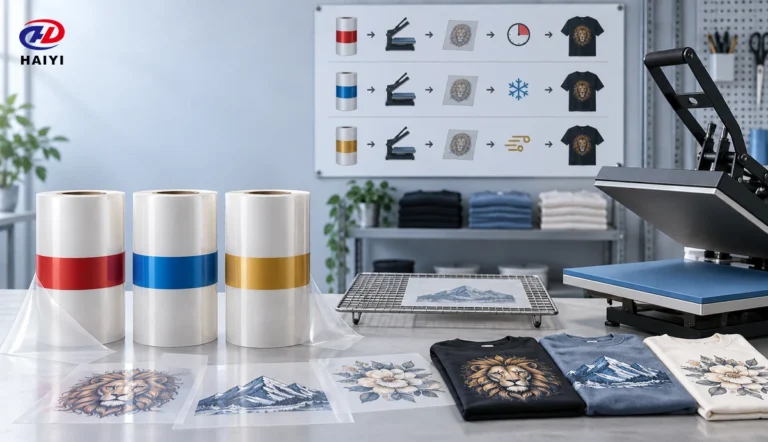
The peel window is the period after pressing when the carrier can be removed without damaging the print or leaving an unstable edge. A hot-peel film may be designed for immediate removal, a warm-peel film may need a short controlled delay, and a cold-peel film normally needs to reach a much lower surface temperature. Product labels alone are not enough because the actual window also depends on the press, garment, transfer size, room conditions, and operator speed.
Why Timing Changes the Result
- Too early: adhesive and ink layers may still be soft, so details can lift with the carrier.
- Too late: some fast-release systems can become harder to remove after the transfer cools completely.
- Uneven cooling: large graphics can have a cool edge and a warm center, creating mixed release behavior.
- Operator variation: phrases such as “peel warm” mean different things unless the team uses a measurable rule.
Run a Controlled Peel-Timing Test
- Use transfers from one printed and cured batch.
- Use the same garment type, press, platen position, pressure, and first-press settings.
- Prepare several identical samples and assign a different peel delay to each sample.
- Measure delay from the moment the press opens. If possible, also record the transfer surface temperature.
- Peel every sample at the same angle and speed.
- Record release force, edge lift, fine-detail loss, surface appearance, and residue.
- Apply the same finishing press to all acceptable samples, then complete stretch and wash checks.
Use a Practical Pass/Fail Scorecard
| Check | Pass condition | Failure signal |
|---|---|---|
| Release | Carrier removes smoothly | Sudden sticking or excessive force |
| Detail | Fine lines remain complete | Small elements lift or break |
| Edges | Edges remain flat | Corners rise during peeling |
| Surface | Finish is even | Patchy gloss, marks, or residue |
| Durability | Passes the defined wash test | Cracking, lifting, or shedding |
Separate Timing Problems from Other Causes
If every timing sample fails in the same way, the root cause is probably not the peel delay. Check curing, powder melt, pressure distribution, fabric treatment, ink load, and film compatibility. A timing test should change the release result. If it does not, stop adjusting the delay and inspect upstream variables.
Also confirm that the production film matches the approved sample. Changes in coating, thickness, surface treatment, or storage condition can move the usable peel window. Teams buying DTF film rolls should record the lot number on the test sheet so a result can be traced to the material received.
Turn the Best Result into an Operator Rule
Do not document only a single delay such as “peel after 12 seconds.” Record a usable range, the fabric type, transfer size, press settings, room condition, peel direction, and finishing step. Post the approved rule near the press and retrain operators when the film, powder, ink, garment, or equipment changes.
When to Requalify the Peel Window
Repeat the test after a supplier or film grade change, a new garment fabric, major seasonal humidity changes, press maintenance, a different powder or ink, or an unexplained increase in rework. A short requalification is less expensive than allowing an unstable process to continue through a large order.
Wholesale Film Support from Haiyi
Haiyi supplies DTF film for wholesale and customization projects. B2B buyers can request samples for controlled peel-window testing and discuss roll format, release behavior, packaging, and private-label requirements. Contact Haiyi with your printer, powder, fabric, press workflow, and expected order volume so the team can support a practical qualification plan.