







How To Use DTF Transfer Film

DTF film full process operation guide: standardized tutorial from printing to finished products
As the core technology in the field of personalized customization, DTF film technology is widely used in clothing, luggage, advertising signs and other fields with its high precision, strong adhesion and environmental protection characteristics. This article will systematically sort out the full process operation specifications from printing preparation to finished product delivery, and combine equipment parameters and process points to provide practitioners with a practical technical guide.
Core process flow analysis
1. Printing preparation stage
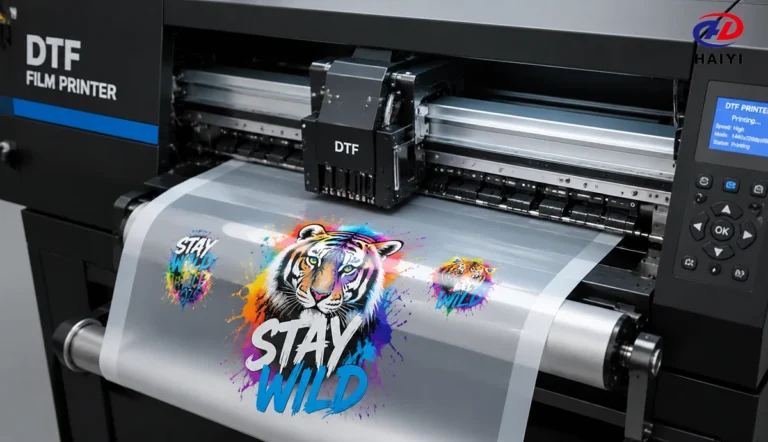
Material pretreatment: Accurately embed the PET film into the printer tray, and make sure that the film is flat and wrinkle-free. It is recommended to use equipment with a vacuum adsorption platform to avoid displacement of the film during printing.
Mirror printing technology: Set the horizontal flip parameter in the RIP software to ensure that the final pattern direction is consistent with the direction of the fabric presentation. The printing resolution is recommended to be set above 1200×1200DPI to ensure line accuracy.
DTF primer process: Using CMYK+W five-color printing mode, the thickness of the white ink layer needs to be controlled in the range of 8-12μm. Tests show that this thickness range can achieve the best balance between color reproduction and film transmittance.
2. Powder handling system
Intelligent powder shaking device: equipped with a powder spreader with adjustable vibration frequency, it is recommended to use a 45° inclination angle to evenly drop powder. The powder particle size needs to be tested by a 200-mesh sieve. Too large particles are prone to uneven melting.
Circulation recovery system: Design a closed powder recovery channel, the recovery rate of unattached powder can reach more than 95%, significantly reducing material loss.
Powder melting process window: The temperature of the hot press is set at 160-170℃, and the time accuracy needs to be controlled within ±5 seconds. Actual measured data shows that this parameter range can make the hot melt powder melting index reach the ideal state of 8-12g/10min.
3. Pre-pressing and transfer process
Cloth pretreatment: Use 180℃ rapid pre-pressing for 3 seconds, which can effectively remove the air between the fabric fibers and improve the transfer yield.
Control of three elements of transfer printing:
Temperature: 165℃±2℃ (it is recommended to configure an infrared thermometer for real-time monitoring)
Pressure: 0.35-0.45MPa (dynamically adjusted according to the thickness of the fabric)
Time: 18 seconds (cotton fabric can be extended to 22 seconds)
Cooling and peeling process: The forced air cooling system needs to reduce the film temperature to below 40℃ within 5 seconds. Peeling too early will cause color migration, and peeling too late may cause false adhesion.
Equipment selection and parameter optimization
1. Printer configuration standards
Nozzle type: industrial-grade piezoelectric nozzle (such as Epson I3200 series)
Ink system: equipped with a secondary ink filter device, filter accuracy ≤1μm
Negative pressure control: dynamic ink pressure adjustment range -2.5 to +1.5kPa
2. Hot press performance requirements
Heating plate material: 6061 aluminum alloy substrate + Teflon coating
Temperature control accuracy: ±1℃ (PID intelligent temperature control module)
Pressure sensor: range 0-500N, resolution 0.1N
3. Environmental protection supporting facilities
Activated carbon adsorption device: for trace VOCs generated by the hot pressing process, the treatment efficiency is ≥90%
Electrostatic dust removal system: configure ion wind rods in the front section of printing to eliminate electrostatic accumulation of film materials
Key points of quality control
1. Adhesion test standard
Refer to ASTM D3359 standard performs tape test, requiring 5B grade (no peeling of the edge of the grid)
Water washing test: 40℃ warm water machine wash 50 times, color fastness ≥4 grade (AATCC 61-2013 standard)
2. Common defect solutions
Bubbles/wrinkles: check the parallelism of the heat press and adjust the pressure uniformity
Color deviation: calibrate the ICC curve and update the nozzle waveform file
Film material residue: optimize the melting powder process parameters and extend the cooling time
3. Maintenance cycle
Daily: clean the nozzle surface and detect the negative pressure value
Weekly: calibrate the temperature control system and replace the filter cotton
Monthly: perform deep cleaning of the nozzle and check the accuracy of the pressure sensor
Operational safety specifications
1. Personal protective equipment
Anti-scalding gloves: temperature resistance ≥200℃, in line with EN 407 standards
Goggles: pass the ANSI Z87.1 impact test
Dust mask: filtration efficiency above N95 level
2. Electrical safety requirements
Equipment grounding resistance ≤ 4Ω
Emergency stop device response time < 0.2 seconds
Power isolation transformer complies with IEC 61558 standard
3. Waste treatment process
Waste film recycling: Cooperate with professional institutions to achieve PET material recycling
Waste ink treatment: Entrust qualified units to dispose of hazardous waste and establish a transfer joint form system
By strictly implementing the above process specifications, the yield of DTF film can be increased to more than 98%, while reducing the overall production cost by 20%. With the integration and development of intelligent equipment and new material technology, this process will show broader application prospects in the field of personalized customization.