







Reflective DTF Film for Fashion vs Safety Applications
Compare reflective DTF film for fashion vs safety workwear: cd/lux/m2 brightness, EN ISO 20471 & ANSI 107 rules, RIP ink limits, heat press & B2B wholesale.

Key Takeaways: Reflective DTF film enables full-color, weed-free luminous transfers on both streetwear and workwear, but fashion and occupational safety applications operate under completely different optical, durability, and legal rules. Fashion and activewear prioritize soft hand-feel, stretch recovery, and rainbow or silver flash aesthetics (typically 80 to 300 cd/lux/m2), whereas high-visibility safety apparel must comply with EN ISO 20471 or ANSI/ISEA 107 retroreflectivity thresholds (330 to 500+ cd/lux/m2 initial) and industrial wash durability. At HAIYI, we engineer and wholesale silver and rainbow reflective DTF films with controlled ink-absorption and cold-peel release coatings so apparel decorators and distributors can match the exact film, ink density, and TPU powder to every end-use market.
Reading time: 12 minutes
What Is Reflective DTF Film, and How Does It Work Optically?
Reflective Direct-to-Film (DTF) transfer film is a specialty coated PET carrier that integrates a microscopic retroreflective layer—composed of high-refractive-index glass microbeads paired with a metallic reflective backing—beneath an ink-receptive top coating. Unlike conventional white or clear DTF PET film where light scatters diffusely off pigment ink, reflective DTF film returns incident light beams (such as smartphone camera flashes, streetlights, or vehicle headlights) directly back toward the light source along the incoming angle. When printed with standard DTF CMYK and white pigment inks, powdered with hot-melt TPU adhesive, and heat-pressed onto fabric, the transfer delivers intricate multi-color graphics that appear subtly metallic in daylight and glow intensely under directional light.
Understanding this optical stack is critical because ink opacity directly competes with retroreflectivity. Every drop of dense CMYK or white ink placed in front of the glass microbeads absorbs or blocks incoming light before it can strike the beads and bounce back to the viewer. In our coating laboratory at HAIYI, we formulate reflective DTF films with calibrated ink-receptive layers so decorators can print crisp fine lines and gradients while keeping open silver or rainbow reflective channels bright. How you balance ink density, film finish, and adhesive chemistry depends entirely on whether the finished garment is headed for a streetwear lookbook or a highway construction crew.
Fashion vs. Safety Applications: Core Differences Every Decorator Must Know
Although both fashion brands and workwear suppliers buy reflective transfers, treating the two segments identically leads to either stiff, uncomfortable streetwear or non-compliant safety garments that fail regulatory inspection. Separating the engineering targets for each market ensures consistent customer satisfaction and zero compliance liability.
Fashion, Streetwear, and Athleisure Applications
In fashion and sportswear, reflective DTF film is an aesthetic differentiation tool designed to create visual drama under nightlife lighting, social-media flash photography, and evening running conditions. Streetwear labels value complex, weed-free artwork—such as distressed typography, multi-color chest emblems, tonal silver sleeve graphics, and rainbow-iridescent back prints—that would be impossible or prohibitively slow to cut from traditional reflective heat transfer vinyl (HTV). Because consumers wear hoodies, oversized tees, and compression tops directly against the skin, fashion buyers prioritize soft hand-feel, four-way stretch recovery, crack resistance, and wash fastness across 20 to 50 domestic wash cycles at 40 degrees Celsius. For broader ideas on integrating specialty films into apparel drops, explore our guide on DTF film for streetwear brands and special effects.
Occupational Safety and High-Visibility Workwear Applications
In industrial workwear, logistics, utilities, and emergency response, reflectivity is a life-safety function governed by strict photometric and mechanical standards. The garment must make a worker visible to drivers from 150 to 300 meters away in darkness, rain, or fog, and survive harsh abrasion, oil exposure, flexing, and high-temperature industrial laundering (60 degrees Celsius or higher). Design complexity is secondary to photometric brightness (measured in candela per lux per square meter, or cd/lux/m2), adhesion strength on heavy-duty fluorescent polyester or poly-cotton twill, and strict legal compliance with regional high-visibility PPE standards.
| Performance Dimension | Fashion, Streetwear & Activewear | Occupational Safety & Hi-Vis Workwear |
|---|---|---|
| Primary Objective | Flash aesthetics, brand differentiation, evening jogger visibility | Long-distance headlight detection, worker safety, legal PPE compliance |
| Preferred Film Finish | Rainbow reflective, iridescent, dark/tinted, or soft silver | High-intensity silver-gray retroreflective (maximum cd/lux/m2) |
| Typical Retroreflectivity (RA) | 80 – 300 cd/lux/m2 (depends on finish and CMYK ink coverage) | 330 – 500+ cd/lux/m2 initial; >= 100 cd/lux/m2 after test cycles |
| Artwork Complexity | High: fine lines, halftones, full CMYK gradients, intricate logos | Low to Moderate: solid silver bands + high-contrast off-tape logos |
| Target Garment Fabrics | 100% cotton, combed fleece, 50/50 blends, poly-spandex knits | Fluorescent neon polyester mesh, heavy twill, canvas, FR workwear |
| Laundering Durability | 20 – 50 domestic washes (30 – 40 deg C, inside-out) | 25 – 50+ heavy or industrial washes (60 deg C+, mechanical abrasion) |
| Regulatory Standards | Unregulated for visibility; OEKO-TEX Standard 100 / CPSIA focus | EN ISO 20471 (Europe) & ANSI/ISEA 107 (North America) |
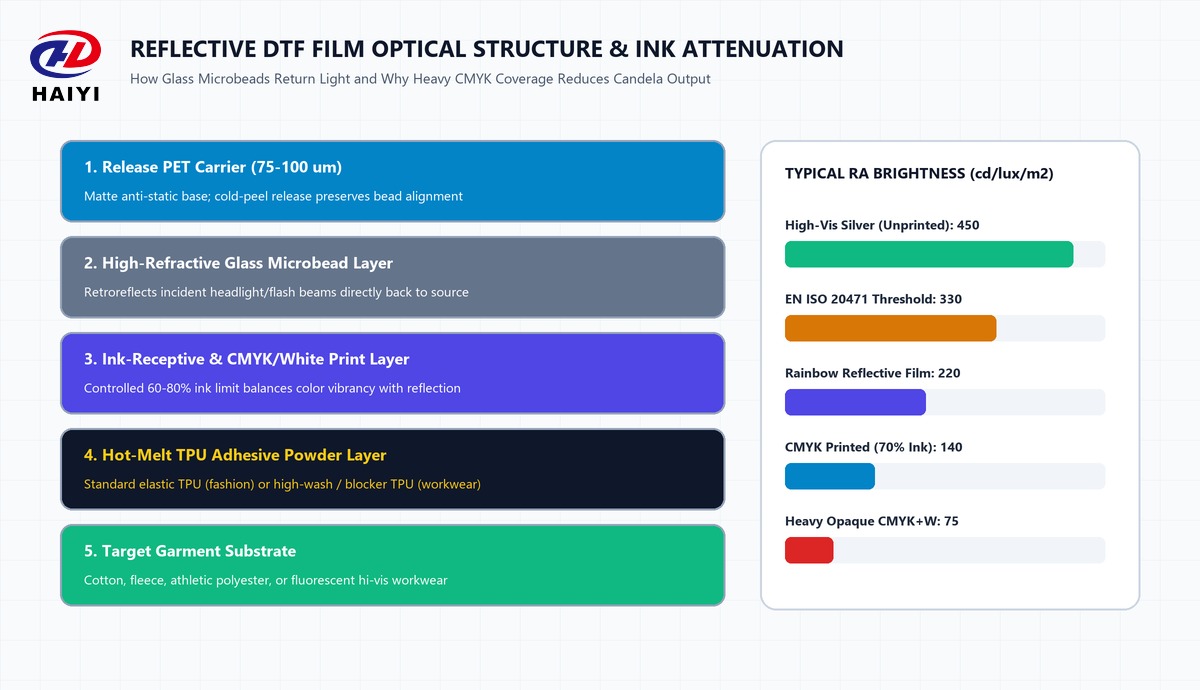
Retroreflectivity (cd/lux/m2) Explained: Silver vs. Rainbow vs. Full-Color Printed DTF
Retroreflectivity—denoted as the coefficient of retroreflection (RA) and measured in cd/lux/m2 under ASTM E808/E809 test geometry (typically 0.2-degree observation angle and 5-degree entrance angle)—quantifies how brightly a material returns light to an observer near the light source. Comparing different reflective DTF film constructions reveals why finish selection and ink coverage matter so dramatically:
- High-Intensity Silver-Gray Reflective Film (Unprinted): Delivers the highest optical return, typically reaching 350 to 500 cd/lux/m2. Silver glass-bead layers maximize light reflection across the entire visible spectrum, making silver the only viable base for high-visibility safety accents.
- Rainbow / Holographic Reflective DTF Film: Uses specialized optical interference coatings over glass microbeads to split reflected light into vibrant spectral colors under flash or headlights. While stunning for fashion hoodies and festival wear, spectral dispersion lowers single-angle photometric intensity to roughly 150 to 250 cd/lux/m2—well below mandatory PPE tape ratings.
- Dark / Black Reflective Film: Appears sleek matte charcoal or black in daylight and glows silvery-white under direct flash. Its light-absorbing dark pigment layer cuts optical efficiency to roughly 60 to 140 cd/lux/m2, making it strictly a fashion and stealth-branding effect.
- Full-Color CMYK Printed Over Reflective DTF Film: Printing translucent CMYK pigment over a silver reflective base creates colored reflective graphics, but typically reduces brightness by 40% to 75% depending on ink saturation. Heavy dark colors (black, navy, deep red) block nearly all light from reaching the beads, whereas light cyan, yellow, and open unprinted silver channels retain strong reflection.
EN ISO 20471 and ANSI/ISEA 107 Compliance Rules: What Decorators Must Never Do
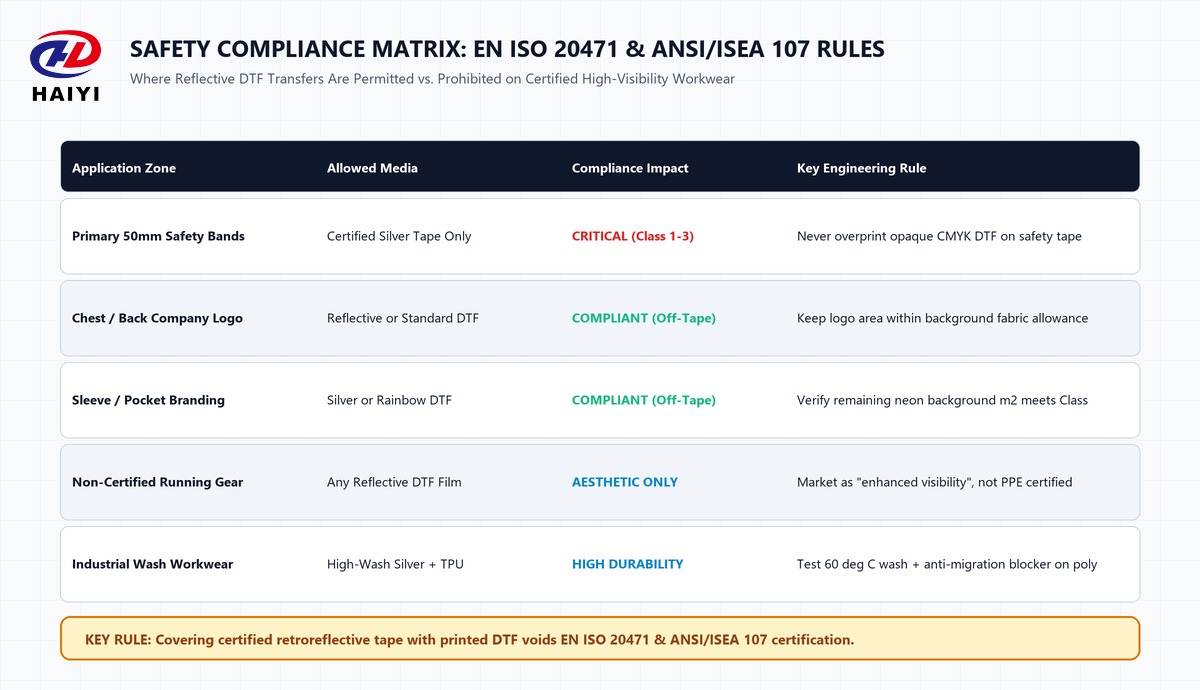
One of the costliest mistakes apparel decorators make when entering the B2B workwear market is assuming that printing a company logo on reflective DTF film automatically creates a certified high-visibility safety garment. Under both EN ISO 20471 (Europe) and ANSI/ISEA 107 (North America), high-visibility personal protective equipment (PPE) is certified as a complete garment system requiring strict minimum surface areas (in square meters) of fluorescent background fabric (neon yellow-green, orange-red, or red) AND certified solid retroreflective bands (typically 50 mm wide) arranged in continuous torso and sleeve patterns.
Three legal and technical compliance rules govern every safety workwear decoration order:
- Full-Color Printed Reflective DTF Cannot Replace Certified Safety Tape: Because CMYK ink lowers retroreflectivity below the 330 cd/lux/m2 minimum initial requirement and changes chromaticity, printed reflective DTF graphics do not qualify as primary EN ISO 20471 or ANSI/ISEA 107 retroreflective striping.
- Never Press Any DTF Transfer Over Existing Reflective Safety Tape: Applying a corporate logo directly across a certified 50 mm safety band physically occludes the retroreflective area, immediately invalidating the garment’s Class 2 or Class 3 certification and exposing the employer to OSHA or EU PPE compliance violations.
- Respect Maximum Logo Area on Fluorescent Background Fabric: Place corporate reflective or standard DTF logos strictly on open background fabric panels (such as the left chest pocket or upper back between vertical bands), and verify that the remaining unobstructed fluorescent fabric area still exceeds the minimum square-meter requirement for the garment’s rated Class.
For non-occupational athletic and lifestyle gear—such as nighttime running shirts, cycling jerseys, dog-walking jackets, or school backpacks—EN ISO 20471 and ANSI/ISEA 107 do not apply. However, brands should market these items accurately as enhanced-visibility activewear rather than certified PPE safety apparel.
Production SOP: RIP Settings, TPU Powder, and Heat-Press Parameters for Reflective DTF
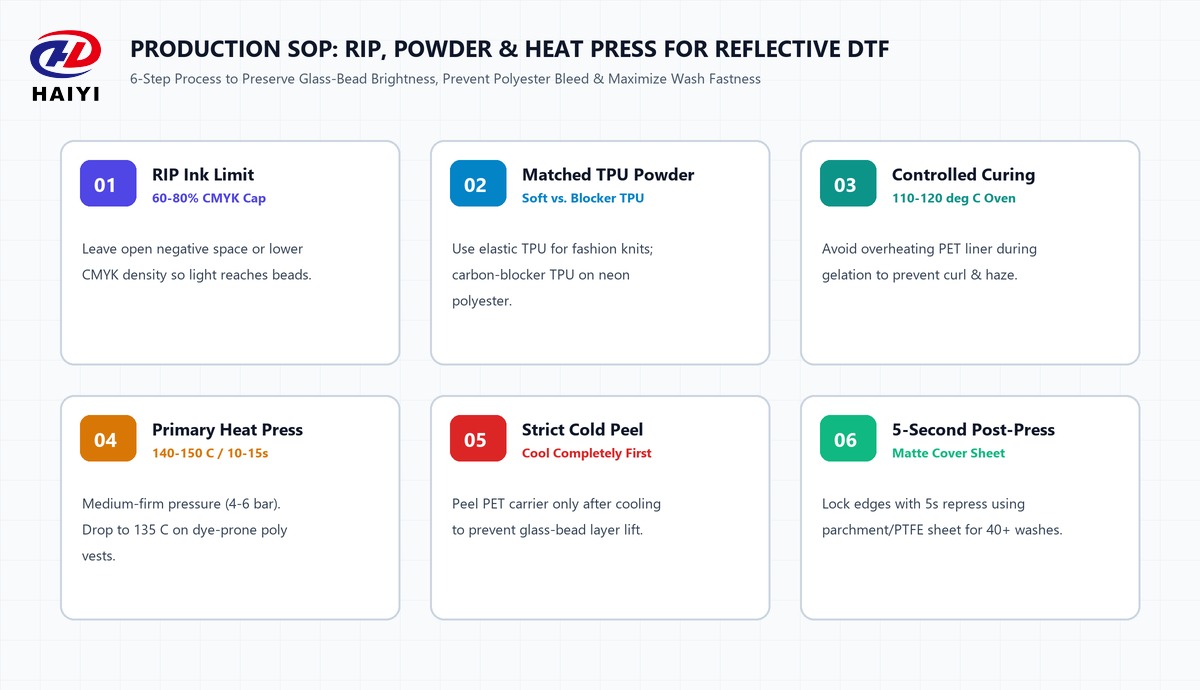
Running reflective DTF film on the exact same printer profile and heat-press recipe used for standard matte cotton DTF film leads to muted brightness, glass-bead delamination, or dye bleed on neon safety vests. At HAIYI, our technical support team recommends a six-step production protocol tailored to reflective DTF coatings.
1. Optimize Artwork and RIP Ink Density (60% to 80% Cap)
In your RIP software, avoid flooding the entire graphic with 100% heavy CMYK ink if you want maximum reflective pop. Use open negative-space strokes, halftone gradients, or capped CMYK ink limits (60% to 80%) so incident light can pass through to the glass microbeads. Maintain a clean, uniform white ink underbase (typically 60% to 75% with 1 to 2 pixels of choke) behind printed areas so the TPU adhesive bonds evenly without white haloing around crisp edges.
2. Match TPU Powder to the Fabric and Wash Requirement
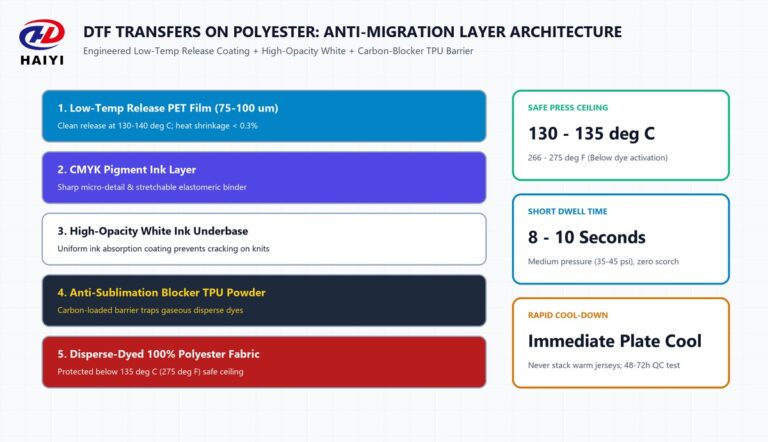
For cotton hoodies, fleece, and stretchy fashion activewear, pair reflective DTF film with soft, elastic fine-to-medium TPU powder (80–200 um) to preserve drape and prevent cracking when stretched. For fluorescent neon yellow or orange 100% polyester safety vests—which are notorious for aggressive disperse dye sublimation—switch to anti-sublimation carbon-blocker TPU powder and lower your press temperature so neon yellow dye does not bleed through white and silver logos. For complete polyester bleed-prevention settings, read our DTF transfers on polyester dye migration guide.
3. Control Curing Oven Temperature Carefully
Melt the TPU adhesive powder in a conveyor shaker-dryer or curing oven at 110 to 120 degrees Celsius (230 to 248 degrees Fahrenheit) for 90 to 120 seconds until the powder develops a uniform orange-peel gloss. Avoid overheating reflective PET film above 135 degrees Celsius inside the curing tunnel, as excessive thermal soak can warp the carrier sheet, dull the optical bead layer, or cause premature release-coating tackiness.
4. Heat-Press Temperature, Pressure, and Strict Cold Peel
Pre-press the garment for 3 to 5 seconds to drive out trapped humidity. Press the reflective DTF transfer at 140 to 150 degrees Celsius (284 to 302 degrees Fahrenheit) for 10 to 15 seconds under medium-to-firm pressure (4 to 6 bar / 40 to 60 psi). On heat-sensitive neon polyester safety vests, reduce temperature to 135 to 140 degrees Celsius for 10 seconds to prevent platen scorch marks and dye migration.
Crucially, most reflective DTF films require a strict cold peel. Let the pressed garment cool completely to room temperature (using a flat aluminum cooling block speeds up production) before peeling the PET liner slowly at a low 180-degree angle. Peeling hot pulls soft adhesive away from the glass-bead layer, causing micro-tearing and dull patchy spots. Finish with a 5-second second press covered by a matte parchment or PTFE sheet to lock transfer edges and boost wash durability to 40+ cycles. For deeper durability benchmarks, see our guide on choosing DTF film with strong wash resistance.
Troubleshooting Common Reflective DTF Printing and Pressing Defects
When decorators test reflective DTF film for the first time, four recurring defects account for almost all scrap. Addressing the exact root cause quickly stabilizes production yield:
- Dull or Non-Reflective Print Under Flash: Almost always caused by excessive CMYK ink density blocking the glass beads or pressing too hot (> 165 degrees Celsius), which sinks the beads into molten TPU. Lower RIP CMYK density to 60%–80%, use lighter colors or open silver contours, and verify actual platen temperature with an infrared thermometer.
- Glass-Bead Layer Lifting or Patchy Release During Peel: Triggered by hot-peeling a cold-peel reflective film or under-pressing with uneven platen pressure. Allow complete cool-down on a flat cooling block and verify firm, uniform pressure across seams and zippers using a pressing pillow.
- Stray Powder Sticking to Blank Film Areas: Caused by static buildup on low-grade PET film or high shop humidity (> 65% RH). Specify anti-static back-coated reflective DTF film (surface resistance < 10^9 ohms) and maintain printroom humidity between 45% and 55% RH.
- Neon Yellow or Orange Discoloration on Safety Vests After 24 Hours: Classic polyester disperse-dye migration. Lower heat-press temperature to 135 degrees Celsius, cut dwell time to 10 seconds, switch to carbon-blocker TPU powder, and never stack hot safety vests immediately off the press.
How B2B Distributors and Print Shops Should Source Reflective DTF Film
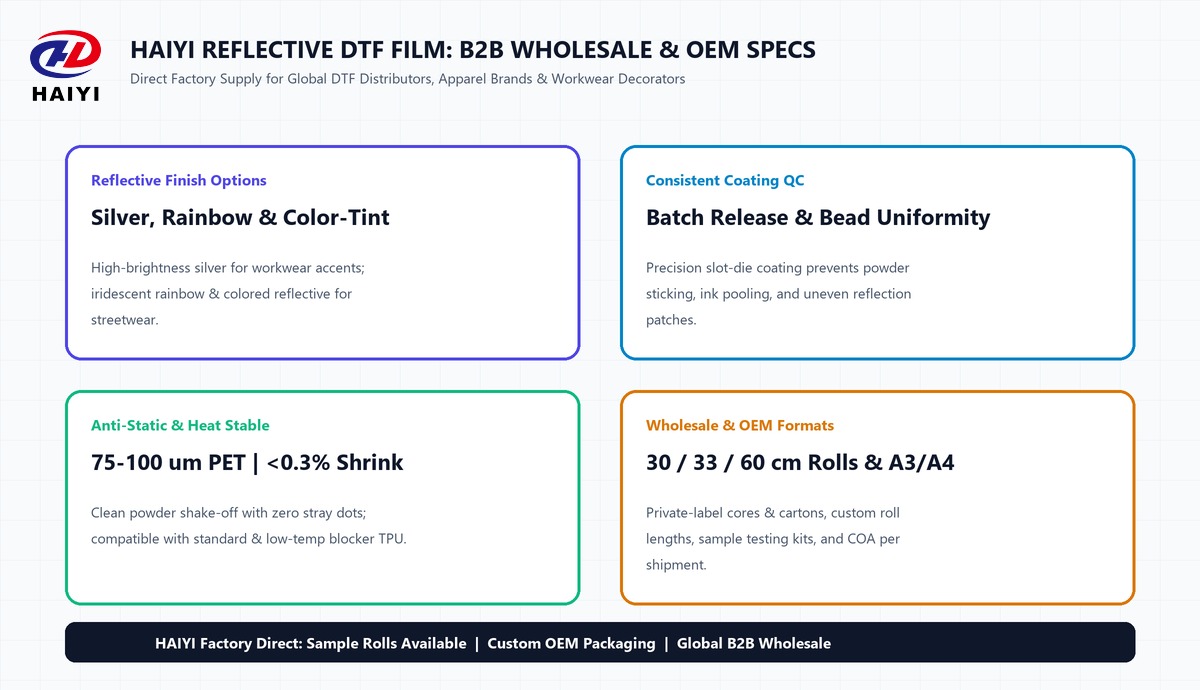
Reflective DTF film is a high-margin specialty SKU that helps distributors and contract printers differentiate from commodity matte-film competitors—provided batch quality is rock-solid. When evaluating a wholesale reflective DTF film factory, audit four measurable quality controls before placing bulk container or pallet orders (and review our full DTF film ultimate buying guide for distributors):
- Coating Uniformity & Zero-Pinhole Inspection: Uneven glass-bead coating creates visible cloudy bands under flash photography. Verify that the manufacturer uses precision automated slot-die coating lines with inline optical defect inspection.
- Batch Release-Force Consistency: Erratic release force causes cold-peel tearing on fine 2 mm lettering. Ask your supplier for batch release-force test logs and print a standardized fine-text sample roll before approving mass production.
- Multi-Width Slitting & Printer Compatibility: Ensure the factory can supply exact roll widths—30 cm (12 inch), 33 cm (13 inch), and 60 cm (24 inch) rolls plus A3/A4 cut sheets—with clean burr-free edges that track straight in high-speed roll-to-roll printers.
- Wash & Skin-Safety Documentation: Request documented wash-fastness test results and OEKO-TEX / RoHS material safety documentation, especially for European and North American apparel brands. Learn how to balance specialty and core films in our DTF film SKU matrix guide for distributors.
Frequently Asked Questions About Reflective DTF Film
Can I print reflective DTF film on any standard DTF printer?
Yes. Reflective DTF film is engineered to run on standard roll-to-roll and desktop DTF printers using regular water-based DTF CMYK + White pigment inks and standard TPU hot-melt powder. You only need to adjust your RIP ink density slightly downward on reflective zones and follow cold-peel heat-press parameters.
Does reflective DTF film meet EN ISO 20471 or ANSI/ISEA 107 safety certification?
Full-color printed reflective DTF graphics do not qualify as certified primary safety striping under EN ISO 20471 or ANSI/ISEA 107 because pigment ink lowers retroreflectivity below mandatory thresholds. However, reflective DTF is widely used on certified safety garments for corporate logos placed strictly off the certified 50 mm safety bands, and for non-certified enhanced-visibility sportswear and workwear.
What is the difference between silver reflective DTF film and rainbow reflective DTF film?
Silver reflective DTF film appears metallic gray in daylight and returns bright, crisp white light (350 to 500 cd/lux/m2 unprinted), making it ideal for athletic visibility and workwear branding. Rainbow reflective DTF film produces a vibrant multi-color iridescent spectrum under flash or headlights (typically 150 to 250 cd/lux/m2), making it a top seller for streetwear, music festivals, and fashion drops.
Why should reflective DTF film be cold-peeled instead of hot-peeled?
Reflective DTF film contains a denser glass-microbead optical layer than standard matte PET film. Peeling while the adhesive is still molten can separate the bead layer from the ink or lift fine graphic edges. Letting the transfer cool fully before peeling ensures 100% clean release and maximum retroreflective brightness.
How many washes do reflective DTF transfers last?
When pressed at 140 to 150 degrees Celsius with matched TPU powder, cold-peeled cleanly, and locked with a 5-second post-press, quality reflective DTF transfers withstand 30 to 50+ domestic wash cycles at 40 degrees Celsius (washed inside-out without bleach or harsh fabric softeners) without cracking or losing flash brightness.
Source Wholesale and Custom Reflective DTF Film Direct from HAIYI
Adding reliable silver and rainbow reflective DTF film to your product lineup unlocks premium margins across streetwear brands, sports apparel printers, and corporate workwear decorators. At HAIYI, we manufacture and wholesale a complete range of specialty and standard DTF transfer films backed by in-house R&D coating laboratories, strict batch quality control, and verified international product certifications.
Whether you are a regional DTF consumables distributor expanding your specialty SKU catalog, a high-volume apparel transfer hub, or a brand seeking custom OEM/ODM private-label DTF film rolls with tailored coating specs and packaging, HAIYI delivers direct-factory pricing, consistent roll-to-roll quality, and fast global shipping. Contact HAIYI today to request free reflective DTF sample rolls, technical datasheets, and a wholesale quotation.