







What Should Be Included in a DTF Film Certificate of Analysis?
Learn which product identifiers, test methods, batch results, acceptance limits, traceability records, and approvals belong in a useful DTF film COA.

Estimated reading time: 13 minutes
A DTF film Certificate of Analysis, or COA, should identify the supplied product and production lot, connect that lot to sampled material, and report agreed quality characteristics with methods, units, acceptance limits, actual results, and an authorized release decision. A useful COA provides traceable evidence for a particular batch; a generic product sheet describes expected performance without proving what was checked on that delivery.
For DTF film distributors and wholesale buyers, the strongest COA is not necessarily the longest document. A concise report covering meaningful, reproducible controls is more useful than a page of unexplained numbers. Buyers should agree on the required fields before ordering, because a certificate assembled after a complaint cannot recover missing sampling records or measurements that were never performed.
This guide addresses PET transfer film used for textile DTF printing, not the separate A/B film system used in UV DTF decoration. The focus is document content and buyer interpretation, rather than another laboratory testing tutorial. The proposed fields are a purchasing framework to adapt with the supplier, not a universal mandatory specification or a representation of an actual Haiyi COA.
What does a DTF film COA prove, and what does it not prove?
A batch-specific DTF film COA records the results and conclusions supported by its stated sampling and testing scope. Compared with a verbal assurance of consistent quality, a traceable report gives buyers evidence they can check against a purchase specification. However, a passing sample does not establish that every square meter was tested or that every printing workflow will perform identically.
A DTF film COA should distinguish measured properties from declarations and periodic qualification evidence. Thickness measured on the current lot is different from a typical thickness copied from a catalogue, while a historical wash test describes a particular transfer system. Keeping these evidence types separate prevents a buyer from interpreting reference information as fresh batch testing.
| Document | Main purpose | Important limitation |
|---|---|---|
| Certificate of Analysis | Report identified lot results against agreed requirements | Evidence depends on sampling, methods and stated scope |
| Technical data sheet | Describe product properties and recommended processing | Typical values are not necessarily current lot measurements |
| Certificate of Conformance | Declare conformity with identified requirements | May not contain individual numerical results |
| Qualification test report | Document a defined trial or extended performance evaluation | Applies to the tested material and conditions, not automatically every shipment |
Document names can vary between suppliers, so buyers should evaluate the actual contents rather than the heading alone. A document called a COA but containing only a general approval statement offers less analytical detail than a report listing traceable test results. The purchase agreement should define the required evidence explicitly instead of relying on terminology.
Which product and shipment identifiers belong on the COA?
The identification section should include the manufacturer or responsible issuer, product name, supplier product code, customer item code where applicable, film construction or grade, and specification revision. A generic description such as DTF film is weaker than an identifiable SKU because different peel types, coatings, and formats can share a similar appearance while requiring different acceptance criteria.
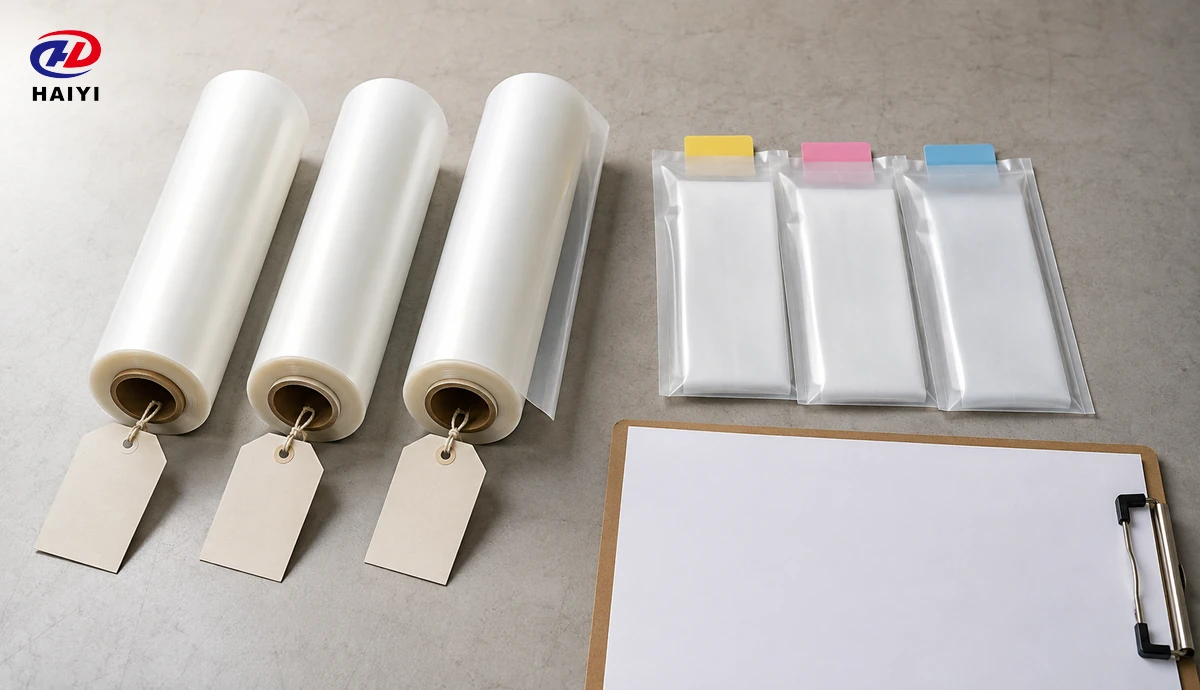
The shipment section should record the purchase order reference, production lot number, relevant production date or date range, and the rolls or quantity covered. If a delivery contains several production lots, each lot needs a separate result set or a clearly mapped certificate section. One shipment number alone cannot show which rolls are represented by a particular sample.
The traceability section should connect finished roll identifiers to the tested manufacturing lot through an accessible record. A slit roll may have a different identifier from its parent jumbo roll, so a mapping reference is more useful than assuming the numbers match. Buyers do not necessarily need confidential production details, but they need a reliable route for investigating affected material.
How should specifications, actual results, and units be presented?
Each numerical COA row should state the characteristic, approved limit or range, test method revision, unit, measured result, and conformity decision where required. A single value without a limit describes a measurement but does not explain acceptance. Conversely, a limit without a result describes the requirement but provides no evidence that the current batch met it.
DTF film COA results should distinguish averages, minimums, maximums, and individual readings rather than presenting every number as an unspecified result. An average can hide local variation that affects printing or feeding. When uniformity matters, the certificate should summarize the spread and refer to the underlying position data, so buyers can understand whether acceptable averages conceal unacceptable extremes.
Measurement units should remain explicit and consistent throughout the COA. Micrometers for thickness, millimeters for width, grams per square meter for coating mass, and force per defined specimen width describe different quantities. A number copied into the wrong unit column can look plausible while changing its meaning, so conversions and rounding should follow the agreed reporting convention.
Which physical film properties should the COA cover?
Should thickness refer to the PET base or the finished film?
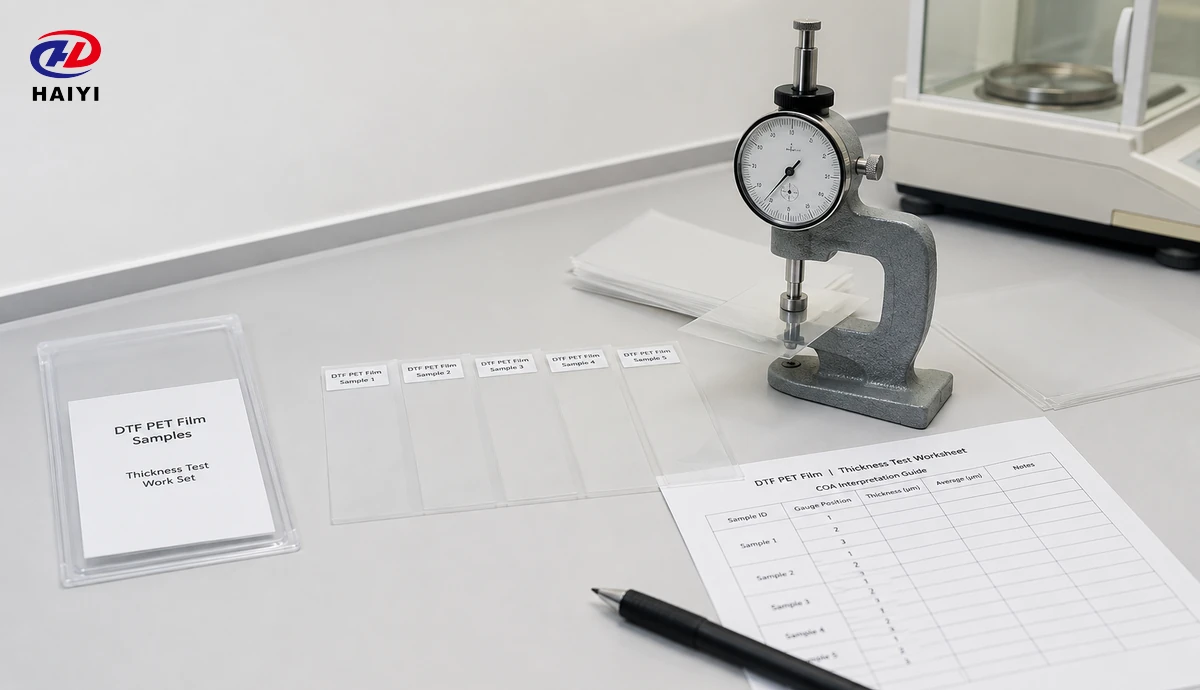
The thickness row should identify whether the result describes uncoated PET substrate, total coated film, or another defined construction. These measurements are not interchangeable because the finished film includes coating layers. The report should specify the measuring method and sampled positions; a nominal base film thickness alone does not establish the thickness variation of the delivered coated product.
How should width, length, and roll format be documented?
Width and length information should separate nominal ordered dimensions from verified results and production-record declarations. A length derived from a calibrated winding counter is different from direct measurement of every delivered roll. Core size, winding direction, splice allowance, and usable width can be referenced to the product specification, with exceptions listed clearly instead of silently changing the supplied format.
Does coating weight belong on every COA?
Coating weight belongs on a DTF film COA when the supplier and buyer have agreed on a meaningful, controlled method and reporting scope. The row should distinguish dry coating mass from wet application mass and identify the layer or combined coating measured. The guide to measuring coating weight and uniformity explains why an undefined mass difference cannot automatically be assigned to one functional layer.
How should performance tests be recorded without overstating the evidence?
Performance rows should identify both the film and the test system because transfer behavior depends on interacting materials and settings. A result from blank film handling is different from a result after printing, powder application, curing, pressing, and peeling. A COA should say which sequence was evaluated instead of presenting a system-level result as an intrinsic film property.
A release-force entry should reference the specimen width, peel angle, peel speed, temperature or cooling condition, and the relevant transfer construction. Force results obtained under different conditions are not automatically comparable. Buyers needing the measurement details can consult DTF film release-force testing methods; the COA itself should preserve the conditions needed to interpret the reported value.
A heat-shrinkage entry should show machine-direction and transverse-direction results separately, with exposure temperature, duration, heating environment, specimen restraint, and calculation convention referenced. Directional information matters because length and width changes can affect registration differently. The DTF PET film heat-shrinkage guide provides context for deciding which dimensional evidence belongs in a purchase specification.
Named test methods must match the procedure actually used. For example, ASTM D1204 addresses dimensional change under specified elevated-temperature conditions and distinguishes its air-heating approach from a liquid-medium method. A supplier-modified DTF production check should identify its own procedure and deviations, rather than implying that a familiar standard number validates a different test.
An antistatic performance entry should identify whether the measured quantity is surface resistance or surface resistivity, together with units, electrode arrangement, applied voltage, test duration, and conditioning. Humidity and test geometry affect interpretation, so a bare number cannot establish equivalent performance between laboratories. The surface-resistance testing guide helps buyers frame the required method details.
A print-and-transfer check should identify the approved test file, ink and powder references, process settings, fabric, peel timing, and assessment criteria. A visual pass should reference an approved defect scale or comparison sample instead of an undefined impression. Long-term washing or durability evidence should be labeled as lot testing or periodic qualification, because these are different levels of assurance.
What sampling and laboratory information makes results traceable?
The sampling record should identify the lot size, sampled roll count, sample identifiers, and relevant cross-web and roll-length locations. Multiple readings from one small coupon are not equivalent to samples from multiple rolls. Reporting the sampling structure helps a buyer distinguish measurement repeatability from evidence about variation across the shipment.
The testing record should provide the test date, laboratory or responsible department, method version, and conditioning conditions where relevant. Equipment identifiers and calibration references can remain in linked laboratory records rather than crowding the certificate. A traceable reference is preferable to an unsupported statement of calibration because it allows the underlying measurement history to be checked when needed.
The COA should state whether results came from finished rolls, a parent roll, in-process samples, or an external laboratory. These sources can all contribute useful evidence, but their coverage differs. A parent-roll result may support material properties while leaving slitting damage, winding defects, and final labeling to separate inspection records.
How should buyers interpret limits and borderline results?
Acceptance limits should be agreed before testing and linked to the approved product revision and intended process. A supplier target describes an operating aim, while a customer acceptance limit defines a release boundary. Changing the boundary after seeing results makes a pass difficult to interpret and weakens comparisons between successive deliveries.
A borderline COA result needs a documented decision rule, not selective rounding. Buyers should agree how measurement uncertainty and reporting resolution affect acceptance where those issues matter. For example, a displayed value at the limit may conceal additional decimal places; retaining the original reading and stated rule is more defensible than rounding solely to obtain a pass.
| Illustrative entry | Why the entry is weak | More useful reporting |
|---|---|---|
| Thickness: good | No quantity or acceptance boundary | Construction, method, units, limits, sample count and measured summary |
| Release: pass | Peel conditions and criteria are unknown | Method revision, transfer setup, results and defined assessment criteria |
| Shrinkage: 0.4% | Direction and heating conditions are missing | Separate directional results and the complete referenced exposure method |
| All properties typical | No current batch evidence is identified | Label reference values separately from actual lot measurements |
The example shrinkage number above is fictional and illustrates incomplete reporting only; it is neither a Haiyi result nor a recommended limit. Numeric examples become misleading when detached from their conditions. Buyers should therefore use placeholders in a supplier template until both parties approve the real method, reporting format, and application-specific acceptance criteria.
What should a reusable DTF film COA template contain?
A reusable COA template should keep product identity, batch coverage, results, and authorization in distinct sections. Separating these sections makes an incomplete document easier to detect than a mixed narrative report. The following template specifies information to request; it is not a completed certificate and must not be used as evidence that any material has passed testing.
DTF FILM CERTIFICATE OF ANALYSIS - FIELD TEMPLATE
Document number and revision:
Issue date and superseded document, if any:
Issuer, manufacturing entity and contact:
Customer and purchase order reference:
Product name, supplier SKU and customer SKU:
Film grade, peel type and supplied format:
Approved specification number and revision:
Production lot and production date range:
Covered roll identifiers, quantities and packing-list reference:
Parent-roll mapping reference, where applicable:
Sampling plan, sample IDs and sampling locations:
Test dates, laboratory and method revisions:
Conditioning and applicable process setup references:

RESULTS - REPEAT FOR EACH AGREED CHARACTERISTIC
Characteristic and construction or surface tested:
Method and revision:
Unit and acceptance limits:
Actual result, sample count and summary type:
Individual data or inspection-record reference:
Decision rule and conformity conclusion:
Evidence type: current lot / periodic / declared / not tested:
Deviation or exception reference:

DISPOSITION AND AUTHORIZATION
Lot disposition and any approved limitations:
Authorized reviewer, role and approval record:
Release date:
Retained sample and record retrieval reference:
Storage guidance document and applicable validity basis:
Attachments, page numbering and document verification contact:
Not every template field needs to appear in full on the front page. A controlled attachment can hold detailed readings, sampling maps, and process settings if the COA identifies the attachment and its revision. A missing attachment is different from a concise certificate, however, so buyers should verify that referenced evidence is actually available.
Who should approve the COA, and how should corrections be controlled?
Supplier qualification should confirm who owns certificate preparation, data review, and customer queries before routine deliveries begin. The DTF film supplier audit checklist can support that discussion. A documented responsibility chain is more dependable than a single sales contact because technical questions and correction requests need access to the original quality records.
The COA should identify an authorized reviewer, approval date, and a verifiable approval record. A handwritten signature is not inherently more reliable than controlled electronic authorization; the important issue is whether the responsible issuer can confirm the document. Approval should follow review of the stated evidence rather than simply adding a sales stamp to an unverified table.
A corrected COA should receive a revision identifier, explain the correction, and identify the document it replaces. Quietly overwriting a result breaks the audit trail and can leave different customers using different versions. The supplier should distinguish a transcription correction from a new test result, because the second change may require a renewed disposition decision.
A concession for out-of-specification material should be recorded separately from an ordinary pass. The record should identify affected rolls, the deviation, approved use restrictions, and customer authorization when required by the agreement. Commercial urgency does not turn a failed requirement into conformity; transparent exception handling allows the buyer to decide whether restricted use is acceptable.
How should a distributor review a COA before releasing inventory?
A distributor should first match the COA to the purchase order, packing list, roll labels, and approved product revision. Identity checks come before numerical review because accurate results from the wrong lot cannot support the delivered goods. Mixed lots, missing roll mappings, or mismatched SKU codes should trigger clarification before the inventory is released.
The next review should check required result rows, units, method revisions, limits, and exceptions against the agreed specification. Missing data should be labeled and investigated, not interpreted as a pass. If the supplier provides an older qualification report instead of a current batch result, the buyer should decide whether that evidence satisfies the previously agreed testing frequency.
Incoming verification should remain proportionate to supplier history, application risk, and shipment condition. A COA supports receiving decisions but cannot reveal transport damage that occurred after testing. Buyers can use the two-batch DTF film comparison workflow when a result trend or production trial suggests that the new lot behaves differently from the approved reference.

What should buyers do when supplier and incoming results disagree?
A result discrepancy should first trigger a comparability check covering sample identity, conditioning, equipment, method revision, units, and calculation. Different procedures can produce different values without proving that either laboratory acted incorrectly. Comparing retained split samples under an agreed method is more informative than comparing unrelated coupons tested under different environments.
A retest should follow a written plan that preserves original data and defines who reviews the combined evidence. Repeating measurements until one passes conceals the initial concern instead of resolving it. If disagreement remains, the buyer and supplier can agree on an independent laboratory, sample custody, decision rule, and disposition route before additional material is consumed.
Which questions commonly arise about DTF film COAs?
Can one COA cover a private-label shipment?
One COA can cover a private-label shipment when every covered lot and customer SKU remains traceable to its results. Relabeling should not erase manufacturing identity. The private-label DTF film guide explains the commercial workflow; the quality document still needs a controlled mapping between branded stock and production records.
Does a COA replace compliance documentation?
A routine film COA should not be treated as a substitute for any separately required compliance evidence. Batch measurements and market-specific declarations answer different questions. Buyers should request the documents relevant to their product and destination separately, and verify their scope instead of assuming a quality-control pass supports every chemical or end-use claim.
Does a COA have an automatic expiry date?
A COA records evidence from stated dates; product usability depends on the applicable storage and shelf-life basis rather than a universal certificate expiry period. A later reprint of the document does not refresh the film. Buyers should distinguish production date, test date, issue date, and any supported retest or shelf-life date.
How can buyers request a useful COA for wholesale or custom DTF film?
Wholesale buyers should send the intended application, film format, peel requirements, order volume, approved process window, and requested COA fields with the initial inquiry. Agreeing on documentation before the order is more effective than demanding unavailable measurements at shipment. Ask which checks are performed per lot, which are periodic, and which require a separately agreed test program.
Haiyi offers DTF film wholesale and customization services for distributors and printing businesses. To discuss a supply program, review Haiyi wholesale and OEM DTF film options and send your product specification, packaging needs, estimated purchasing volume, and COA template. Request confirmation of available documentation and sampling arrangements for the selected product rather than assuming every suggested field is routinely supplied.
A useful DTF film COA connects an identifiable shipment to understandable evidence and a controlled release decision. Product identity without results is incomplete, while results without methods and lot coverage are difficult to trust. For repeat B2B purchasing, define the certificate together with the product specification so each delivery can be evaluated consistently.