




Water-Based DTF Film: What the Claim Means and How to Verify It
Learn what water-based DTF film means, which environmental claims require evidence, and how to verify coating, documents, and production performance.

Reading time: 7 minutes
Water-based DTF film normally means that water is the primary carrier or dispersion medium in part of the film’s wet coating process. The phrase does not automatically mean the finished PET film is biodegradable, compostable, bio-based, solvent-free, zero-VOC, recyclable in every local system, or environmentally superior across its full life cycle.
Buyers should treat “water-based” as a technical formulation statement that needs a defined scope and supporting evidence. Film performance, worker safety, restricted substances, emissions, packaging, manufacturing efficiency, durability, and end-of-life are separate questions.
What is water-based DTF film?
Water-based DTF film is PET carrier film with one or more functional layers produced using a waterborne coating system. The coating controls ink reception, dot shape, powder interaction, drying, release, and transfer appearance. Water serves as a major liquid carrier during application and is removed during controlled drying.
The finished product is still a layered material. Its environmental profile depends on the PET base, coating ingredients, process energy, waste, packaging, transport, use efficiency, and disposal route. The term “water-based” describes neither the complete chemistry nor the total impact.
How is water-based different from oil-based DTF film?
Market labels such as water-based and oil-based are not always standardized product categories. Suppliers may use them to describe coating solvents, resin systems, manufacturing routes, or simplified product families. Buyers should ask what layer and process the label actually covers.
| Buyer question | Water-based label can indicate | What it does not prove alone |
|---|---|---|
| What carries the coating during application? | Water is a main dispersion or carrier medium | Complete absence of every organic co-solvent or additive |
| What remains after drying? | A functional coating designed for DTF ink and release | That the dried coating is water-soluble or biodegradable |
| What is the base film? | Usually PET in a conventional DTF construction | That the carrier is bio-based, compostable, or locally recyclable |
| Is the process safer or lower impact? | It may reduce reliance on some solvent systems | A verified emission, toxicity, carbon, or life-cycle advantage |
| Will it print better? | It can be engineered for strong ink reception | Compatibility with every ink, printer, powder, or process |
Haiyi’s water-based versus oil-based DTF film guide compares the terms in more detail. The practical rule is to compare supplier definitions, documents, and production samples instead of deciding from the label.
How is a waterborne DTF coating made?
A waterborne coating is prepared as a controlled dispersion containing film-forming and functional ingredients. The formulation is applied to PET, leveled, dried, and conditioned to form a consistent ink-receiving or release layer. The exact construction can contain more than one layer and varies by product design.
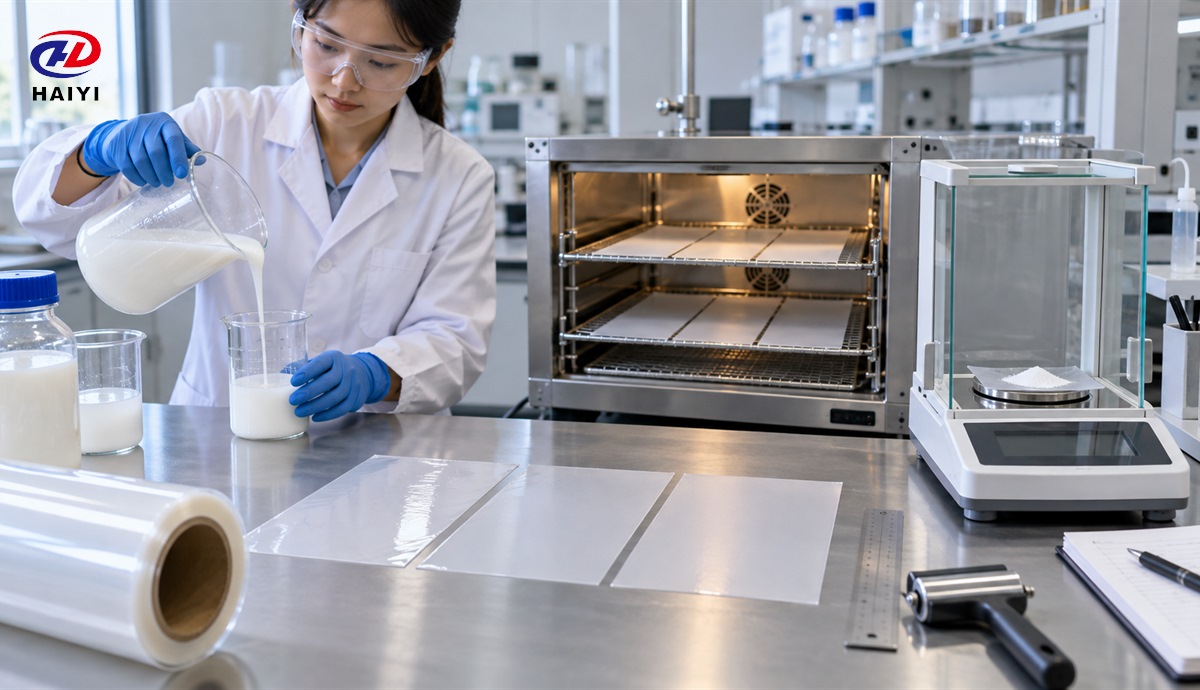
Production quality depends on dispersion stability, filtration, coating weight, web tension, drying profile, line speed, surface treatment, and winding. Water removal requires controlled heat and airflow. A waterborne formula that is not dried or crosslinked correctly can create blocking, curl, inconsistent ink absorption, moisture sensitivity, or release variation.
Does water-based mean solvent-free or zero VOC?
No. A water-based formulation may still contain co-solvents, surfactants, defoamers, preservatives, crosslinkers, and other additives. The presence and amount depend on the formulation. Only supplier composition data and an appropriate test can support a solvent or VOC claim.
Ask whether a claim refers to the wet coating, the manufacturing emissions, or the finished film. Also ask which definition, test method, reporting limit, and regulatory jurisdiction apply. “Low odor” is not a measurement of VOC content, and “water cleanup” is not proof of zero hazardous substances.
Does water-based DTF film mean biodegradable?
No. A waterborne coating and a biodegradable finished film are different claims. Conventional PET does not become biodegradable merely because a coating was dispersed in water. Biodegradable, compostable, and bio-based are also different terms and require defined materials, conditions, standards, and evidence.
Do not publish or print disposal claims unless the supplier can identify the tested product construction and the applicable standard. A result for one coating ingredient cannot automatically be applied to the complete film roll, liner, adhesive, ink, transfer, garment, or package.
What environmental evidence should a buyer request?
A buyer should request evidence that matches the intended claim and market. Useful documents may include a technical data sheet, safety data sheet, restricted-substance declaration, test report from a competent laboratory, manufacturing or emissions data, packaging specification, and material composition statement. The exact documents depend on the buyer’s jurisdiction and customer requirements.
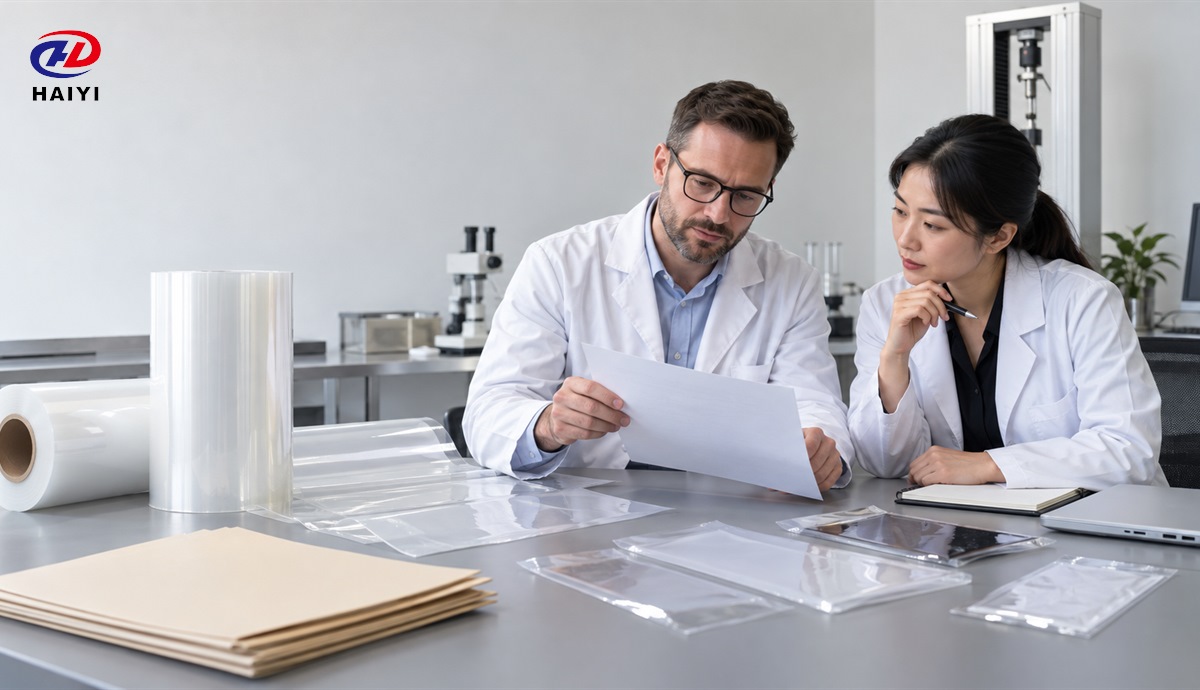
Check that every document identifies the supplier or manufacturer, product, version, date, batch or scope, test method, result, unit, laboratory, and pass criteria where applicable. A generic certificate, expired report, ingredient-level result, or document for a different film construction should not support a finished-product claim.
Haiyi’s DTF film certificate of analysis checklist explains how lot-specific quality evidence differs from broader compliance or environmental documentation.
Which claims require special caution?
| Claim | Evidence question | Common overreach |
|---|---|---|
| Water-based | Which layer and which liquid system does the term describe? | Applying the term to the entire life cycle |
| Solvent-free | What definition and detection method were used? | Assuming water as the main carrier means no organic substances |
| Low VOC | Which method, unit, product state, and legal framework apply? | Using odor as proof |
| Biodegradable or compostable | Which complete construction passed which standard and conditions? | Extending an ingredient claim to PET film |
| Recyclable | Is the complete material accepted in the buyer’s actual collection system? | Treating technical recyclability as local availability |
| Eco-friendly or green | Which measurable impact is improved and against what baseline? | Using a broad claim without scope or evidence |
How should water-based DTF film performance be tested?
A water-based coating must still satisfy the same production requirements as any approved DTF film. The film should feed consistently, receive CMYK and white ink without uncontrolled spreading, hold powder where intended, survive curing, release in the specified peel window, transfer cleanly, and meet wash and use requirements.
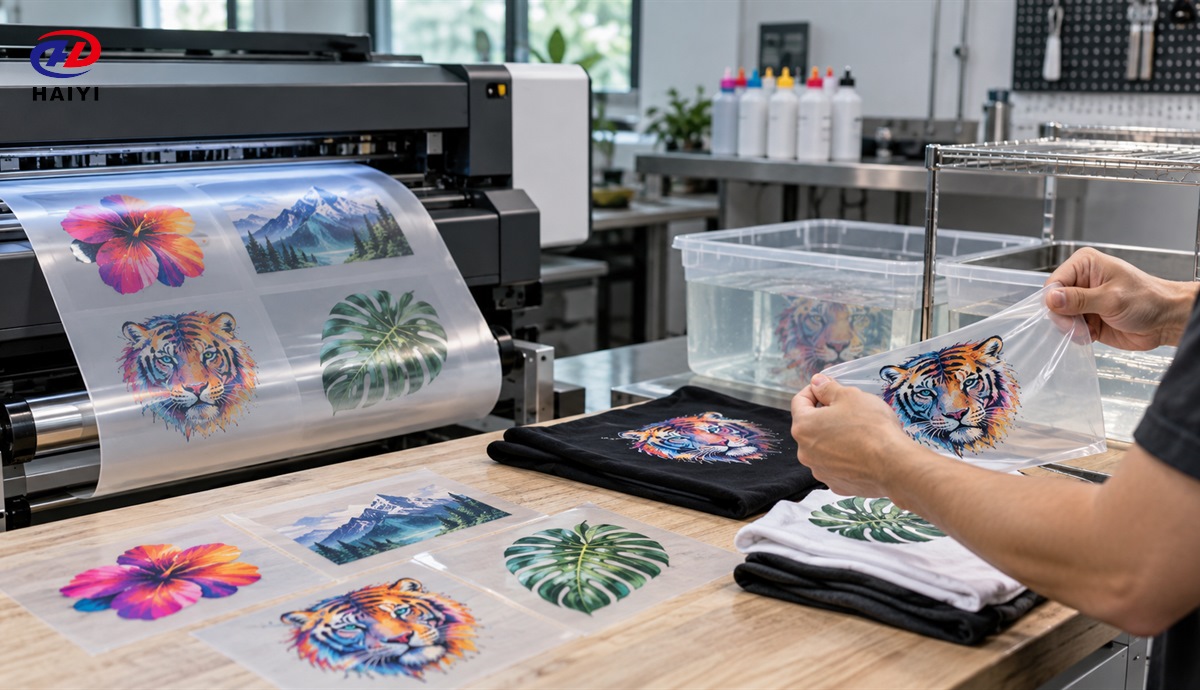
- Confirm roll dimensions, core, winding, printing side, surface condition, and lot identity.
- Test film feeding, curl, static, flatness, and head-clearance behavior.
- Print representative fine detail, gradients, solid color, and heavy white areas.
- Inspect dot control, drying, powder pickup, blank-area cleanliness, and cure.
- Press on the actual cotton, polyester, blend, stretch, or coated garments.
- Verify the specified hot, warm, or cold peel window.
- Evaluate appearance, hand, stretch, adhesion, wash, and repeat-lot consistency.
The test should use the buyer’s actual ink and powder because a coating that works with one combination may not behave the same with another. Use Haiyi’s compatibility sample protocol to document the system.
Can durability be an environmental factor?
Durability can influence material efficiency because transfers that fail early create reprints, garment waste, returns, and extra transport. However, durability alone does not prove a product has a lower total environmental impact. It is one factor in a wider assessment.
Compare the accepted-piece rate, film waste, rejected transfers, energy needed for drying and pressing, packaging, and expected service life. Avoid a narrow claim that ignores tradeoffs outside the coating formulation.
How should distributors describe water-based DTF film?
Distributors should use specific, supportable language. A careful statement identifies the layer and process, such as “PET DTF film produced with a waterborne ink-receiving coating,” when supplier evidence supports it. The description should separately list verified performance, safety, or compliance results.
Avoid unqualified terms such as completely green, non-toxic, zero pollution, earth-safe, or fully biodegradable. Claims must remain accurate after translation and private labeling. Keep the supplier evidence and version history behind every published statement.
What should be included in a water-based film RFQ?
An RFQ should state the intended water-based claim, market, film width and roll length, PET thickness, peel behavior, single- or double-sided treatment, printer and ink system, powder, cure equipment, garments, performance tests, restricted-substance requirements, document list, packaging, private-label language, and batch-traceability expectations.
Ask the supplier to mark which statements are formulation facts, measured production results, third-party test results, or marketing descriptions. This distinction reduces compliance risk for the distributor.
Häufig gestellte Fragen
Is water-based DTF film safer than oil-based film?
The label alone cannot answer that question. Safety depends on the complete ingredients, exposure route, manufacturing controls, use, and applicable documents. Compare SDS and regulatory evidence for the exact products.
Can water-based DTF film be recycled?
Recycling depends on the complete film construction and the collection and processing system available in the buyer’s location. A waterborne coating does not automatically make coated PET accepted by local recyclers.
Does water-based coating improve print quality?
A waterborne coating can be engineered for strong DTF performance, but the carrier medium does not guarantee quality. Coating formulation, weight, uniformity, drying, film treatment, storage, and compatibility determine the result.
Discuss verifiable water-based DTF film requirements with Haiyi
Haiyi supplies wholesale and customizable DTF film for distributors, print shops, and private-label programs. B2B buyers can request product documentation and samples for their printer, ink, powder, curing, press, peel, garment, packaging, and market requirements. Review Haiyi’s DTF coating-weight and uniformity guide or Kontaktieren Sie Haiyi with the exact claim and evidence your market requires.