







DTF Gang Sheet Layout: How to Improve Film Utilization and Reduce Waste
Improve DTF gang sheet layouts with verified print areas, practical spacing, order grouping, worked utilization calculations, and a repeatable waste review.

Geschätzte Lesezeit: 13 Minuten
A DTF gang sheet layout improves film utilization when multiple approved designs share the usable print area while retaining enough space for cutting, handling, and order identification. The objective is to produce the required accepted transfers with less consumed film and manageable labor. A visually dense arrangement only saves money when its output remains printable, separable, correctly counted, and useful to the customer.
For transfer shops and DTF film distributors, reliable waste reduction starts with four controls: correct artwork dimensions, verified printable width, practical separation rules, and compatible order grouping. These controls prevent a common mistake: optimizing the screen preview while ignoring margins, startup film, sorting errors, or reprints. Film utilization should therefore be measured across the production workflow as well as inside the layout.
This guide focuses on layout decisions, a worked planning example, and a repeatable improvement process. The example dimensions and costs are illustrative assumptions rather than equipment settings, Haiyi test results, or universal performance targets. Readers needing a broader cost framework can use the DTF printing cost per transfer guide alongside the layout calculations.
What is a DTF gang sheet, and which designs can share it?
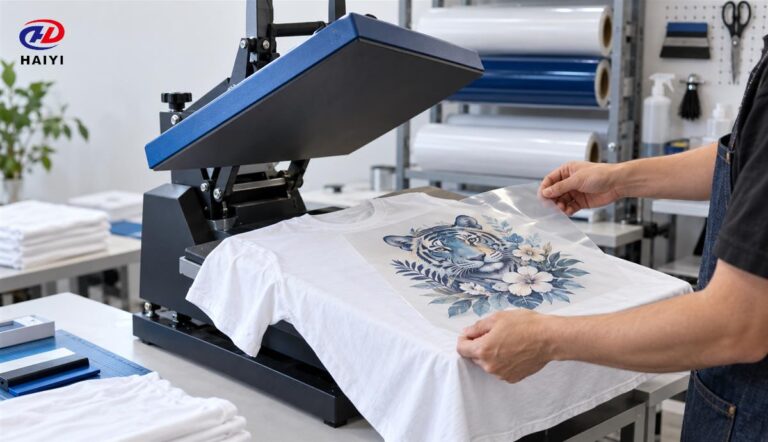
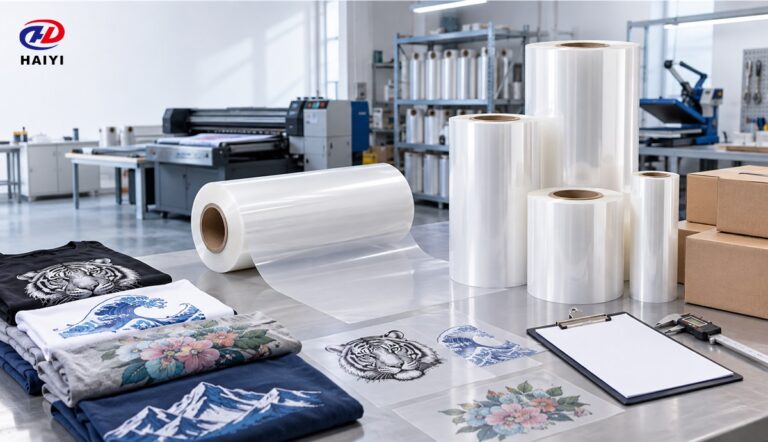
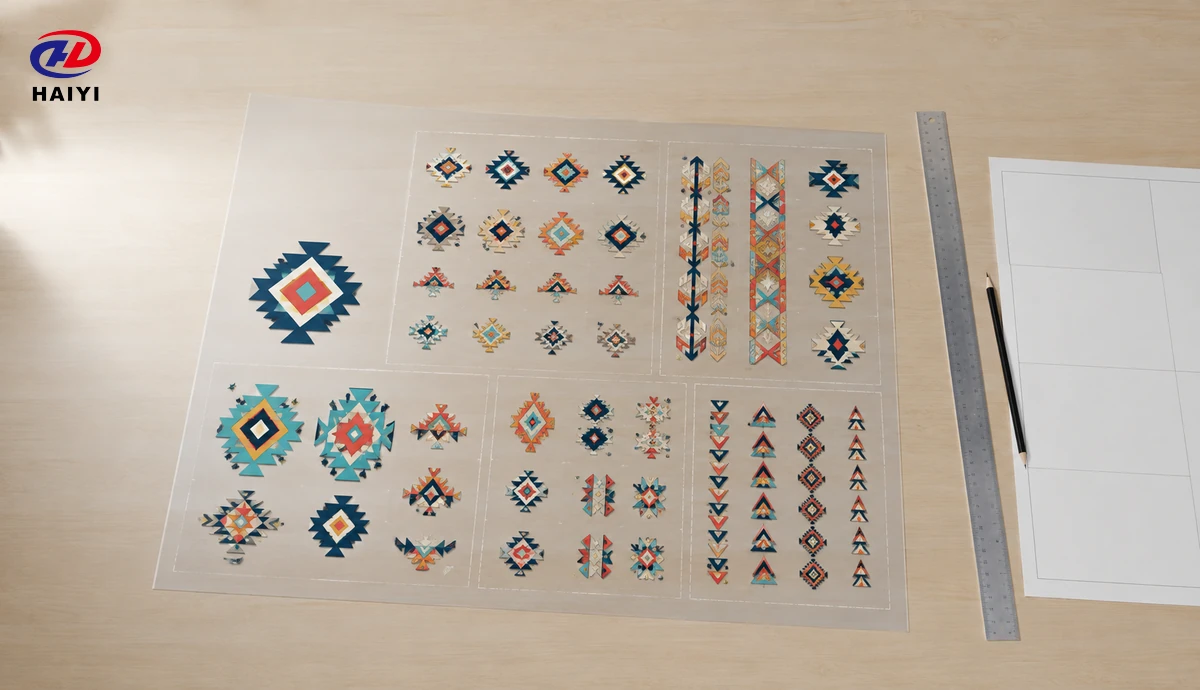
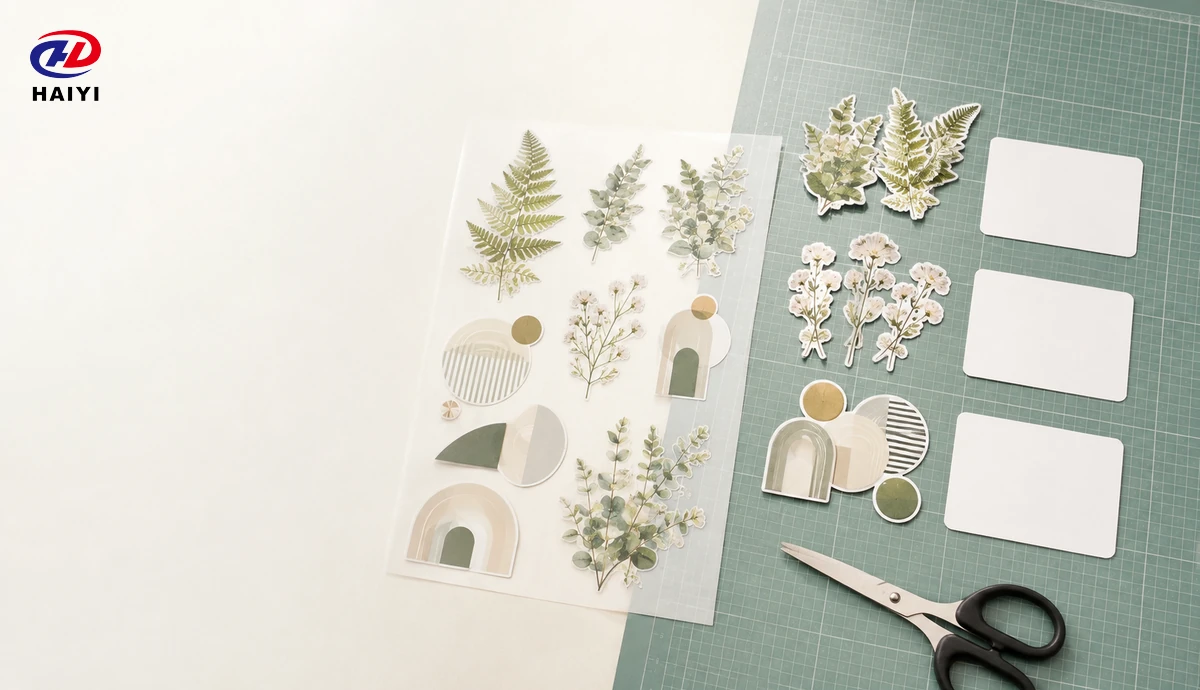
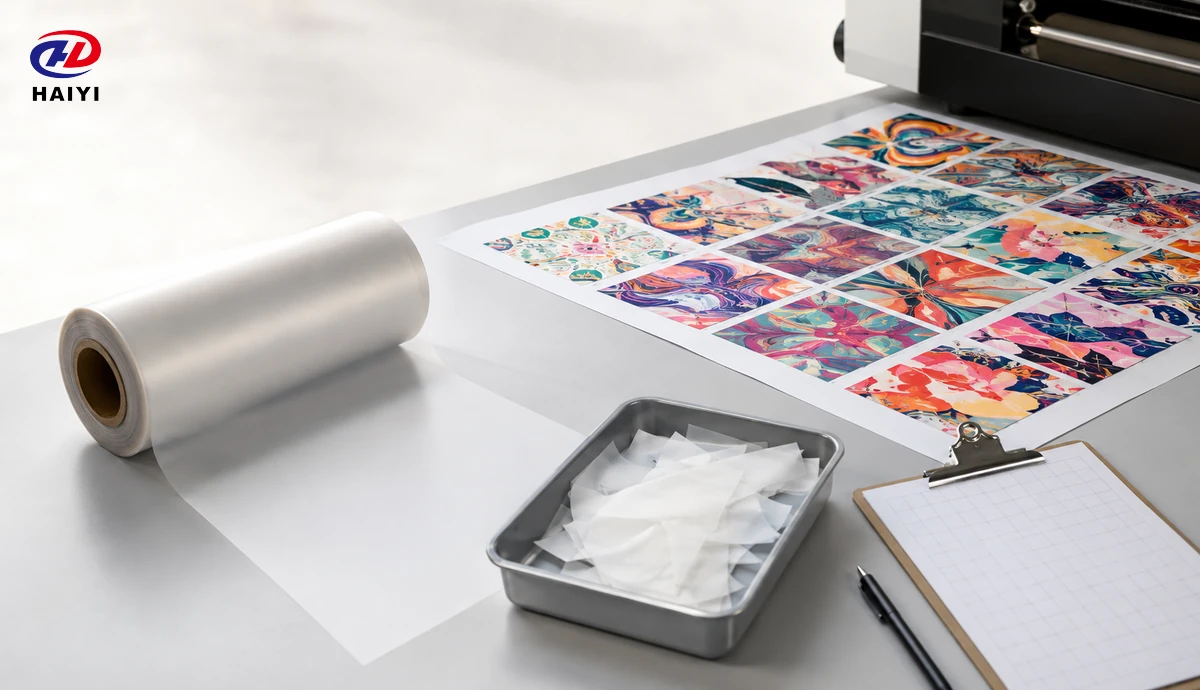
A DTF gang sheet combines several transfer designs, sizes, or copies into one print layout on coated PET film. The printed sheet or roll section is normally separated into the pieces needed for application or delivery. Combining work reduces empty space when shapes complement each other, but the arrangement must preserve the approved artwork scale and each order quantity.
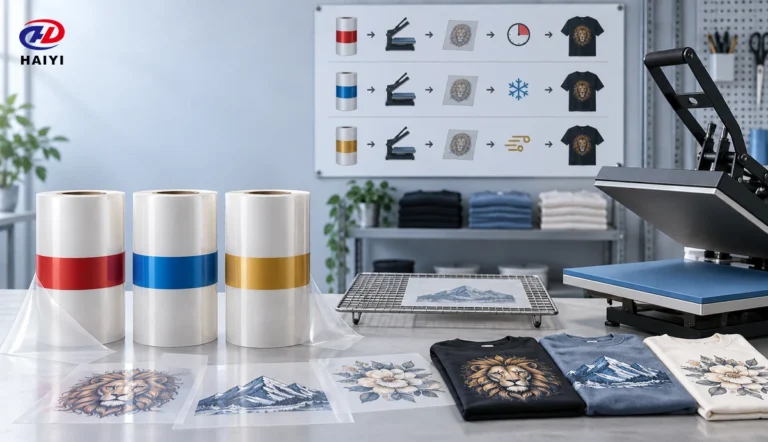
Designs should share a gang sheet only when their printing and downstream processing requirements are compatible. Jobs needing the same film, print configuration, powder, curing workflow, and delivery route are easier to combine than jobs needing different settings. Similar artwork colors alone do not establish compatibility because the required process and fulfillment conditions determine whether grouping is practical.
Order grouping should also respect deadlines and artwork approval status. Waiting for an uncertain design to fill a small gap can delay every ready order on the sheet. A planned batching cutoff balances material savings against delivery commitments and allows operators to release a slightly less dense layout when further waiting would create a larger business cost.
How should film utilization be measured?
Layout utilization needs an explicit numerator and denominator because different definitions produce different percentages. For straightforward rectangular planning, divide the combined area of the defined artwork bounding boxes by the usable layout area. A bounding box encloses the complete design, including intentional internal openings; this measure describes packing efficiency rather than ink coverage.
Gross film utilization uses the total film area consumed, including unusable margins and relevant feed allowances, as the denominator. The same design arrangement can therefore have a high usable-area occupancy but a lower gross-film figure. Keeping both numbers visible separates choices about nesting from losses associated with machine setup, roll handling, and production interruptions.
| Measure | Calculation basis | What it helps evaluate |
|---|---|---|
| Layout occupancy | Defined artwork box area / usable layout area | How efficiently the permitted canvas is packed |
| Gross film occupancy | Defined artwork box area / total film area consumed | The effect of margins, feed allowances and empty sections |
| Accepted transfers per meter | Accepted required pieces / consumed linear meters | Output efficiency for a comparable order mix |
| Film cost per accepted transfer | Consumed film cost / accepted required pieces | Material cost after rejects and other consumption |
Utilization comparisons should hold the required design mix and piece sizes constant. A batch of tiny logos naturally produces more pieces per meter than large front prints, even without better nesting. Comparing unlike jobs can reward a favorable order mix instead of a real layout improvement, so record dimensions and quantities with every trial.
True-shape nesting requires an additional measurement convention because design bounding rectangles may overlap even when printed shapes remain separate. Summing overlapping box areas can exaggerate occupancy. For irregular nesting, report a consistently defined shape or occupied-region measure, or compare consumed film for the identical job set; do not compare an undefined shape percentage with rectangular box occupancy.
How do you establish the usable print area?
Usable print width should come from the actual printer configuration, loaded film, required side clearances, and any reserved control areas. Nominal roll width is the physical material width, while printable width can be smaller. Building the canvas from the roll label alone risks clipping designs or moving artwork into regions that the production setup cannot use reliably.
Usable length should account for the planned output format and any top or bottom allowances. A continuous roll job may need leading and trailing feed sections that differ from the margins inside each gang sheet. Record these allowances separately to avoid counting them twice or presenting a theoretical layout length as the full film consumption.
Film width selection should follow verified machine and workflow compatibility before nesting convenience. A wider roll can accommodate more arrangements, but it may leave larger unused strips when the order mix is narrow or the printer cannot use its full width. The DTF film roll buying guide provides a starting point for discussing format, with final dimensions checked against the actual equipment.
What artwork checks prevent avoidable layout waste?
Artwork dimensions should be confirmed at the final transfer size before duplication or nesting. A file that appears small in the preview may contain an oversized transparent canvas, while an imported image may be scaled unexpectedly. Compare the displayed width and height with the approved order specification, because one incorrect master size becomes many incorrect transfers after repetition.
Transparent padding should be removed only when it is unnecessary to the approved design or placement workflow. Trimming empty borders can improve nesting without changing the visible artwork, whereas removing intended clear space between disconnected elements can alter registration or handling. Save the original and verify the trimmed file against the approved dimensions and composition.
Artwork preflight should also check effective image detail at final size, transparency, unintended background pixels, and the approved white-layer behavior. A dense layout cannot compensate for an artwork defect copied across the sheet. Inspect representative files before duplication so cleanup happens once rather than becoming a full-sheet reprint.
Mirroring should occur at one controlled stage in the approved DTF workflow. A file already mirrored upstream can be reversed again by an output setting, producing an incorrect transfer orientation. Confirm readable final garment orientation with the production preview or an approved test, and record which stage owns the transformation to prevent inconsistent operator assumptions.
How much space should remain between transfers?
Transfer spacing should be established by the actual cutting method, handling requirements, artwork shape, and validated production behavior. A gap that works for careful individual scissors cutting may be inconvenient for straight batch cuts or order separation. The practical minimum is the smallest tested clearance that preserves reliable cutting and handling for the intended operator and tools.
Spacing should be checked around the outermost transferable artwork, including isolated dots and fine details. Software may display an image boundary that differs from the visible artwork or the intended cut boundary. Define whether the selected setting controls box spacing, contour clearance, or another geometry so the operator knows what the reported gap actually represents.
Cutting lanes and handling tabs consume film but can reduce labor and damage. A slightly wider lane may permit one straight cut across several pieces, while tight irregular nesting may require slow individual cutting. Evaluate both film saved and finishing time before reducing clearance, especially when the customer expects separate, easy-to-position transfers.
Printed order marks and cutting guides should occupy an identified waste area and remain clear of the usable transfer. Unnecessary printed marks consume ink and can create unwanted transferable material if they reach the garment. An external packing label or a simple sheet map may provide identification without placing extra graphics beside every design.
Which nesting method works best for different jobs?
Repeated rectangular artwork often works well in aligned rows because counting and straight cutting remain simple. Mixed sizes can benefit from placing large items first and filling remaining strips with smaller approved jobs. The best sequence depends on the complete required set, so compare several arrangements rather than assuming the first automatic result is optimal.
Rotation can reduce layout length when a design and its handling requirements allow a different orientation. Turning a rectangular item changes its packing dimensions without requiring a change to final printed size. Keep orientation restrictions for directional media, established cutting workflows, or customer-specific handling, and validate any production effect rather than assuming every rotation is interchangeable.
Irregular or true-shape nesting can place complementary outlines closer together than rectangle-based nesting. The benefit depends on whether operators can separate the resulting shapes efficiently and preserve each complete transfer. A hollow region inside one design should not automatically receive another design if removing the inner piece would damage the outer transfer or make sorting unreliable.
Automatic nesting should be treated as a candidate layout that still needs inspection. Check quantity, overlap, clipping, spacing, orientation, labels, and final length before release. Software settings can optimize geometry within their rules, but they cannot infer an unrecorded deadline, customer grouping requirement, or difficult cutting sequence.
What does a realistic layout calculation look like?
Consider an illustrative job using 600 mm wide film with a verified 560 mm usable width. The order requires twenty identical artwork boxes measuring 100 mm by 140 mm. For this example only, the layout uses 10 mm between boxes, with 20 mm leading and trailing allowances; these figures demonstrate arithmetic and are not recommended machine settings.
In arrangement A, five 100 mm wide boxes fit across the usable width because five widths plus four gaps equal 540 mm. Four rows satisfy the twenty-piece order. The rows occupy 590 mm of length, calculated as four times 140 mm plus three 10 mm gaps; adding the two end allowances gives 630 mm of consumed film.
In arrangement B, rotating every box places 140 mm across the width and 100 mm along the feed direction. Only three fit across because four widths plus three gaps would require 590 mm. Seven rows are needed for twenty pieces, giving 760 mm of occupied length and 800 mm with the end allowances; the last row contains two pieces.
| Illustrative result | Arrangement A | Arrangement B |
|---|---|---|
| Across by rows | 5 by 4 | 3 by 7, final row partly filled |
| Required pieces | 20 | 20 |
| Consumed length with stated allowances | 630 mm | 800 mm |
| Consumed film area at 600 mm width | 0.378 square meters | 0.480 square meters |
| Artwork box area / consumed film area | 74.1% | 58.3% |
Arrangement A uses 0.102 square meters less film than arrangement B for the same twenty pieces, a 21.25% reduction relative to B. The calculation demonstrates why orientation should be compared rather than universally enabled. It does not prove that A is the best possible mixed-orientation layout or that another order mix will achieve the same saving.
If the illustrative film price is 2.00 currency units per square meter, film costs are 0.756 for A and 0.960 for B before other losses. Divide each cost by accepted required pieces to obtain the film component per transfer. Actual accounting should add startup sections, test output, and reprints when those are consumed outside the stated example.
How can mixed orders fill gaps without creating new waste?
A controlled filler queue can hold approved small designs with known quantities, compatible settings, and suitable deadlines. These jobs can occupy strips left beside larger transfers, increasing useful output without extending the run. Printing speculative extras merely to fill space increases visual density but can consume ink, powder, handling time, and storage without producing required sales output.
Mixed-order layouts should preserve a clear count and location map for each customer. Grouping all designs by shape may save film but scatter similar items across the sheet, increasing sorting errors. For busy fulfillment teams, modest customer zones or labeled batches can provide better total productivity than a maximally interlocked arrangement.
Order cutoffs should specify when a layout is frozen and how late additions are handled. Reopening a released file can change dimensions, quantities, or nesting unexpectedly. A revision identifier and saved preview let operators confirm that the printed file matches the approved job list and provide a reliable reference if a partial reprint is needed.
How do film condition and process stability affect utilization?
Film utilization falls when otherwise efficient layouts produce rejected transfers through feeding, contamination, or processing problems. Increasing nesting density cannot correct those causes. Keep the film grade and validated process consistent during layout comparisons, and use the DTF film handling checklist to review routine loading and handling practices that can influence usable output.
Powder remaining in unwanted areas can increase trimming work or cause rejected transfers. Tightening gaps may make this problem harder to manage without addressing its cause. The DTF film surface-resistance guide explains one relevant material characteristic, but actual powder behavior should be evaluated with the full film, environment, and production setup.
Dimensional change can affect planned cut locations and consistency when the film passes through heat. A layout designed from nominal dimensions should be checked after the actual processing sequence before close clearances become standard. The DTF PET film heat-shrinkage guide provides context for discussing dimensional behavior without assuming one correction factor applies to every film.
How should a shop test whether a denser layout is better?
A useful trial compares two layouts for the same approved job set under comparable production conditions. Record film width, consumed length, accepted quantities, rejects, cutting time, sorting time, and any reprints. A comparison based only on the preview can miss a layout that saves a small amount of material while adding more finishing labor than the saving is worth.
Trial records should identify why material was lost. Separate unused margins, empty nesting space, setup or feed sections, artwork errors, process rejects, cutting damage, and sorting mistakes. These categories lead to different corrective actions, while one combined waste percentage can encourage repeated layout changes when the main loss actually comes from another step.
Production comparisons should also preserve film lot identity. If the material changes between trials, a different rejection rate may be attributed incorrectly to the layout. The two-batch film comparison workflow can support a separate material evaluation when a new lot appears to behave differently.
What should a reusable gang sheet release checklist contain?
A release checklist should verify the product requirements and production constraints before the file enters the print queue. Consistent checks are particularly useful when several operators prepare layouts. The following record makes the key assumptions visible so the printed result can be compared with the intended job instead of relying on memory.
DTF GANG SHEET RELEASE RECORD
Job group, file revision and operator:
Approved artwork references and final dimensions:
Required quantities by design and customer:
Film grade, lot and loaded width:
Verified printable width and reserved margins:
Print configuration and mirroring responsibility:
Permitted rotations and nesting method:
Transfer clearances, cut lanes and handling areas:
Customer zones, identification and sorting map:
Final layout length and additional feed allowances:
Preview checked for overlap, clipping and stray pixels:
Release time, deadline and approved output file:

POST-RUN REVIEW
Actual film length consumed:
Accepted required pieces by design:
Reject and reprint quantities with causes:
Cutting, sorting and packing time:
Film cost per accepted transfer:
Changes recommended for the next comparable job:
Which common questions affect daily layout decisions?
Does higher layout occupancy mean higher ink consumption?
Layout occupancy and ink consumption describe different quantities. Moving the same approved designs closer together usually changes the film length without changing the intended printed artwork area. Adding extra designs changes both output and consumable demand. Keep artwork coverage and print settings consistent when estimating savings, so reduced film consumption is not confused with an unrelated ink reduction.
Should a damaged transfer trigger a complete sheet reprint?
A reprint should normally cover the identified shortage after accepted pieces are counted. A saved layout map helps isolate the missing design and quantity. Reprinting the entire group can create surplus stock and hide the true cost of the original defect.
Should every gang sheet reach the same utilization target?
A single utilization target is unsuitable for every artwork mix and delivery requirement. Large irregular designs, small repeated logos, and customer-separated sets create different packing opportunities. Establish a baseline for comparable work and improve that baseline while tracking accepted output and labor, rather than forcing every job toward one unsupported percentage.
Can every empty film area be reused later?
An empty region inside processed film is not automatically suitable for another printing pass. Feeding condition, coating exposure, contamination, and equipment handling requirements determine whether reuse is practical. Prevent avoidable empty regions during planning instead of including hypothetical reuse in the savings calculation; count material as recovered only when an approved process actually produces usable output.
How can wholesale film purchasing support efficient gang sheets?
Wholesale buyers should evaluate film format against their actual order mix, usable printer width, handling needs, and accepted yield. Comparing purchase price alone can overlook costly rejects or inconvenient roll formats. Share representative artwork sizes and monthly consumption estimates with the supplier so sample trials can reflect the production work the film will support.
Haiyi provides DTF film wholesale and customization services for distributors and printing businesses. Review Haiyi wholesale and OEM film options and send your required width, roll format, peel requirements, estimated volume, and packaging needs. Ask the team to confirm available specifications and sample arrangements for your production setup before committing to a larger order.
Distributors building a branded supply program can also review private label DTF film services and include their preferred product labels and carton information in the inquiry. Combine purchasing decisions with measured layout trials so the selected film supports both reliable transfers and a practical production workflow.