





Water-Based vs Oil-Based DTF Film: What Buyers Should Compare
Water-based and oil-based DTF film are not standardized product classes. Learn what the labels may mean and which measurable tests buyers should use instead.

Water-based and oil-based DTF film are not universally standardized product classes, so neither label is automatically better. In standard textile direct-to-film printing, the ink is normally a water-based pigment ink, while the film is a PET carrier with functional coatings. When a supplier describes a film as "water-based" or "oil-based," the description usually refers to the coating formulation or coating-production route, not to the PET itself and not necessarily to the ink that the printer should use. A buyer should therefore treat the label as the start of a technical discussion, not as proof of print quality.
The most reliable purchasing decision compares measurable outcomes: ink reception, coating uniformity, release force, heat stability, static behavior, finished-transfer durability, batch consistency, documentation, and usable cost. A film that performs consistently with a specific printer, ink, powder, curing system, press, and fabric is the better film for that production line, regardless of the shorthand name printed on the carton.
What does "water-based DTF film" actually mean?
A "water-based DTF film" normally means that water is the main liquid carrier used to apply one or more functional coating layers during film manufacture. The water evaporates during controlled drying, leaving polymeric and functional solids on the PET surface. The finished roll is not a roll of wet, water-soluble material; it is a dry coated film engineered to receive liquid DTF ink, retain printed detail, interact with hot-melt powder, and release the transfer under specified heat and peel conditions.
The phrase "water-based film" can cause confusion because standard textile DTF ink is also commonly water-based pigment ink. The ink chemistry and the coating-production chemistry are related through wetting and absorption, but they are not the same specification. A buyer who hears "water-based" should ask whether the supplier means the ink-receptive coating, the release coating, every coating layer, or simply compatibility with standard DTF pigment ink.
What does "oil-based DTF film" actually mean?
An "oil-based DTF film" is an informal market term that may refer to a solvent-borne, resin-rich, or otherwise non-aqueous coating system used during manufacture. The label does not mean that operators should load oil-based ink into a standard textile DTF printer. It also does not establish a universal chemical formula, layer count, peel behavior, surface gloss, or durability level because suppliers may use the same phrase for materially different coating systems.
A buyer should ask the supplier to define the term in writing. A useful definition identifies which layer is being described, what liquid carrier or resin family is involved, which DTF inks the film is designed to receive, what peel window is validated, and which test results support the claimed benefit. If a supplier cannot connect the label to a technical data sheet and repeatable sample results, the label has little procurement value.
How is DTF transfer film constructed?
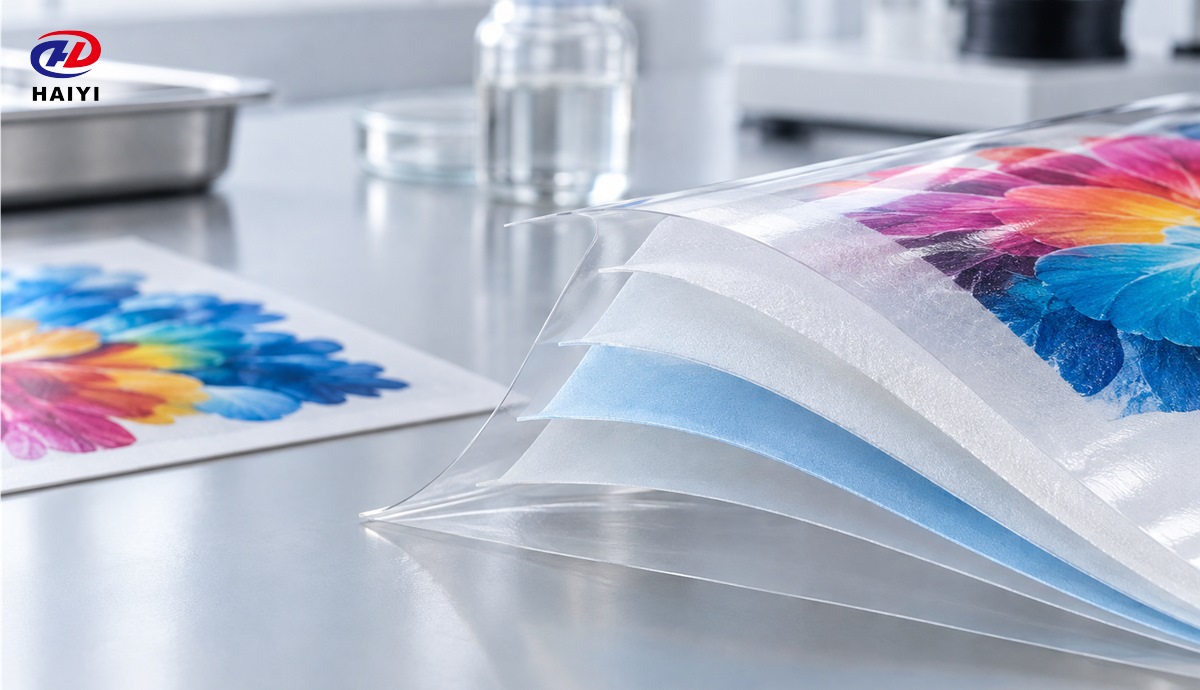
A typical DTF transfer film starts with a dimensionally stable PET carrier and adds one or more functional layers. The print-side coating must accept CMYK and white pigment ink without uncontrolled spreading, pooling, cracking, or slow surface setting. A release function must hold the image during printing, powdering, curing, handling, and pressing, yet separate predictably when the specified hot, warm, or cold peel step begins. Some films also use a back coating to improve feeding, reduce static, limit blocking, or protect the roll surface.
The layer structure explains why a simple chemistry label cannot predict the finished result. Two water-based coating systems can use different polymers, crosslinking, solids content, coating weights, drying profiles, and release additives. Two products sold as oil-based can also differ in surface energy, thickness, peel response, and residual-volatiles control. The manufacturing formula matters, but coating uniformity and process control determine whether that formula is reproduced across the full web and from batch to batch.
Buyers who need a broader foundation can review how coated PET transfer film works in the complete DTF film guide. The practical distinction is that the PET carrier supplies mechanical support, while the coating system supplies most of the ink-reception and release behavior that operators experience.
Water-based vs oil-based DTF film: which is better?
Water-based coating technology can be an attractive manufacturing choice when a supplier has controlled formulation, drying, and contamination. Non-aqueous coating technology can also produce usable film when the chemistry and residual-solvent controls are well managed. Neither route guarantees better color, softer hand feel, faster peeling, or stronger wash resistance because those outcomes also depend on ink loading, powder, curing, press conditions, fabric, and the exact coating architecture.
The following comparison shows what the two labels can suggest and, more importantly, what they do not prove.
| Entscheidungsfaktor | Water-based coating claim | Oil-based or non-aqueous coating claim | What the buyer should verify |
|---|---|---|---|
| Bedeutung | Water is described as the main coating carrier. | A non-aqueous route or resin system is implied. | Written definition of the exact layer and chemistry category. |
| DTF-Tinte | Often designed for water-based pigment DTF ink. | May still be designed for the same water-based DTF ink. | Printer and ink compatibility confirmed by a controlled test. |
| Environmental claim | May reduce some solvent use during coating. | May require solvent capture and residual controls. | SDS, restricted-substance evidence, emissions data, and applicable certificates. |
| Ink reception | Not guaranteed by the label. | Not guaranteed by the label. | Dot gain, bleeding, color density, white-ink holdout, and drying behavior. |
| Schälverhalten | Can be engineered for hot, warm, cold, or multi-peel use. | Can also be engineered for different peel windows. | Release-force range and transfer completeness at defined conditions. |
| Hand feel and wash life | Depend on the complete transfer stack. | Depend on the complete transfer stack. | Finished-transfer stretch, feel, adhesion, and wash testing. |
| Konsistenz | Depends on formulation and coating control. | Depends on formulation and coating control. | Cross-web, roll-to-roll, and batch-to-batch data. |
What claims should buyers avoid accepting without evidence?
A coating label does not by itself prove that a film is safer, more environmentally responsible, softer, brighter, more washable, or compatible with every printer. Safety and environmental performance require specific evidence such as an SDS, substance declarations, test reports, and a clear scope showing whether the evidence covers the film, ink, powder, or finished transfer. A broad statement such as "eco-friendly" is not a substitute for documented chemical requirements in the buyer's market.
A coating label also does not prove that the finished print will feel soft. Hand feel is strongly affected by artwork coverage, white-ink volume, powder type and particle distribution, cure degree, press pressure, fabric structure, and post-press procedure. A fair comparison uses the same design and process settings, then evaluates equivalent transferred samples rather than touching unused film.
A coating label does not establish peel speed. Hot peel, warm peel, cold peel, and instant peel are performance specifications that require a defined press temperature, dwell time, pressure, wait time, peel angle, and peel speed. A film may release quickly in one production window and incompletely in another, so buyers should approve a working window instead of relying on a single demonstration.
Which measurable properties matter most?
1. Ink reception and image definition
Ink reception measures whether the coated surface accepts the intended ink load without beading, uncontrolled dot spread, color-to-color bleeding, white-ink displacement, or surface damage. A useful test file includes small text, fine positive and negative lines, solid CMYK areas, gradients, skin-tone colors, and several white-underbase densities. The better film preserves edges and tonal transitions across the entire printable width under a realistic production ink load.
Ink reception should be evaluated at normal shop temperature and humidity because a moisture-sensitive coating may behave differently after storage or exposure. The test should record ambient conditions, printer mode, pass count, resolution, ink limits, and the time between printing and powder application. Without those controls, a buyer cannot know whether a difference came from the film or from the process.
2. Coating weight and cross-web uniformity
Coating uniformity matters because local thin areas can cause poor ink holdout or unstable release, while local heavy areas can change drying, tack, and peel force. Sampling only the center of a roll can miss edge-to-center variation. A disciplined incoming inspection takes specimens from the left, center, and right positions and repeats the measurement at different points along the roll.
Buyers who want a repeatable method can use the DTF film coating weight and uniformity guide. Coating weight should be paired with print-performance results because identical mass does not guarantee identical chemistry, surface structure, or release behavior.
3. Release force and usable peel window
Release force determines how strongly the carrier holds the transfer before and during peeling. A force that is too high can stretch fabric, tear details, slow production, or leave part of the image on the film. A force that is too low can permit premature lifting or handling damage. The target is not the lowest possible force; the target is a stable range that protects the image and supports clean transfer in the chosen peel window.
A production approval should measure or consistently rate release at controlled temperature, wait time, angle, and speed. The DTF film release-force testing protocol explains why acceptance criteria must connect instrument data with actual transfer completeness, edge quality, and operator repeatability.
4. Heat shrinkage and dimensional stability
Heat stability matters because the PET carrier and coating encounter heat during curing and pressing. Excessive or uneven shrinkage can distort artwork, create registration error between CMYK and white layers, encourage curling, or complicate multi-image gang sheets. A coating label does not predict dimensional change, so film should be measured before and after a defined thermal cycle.
Der DTF PET film heat-shrinkage test guide provides a structured way to control sample direction, conditioning, temperature, time, and calculation. Buyers should set separate machine-direction and cross-direction limits because the two axes can respond differently.
5. Static behavior and feeding stability
Static control affects dust attraction, sheet separation, powder cleanliness, tracking, and operator handling. Static is influenced by film treatment, back coating, humidity, equipment grounding, unwinding speed, and nearby materials. A film can therefore perform well in a humid sample room but attract dust or misfeed in a dry production environment.
Surface-resistance measurement is more informative than a vague "anti-static" claim. The DTF film anti-static testing guide shows how conditioning and measurement method affect the result. A purchasing specification should connect resistance data with observed feeding, dust attraction, and powder-shaking performance.
6. Finished-transfer durability
Wash resistance is a system result, not a film-only result. Adhesion after laundering depends on ink, powder, cure completeness, pressing, fabric finish, garment construction, detergent, water temperature, drying, and the film's release behavior. A supplier can help optimize the system, but a buyer should not attribute every crack, edge lift, or color loss to coating chemistry alone.
A fair durability comparison uses identical fabric lots, artwork, consumables, cure settings, press settings, wash method, and evaluation points. The guide to choosing DTF film for strong wash resistance explains how to separate initial appearance from retained adhesion, flexibility, and visual quality after repeated laundering.
How should a print shop compare two film candidates?
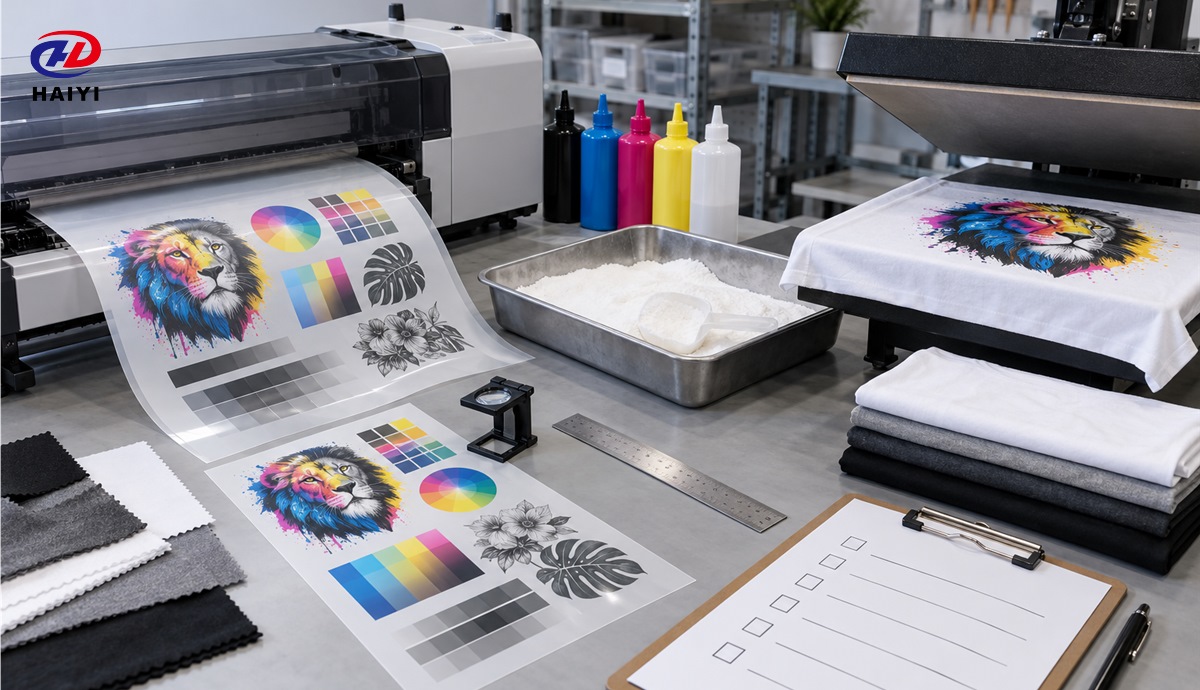
A valid comparison changes one principal variable at a time. The shop should keep the same printer, maintained printheads, RIP profile, ink lot, white-ink circulation condition, powder lot, shaker settings, curing equipment, heat press, fabric lot, artwork, and environment while changing only the film candidate. This design makes the result interpretable and prevents a good film from being rejected because another consumable or setting changed.
The first stage is a visual and dimensional incoming check. Record roll width, length or weight basis, thickness, winding quality, edge condition, surface defects, odor observations, packaging condition, and lot identification. Measure multiple positions rather than one convenient sample. Any unexplained difference between the delivered roll and the approved sample should stop the comparison until the supplier clarifies the specification.
The second stage is a print-window test. Run a standard file at the normal ink limit, then test a small planned range around the normal setting if the film is being introduced into a new system. Inspect wet ink control, fine detail, white-underbase alignment, powder pickup, unwanted powder retention, curing appearance, film flatness, and any surface marks. The objective is to find a stable window, not a single unusually good print.
The third stage is a transfer-window test. Press equivalent samples at the intended production temperature, dwell, and pressure, then evaluate the specified peel timing. Repeat enough samples to detect inconsistency. Record transfer completeness, fine-detail survival, surface finish, edge definition, color change, stretch recovery, hand feel, and visible adhesive contamination.
The fourth stage is durability and aging. Wash a defined sample set, retain an unwashed control, and inspect results at agreed cycles. Store printed-but-unpressed transfers for the intended inventory period and repeat transfer testing. A distributor or high-volume shop should also expose unopened and opened film to realistic storage conditions because packaging and moisture protection influence shelf performance.
A detailed DTF consumables compatibility test protocol helps buyers document the complete film, ink, powder, curing, press, and fabric system. The protocol is especially useful when two candidates produce similar first impressions but different process stability.
How should buyers calculate the real cost difference?
The correct comparison is cost per acceptable transfer, not price per roll. A lower-priced film becomes expensive when it increases head cleaning, misfeeds, powder contamination, rejected transfers, reprints, operator waiting, customer returns, or batch-change recalibration. A higher-priced film is not automatically economical either; its premium must produce measurable savings or reduced risk.
A practical usable-cost model adds purchase price, freight, duties, storage loss, setup waste, print waste, transfer waste, labor for rework, downtime, and complaint cost, then divides the total by the number of accepted transfers. The model should use the same artwork mix and production period for both candidates. This calculation turns a chemistry debate into a margin decision that purchasing, production, and sales teams can understand.
What documents should support a wholesale order?
A wholesale order should be supported by a product specification that defines PET thickness and tolerance, width and length, coating sides, surface finish, peel type, intended ink system, storage conditions, shelf-life basis, recommended processing window, packaging, and lot coding. The specification should distinguish guaranteed limits from typical values so buyers know which deviations trigger corrective action.
A certificate of analysis should report lot-specific results instead of repeating catalog claims. Depending on the approved specification, useful fields can include dimensions, appearance, coating-related measurements, release behavior, heat response, static or surface-resistance data, and traceability. The DTF film certificate-of-analysis checklist explains how distributors can connect each field to an acceptance method and limit.
Chemical and compliance documents should match the actual material and intended market. Buyers may request an SDS where applicable, restricted-substance declarations, third-party reports, and evidence of the test scope. A certificate logo or general statement is insufficient if the report does not identify the tested product, sample, standard, date, issuing laboratory, and result.
How can distributors control batch-to-batch risk?
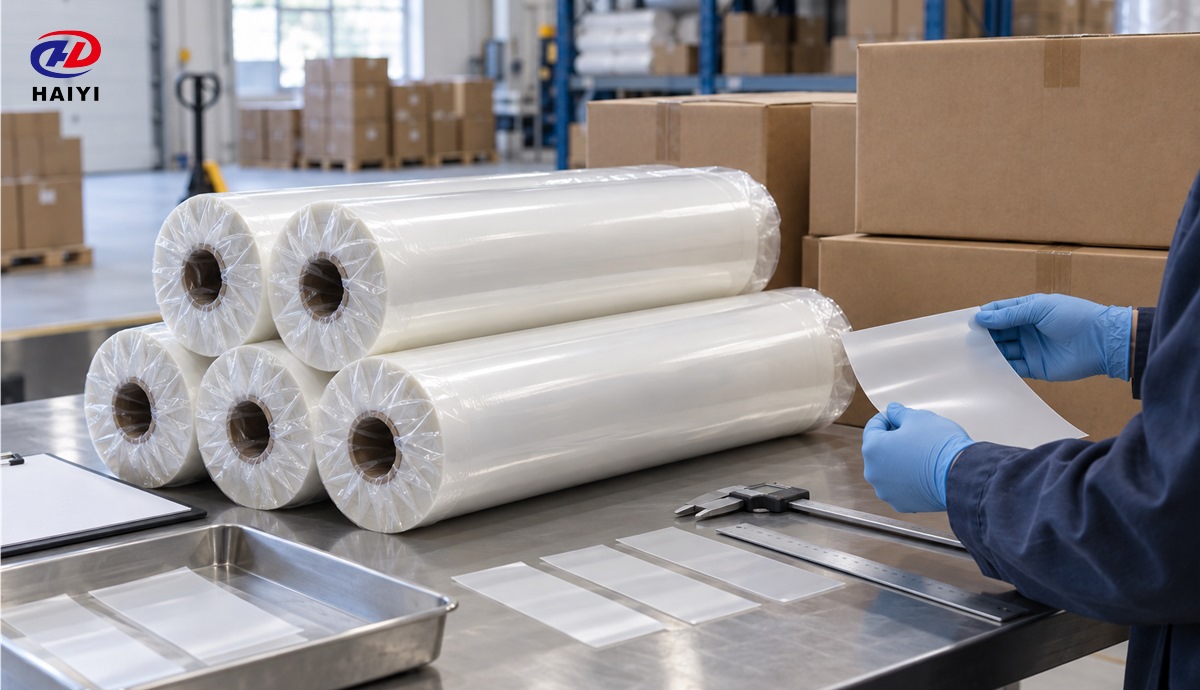
A distributor should approve a reference sample and retain sealed material from each accepted production lot. Incoming inspection can then compare appearance, dimensions, print response, release, and transfer behavior against the approved reference under fixed conditions. Retained samples make later complaint analysis faster because the distributor and manufacturer can test representative material from the same lot.
Batch control should use trend data rather than a pass-or-fail result alone. A result can remain inside a broad limit while drifting toward failure over several shipments. Recording coating, release, shrinkage, static, and reject-rate data by lot helps buyers detect process change before customers experience widespread problems.
Der guide to comparing DTF film across two production batches provides a practical framework for matched sampling, controlled printing, scored transfers, and evidence-based supplier feedback. The same method can compare a water-based claim with an oil-based claim without assuming that either label deserves a performance advantage.
Common mistakes when evaluating water-based and oil-based DTF film
The first common mistake is confusing film coating with printer ink. Standard textile DTF workflows normally require purpose-formulated water-based pigment ink, even when the film is marketed with an oil-based coating label. Loading an unapproved ink based on the film name can damage equipment and invalidate the comparison.
The second common mistake is testing only one attractive graphic. A saturated design can hide fine-detail loss, while a simple logo may not challenge ink loading or white coverage. A standardized test file should combine detail, solids, gradients, reversed text, multiple colors, and different underbase levels.
The third common mistake is changing RIP settings until every candidate looks acceptable without recording the changes. Optimization is legitimate, but the buyer needs both a common baseline and a documented best-setting result. The baseline reveals compatibility, while the optimized result reveals each film's practical potential and setup cost.
The fourth common mistake is approving a hand-delivered sample without confirming mass-production equivalence. The purchase agreement should link the sample to a product code, specification revision, lot-control plan, packaging method, and change-notification requirement. That connection prevents an excellent sample from becoming an unrepeatable exception.
Häufig gestellte Fragen
Is water-based DTF film the same as film for water-based DTF ink?
No. Standard textile DTF film is generally designed to receive water-based pigment DTF ink, but the phrase "water-based film" may specifically describe how a coating was formulated or applied. Buyers should confirm both the coating description and the intended ink compatibility because the two statements answer different questions.
Does oil-based DTF film require oil-based ink?
Not necessarily, and operators should never assume that it does. An oil-based film label often refers to a supplier's coating terminology, while the printing system may still require standard water-based pigment DTF ink. The printer, printhead, ink, and film suppliers should confirm compatibility before any production trial.
Is water-based coating always safer or more sustainable?
No coating label alone proves total safety or sustainability. A water-borne route may reduce reliance on certain organic solvents during coating, but the full assessment also includes raw materials, energy and drying, emissions controls, worker exposure, waste, packaging, transport, restricted substances, and end-of-life considerations. Buyers should request specific evidence instead of relying on a broad claim.
Which film produces a softer transfer?
Finished softness depends more on the complete transfer construction than on the water-based or oil-based label. Artwork coverage, white-ink deposit, adhesive powder, cure, pressing, and fabric all affect hand feel. The fairest method is a blind comparison of finished transfers produced with controlled settings and equivalent coverage.
Which film is better for hot peel?
The better hot-peel film is the candidate that produces complete, repeatable release across the approved hot-peel window. Both water-based and non-aqueous coating systems can be engineered for hot, warm, cold, or multi-peel behavior. Buyers should compare measured release and repeated transfer results rather than inferring peel type from coating chemistry.
Can a buyer compare supplier samples without laboratory equipment?
Yes, a production shop can perform a useful first-stage comparison with controlled materials, a standardized test file, calibrated temperature checks, dimensional tools, a consistent press, wash testing, scoring sheets, and retained samples. Laboratory measurements become more important for formal specifications, disputed results, chemical compliance, or high-volume programs where small variation creates large costs.
What information should be sent when requesting a DTF film sample?
A useful sample request identifies printer model and width, printhead, ink system, RIP and normal ink load, powder type, curing equipment, press conditions, peel preference, target fabrics, roll or sheet dimensions, monthly volume, storage environment, compliance market, and current defect priorities. This information helps the supplier propose a technically relevant sample instead of sending a generic roll.
Choose film by evidence, not by shorthand
The strongest conclusion is simple: water-based versus oil-based is not a complete DTF film specification. A professional buyer should define the term, verify compatibility, test the complete production system, measure repeatability, compare usable cost, and require batch documentation. This evidence-based approach produces a decision that remains valid even when marketing terminology changes.
Haiyi supplies wholesale and customized DTF film programs for distributors, print-supply businesses, and production users. Buyers can discuss roll dimensions, coating and peel requirements, private-label packaging, sampling, quality documents, and repeat-order controls with the Haiyi team. Kontaktieren Sie Haiyi with your printer, ink, powder, process, target market, and order volume to request a matched sample and B2B quotation.