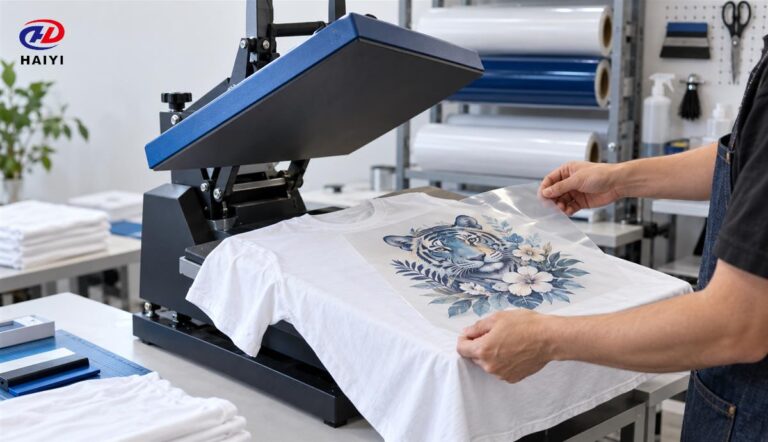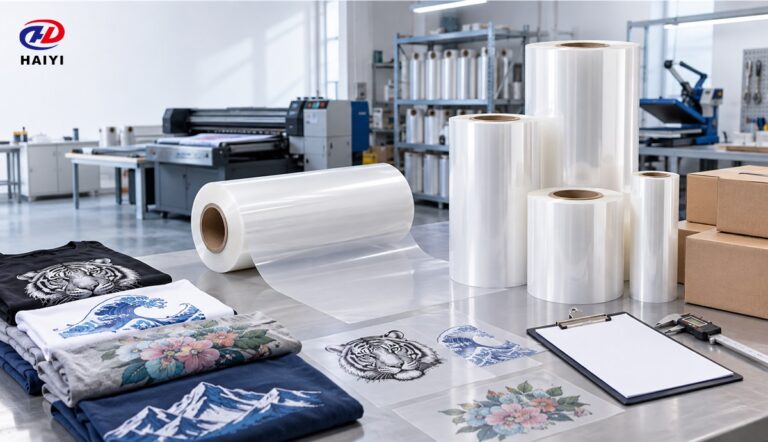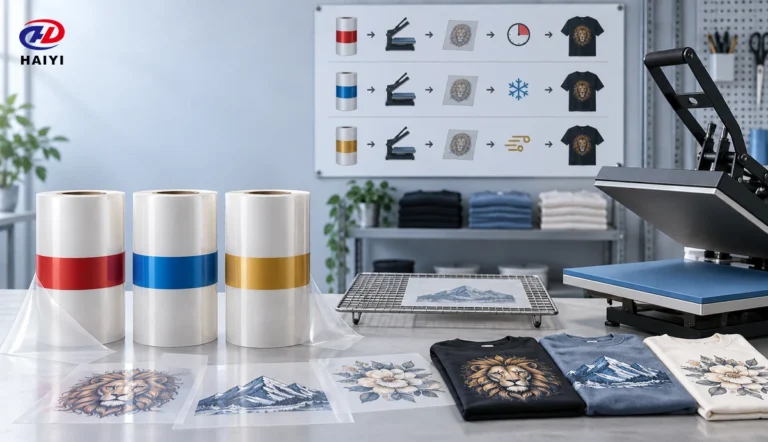








Испытание силы отрыва пленки DTF: методы и критерии приемлемости.
Узнайте, как измерять силу отрыва пленки DTF с использованием контролируемых образцов, фиксированной геометрии отслаивания, кривых силы, повторных измерений и практических критериев приемки партии.

Примерное время чтения: 14 минут
DTF film release force testing measures the force required to separate the PET carrier from a transferred graphic under defined conditions. A useful method fixes the film, artwork, ink, powder, curing, fabric, press cycle, cooling condition, specimen width, peel angle, and peel speed. The result is a force-versus-distance curve that can support batch comparison, troubleshooting, and supplier approval.
There is no single release-force number that is correct for every DTF film. Hot, warm, and cold peel products use different release behavior, and the measured value changes when the test geometry or transfer process changes. A professional acceptance specification therefore combines a validated test method, a product-specific force window, repeatability limits, curve rules, visual transfer requirements, and functional checks. This guide explains how to build that system without confusing easy peeling with good transfer quality.
What does DTF film release force actually measure?
Release force describes resistance at the separation front between the PET carrier and the transferred image after heat pressing. The test does not measure only the coating on an unused film. It measures the behavior of a complete prepared specimen, so coating chemistry interacts with ink deposit, adhesive powder, curing, fabric, heat, pressure, cooling, and peeling mechanics.
That system boundary matters. A higher force can indicate strong resistance at the carrier interface, but it can also result from excessive press conditions, an early peel, too much powder, a steep angle, or a heavy white underbase. A very low force may feel convenient yet still accompany incomplete transfer, edge lift, detail loss, or contamination. The force value becomes useful only when the failure mode and final transfer quality are recorded at the same time.
Release force is also different from the peel window. The peel window defines when a hot, warm, or cold peel product should be removed. The existing guide to DTF film peel timing explains how to find that operating period. Release-force testing holds the approved timing condition steady and quantifies what happens during removal.
Why should distributors and factories quantify release behavior?
An instrumented method reduces that ambiguity. The test can reveal a gradual shift in average force, isolated spikes, unstable release across a strip, or increasing variation among replicates. Those signals help quality teams investigate before customer complaints appear. Quantitative records also give a distributor a clearer basis for approving a new supplier, verifying a private-label specification, and comparing a complaint sample with a retained sample.
The objective is not to chase the lowest possible force. The objective is a stable release response inside a proven process window, with clean transfer, intact detail, no unacceptable residue, and satisfactory downstream durability. Release-force data should support a product decision, not replace the product decision.
Which release-force methods are practical for DTF film?
Two levels of testing are useful. An instrumented peel test is the preferred method for specification development, supplier qualification, batch release, and detailed troubleshooting. A controlled manual screening method can support incoming checks where a test machine is unavailable, but it should not be reported as an equivalent numerical measurement.
| Method | Оборудование | Output | Best use | Main limitation |
|---|---|---|---|---|
| Instrumented peel | Universal test machine or force tester, low-force load cell, grips, controlled-angle fixture | Peak, average, variation, and force curve | Specifications, supplier comparison, lot acceptance, root-cause analysis | Requires validated fixtures, software, calibration, and trained operators |
| Controlled manual screen | Prepared strip, angle guide, timing and temperature controls, visual scorecard | Pass, hold, or fail with defect observations | Fast production screening and escalation | Operator force and speed remain subjective |
| Raw-film proxy screen | Laboratory contact material applied to unused film | Relative coating response | Internal process monitoring after correlation work | Does not reproduce a printed, powdered, pressed DTF transfer |
How should test specimens be prepared?
Specimen preparation usually creates more variation than the test machine. Build a controlled print file with repeated solid areas, fine lines, small isolated details, and a consistent white underbase. The release-force strip should have a uniform width and a long enough steady section for averaging after the peel begins. Keep a free carrier tab for gripping without damaging the transfer zone.
Use one defined printer, ink set, powder, print mode, cure cycle, press, platen condition, fabric lot, and finishing procedure for comparison work. Record the actual settings rather than relying on a preset name. If the test purpose is film qualification, hold these process variables constant. If the purpose is process development, change one planned factor at a time through a documented matrix.
Prepare replicates from the left, center, and right of a roll when coating uniformity across the web is relevant. For long-roll studies, include positions from the beginning, middle, and end. Condition film, powder, fabric, and prepared specimens for a defined period in a recorded environment. The chosen temperature and humidity need to reflect laboratory control and product risk; they should not be invented after results are reviewed.
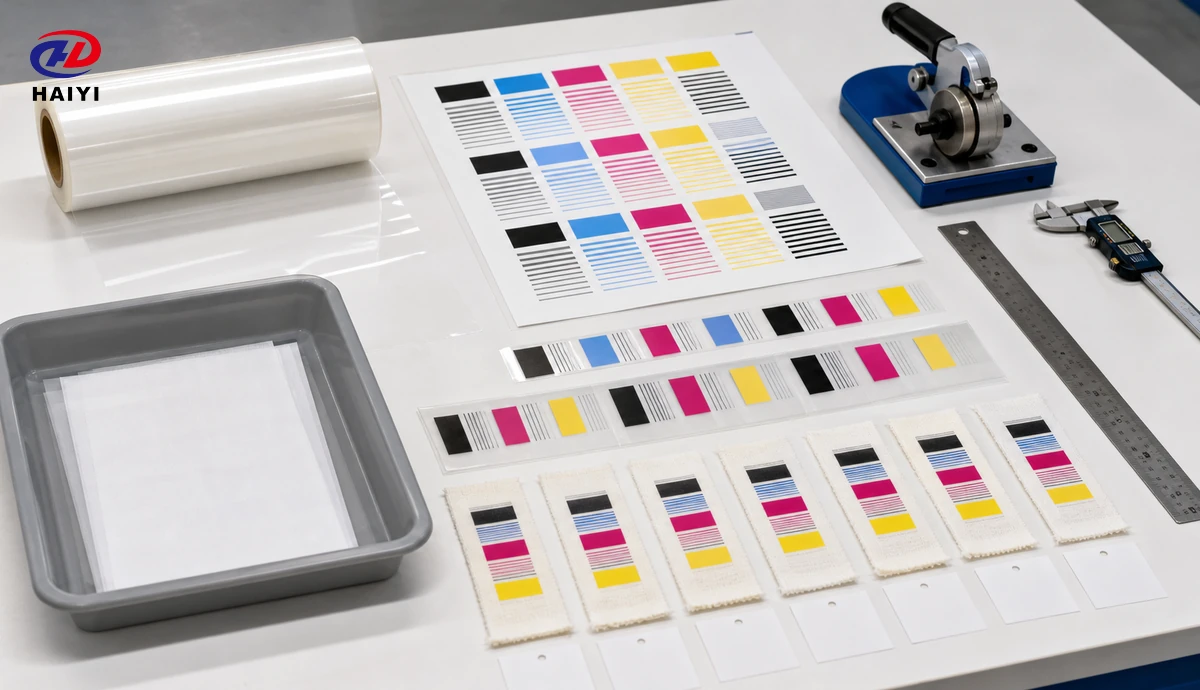
Teams that are qualifying a new film should coordinate release-force work with a broader DTF print parameter test matrix. That approach identifies a robust printing and pressing window before one condition is frozen as the release-force reference method.
What equipment is needed for an instrumented peel test?
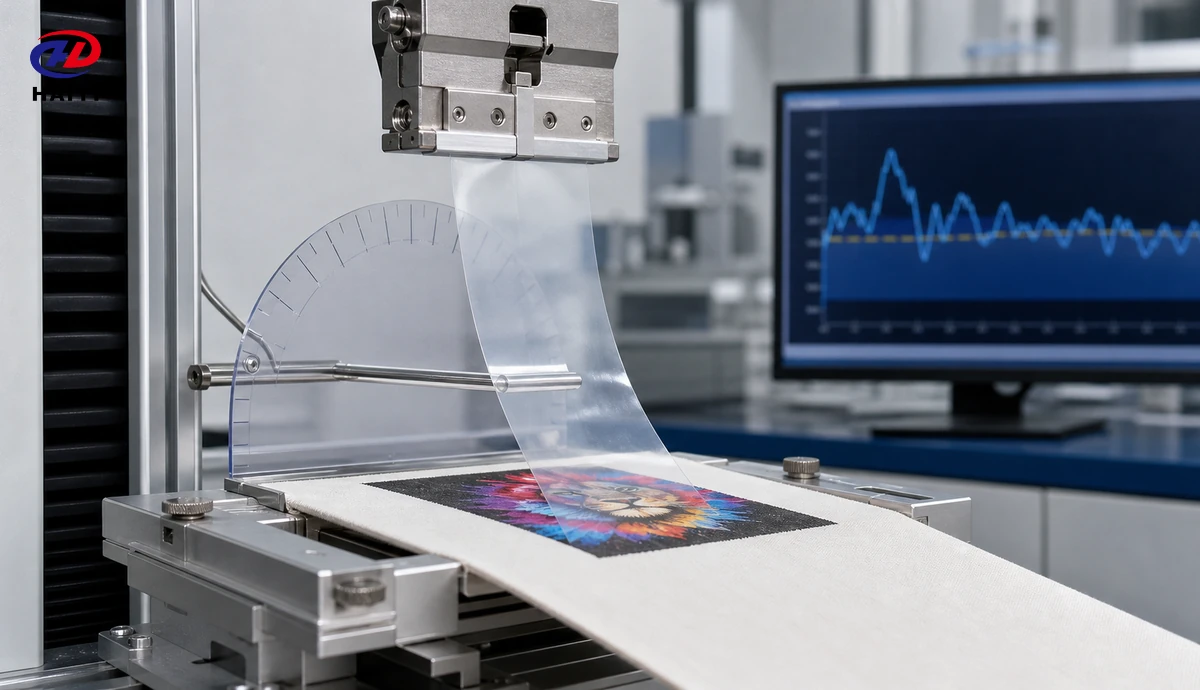
A practical laboratory setup uses a universal test machine or dedicated force tester fitted with a load cell appropriate to the expected low-force range. Resolution and accuracy near the measured force matter more than a very high maximum capacity. The system also needs a grip that holds the PET tab without slipping or cutting it, a fixture that supports the fabric specimen, and a way to maintain the selected peel angle during travel.
Before formal testing, run a blank movement check and confirm that the grip and fixture do not add friction that changes during travel. Verify that the carrier does not slip, stretch excessively, or rub against an unintended surface. Start the test with enough free tab for stable gripping while keeping the analyzed region away from the initial handling damage.
Should the test use a 90-degree or 180-degree peel angle?
Either geometry can support internal comparison when the fixture maintains it consistently and the method is validated. A 180-degree method folds the PET carrier back approximately parallel to the specimen. A 90-degree method pulls the carrier approximately perpendicular to the bonded plane while the specimen support moves or otherwise preserves the angle.
The numerical results from different angles should not be combined. Peel geometry changes the force balance, bending of the carrier, and stress at the separation front. A change from 90 degrees to 180 degrees can change the measured result even when the film and transfer are identical. Select the geometry that the laboratory can control reliably and that gives useful discrimination among accepted and rejected material.
Peel speed must also remain fixed. A rapid peel can create higher peaks or mechanical shock, while a slower peel can produce a different average response. Specimen width should be controlled and reported. Many laboratories normalize force by strip width, such as force per millimeter or force per defined strip width, so results remain interpretable when widths differ. The unit and calculation must be written in the specification.
How is the instrumented test run step by step?
- Verify specimen identity. Record film product, lot, roll position, print file, ink, powder, fabric, operator, conditioning, and process method.
- Prepare the transfer. Print, powder, cure, press, cool, and finish with the approved settings. Record actual time, temperature, pressure setting, and peel delay or surface condition.
- Measure the strip. Confirm test width and usable peel length. Reject a specimen with handling damage in the analyzed region.
- Mount the specimen. Align the transfer with the fixture, secure the substrate, grip the free carrier tab, and establish the defined angle.
- Zero and start. Confirm the correct load cell and method, remove slack without pre-peeling the analyzed zone, and run at the specified crosshead speed.
- Exclude defined transients. Apply the written rule for the start and end regions. Do not choose the analyzed interval after seeing the curve.
- Record the curve and failure mode. Save the raw data, average force, peak force, variability metrics, visual defects, and location of any abnormal event.
- Repeat and decide. Complete the required replicates, compare the set with every acceptance rule, and retain samples according to the quality plan.
For hot, warm, and cold products, a separate procedure may be required because peel timing is part of product design. The existing peel-test SOP for hot, warm, and cold peel film covers operator instructions and process qualification. The instrumented method adds quantitative force measurement to the approved procedure.
Which values should be calculated from the force curve?
Average steady-state force is usually the main comparison value because it represents sustained separation after the initial peel begins. Peak initiation force can identify difficulty starting the peel, but an isolated start peak should not automatically define the entire product. Maximum force within the analyzed zone helps detect local sticking or a sudden defect.
Variation is equally important. Calculate the standard deviation or range among replicate averages, and consider the coefficient of variation when the mean is not near zero. Within-strip instability can be described by the spread of the curve, the number of spikes above a defined threshold, or the difference between local high and low regions. The exact statistics should be selected before testing and used consistently.
Always classify the failure mode. Useful observations include clean carrier separation, partial image lift, edge lift, fine-detail loss, adhesive residue, carrier tearing, fabric distortion, and local sticking. A curve can sit inside the force window while the transferred image fails visually. That specimen does not pass.
Как следует устанавливать критерии приемки?
Acceptance limits should come from product qualification data, not from a generic value found online. Start with an approved film and process that produce clean transfers and acceptable durability. Test multiple independent qualified lots, enough specimens to understand normal variation, and the relevant roll positions. Include intentionally weak or off-condition samples when possible so the method can demonstrate useful discrimination.
Set a lower and upper limit for the average force only after the relationship between force and transfer outcome is understood. A lower limit can detect material that releases too freely and risks premature separation or incomplete transfer under the defined method. An upper limit can detect excessive resistance that may slow production, damage detail, or lift the transfer. Some products may need only an upper limit if qualification shows no meaningful low-force failure mode.
| Criterion | Example specification form | Reason |
|---|---|---|
| Average release force | Product-specific lower limit to upper limit, in a defined normalized unit | Controls the central release response |
| Maximum force or spike | No point above a validated maximum, with a defined filtering rule | Detects local sticking that an average can hide |
| Replicate variation | Range, standard deviation, or coefficient of variation below a set limit | Controls within-lot consistency |
| Individual result | Every specimen inside limits, or a prewritten retest rule | Prevents informal removal of inconvenient data |
| Visual transfer | No critical lift, residue, carrier tear, or detail loss | Connects the number to real quality |
| Functional result | Pass the approved stretch, wash, or end-use checks | Confirms that easy release did not weaken performance |
What should a DTF release-force acceptance worksheet contain?
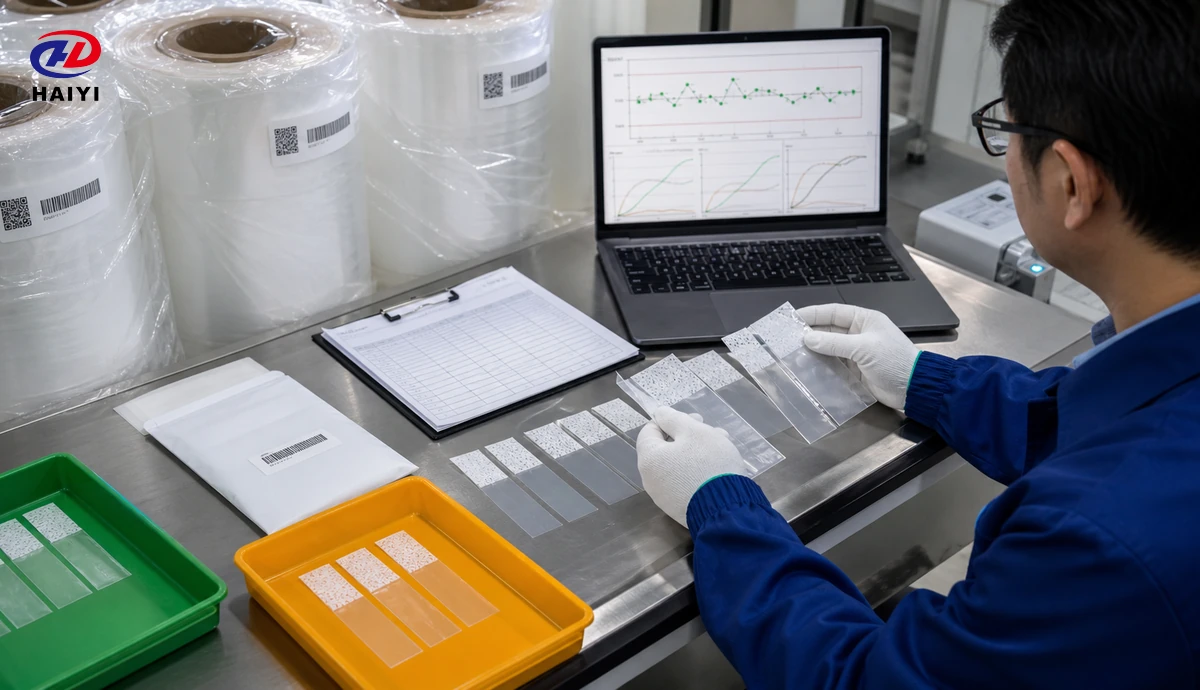
The method header should identify the product, peel type, film thickness, roll format, specimen width, substrate, artwork revision, print mode, cure cycle, press settings, peel condition, angle, speed, load cell, analyzed distance, data-filtering rule, and unit. The result section should list every replicate rather than only the final average.
Record mean force, maximum force, selected variability metric, curve disposition, visual result, functional result, operator, instrument, calibration status, date, film lot, ink lot, powder lot, fabric lot, and any deviation. The disposition should be pass, hold, or fail. A hold status is useful when the numerical result is borderline, a test deviation occurred, or investigation is required before material can be released.
Define retest rules in advance. A quality team should not keep repeating specimens until acceptable numbers appear. A valid rule may allow a documented retest after an identifiable preparation or equipment error. If no assignable test error exists, an out-of-specification result should enter the nonconformance process.
How can a laboratory verify that the measurement system is reliable?
First verify basic equipment control: calibration, suitable load-cell range, grip condition, speed accuracy, fixture alignment, angle stability, and software method protection. Then study repeatability by having one trained operator retest comparable specimens. Study reproducibility by comparing operators, days, or laboratories while the material and written method remain controlled.
A formal measurement-system analysis can separate equipment and operator variation from actual product variation. The study design should reflect the real method and force range. If measurement variation is too large relative to the acceptance window, tightening product limits will create arguments rather than better control. Improve the fixture, training, specimen preparation, or data-reduction rule first.
Which variables most often change measured release force?
| Variable | How it changes the result | Control action |
|---|---|---|
| Peel delay or temperature | Changes coating and adhesive state at separation | Define delay, surface condition, or temperature window by peel type |
| Peel angle and speed | Changes stress geometry and force response | Use a controlled fixture and fixed machine speed |
| Strip width | Changes total force carried at the peel front | Cut consistently and normalize results when specified |
| White ink and powder load | Changes transfer thickness, thermal behavior, and unwanted bonding | Use controlled artwork, print mode, and powder process |
| Cure and press conditions | Change adhesive activation and interface behavior | Record actual time, temperature, and pressure method |
| Fabric and surface texture | Change transfer support and thermal contact | Use one reference substrate for film QC |
| Film storage and humidity | Can change coating, static, and process consistency | Condition and record material before testing |
| Равномерность покрытия | Creates drift or local force spikes across a roll | Sample web and roll positions and review the curve |
Coating-related behavior is only one part of the system, but it remains a critical film property. The guide to how DTF film coating affects print quality explains the connections among ink reception, powder, transfer, and release. Film thickness can also influence handling and test mechanics, so buyers comparing formats should review the руководство по толщине пленки DTF.
How should abnormal force curves be diagnosed?
A high start peak followed by a stable plateau points toward initiation difficulty, grip alignment, peel timing, or edge preparation. Repeated sharp spikes through the measured zone suggest local sticking, powder contamination, nonuniform pressure, coating variation, or inconsistent printed coverage. A steady upward or downward trend can indicate a changing peel angle, specimen movement, temperature gradient, or position-related material variation.
Very low force with image lift is not a successful low-force product. Check transfer activation, powder, pressure, timing, and interface compatibility. High force with a clean final image may still be outside a production requirement if it creates operator difficulty or risks fine-detail damage. Compare the complaint pattern with the comprehensive hard-to-peel troubleshooting guide, then use instrumented data to narrow the likely causes.
How should release-force testing support supplier and batch approval?
A purchase specification should state the test method revision and product-specific criteria, not only a claim of easy release. Ask the supplier how specimens are prepared, which peel condition is used, how force is normalized, how many replicates are tested, how abnormal curves are handled, and whether raw data can be linked to a production lot.
Release force should sit within a wider supplier-control system covering specification review, change notification, retained samples, coating consistency, dimensions, static behavior, packaging, traceability, and corrective action. Importers can use the Контрольный список для проверки поставщика пленки DTF to connect test evidence with broader manufacturing controls.
What are the most common release-force testing mistakes?
- Using one universal number: different products and methods require different validated windows.
- Changing angle or speed: results are not comparable after the geometry or rate changes.
- Ignoring process inputs: film cannot be isolated from ink, powder, curing, pressing, cooling, and substrate in a transfer test.
- Reporting only the average: peaks, variation, and failure mode can reveal defects hidden by a mean.
- Testing one specimen: a single strip cannot characterize repeatability or roll uniformity.
- Removing outliers informally: exclusion and retest rules must be written before results are reviewed.
- Passing a bad image: a force value inside limits does not override lift, residue, missing detail, or poor durability.
- Using raw-film proxy data as final proof: a proxy requires demonstrated correlation with the real printed transfer.
Часто задаваемые вопросы
Is lower DTF release force always better?
No. Lower force can improve handling, but force that is too low may accompany premature release or incomplete transfer under a defined method. Acceptance requires both the numerical window and a clean, durable transferred image.
Can release force identify a defective coating?
Release-force data can support that diagnosis, especially when reference material passes under the same controlled process. It cannot prove a coating defect until equipment, timing, ink, powder, cure, press, fabric, storage, and specimen preparation have been checked.
How many specimens should be tested?
The quantity should come from the quality plan and risk. Development needs enough replicates and independent lots to establish normal variation. Routine batch acceptance may use a smaller validated sample. The plan should define locations, retest rules, and escalation before testing begins.
Can hot peel and cold peel film use the same acceptance limits?
Usually not without evidence. Their approved separation conditions differ, so their force windows may also differ. Maintain separate methods or clearly separated product conditions even when the same machine and fixture are used.
Should release-force testing replace wash testing?
No. Release force evaluates carrier removal under a controlled condition. Wash, stretch, appearance, and end-use tests evaluate other performance requirements. A complete approval plan links them instead of substituting one result for another.
How can Haiyi support wholesale DTF film quality programs?
Haiyi supplies DTF film for wholesale, distributor, printing-business, and customized product requirements. Buyers can discuss roll or sheet formats, film thickness, hot, warm, or cold peel behavior, coating configuration, packaging, branding, and repeat-order specifications. A technical inquiry should identify the printer, ink, powder, fabric, press process, preferred peel condition, roll dimensions, monthly volume, and target market.
Need a wholesale or customized DTF film program with defined release performance? Review the Haiyi DTF film product range and contact the Haiyi team with your film format, peel type, test conditions, acceptance criteria, packaging needs, and order volume. Haiyi can support sample evaluation and a product specification for distributor, private-label, or bulk supply programs.