

What Is DTF Film Made Of? PET, Coatings and Adhesive Explained
Understand the PET carrier, printable coating and optional back treatment, and why DTF ink and powder are usually added later.

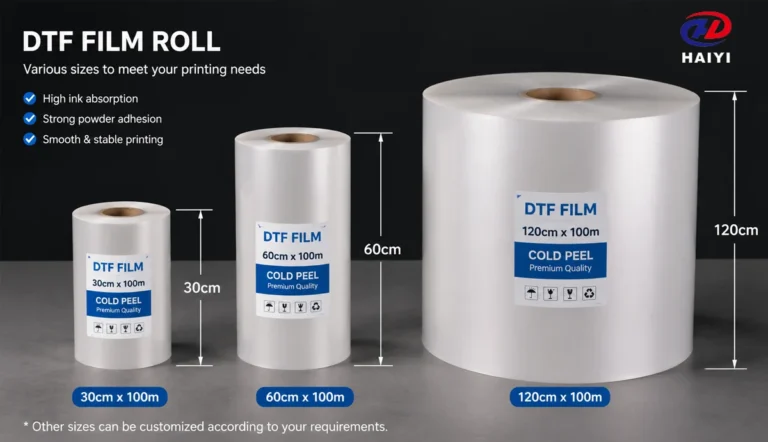
DTF film is usually a PET carrier with purpose-designed surface treatments, not a preassembled stack of ink and adhesive. The transparent polyester base provides strength and dimensional stability. A designated printable coating controls how DTF ink is held and released. Some products also have a backside treatment for feeding or static control. Ink and hot-melt powder are normally added later during the transfer-making process.
Estimated reading time: 8 minutes.
What is the base material of DTF film?
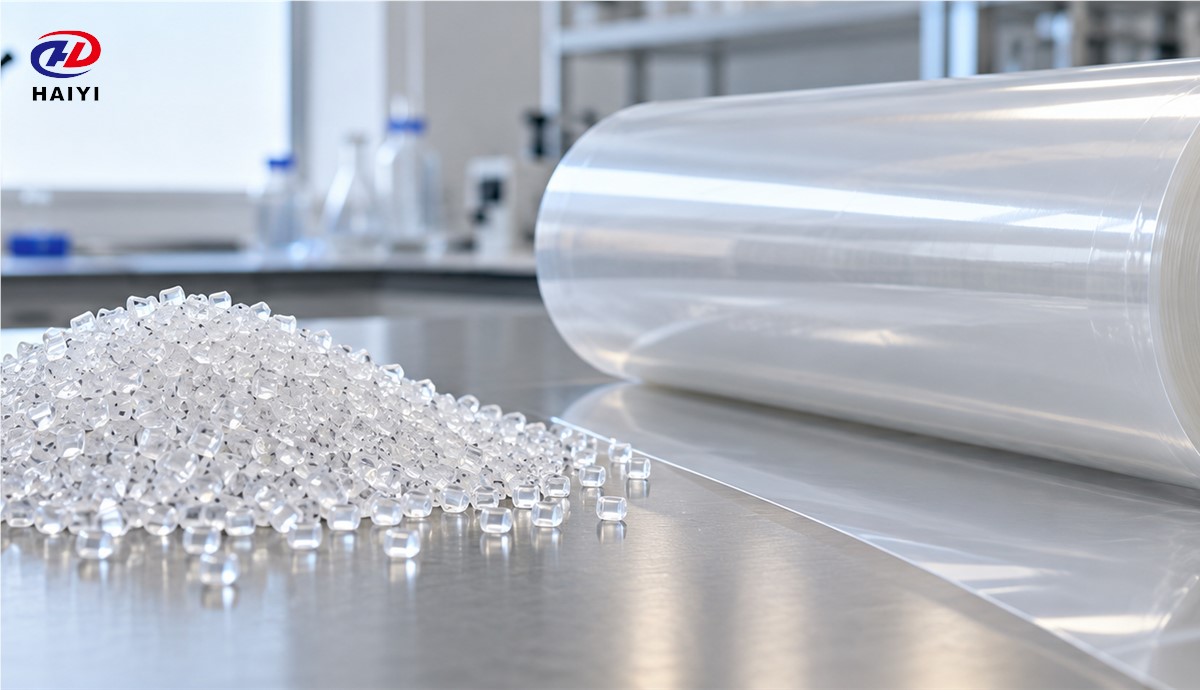
The carrier is typically polyethylene terephthalate (PET), a polyester film used because it can be manufactured with a consistent surface, controlled thickness and useful heat resistance for the intended transfer cycle. PET supports printing, powdering, curing and handling while the image remains on a temporary carrier. It is peeled away after transfer; the garment does not retain the PET sheet.
PET grade, thickness and heat behavior matter independently of coating quality. A film that curls under the chosen cure cycle can misfeed even if the ink coating is excellent. Conversely, a mechanically stable sheet can still print poorly when its receiving surface is incompatible with the ink. See our Guida allo spessore della pellicola DTF for how gauge affects handling and application.
What is on the printable face?
The printable face is a proprietary receiving or release coating engineered for the intended ink and peel conditions. Its exact chemistry varies by manufacturer and product, so a buyer should not assume that every DTF film has one universal formula. The coating must accept the ink without excessive spreading, preserve fine detail during powder application and permit the finished transfer to release at the specified stage.
Ink absorption and release are related but different functions. Strong wetting alone does not guarantee clean release after pressing, while easy release alone does not guarantee sharp printing. The ink-absorbing coating guide explains why these trade-offs should be evaluated as a system.
Is there always a coating on the back?
No single layer sequence describes every product. Some films use a backside treatment to improve transport, reduce static or control blocking; others achieve acceptable handling through different construction choices. A matte back is not proof that the back is printable. Supplier documentation and a small approved print test are more reliable than visual texture alone. Our printable-side identification guide covers this distinction.
Is adhesive powder built into blank DTF film?
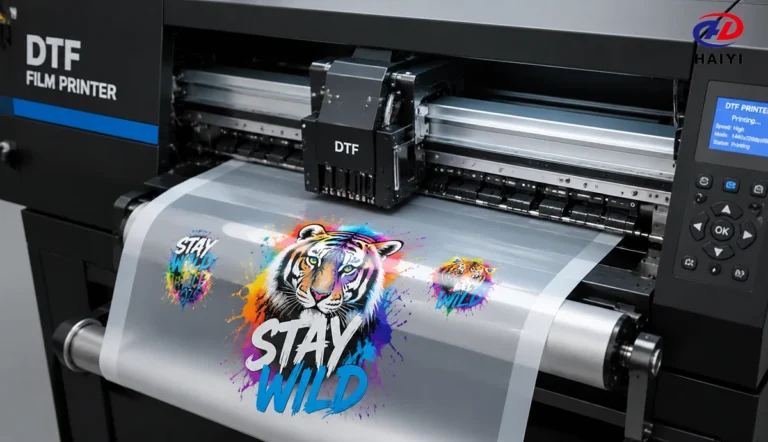
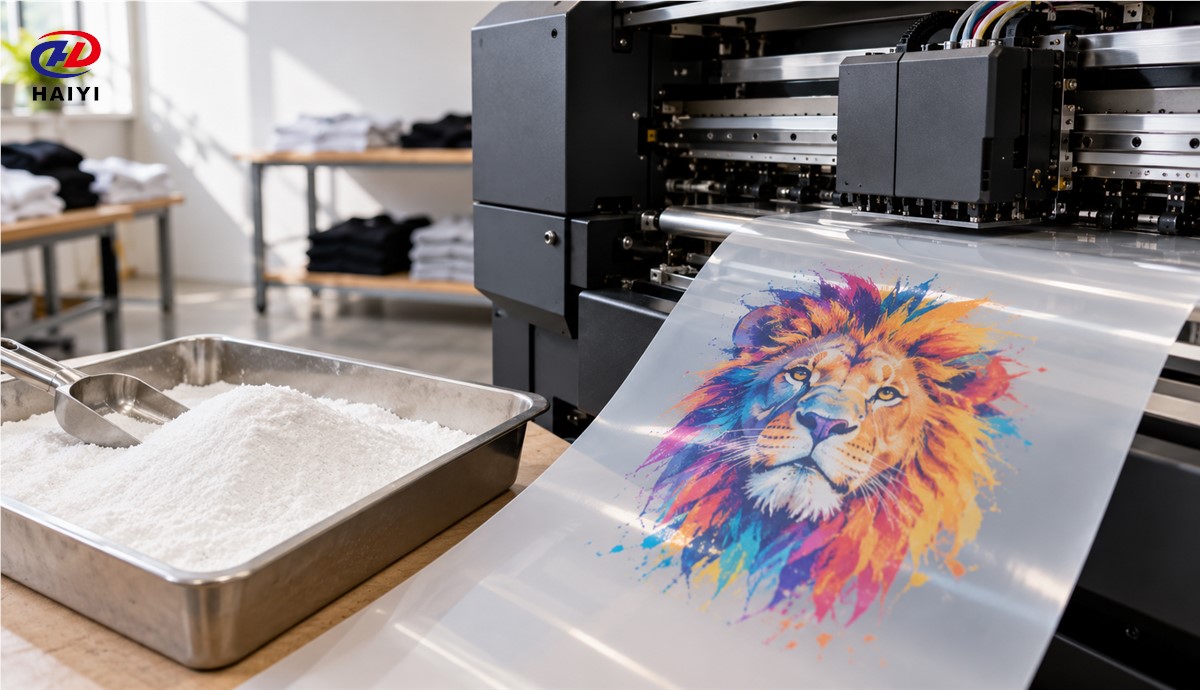
For conventional powder-based DTF printing, the hot-melt adhesive is a separate consumable. It is applied to the freshly printed image, excess powder is removed, and the retained powder is cured before pressing. The blank film roll should not be described as already containing the final garment adhesive unless a specific specialty product’s technical sheet says so. Ink is also deposited during printing rather than manufactured into the blank carrier.
How do these materials work together?
The PET base carries the process; the receiving face manages ink and release; optional back treatment helps handling; printed pigment makes the image; and cured adhesive bonds the image to the fabric. A defect can therefore arise at several different interfaces. An edge that bleeds before powdering points toward ink/coating interaction, whereas a print that looks sharp on film but fails after washing may involve adhesive, cure, press or fabric preparation.
That distinction prevents costly misdiagnosis. Changing film to solve an undercured powder problem may create a new feed issue without solving the original failure. For a functional breakdown of the coating sequence, see how DTF film layers work.
What specifications should a buyer request?
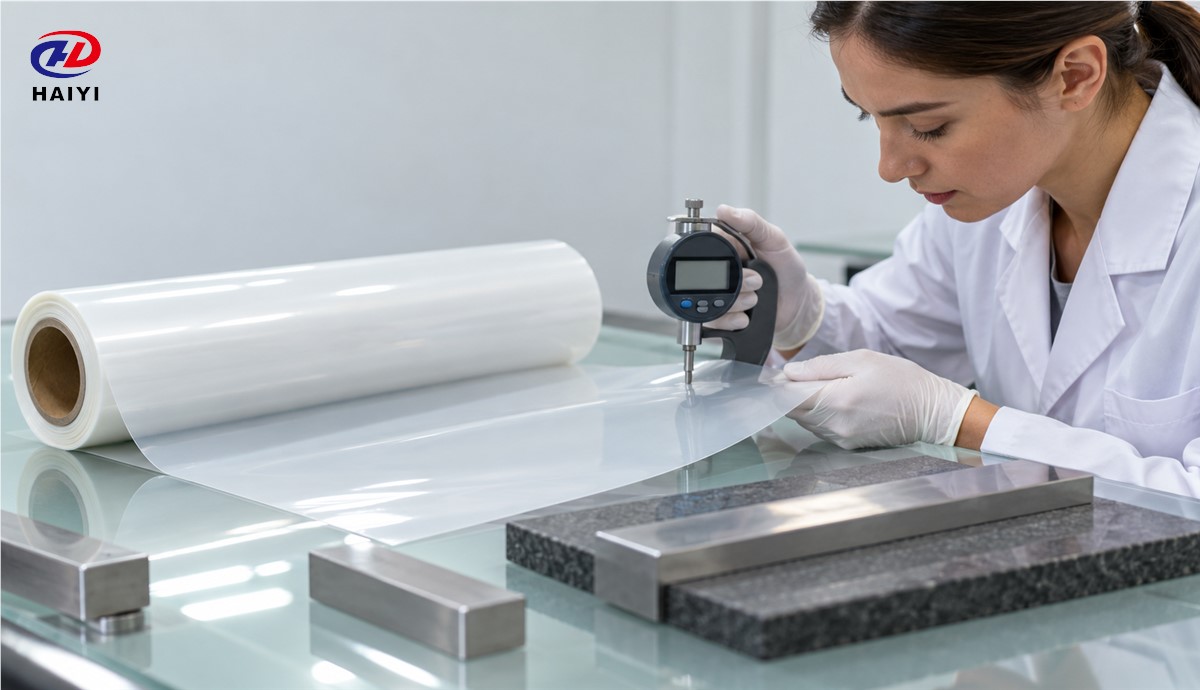
Ask for nominal thickness and tolerance, sheet or roll dimensions, printable-side designation, peel window, compatible ink system, recommended handling and storage conditions, batch identification and test methods. If the supplier cites anti-static performance or coating weight, ask for the method and acceptance range rather than a marketing adjective. The coating weight and uniformity guide explains how such data can be assessed.
How should a new material be qualified?
Use the same printer, artwork, ink, powder, cure and garment as the current approved film. Compare print sharpness, feeding, static, excess powder, peel behavior and washed garment appearance. Test more than one section of a roll and retain batch IDs. A film should be approved for a defined workflow, not simply because its base polymer is PET.
Need DTF film for wholesale or private label? Haiyi can discuss film formats and customization for distributors and production buyers. Contattaci with your ink, printer, peel preference and target quantity to plan a relevant sample evaluation.
FAQ
Is DTF film the same as ordinary PET sheet?
No. DTF film uses a carrier plus surface treatments designed for the printing and transfer process.
Does every DTF film have the same chemical formulation?
No. Coating design and backside treatment vary by supplier and product.
Does the PET remain on the garment?
No. The PET is a temporary carrier removed at the film’s specified peel stage.