





DTF Film Ultimate Buying Guide for Distributors and Bulk Buyers
A distributor-focused DTF film buying guide covering product selection, SKU planning, usable cost, compatibility evidence, packaging, and repeat supply.

Reading time: 13 minutes
The right DTF film is the film that runs reliably through a specific printer, works with the selected ink and powder, releases within the intended press workflow, produces an acceptable transfer on the target fabrics, and remains consistent across repeat orders. A buyer should therefore choose DTF film as part of a production system, not by selecting the lowest price, the thickest PET base, or the fastest peel label in isolation.
This DTF film ultimate buying guide is written for distributors, wholesalers, print shops, and private-label buyers who need more than a basic product comparison. The guide explains how to translate customer demand into a controlled film assortment, how to compare offers on usable cost, which evidence should support approval, and how to build a repeat-supply program without creating unnecessary SKUs.
What should a complete DTF film buying decision accomplish?
A complete DTF film buying decision should define the application, narrow the technical options, verify the full consumables system, compare commercial terms on a common basis, and document what must remain consistent after approval. A film that produces one attractive sample is not automatically suitable for distribution because a distributor must also manage stock, customer expectations, lot traceability, packaging, complaints, and reorders.
The most useful buying sequence moves from application requirements to product specification, then from controlled samples to a pilot order and repeatable supply. Buyers who need a detailed risk-based approval method can also use Haiyi's DTF film buying guide for sample, pilot, and bulk-order decisions. This article takes a different angle by concentrating on assortment architecture and wholesale purchasing controls.
Which information should be defined before comparing DTF film?
A buyer should define the printer format, feed method, ink system, powder, curing equipment, heat press, garment mix, artwork profile, production volume, operator routine, and storage environment before requesting quotations. These variables determine which differences between films are commercially meaningful and which differences are only labels.
Printer width establishes the usable film width, but width alone is not enough. A buyer must also confirm roll diameter, core size, winding direction, printable side orientation, tension behavior, and whether the film is intended for sheet feeding or roll feeding. A nominally compatible roll can still create waste if it does not fit the machine path or the buyer's gang-sheet layout.
The garment and artwork mix defines the performance challenge. Fine lines, solid color areas, dense white ink, stretch fabrics, workwear, and textured garments place different demands on ink reception, powder retention, release behavior, and the finished transfer. A distributor serving several customer groups should identify the largest repeatable demand segments instead of trying to promise one film for every possible job.
How do the main DTF film specifications affect a buying decision?
DTF film specifications should be read as interacting variables. PET thickness affects handling and mechanical stability, while the coating system affects ink reception and release. Peel classification affects operator timing, while width and format affect printer compatibility and material utilization. No single specification can predict the finished result without a controlled production test.
| Decision variable | What it changes | What the buyer should verify |
|---|---|---|
| Soyma davranışı | Press flow, cooling space, operator timing, and throughput | Document the supplier's peel window and test it under the actual press routine |
| PET kalınlığı | Stiffness, handling, feed stability, winding, and storage behavior | Compare nominal thickness with measured consistency and printer feeding |
| Coating system | Ink holdout, dot control, powder pickup, drying, and release | Evaluate multiple positions and more than one roll or lot |
| Single- or double-sided treatment | Loading discipline, backside friction, static behavior, and cost | Confirm which surfaces are treated and how the roll must be loaded |
| Surface finish | Handling cues and the appearance produced by the complete transfer process | Approve the finished garment, not the unused film's appearance |
| Width and roll format | Machine fit, layout efficiency, changeover frequency, and freight density | Confirm usable width, core, winding, length tolerance, and packaging |
The table is a screening tool, not a substitute for testing. For example, a thicker PET base may feed more predictably in one machine but create unnecessary stiffness or cost in another workflow. Haiyi's guide to DTF film kalınlığını seçmek explains why thickness should be matched to mechanical requirements rather than treated as a general quality grade.
How should hot peel, cold peel, warm peel, and instant peel be compared?
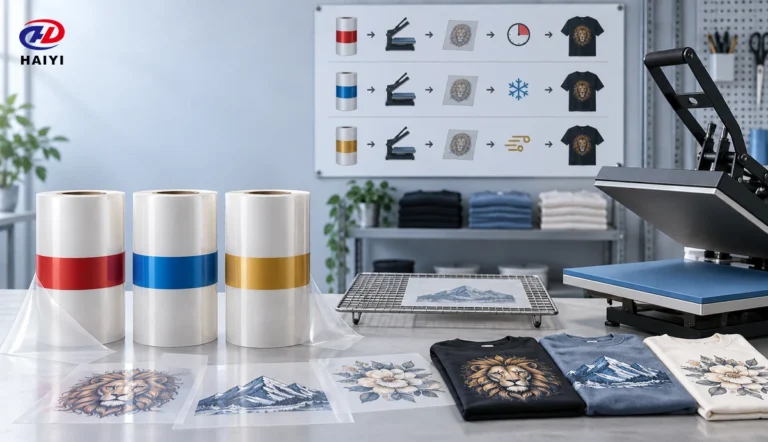
Peel terms describe when and under what conditions the carrier is removed after pressing. Cold peel normally requires a defined cooling period, hot peel is removed while the transfer is still hot, and warm or instant-peel products use their own specified window. The correct choice depends on the process window that the buyer can repeat, not on the fastest label.
A faster peel can shorten the handling cycle, but speed has value only when operators can reproduce the required temperature, pressure, dwell, and peel motion. A more forgiving cooling window can be valuable when substrates vary or when several operators share the same press. The comparison should therefore include accepted yield and rework, not just seconds per press.
A distributor should avoid translating peel categories into universal press settings. Each approved product should carry a documented operating range and should be tested with the intended consumables and fabrics. The hot peel, cold peel, and instant peel selection guide provides a deeper workflow comparison for buyers who need to choose between these operating models.
When are single-sided and double-sided DTF films useful?
Single-sided film has a designated printable surface and usually requires clear loading instructions. Double-sided treatment can make orientation easier and may be paired with backside properties intended to improve handling, but the term "double-sided" does not by itself define coating chemistry, anti-static performance, or printer compatibility.
A distributor should compare the two constructions by misloading risk, feed behavior, static tendency, surface identification, storage, and price. Double-sided treatment can be useful for customers who frequently handle sheets or who need a clearer loading routine, while a controlled roll-fed operation may prefer a simpler construction. The decision should be based on documented surface functions and a production trial rather than a generic assumption that more coating always means better quality.
How should a distributor build a practical DTF film assortment?
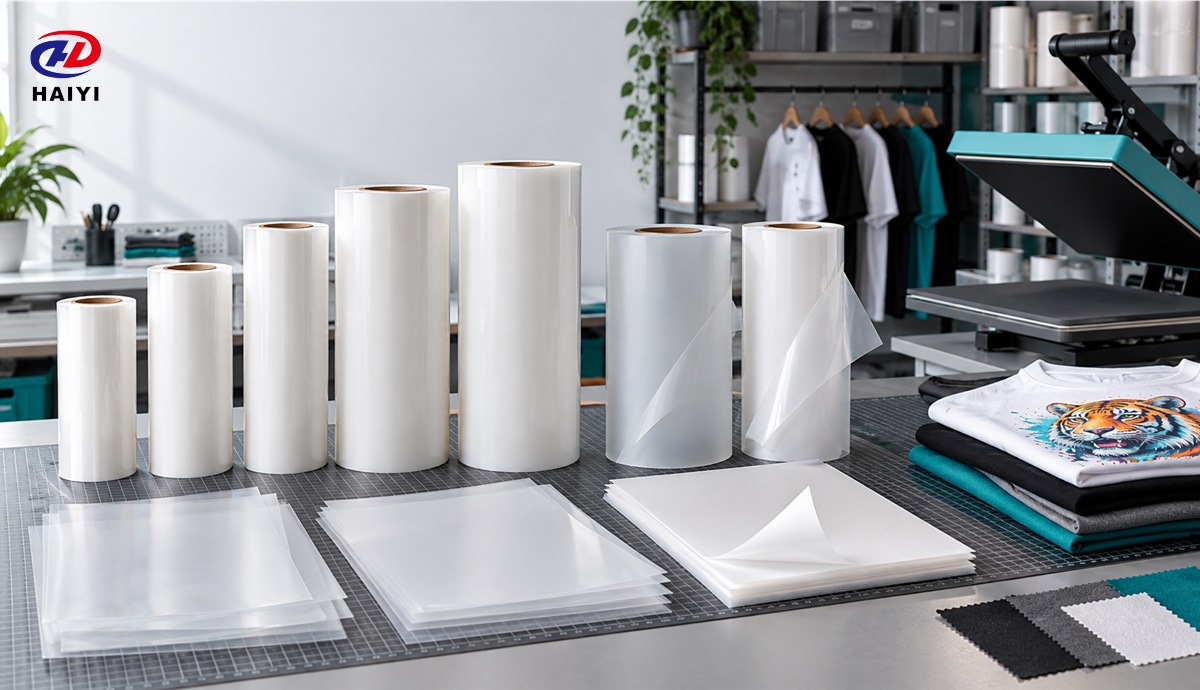
A practical assortment begins with customer jobs, not with every film a factory can produce. Each SKU should serve a defined role such as a core production film, a speed-oriented option, a detail-oriented option, a sheet format for smaller printers, or a private-label product for a qualified channel. Two SKUs that solve the same problem for the same customer may create inventory duplication rather than useful choice.
The first step is to map demand by printer width, peel workflow, customer type, and monthly consumption. The second step is to identify which combinations create enough demand to justify stock. The third step is to assign each SKU a stocking role: core, complementary, specialized, sample-only, or discontinued. This role determines inventory depth, reorder priority, and sales training.
A core SKU should cover a large, repeatable demand segment with a stable specification and a broad but verified process window. A complementary SKU should solve a real alternative need, such as a different peel routine or format. A specialized SKU should remain controlled until demand is visible because slow-moving film ties up cash and faces storage exposure. Haiyi's guide to building a profitable DTF film SKU matrix provides a dedicated method for contribution, inventory, and assortment decisions.
How can buyers compare DTF film cost fairly?
DTF film quotations should be normalized before price comparison. A buyer should convert every offer into the same currency, usable area, roll length, width, packaging unit, delivery basis, and tax treatment. Comparing only price per roll can be misleading when rolls have different widths, lengths, cores, tolerances, freight terms, or usable yields.
A simple area calculation is: nominal roll area equals roll width multiplied by roll length. A more useful operating calculation is: usable film cost per square meter equals landed roll cost divided by accepted usable area. Accepted usable area removes damaged edges, startup waste, rejected printing, and film lost to handling or coating defects.
Consider a hypothetical comparison. Film A has a lower landed price but produces more edge waste and more rejected transfers. Film B costs more per nominal square meter but produces a higher accepted yield and fewer interruptions. Film B can have the lower usable cost even though its invoice price is higher. The calculation becomes more accurate when labor, reprints, customer credits, and emergency replacement freight are included.
O DTF film toptan fiyat rehberi explains how MOQ, packaging, freight, payment terms, usable yield, and inventory exposure influence a bulk offer. Buyers should use the same cost model for every supplier so that a commercial comparison does not hide technical differences.
Why must DTF film be tested as part of a complete system?
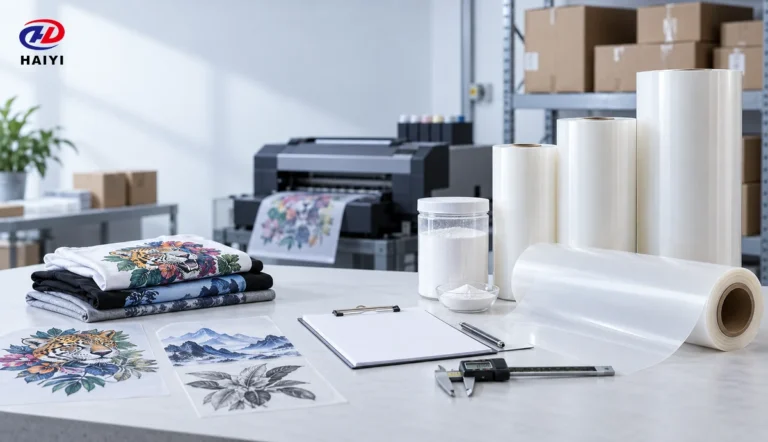
DTF film performance emerges from the interaction between the PET base, coating, printer feed, ink laydown, white-ink load, powder, curing conditions, heat press, garment, and operator method. A film cannot be declared compatible from a product sheet alone because a change in any linked consumable or process can change the result.
A controlled compatibility test should keep artwork, printer settings, ink, powder, cure method, press conditions, substrate, and inspection timing consistent while comparing a candidate film with an approved reference. The test should include demanding design elements such as solid fills, gradients, small details, fine lines, and areas with high white-ink coverage. The buyer should record observations at printing, powdering, curing, pressing, peeling, and after the finished transfer has stabilized.
Compatibility approval should answer several separate questions. Does the film feed without skewing or head contact? Does the surface hold the intended ink load without uncontrolled spreading? Does powder attach to the printed area without excessive contamination? Does the transfer release within a repeatable window? Does the finished garment meet appearance, stretch, adhesion, and care requirements? One attractive output cannot answer all of these questions.
Haiyi's step-by-step DTF consumables compatibility protocol shows how to compare film, ink, and powder as a defined combination. Buyers should retain the exact test settings and sample identity so the result can be connected to a later pilot and production lot.
Which quality evidence should support a bulk DTF film order?
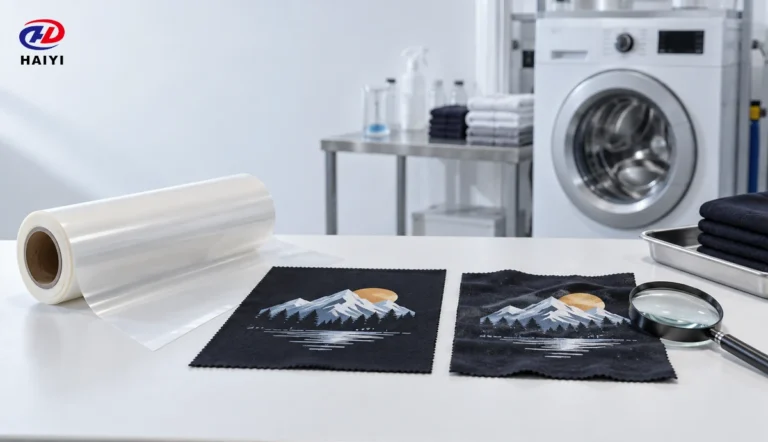
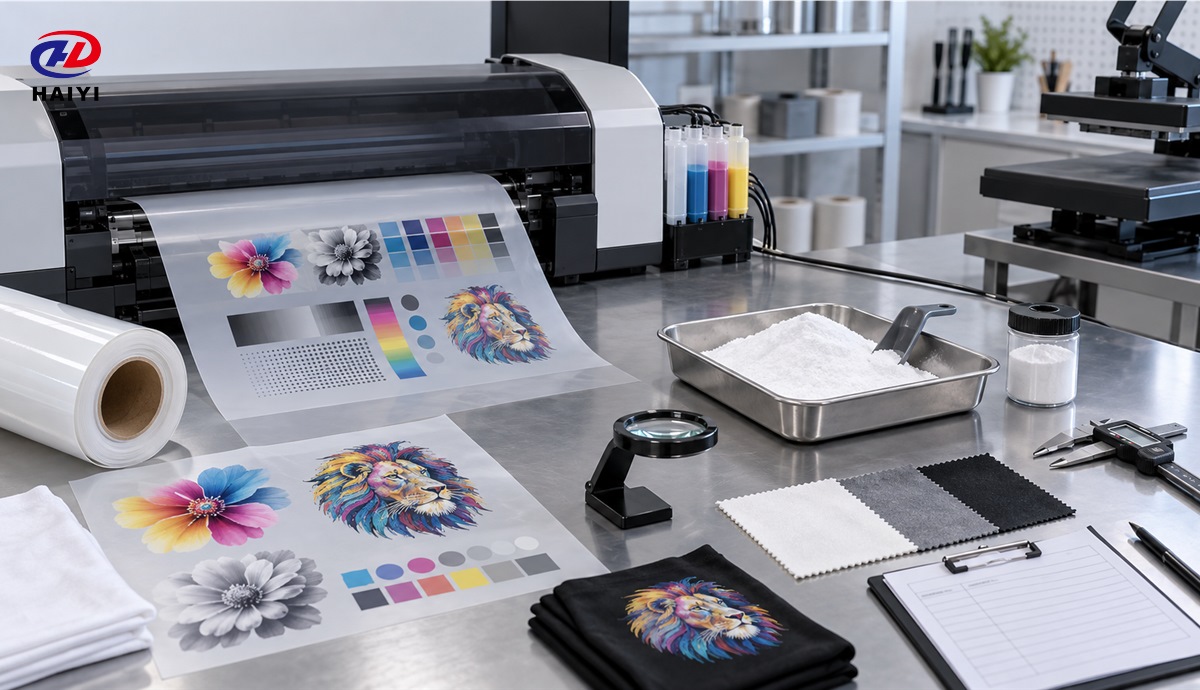
Useful quality evidence connects a defined product and lot to repeatable measurements. A buyer may review width, length, thickness, appearance, edge condition, winding, coating uniformity, release behavior, dimensional response to heat, and relevant finished-transfer results. The exact tests and limits should match the product, application, and risk rather than being copied from an unrelated supplier sheet.
Coating consistency should be evaluated across the web and along the roll because an average value can hide local variation. Buyers who need a measurement framework can review Haiyi's method for measuring DTF film coating weight and uniformity. Release should also be treated as a controlled behavior, not just a pass/fail impression; the DTF film release force testing guide explains how fixed geometry and consistent specimens improve comparison.
A certificate of analysis is useful only when it identifies the product, lot, test method, result, acceptance limit, and approval status. A generic document without traceability cannot demonstrate that the shipped film matches the tested sample. The buyer should agree on which results belong in the order documentation and how out-of-limit findings will be handled.
What is the correct path from sample to repeat order?
The safest path is sample, controlled trial, pilot order, bulk release, and monitored reorder. A sample establishes initial compatibility. A pilot exposes longer-run feed, winding, handling, packing, and operator effects. A bulk release confirms that the production lot matches the approved reference. A reorder verifies that the supplier can reproduce the specification over time.
Sample approval should record the sample code, lot identity when available, date, equipment, consumables, settings, substrates, artwork, observations, and decision. A buyer should not approve an anonymous sheet and later assume that any film sold under the same marketing name will be identical.
The pilot order should be large enough to reveal routine production behavior but limited enough to contain risk. The correct quantity depends on the customer's consumption, machine, supply lead time, and cost of failure. The buyer should predefine acceptance criteria and escalation rules rather than deciding after results are known.
Which commercial terms matter in wholesale DTF film purchasing?
Wholesale terms should specify more than unit price. A complete quotation should identify the construction, peel method, nominal thickness, width, length, core, winding, packaging quantity, MOQ, sample policy, production lead time, delivery basis, payment terms, label requirements, carton marks, documentation, and claim procedure.
MOQ should be interpreted by product and customization level. A stocked standard roll may support a lower trial quantity, while custom coating, slitting, printed cores, branded cartons, or mixed-SKU packing may require a larger production commitment. Buyers can use Haiyi's overview of typical wholesale DTF film MOQ structures to separate samples, pilots, standard orders, and customized programs.
Lead time should distinguish material preparation, coating or conversion, slitting, printing, packing, inspection, and transport. A promised shipment date has limited value unless both parties agree on when specifications and artwork are frozen. Reorder planning should also include safety stock, forecast updates, and an escalation path for urgent demand.
How should packaging and traceability be specified?
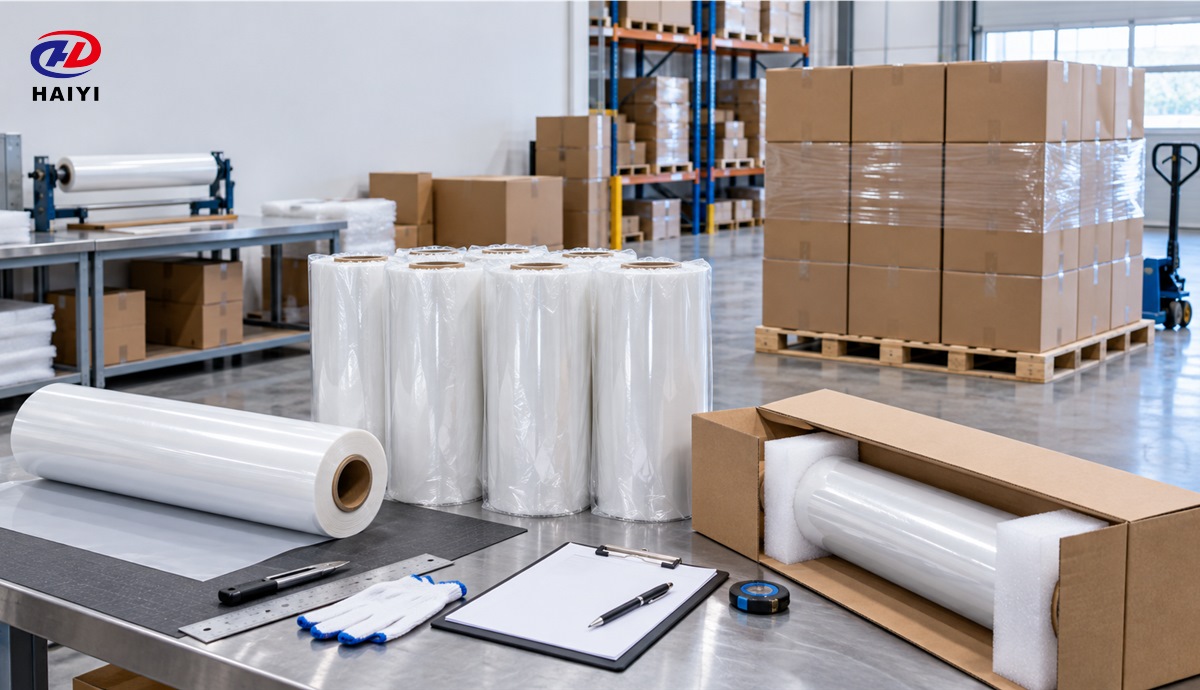
DTF film packaging should protect roll edges, surfaces, cores, and moisture-sensitive coatings through storage and transport. The buyer should define individual wrapping, end protection, carton strength, roll orientation, labels, pallet requirements, and any limits on stacking or compression. Packaging should be validated against the actual transport route rather than judged only by appearance.
Traceability should connect the carton and roll to the production lot and purchase order. A useful label may include the product code, dimensions, peel category, quantity, lot code, and production or inspection reference. The exact content depends on the buyer's inventory system and market requirements, but the code must remain readable and unique.
Private-label buyers should approve artwork, color, materials, regulatory wording, carton marks, barcode rules, and change control before mass printing. Haiyi explains the commercial sequence in its guide to Dağıtımcılar için özel etiketli DTF film. Packaging approval and film approval should remain separate decisions because a correct carton cannot compensate for an unapproved production lot.
How can a buyer assess a DTF film supplier?
A supplier assessment should determine whether the organization can identify the agreed product, control production and conversion, inspect relevant characteristics, isolate nonconforming material, preserve lot traceability, protect goods during packing, and respond to complaints with evidence. A polished sample room does not prove that these controls operate during routine production.
Buyers should request records that match the proposed order. Useful evidence may include a specification, sample identification, inspection plan, lot record, retained-sample process, packing standard, change-notification rule, and corrective-action workflow. The depth of review should increase when the program involves private labeling, multiple markets, large inventory exposure, or customer-specific performance requirements.
Haiyi's DTF film tedarikçisi denetim kontrol listesi organizes these questions into scope, process control, testing, traceability, findings, and corrective-action closure. A remote review can screen documentation, but high-risk programs may also require direct process evidence or an on-site assessment.
What should be included in a DTF film RFQ?
A DTF film request for quotation should make competing offers comparable. The RFQ should include the intended market, printer format, sheet or roll form, width and length, core and winding, nominal thickness, peel requirement, printable-surface requirement, expected order volume, packaging, private-label scope, delivery destination, Incoterm, sample quantity, required documentation, and target schedule.
The RFQ should also state what must be proven before bulk release. Buyers can request representative samples, a controlled compatibility trial, a pilot lot, agreed acceptance criteria, and lot-specific documentation. If an important requirement is not written in the RFQ or purchase specification, it may be difficult to enforce after production.
Which DTF film buying mistakes create the most avoidable cost?
- Buying by peel label alone: A peel category does not define the whole coating system or prove compatibility with the buyer's process.
- Using price per roll as the only comparison: Different dimensions, yields, freight terms, and rejection rates make roll prices incomparable.
- Adding too many similar SKUs: Duplicate choices split inventory, confuse sales teams, and increase slow-moving stock.
- Approving an untraceable sample: A successful anonymous sample cannot reliably control the production lot supplied later.
- Changing several consumables at once: Simultaneous changes make it difficult to identify the cause of improvement or failure.
- Assuming one setting is universal: Film, ink, powder, fabric, equipment, and environment can require different validated windows.
- Ambalaj ve depolama koşullarını göz ardı edersek: A technically acceptable film can arrive damaged or deteriorate when protection and inventory rotation are weak.
Frequently asked questions about buying DTF film
What is the best DTF film for every printer?
No single DTF film is best for every printer because feed path, consumables, curing, press conditions, fabrics, artwork, and operator routines differ. The best choice is the film that passes a controlled compatibility test and remains consistent within the buyer's documented production window.
Is hot peel always better for wholesale production?
Hot or instant peel can support faster handling, but speed is useful only when accepted yield remains stable. A cold or warm peel workflow may produce better commercial results when cooling space is available and the operation values a wider timing margin.
Does thicker DTF film mean higher quality?
Thickness is a mechanical specification, not a complete quality grade. A thicker base can improve stiffness or handling in some equipment, while coating consistency, release behavior, heat response, and system compatibility determine other important outcomes.
How many DTF film SKUs should a distributor stock?
A distributor should stock only enough SKUs to cover verified customer segments without creating duplicate roles. Core products deserve inventory depth, while specialized widths, peel types, or packaging options can remain sample-led or order-based until demand supports stock.
What should a buyer approve before placing a bulk order?
A buyer should approve the product specification, representative sample, compatibility result, pilot performance, acceptance criteria, packaging, traceability, commercial terms, and change-control expectations. Approval should identify the exact sample or lot so the bulk shipment can be compared with a known reference.
Build a controlled DTF film supply program with Haiyi
Haiyi provides wholesale and customized DTF film programs for distributors, importers, print-supply businesses, and production users. A productive inquiry should include your printer width, preferred peel workflow, target fabrics, expected volume, packaging requirements, destination market, and any private-label needs so the discussion can begin with the correct product and validation path.
For product options, samples, bulk quotations, customized specifications, packaging, or repeat-supply planning, Haiyi ile iletişime geçin. Haiyi can help B2B buyers compare suitable formats, organize sample evaluation, and define the commercial details required for a stable wholesale program.