






How to Choose DTF Ink: Compatibility, Stability, and Batch Control
Choose DTF ink by printhead compatibility, white ink stability, film interaction, sustained-flow testing, batch control, and accepted-output cost.

Reading time: 7 minutes
The right DTF ink is the ink that is explicitly compatible with the printer and printhead, remains stable in the ink path, produces controlled droplets on the selected film, works with the powder and cure process, transfers correctly to the target garments, and stays consistent across repeat batches. Color brightness or a low bottle price cannot prove those requirements.
This buying guide helps print shops, distributors, and production teams compare DTF ink without relying on unsupported universal specifications. It covers CMYK and white ink, compatibility evidence, sample testing, maintenance, batch control, usable cost, and supplier documentation.
What information should be defined before choosing DTF ink?
A buyer should define the printer model, exact printhead, ink-delivery system, white-ink circulation method, RIP software, film, powder, curing equipment, heat press, garment mix, production volume, maintenance routine, and room conditions. These details determine whether a supplier’s ink is a realistic candidate.
Do not accept a statement that an ink works with every DTF printer. Printheads and ink paths differ in nozzle design, firing behavior, materials, flow, filtration, and maintenance. Ask the printer or ink supplier to confirm compatibility in writing for the exact configuration and to explain the required flush or conversion procedure before changing chemistry.
How do CMYK and white DTF inks perform different jobs?
CMYK inks create the color image, while white ink creates an opaque underbase and the wet surface that receives adhesive powder. CMYK evaluation emphasizes color accuracy, gamut, gray balance, droplet control, and batch consistency. White ink evaluation also emphasizes settling, redispersion, circulation, sustained flow, opacity, coverage, and interaction with powder.
| Evaluation area | CMYK concern | White ink concern |
|---|---|---|
| Printhead compatibility | Stable jetting and correct drop formation | Stable jetting with dense pigment and circulation requirements |
| Visual result | Hue, neutrality, gradients, detail, repeat color | Opacity, uniformity, no pinholes or banding |
| Film behavior | Sharp dots without beading or feathering | Controlled wet layer that holds powder consistently |
| Storage behavior | No separation, contamination, or irreversible change | Controlled settling and reliable redispersion under the approved routine |
| Production risk | Color drift, clogged nozzles, weak gradients | Settling, starvation, clogging, air, uneven underbase, excess ink load |
Why is white ink stability especially important?
White ink contains a high concentration of dense pigment. That pigment naturally tends to settle, so a DTF system normally relies on controlled agitation or circulation plus regular operation and maintenance. An ink that looks acceptable after bottle shaking may still behave poorly in tubing, dampers, filters, and the printhead during a full production run.
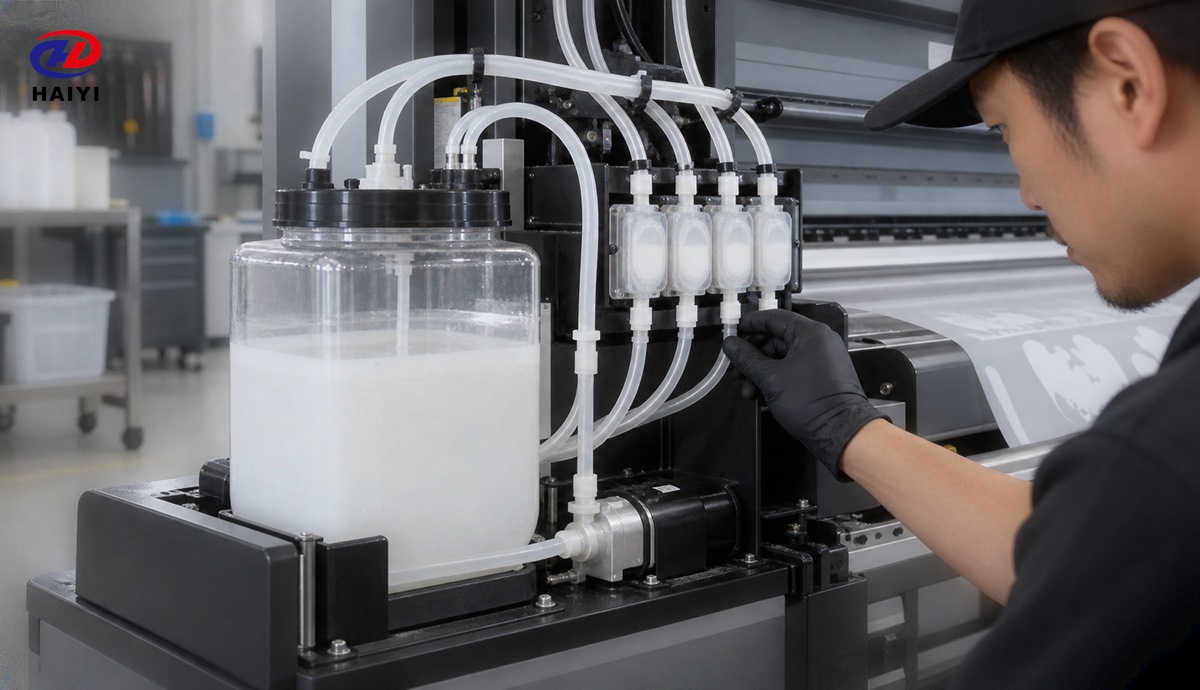
Evaluate white ink after realistic idle periods and sustained printing, not only after a fresh refill. Record whether the ink redistributes under the approved routine, whether nozzle performance remains stable, and whether opacity changes from the beginning to the end of a job. Follow equipment guidance because too much agitation can introduce air in some systems.
Which technical data should a DTF ink supplier provide?
A useful supplier file should identify the product and batch, intended printhead or printer compatibility, storage range, shelf life, handling method, safety information, circulation or agitation requirements, recommended operating conditions, and changeover procedure. Technical properties such as viscosity, surface tension, particle distribution, and pH are meaningful only with a stated test method and temperature.
Do not compare isolated numbers measured by different methods as if they were directly equivalent. A narrow viscosity claim does not prove jetting stability, and a wide color-gamut claim does not prove accuracy with the buyer’s printer, RIP, film, profile, and garment. Use documents to screen candidates, then use production tests to approve them.
Does neutral pH prove that an ink is safe?
No. pH can matter for material compatibility, but it does not by itself prove that an ink is safe for a printhead or ink path. Corrosion, swelling, seal compatibility, sediment, filtration, particle behavior, preservatives, and long-term storage also matter. The equipment and ink suppliers should confirm compatibility for the exact system.
Avoid home tests that leave open ink exposed for weeks and then treat the result as production evidence. Evaporation, dust, microbial contamination, and uncontrolled temperature make that comparison unreliable and unsafe for the printer.
How should DTF ink be tested before a bulk purchase?
A DTF ink sample should be tested in a controlled, traceable sequence that protects the printer. Confirm whether flushing is required before introducing the sample. Do not mix unknown formulations in the same tank or line because chemical incompatibility can cause flocculation, clogging, or unstable color.
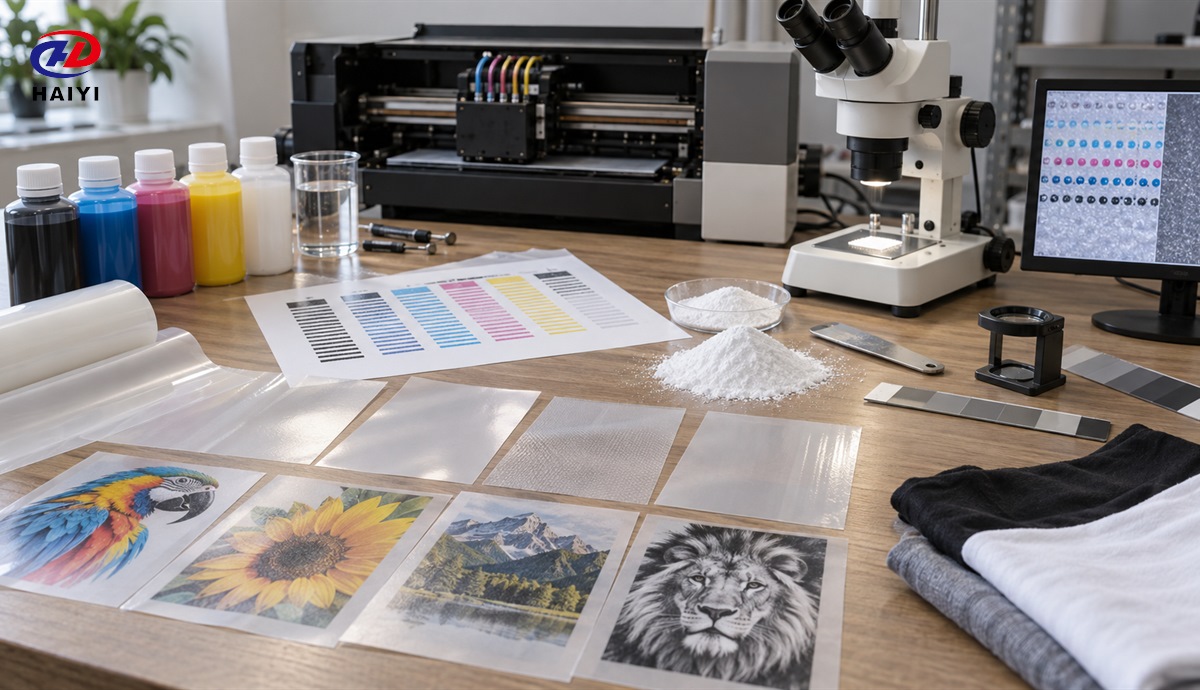
- Review compatibility and conversion instructions. Protect the printhead before the sample enters the ink path.
- Record the baseline. Save current nozzle checks, color output, white opacity, maintenance frequency, and accepted samples.
- Verify jetting. Check nozzle recovery, sustained printing, banding, misting, drop placement, and idle restart.
- Verify film interaction. Inspect dot sharpness, color-to-white registration, wetness, feathering, and powder pickup.
- Verify cure and transfer. Use the intended film, powder, oven, press, peel window, and fabrics.
- Verify durability. Test stretch, wash, rubbing, and end-use requirements under one documented method.
- Repeat across batches. One attractive sample does not prove supply consistency.
Haiyi’s DTF consumables compatibility protocol provides a broader system-level test that includes film and powder.
What should a sustained-flow test reveal?
A sustained-flow test should show whether nozzle performance, white opacity, and color output remain stable during a production-length job. Compare nozzle checks and printed control areas before, during, and after the run. A printer that starts clean but loses white after several minutes may have a circulation, damper, filter, air, temperature, or flow problem that a short test misses.
Keep the artwork and film width representative of real work. Small test patches may not create the same white-ink demand as a wide gang sheet with large solid areas. Record ink consumption, cleaning cycles, waste, and rejected length because these affect usable cost.
How should color performance be evaluated?
Color performance should be evaluated with the actual printer, RIP, profile, film, white underbase, powder, press process, and garment. Compare neutrals, saturated colors, gradients, skin tones where relevant, fine lines, and shadow detail. Measure color when the buyer has a defined tolerance, but also retain an approved visual reference.
Changing ink can invalidate an existing profile. A new ink may require linearization and profiling rather than a simple density adjustment. Do not force color by increasing ink load until the film becomes too wet; solve color management and droplet control together.
How should drying and film wetting be judged?
DTF ink must remain wet enough for powder application but controlled enough to hold the intended dot and underbase shape on the film. Ink that spreads can create blurred edges and powder halos. Ink that dries too far before powdering can create bare or weak adhesive areas.
The result belongs to the ink-film-environment system. Surface tension and viscosity matter, but the film coating, printing side, ink density, platen or room temperature, humidity, and time to powder also change wetting. Haiyi’s DTF ink-spreading diagnostic guide explains how to isolate those causes.
How should DTF ink storage and changeover be controlled?
Store ink sealed within the supplier’s stated temperature and light conditions, preserve batch labels, use first-in-first-out inventory, and avoid contamination during refilling. Allow cold ink to condition while sealed before use when temperature change could create condensation.
Before changing ink, obtain a written flush and conversion procedure that covers tanks, lines, dampers, filters, caps, and waste. Never pour a new formulation into a partly filled system merely because both products are called DTF ink. Preserve a sample of the old and new batch when diagnosing a transition.
How should wholesale DTF ink batches be inspected?
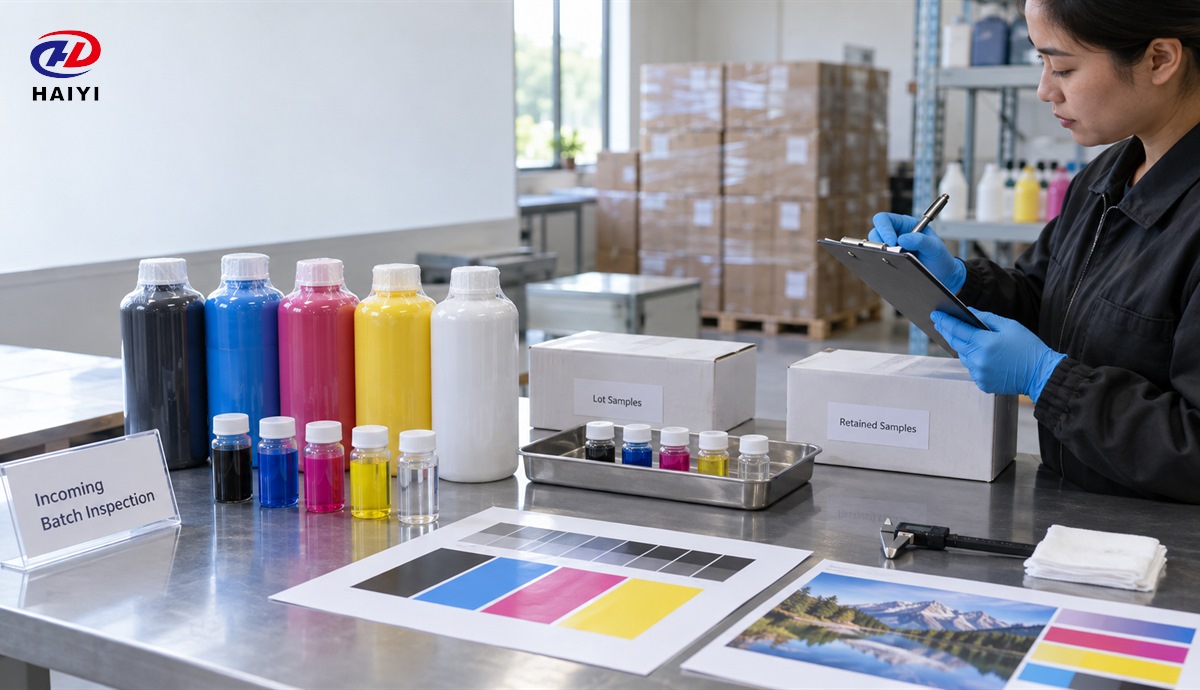
Receiving inspection should confirm product identity, batch, quantity, packaging integrity, manufacture or expiry information where supplied, storage exposure, safety documents, and any abnormal separation or leakage. Quarantine damaged or questionable units instead of combining them with released stock.
Run an agreed incoming test before releasing a large batch. Link the test result to the ink lot, film lot, powder, printer, RIP preset, and control artwork. A retained sample helps determine whether a later change came from the received ink or the production environment.
How should DTF ink cost be compared?
Compare DTF ink by cost per accepted output, not bottle price. Include ink consumption, white coverage, cleaning ink, flushed ink, maintenance, downtime, rejected film, reprints, profiling, operator time, and printhead risk. An ink with a lower purchase price can cost more if it increases waste or service work.
Preguntas frecuentes
Can different DTF ink brands be mixed?
Do not mix ink formulations unless the responsible suppliers explicitly approve the combination. Different dispersants and additives can react, destabilize pigment, change flow, or damage the ink path.
Is the brightest DTF ink the best choice?
No. Brightness must be balanced with color accuracy, jetting stability, film wetting, white opacity, cure, transfer, durability, and repeat-batch consistency.
How long should an ink sample be tested?
The sample should cover realistic startup, sustained production, idle restart, maintenance, transfer, and durability behavior. One short print cannot reveal long-run white flow or batch consistency.
Build a compatible DTF consumables system with Haiyi
Haiyi supplies wholesale and customizable DTF film for distributors, print shops, and private-label buyers. Haiyi film samples can be evaluated with the buyer’s selected ink, powder, printer, curing line, heat press, and garments before a bulk order. Review the DTF film buying guide or Contactar a Haiyi with your printer, printhead, ink system, film width, peel requirement, monthly volume, and target fabrics.