Transparent-Liner vs Paper-Liner UV DTF Film: Practical Differences
Compare transparent PET and paper UV DTF A-film liners for print feeding, registration, A/B pairing, inspection, adhesion testing and wholesale sourcing.

Kurze Antwort: Transparent-liner and paper-liner UV DTF A films can both produce high-quality transfers, but their backing materials change how the film feeds, how easily operators see and position a design, how the roll responds to storage conditions, and how it releases during transfer. A transparent PET liner may help visual registration and dimensional consistency; a paper liner can provide an opaque, easy-to-handle backing and may fit an established production setup. Neither choice is inherently better for every printer. Test the A film, B film, ink, laminator, and target surface as one system before buying in volume.
The most important clarification is what the word liner means. In this article, it means the removable backing associated with UV DTF A film, not the clear B transfer carrier and not a white ink layer that remains in the finished graphic. Suppliers sometimes use paper base, white base, backing paper, clear base, and transparent liner inconsistently. Ask for a layer diagram and identify exactly which layer is removed. An opaque paper liner does not automatically leave a white background on the product; final opacity depends on the layers that actually transfer, including the printed white ink.
This comparison is written for print shops, distributors, and B2B buyers who need repeatable UV DTF production. Haiyi’s A film and B film pairing guide explains the overall transfer bond sequence. The narrower decision here is whether a transparent or paper liner better suits a given machine, workflow, design, and buying program.
Where does the liner sit in a UV DTF transfer?
UV DTF normally uses an A film that receives UV-cured ink and an adhesive layer, followed by a B film that carries the printed image to a rigid object. The protective or release liner is part of the A-film construction while the print is made and handled. Depending on the equipment design, a protective layer may be removed before printing, and the A-film support is separated when the printed design is picked up by B film. A buyer must confirm the exact layer order for the supplier’s product rather than assuming every roll is assembled identically.
The working transfer has three handoffs: the image must remain stable on the printing surface during printing; B film must collect the cured image during lamination and separation; the image must then adhere to the object while B film releases. The liner can influence the first two handoffs through stiffness, coating, release force, and handling. It does not replace a suitable B film, proper cure, or a clean target surface.
A simple receiving-room check is to label the roll’s top and bottom surfaces, peel only the layer specified by the supplier, and compare the exposed surface with the printer’s loading diagram. This prevents an expensive mistake: loading the wrong side, exposing adhesive too early, or treating B film as the liner. Haiyi’s UV DTF process article covers the full sequence from A film through application.
How do transparent PET and paper liners compare in practice?
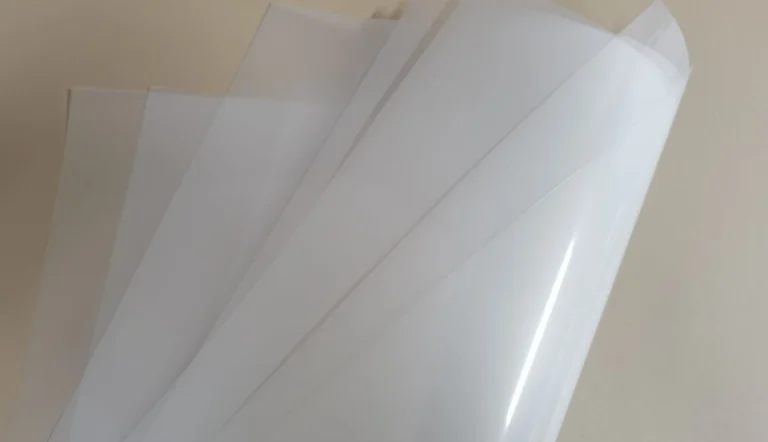
A transparent PET liner allows the operator to view a printed image or registration reference through the backing where the construction permits it. This can help manual placement and inspection, particularly for small isolated artwork or a clear substrate. PET is also less sensitive to ambient moisture than ordinary paper, although the whole multilayer film can still curl or block if its coatings, winding tension, or storage are poor. Transparency is an operational aid, not proof of superior adhesion.
A paper liner provides an opaque background and a familiar handling feel. The opacity can make certain print defects or white-ink coverage easier to see during visual inspection, while the material may provide useful stiffness in some sheet-feeding setups. Paper can absorb or release moisture, so flatness and release should be checked after storage in the buyer’s real climate. Coated paper products differ widely; the term paper liner alone does not predict curl, peel force, or machine compatibility.
| Comparison point | Transparent PET liner | Paper liner | What to verify |
|---|---|---|---|
| Visibility through backing | Usually possible | Usually blocked | Whether operators need see-through positioning |
| Humidity response | PET itself is less moisture-absorbing | Paper may change dimension or flatness | Conditioned roll feeding in your climate |
| Visual quality checks | Useful for registration and edge viewing | Opaque contrast may aid white-ink inspection | Inspection method and lighting |
| Feed and stiffness | Depends on PET gauge and coating stack | Depends on basis weight and coating | Actual printer and laminator trial |
| Release behavior | Determined by release coating and pair | Determined by release coating and pair | Fine-detail pickup with approved B film |
| Final transfer appearance | Not determined by removable liner alone | Not determined by removable liner alone | White ink, adhesive, and retained layers |
These are tendencies to test, not universal rankings. A heavy PET construction can be stiffer than a thin paper construction. A carefully coated paper liner can release more consistently than a poorly coated PET liner. A sample specification needs measurable thickness, width tolerance, winding quality, release behavior, and accepted print result before the materials can be compared fairly.
Does liner transparency change the finished label’s color or opacity?
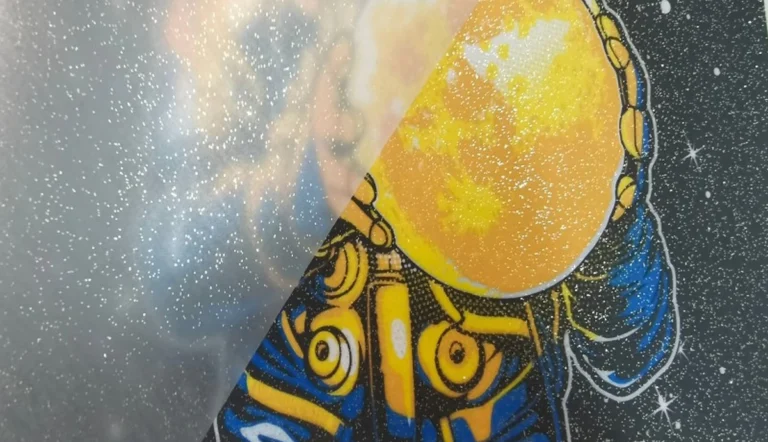
Usually the removable liner does not remain on the product, so its color should not be assumed to define the finished transfer. Final color and opacity depend on the artwork, UV ink sequence, white-ink underlayer, adhesive or primer, varnish, and any film or coating that stays with the graphic. A white paper backing can make an unfinished transfer look more opaque on the bench even when the same artwork appears different after application.
Ask the supplier to show the finished transfer on the buyer’s actual surfaces, including transparent glass, dark plastic, metal, and coated objects if those matter. Inspect the same artwork against light and dark backgrounds. If the graphic needs a white base to keep colors vivid on a dark object, specify white-ink coverage and registration as a print requirement. Do not attempt to solve a missing white-ink layer by changing only the disposable liner.
Confusion is understandable because some catalogues call a complete construction a white base or transparent base. In one product, base may mean the removable A-film liner; in another, it may include a layer that affects the finished graphic. A layer cross-section, peel sequence, and before-and-after sample settle the question more reliably than a product nickname. This distinction is especially important for distributors who compare quotations from several coating lines.
Which liner is easier to feed through a UV DTF printer?
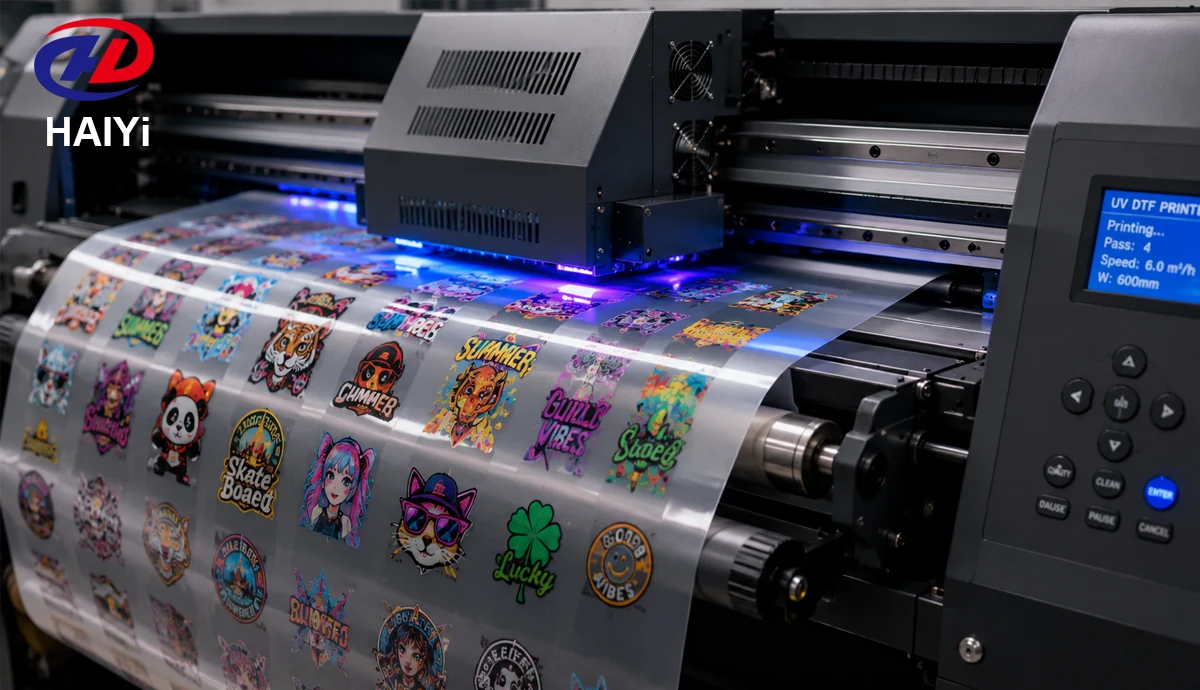
Printer compatibility depends on the complete roll, not just whether its backing is PET or paper. Check width, core size, overall caliper, stiffness, surface friction, winding tension, edge quality, and how the machine detects media. Some optical sensors may need a setting or mark adjustment for clear media; other printers are built to handle clear stock without difficulty. A paper-backed film may be easier for one feed mechanism and less stable in another.
Run the same printed file through both candidates at the intended production speed. Record skew, edge tracking, head-strike risk, curl, wrinkling, static, and take-up behavior. Evaluate the first meters and the middle and end of a roll. A sample sheet that feeds perfectly does not prove a full roll will maintain alignment as diameter and tension change.
Paper’s moisture response matters most when rolls move between different temperatures or humidity levels. Allow packaged film to stabilize before opening if the supplier recommends it, and compare flatness after the conditions the buyer actually faces. Transparent PET can also distort under heat or uneven tension, so test it under the selected UV lamp power and laminator settings rather than treating dimensional stability as unconditional.
How does the liner affect A-to-B film lamination?
The liner supports the A-film construction as the printed image moves into lamination. Its stiffness and flatness can influence wrinkle formation and pressure uniformity, especially across a wide roll. The more important performance question is whether the selected B film reliably lifts the cured image without leaving fine details behind or pulling unwanted material along. A B film that passes with one A-film construction should be retested when the liner or release coating changes.
Use a matched A/B pair or obtain documented cross-compatibility for a mixed supply. The lamination trial should include thin lines, small text, solid ink areas, isolated dots, and any raised varnish or foil effect sold to customers. Record nip pressure, temperature if used, speed, and the interval between print and lamination. These settings can change the outcome more than a visual difference between clear and white backing.
If small elements remain on A film, do not immediately blame the liner. Possible causes include insufficient B-film pickup, under- or over-curing, print-layer geometry, and nonuniform lamination. If the complete image transfers to B but will not stay on the product, examine the target surface and adhesive side rather than changing A film at random. The UV DTF quality standards guide provides a broader inspection framework; a liner comparison should hold other variables steady.
Which liner helps manual positioning and small-detail work?
Transparent backing can be useful when an operator needs to see the target through the transfer assembly before final pressure is applied. That advantage matters for a centered logo on glass or a curved product with a precise start line. However, the B transfer carrier may itself be clear, so the benefit of a transparent A liner depends on which layer is present at the moment of positioning. Confirm the actual application sequence before buying for visibility alone.
Paper backing can offer higher visual contrast when inspecting ink coverage and edge quality before transfer. It may also give an operator a firmer sheet to hold during certain manual steps. Those advantages are less relevant in a fully roll-fed process where alignment is controlled by the printer and laminator. The correct criterion is operator error rate on the intended job, not personal preference after handling one sheet.
Test with difficult designs rather than a large solid rectangle. A useful pattern contains narrow lettering, detached punctuation, a transparent window, a white area, and a curved application. Count failed pickups, bubbles, registration shifts, and rework. A buyer can then decide whether the added visibility or handling feel saves enough labor to justify a stock keeping unit.
Does either liner guarantee stronger adhesion on glass, metal, or plastic?
No. The removable backing is not the primary bond between the finished graphic and the object. Adhesion depends on the transfer’s adhesive layer, cure, film pairing, contact pressure, surface cleanliness, surface energy, texture, and service conditions. A transparent-liner version can outperform a paper-liner version if its adhesive formulation is better matched to the target, but that is a formulation result, not proof that transparency causes adhesion.
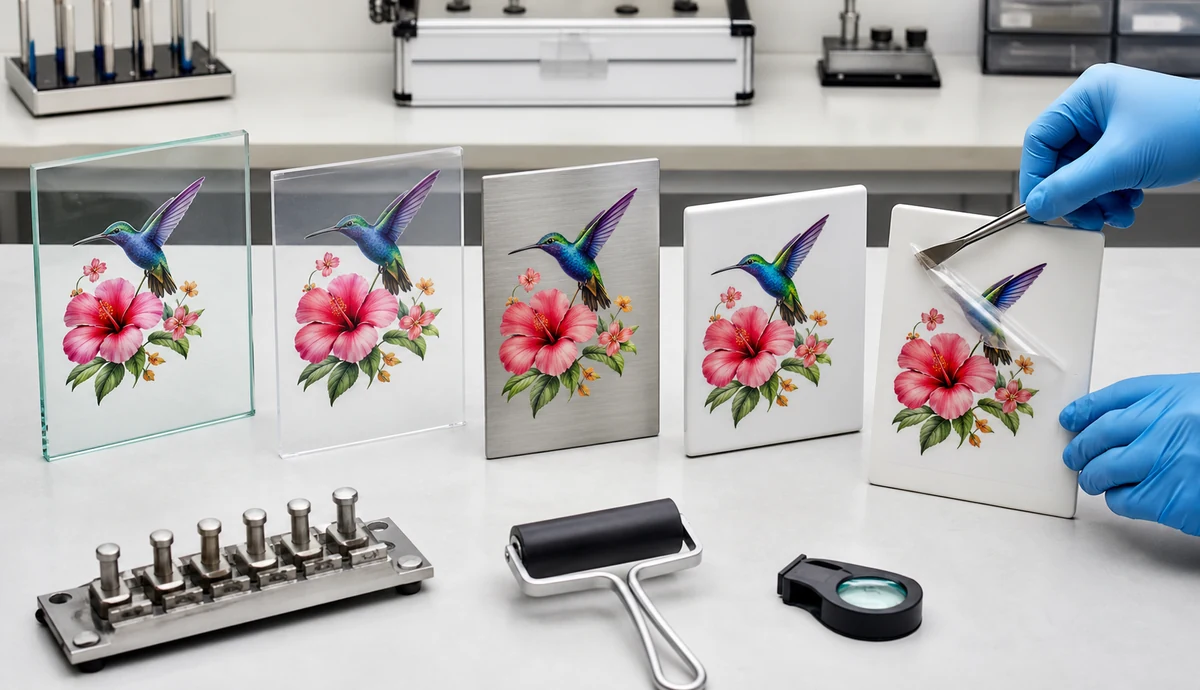
Evaluate samples on representative objects. Clean and condition the surfaces consistently, apply the transfer with the same pressure and dwell, then inspect immediate pickup and later edge lift. Include both easy and difficult substrates from the buyer’s customer base. Clear glass, powder-coated metal, smooth acrylic, and textured plastic can respond differently; a single demonstration on a clean ceramic tile is not a general durability test.
For B2B approval, define a practical pass criterion before testing. It may include complete fine-detail transfer, no visible edge lift after the agreed conditioning period, no unacceptable residue, and appearance after the intended handling or cleaning exposure. Do not advertise waterproof, outdoor, or dishwasher performance unless the particular film, ink, substrate, and test conditions support that claim.
What quality defects should incoming inspection look for?
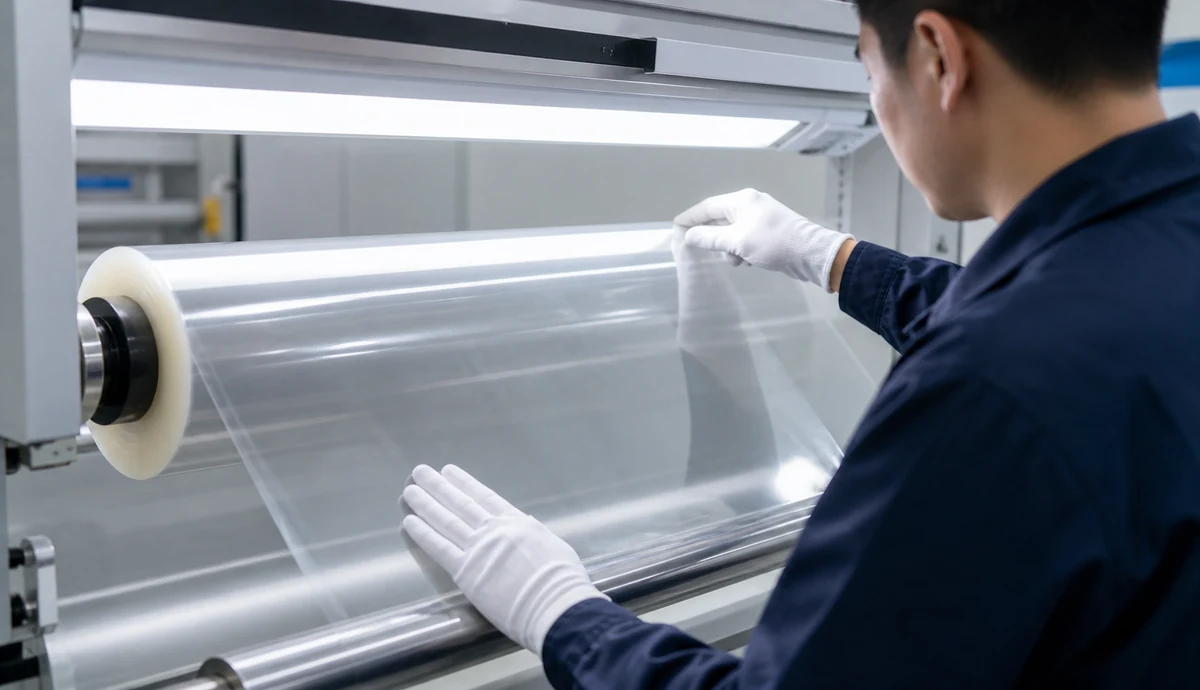
For either liner, inspect the roll before printing: edge damage, telescoping, uneven winding, contamination, blocking, coating streaks, surface scratches, width variation, and inconsistent protective covering. Look for exposed adhesive at the roll edge or signs that layers have shifted. A clear liner can make some contamination easier to spot, while paper may reveal other defects by contrast; neither replaces a documented inspection method.
Check the first and last sections of a roll rather than a single attractive sample. Record lot number, roll width, core, packaging condition, storage history, and date opened. Print a standard control file with the buyer’s ink and settings. Then laminate with the approved B film and apply to reference substrates. Separate visible film defects from process failures before making a claim to the supplier.
Paper-liner stock deserves attention to flatness after humidity exposure. Transparent PET stock deserves attention to static, optical-sensor behavior, and handling scratches where those matter to the machine. Both need release consistency across the roll. The acceptance limit should be a measured production outcome, such as usable transfer yield, not an unsupported statement that one liner is premium.
How should distributors compare costs and inventory risk?
Compare usable transfer cost rather than price per roll alone. Start with landed film cost, B-film pairing cost, print waste, rejected transfers, operator time, and returns. A film that costs slightly more but feeds reliably and reduces rework can be cheaper per accepted label. A low-price roll that only works with a narrow set of settings may create hidden training and troubleshooting costs.
Stocking both constructions can make sense if customer workflows differ. A transparent-liner SKU may serve shops that value see-through inspection or stable feeding in their environment; a paper-liner SKU may suit established printers or sheet-based handling. Inventory becomes harder when each A film requires a different B film or process profile. Label compatible pairs and keep their lot records together so distributors do not create a mixed-material failure at the customer site.
Ask suppliers whether the transparent and paper versions share the same printable coating, adhesive, release target, B-film specification, and recommended ink sequence. Do not assume the liner is the only changed variable. If the constructions differ in more than one layer, request separate samples and datasheets. A fair cost comparison requires the same artwork, printer, ink, B film, target surfaces, and acceptance criteria.
How can a buyer run a fair side-by-side liner trial?
First, define the product and machine: A-film width and format, printer model, UV ink set, B-film type, laminator, target substrates, normal room conditions, and intended run speed. Ask each supplier for its layer diagram and the material that actually remains on the finished object. Keep the approved settings for each construction documented; forcing both films to use one unsuitable setting would not be a fair capability test.
Second, use a fixed artwork panel with fine text, isolated dots, white coverage, a color gradient, a large solid area, and any specialty effect the business sells. Print several repeats from the front, middle, and end of each trial roll. Record feed issues, color and white registration, cure, lamination, A-to-B pickup, B-to-object release, and operator handling. Photograph failures in the same lighting so the supplier can review them.
Third, apply each transfer to the same prepared objects and inspect both appearance and adhesion after the agreed interval. Report usable yield and labor minutes, not only one attractive sample. Repeat with a second lot when the first result determines a large wholesale order. A supplier should be able to explain deviations and document any change in coating, liner, or B-film recipe before scaling production.
What should a wholesale RFQ specify?
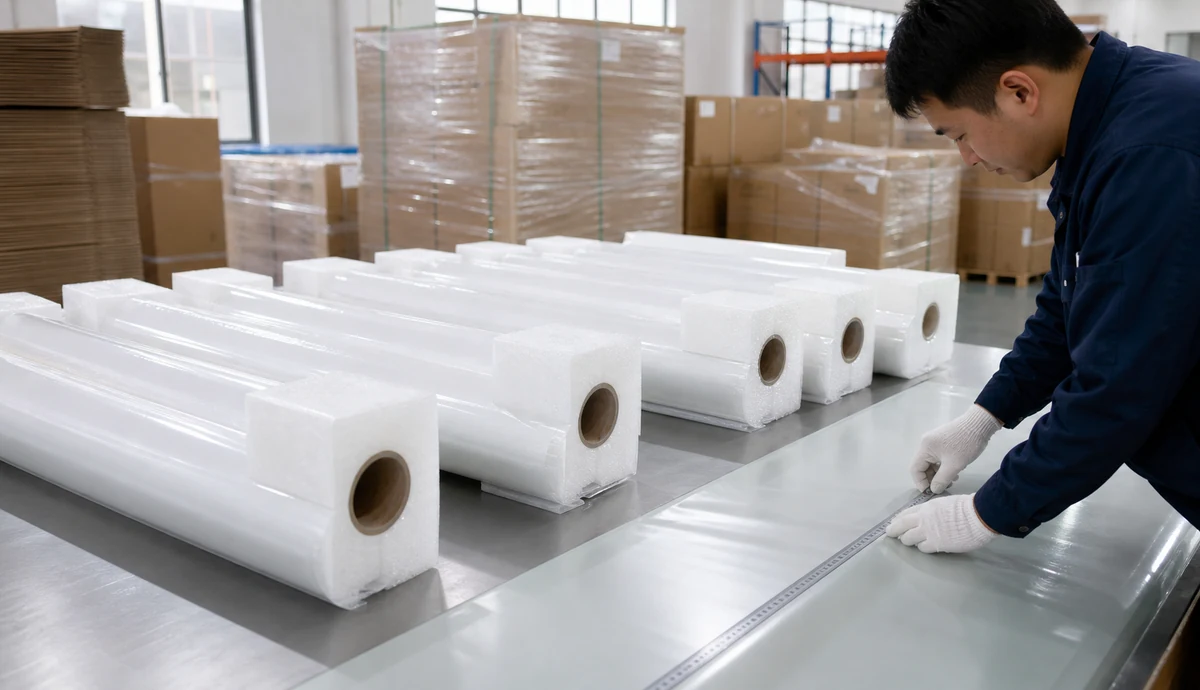
A useful request for quotation names the liner material and asks for a layer diagram, rather than accepting transparent or paper as a complete specification. State roll or sheet format, width, length, core, overall thickness, winding direction, printable side, protective layer, recommended storage conditions, and packaging. Identify the printer and B-film pairing, target surfaces, and required appearance. Ask which parameters are guaranteed, which are typical, and which require a customer trial.
The RFQ should also ask for lot identification, sample and production-run consistency, claims supported by test data, lead time, minimum order quantity, customization options, and a clear process for handling a failed incoming lot. If private-label packaging is needed, specify labeling and compatibility information on the carton. A buyer should receive enough information to reproduce the approved result after the first sample is gone.
Do not confuse a textile DTF heat-transfer film with UV DTF A/B film for hard-surface transfers. The two workflows differ in ink, adhesive, curing, and application. Haiyi’s UV DTF film guide explains the product category; the present RFQ should state the exact A/B construction to avoid ordering the wrong material.
Which liner should you choose?
Choose transparent PET liner when see-through handling matters, the printer accepts clear media reliably, and a controlled trial shows better productivity or consistency. Choose paper liner when the existing printer and operator workflow run it reliably, the opaque backing improves inspection or handling, and climate-conditioned samples meet the same transfer requirements. Choose neither based on appearance of the unused roll alone.
The strongest buying decision is a documented result on the buyer’s real equipment and products. Approve the A film with its B film, ink, cure, lamination, and application method. Compare accepted output per roll and repeat the test across lots. If performance is indistinguishable, select on total cost, availability, and the support the supplier can provide when settings or substrates change.
Häufig gestellte Fragen
Is paper-liner UV DTF film the same as printable paper?
No. Paper-liner UV DTF film is still a multilayer transfer material intended for UV DTF printing and lamination. The paper serves as a backing or release layer in the specified construction. It is not ordinary office paper and should not be substituted for textile DTF transfer film.
Does a transparent liner mean the finished sticker is transparent?
No. The removable liner may be transparent while the printed image contains opaque white ink. Conversely, a paper-backed product may produce a transfer with clear areas if its retained layers and artwork allow it. Inspect the finished transfer on the intended object and request a layer diagram rather than inferring opacity from the backing.
Can the same B film be used with both liner types?
Possibly, but it must be tested with both A-film constructions. Different release coatings or stiffness can change pickup during lamination even when the roll widths match. Approve fine-detail pickup and final release with the same ink and process before a distributor lists one B film as compatible with both.
Does paper always curl more than PET?
No universal ranking applies to finished UV DTF rolls. Paper tends to exchange moisture with ambient air, but coating, thickness, winding, packaging, and storage can dominate the observed flatness. Test the supplied rolls after conditioning in the customer’s real environment.
Which option is better for wholesale custom orders?
The better option is the one that reaches the agreed usable yield on customer equipment with a clear compatibility and lot-control plan. A wholesale buyer should evaluate sample performance, A/B pairing, width and core options, packaging, repeatability, lead time, and cost per accepted transfer. A liner label by itself is not enough to approve a bulk order.
Source UV DTF film with Haiyi
Haiyi supplies DTF film for wholesale and customized B2B programs, including UV DTF A/B film. Send your printer and laminator details, target roll width, artwork type, target surfaces, required liner format, and current failure symptoms. Haiyi can discuss suitable transparent-liner or paper-liner options, matched B film, sample evaluation, packaging, and production quantities. Explore Haiyi’s film range Und contact the team for a wholesale or custom quote.