How to Match DTF Film Width With Your Printer and Powder Shake
A practical guide to matching DTF film roll width with printer feed, printable span, powder shaker, dryer and take-up, including a bulk-order test checklist.

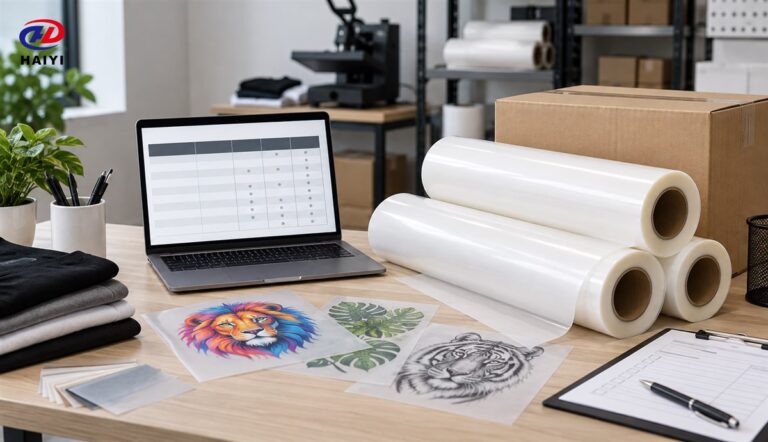
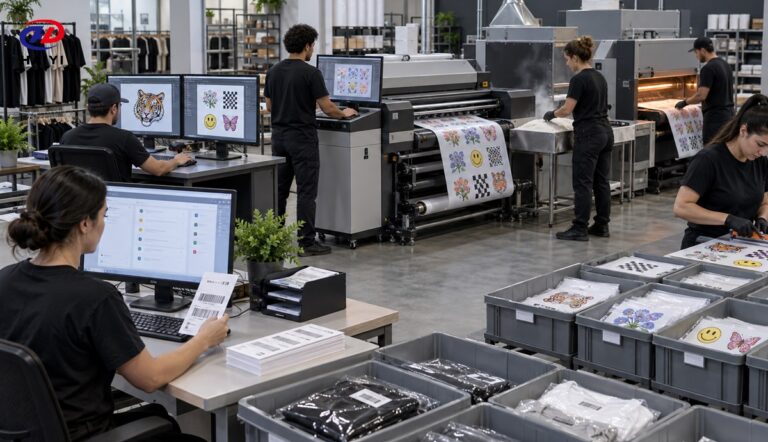
To match DTF film width with a printer and powder shaker, compare the roll’s measured physical width with every part of the film path, then compare the printable area with the transfer layout. A film can fit a printer’s loading shaft but still be too wide for its feed path, too narrow for stable tracking, or unsuitable for the shaker’s powder and take-up system. The correct width is the one that runs reliably from unwind to finished roll while leaving a usable print area for the jobs you sell.
This guide gives print shops and distributors a repeatable method for selecting 30 cm, 33 cm, 60 cm, or a custom DTF film width. It focuses on the mechanical interface between printer, shaker, dryer, and take-up. For a broader comparison of coating, peel type, and purchasing terms, see Haiyi’s DTF-Folienrollen-Kaufratgeber.
What does a DTF roll’s width actually describe?
The quoted roll width is the full cross-machine width of the PET film, not the guaranteed printable image width. A 600 mm roll measures about 600 mm across its edges. The printer may require unprinted margins for feeding, edge detection, or registration, and the RIP may impose a narrower layout. The usable artwork span is therefore normally less than the roll’s nominal width. Get the media and printable-width specifications for the exact printer configuration before choosing artwork dimensions.
Three different width values appear in equipment discussions: maximum media width, maximum printable width, and maximum supported shaker web width. They are not interchangeable. Maximum media width tells you whether the film can physically enter and track through the printer. Maximum printable width tells you how wide the inked image may be. Shaker web width tells you whether the powdering, curing, and take-up path can process that roll. A purchase decision needs all three.
Actual roll width also has a production tolerance. A purchasing specification should state nominal width, permitted deviation, and how width will be measured. Do not assume that a label reading “60 cm” proves every point along a roll is exactly 600 mm. Check both ends of a trial roll and repeat measurements on the first bulk lot, especially when a custom slit width is close to the machine’s limit.
Which machine dimensions should be measured first?
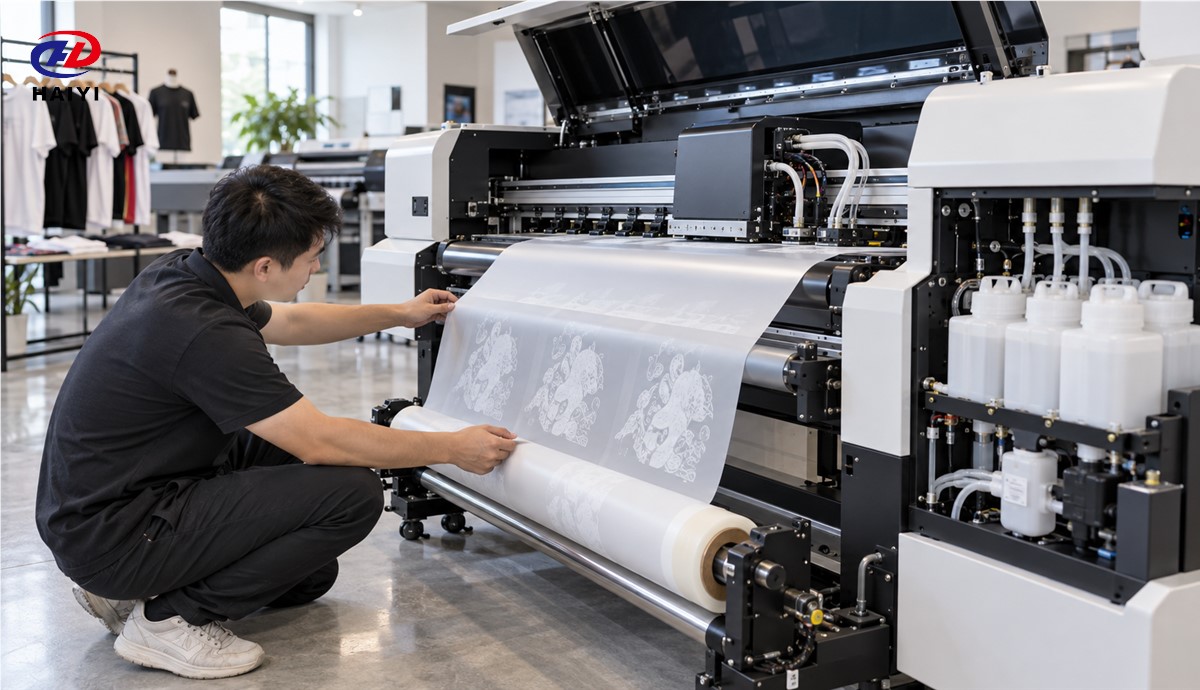
Measure the narrowest working path from the printer’s unwind position through the take-up reel. Confirm the printer’s approved media-width range, pinch-roller or feed-roller positions, edge sensors, platen clearance, and available printable span. Then confirm the shaker’s permitted film-width range, inlet guides, powder application area, excess-powder recovery, dryer opening, exit guides, and take-up shaft. A machine’s model name is only a starting clue; installed accessories and configuration can change the usable path.
What is the width-matching rule for the complete line?
The roll must fit every physical stage, while the design must fit the printer’s usable ink area. In symbols, the chosen roll width must fall inside the approved media range of the printer and the approved web range of the shaker, dryer, and take-up system. The artwork width must then fit inside the actual printable area after margins. If any stage has a smaller maximum or a larger minimum than the selected roll, the line is not a verified match.
The effective printable width can be estimated as the smaller of the printer’s rated printable span and the roll width minus the left and right margins required by the actual setup. This is a planning calculation, not permission to print to a machine’s absolute edge. Measure the margins after loading a real roll and use the RIP’s preview or print boundary to confirm them. A full-width test pattern will expose clipping and edge drift more reliably than a small logo in the center.
For example, a 600 mm roll is not automatically the same as a “24-inch” roll. Twenty-four inches is 609.6 mm, a difference of 9.6 mm. Some product descriptions round these formats together; the machine’s stated media range and the roll’s actual measured width decide whether either fits. Treat 300 mm, 330 mm, and 600 mm as separate SKUs until an equipment trial proves interchangeability.
When does a 30 cm film roll make sense?
A 30 cm roll is a practical candidate for a line whose printer and downstream equipment both support a 300 mm web. The format is common in compact and A3-class DTF workflows, but “A3-class” is a market description rather than a mechanical specification. A3 paper is 297 mm wide in one orientation, so a 300 mm roll is not automatically the same as an A3 sheet feed. Check the printer’s approved roll width and the shaker’s actual support range.
A 30 cm roll can be efficient for smaller transfers and moderate order volume because the web carries less unused material when the job mix is narrow. It may be inefficient for large garment graphics that must be rotated, split, or produced on a larger line. The comparison should use real order dimensions and nesting, not a claim that one width always wastes less film.
When should a shop consider a 33 cm roll?
A 33 cm roll is useful only when the printer accepts approximately 330 mm media and the downstream process can guide it correctly. It can provide extra layout space compared with 300 mm, but the extra 30 mm of film does not necessarily become 30 mm of printable design. Edge margins and the printer’s rated ink span still apply. A 33 cm roll forced into a true 300 mm media path can skew, crease, or strike guides.
When is 60 cm film the right choice?
A 60 cm roll is a candidate for a production line designed to feed and finish a 600 mm web. The wider area can support larger transfers or more gang-sheet nesting per linear meter. That benefit appears only when the printer’s ink span, shaker, dryer, and take-up all support the format and the order mix uses the additional area.
Wider film also increases the importance of straight feeding, stable tension, even powder removal, and flat curing. A slight side-to-side drift can produce uneven margins or a loose edge on the take-up roll. Check the machine’s support for the film thickness and roll weight, not just the headline width. A short full-width sample and a longer production-speed run reveal different problems.
When comparing a 60 cm line with two 30 cm lines, consider output mix, labor, downtime, and SKU inventory. A wide roll may improve nesting for varied small jobs, but narrow orders can leave unused lanes unless the shop can batch them. Two narrow lines offer scheduling flexibility but require two sets of feed and finishing equipment. Use actual job files to calculate material utilization before changing wholesale roll quantities.
Can a narrower film run through a wider shaker?
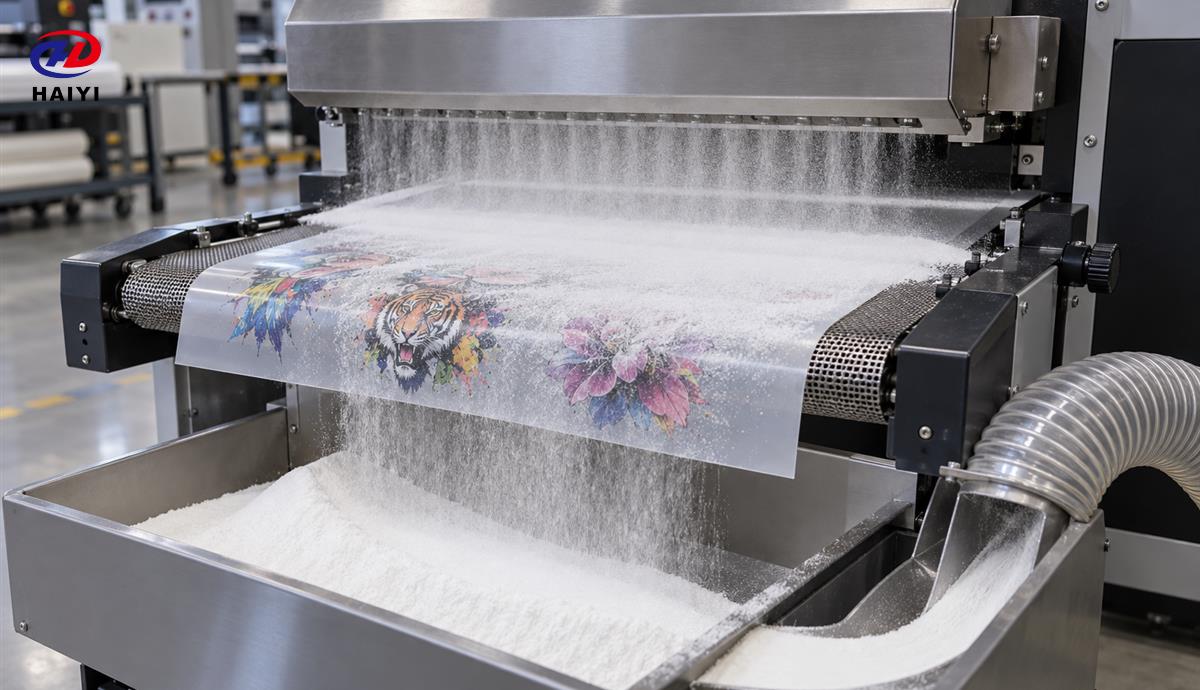
A narrower roll may run through a wider shaker if the machine supports that web size and can guide, powder, cure, and wind it consistently. A wide enclosure by itself is not evidence that every narrow format will work. Look for adjustable guides, centered or configurable powder distribution, stable web support, and a take-up arrangement that keeps the narrower roll square. Ask the machine maker for the minimum supported width or run a supervised trial.
Check where excess powder falls when a narrow film passes through a wide powder bed. Powder outside the film should be collected or managed according to the equipment design, not carried into the dryer as contamination. Review whether shaker speed and vibration settings still remove loose powder evenly across the narrow web.
Can a wider film run through a narrower shaker?
A film wider than the shaker’s approved web path should not be treated as compatible merely because its center section moves through the machine. Unsupported edges can curl, catch, receive uneven powder, or contact heated surfaces. If the powder system covers only part of the printed area, adhesive application will be incomplete. The take-up reel may also be too narrow to wind the roll safely.
Trimming a roll can be an option when a qualified film converter can slit it to the correct width with controlled edges and a compatible core. Hand-cutting a production roll or allowing the shaker to rub off the surplus edge is not an equivalent process. The new slit width must be measured, labeled, and tested as its own SKU.
Why do core size, roll diameter, and tension matter?
Width is only one fit dimension; the roll must also mount and unwind without unstable tension. Specify core inside diameter, core strength, maximum outside diameter, roll length, winding direction, and whether a flange or adapter is needed. An oversized roll can exceed the feeder’s weight or clearance even when its width is correct. A loose core can slip and change feed speed during printing.
Check the printer’s unwind behavior and the shaker’s pull or dancer control as a pair. If the shaker pulls faster than the printer delivers, the web may stretch, skew, or trigger a feed fault. If it pulls too slowly, the film may sag or touch surfaces before powdering. A supplier’s film specification should include the substrate thickness and roll construction, but final tension settings belong to the equipment setup.
Longer wholesale rolls deserve a full-length-path trial because roll weight falls as material unwinds. A line that tracks well when the roll is full can behave differently near the core. Test the first few meters, a middle section, and the final section on any new roll construction. Haiyi’s roll-to-roll production SOP describes how to keep operating settings and observations consistent.
How do edge margins affect usable transfer width?
Usable transfer width is the space left after the machine’s required print margins and a stable buffer from the film edges. The left and right margins may differ because of sensor placement, feed alignment, or RIP settings. Do not calculate utilization from nominal roll width alone. Make a test layout with measured edge markers, print it at production speed, and inspect the entire roll for clipping or drift.
For a gang sheet, the job’s bounding box includes spacing between designs as well as the designs themselves. A wide roll can fit more copies across a row, but only if the RIP’s nesting and the downstream powder system support the full printed span. Compute utilization as printed design area divided by film area consumed, then compare it with defects and reprints. The DTF gang-sheet layout guide covers layout choices in more detail.
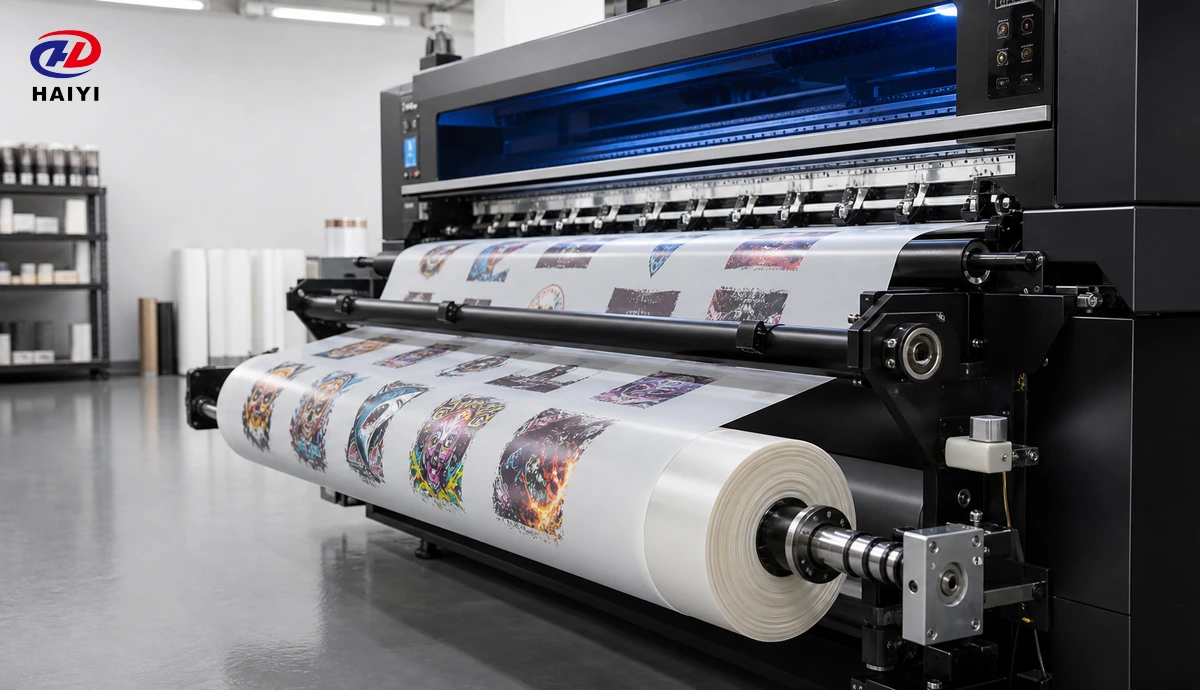
What is a practical width-selection worksheet?
A one-page worksheet should put the job requirement next to every machine limit. Record the required transfer width, candidate film width, measured roll tolerance, printer media minimum and maximum, printer printable span, left and right margins, shaker supported minimum and maximum, dryer clear width, take-up width, core diameter, and maximum roll weight. Identify the limiting stage and the person who verified each specification.
For example, if a customer needs a 310 mm-wide transfer, a 330 mm roll may look adequate on paper. It fails if the printer prints only 300 mm or if the RIP requires margins that leave less than 310 mm. A 600 mm roll may fit the artwork but fail if the shaker accepts only 330 mm. The worksheet makes these failures visible before a carton of film is ordered.
How should a new width be tested before bulk purchase?
Test a complete print-to-press run at the proposed width rather than merely checking whether the roll mounts. First measure the roll and core. Then load it using the equipment’s approved procedure, check edge guidance, print a full-width registration pattern, run the film through powdering and curing, inspect the take-up roll, and press sample transfers. Use normal production speed and the actual ink, powder, and curing settings intended for the order.
Include a long enough run to observe lateral drift and winding behavior, not just the first meter. Record skew, wrinkles, edge curl, powder coverage, blank-film contamination, drying uniformity, and any sensor or tension alarms. Photograph the left, center, and right lanes. A new width that prints cleanly at the center but fails at one edge should not be approved for full-width artwork.
Keep the test variables controlled. If width is the change under review, use the same qualified film coating, ink, powder, artwork, and environment as the baseline where possible. Otherwise a poor transfer may be blamed on width when the real cause is a different coating or curing condition. Haiyi’s consumables compatibility test protocol gives a broader sample-comparison structure.
How can a buyer separate width problems from film-quality problems?
Width-related faults follow the web path and often appear at edges or after longer feeding, while coating or ink compatibility faults may appear across the printed area. Repeated skew, edge rubbing, uneven winding, or a consistent clipped side suggests a mechanical-width or alignment issue. Uniform poor ink reception, peel behavior, or powder adhesion across the full width points toward a different variable. This pattern is a diagnostic clue, not a substitute for controlled testing.
Inspect blank film through the complete line before printing if the equipment procedure allows it. A blank run can reveal tracking, tension, curling, and take-up defects without ink or powder clouding the diagnosis. Then print a simple pattern in left, center, and right lanes. If the defect follows only one lane, check local heating, powder application, and edge support.
What should distributors specify for wholesale rolls?
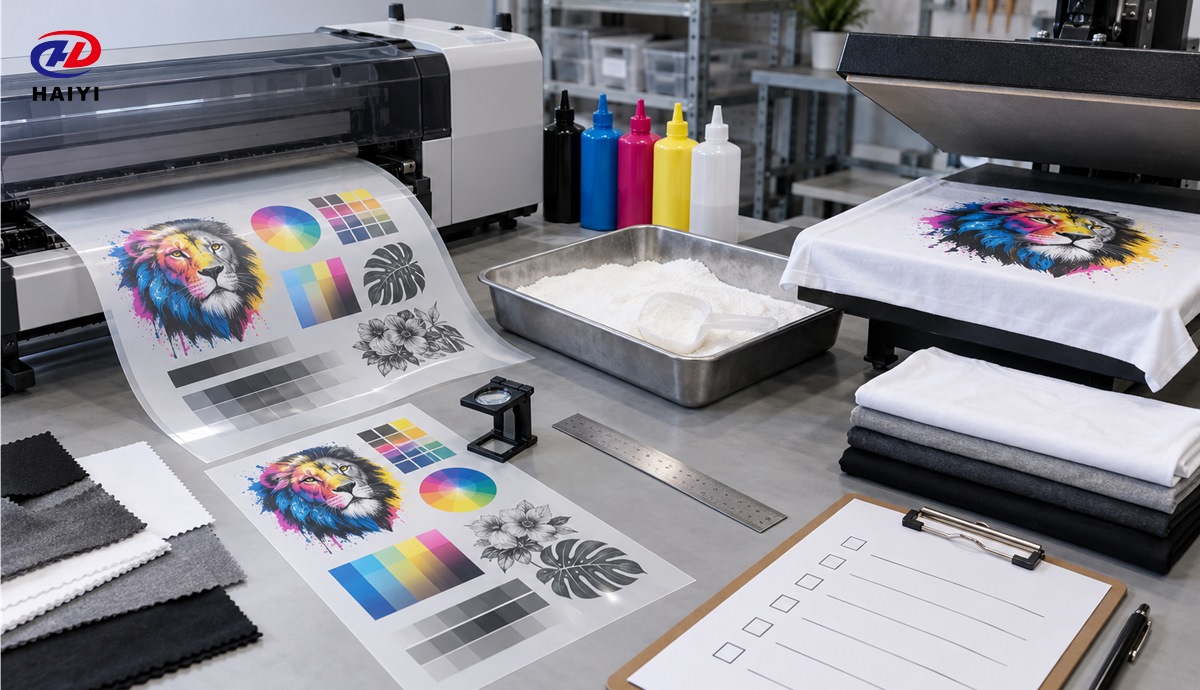
A wholesale film SKU should identify the physical roll and the approved equipment application. Include nominal width and tolerance, length, core inside diameter, roll outside diameter or weight limit, film thickness, coating and printable side, peel type, winding direction, packaging, lot code, and storage conditions. If the roll is custom slit, state the accepted edge quality and how width will be inspected.
Do not label a roll only as “for A3 printers” or “for 24-inch machines.” Those phrases can help customers navigate a catalog, but they do not tell them whether their feeder, shaker, dryer, and take-up accept the exact roll. Publish dimensions in millimeters and inches where useful, and tell customers to check the machine manual. Keep 300 mm, 330 mm, and 600 mm as distinct inventory items unless a specific line is validated for more than one.
What information should be sent to a film manufacturer?
A useful film inquiry describes the machine path and the business volume. Send printer model and permitted media range, shaker model and supported web range, desired roll width and length, core dimensions, film thickness preference, peel type, ink and powder system, target monthly quantity, and whether the order requires custom packaging. Attach photos or a drawing of the unwind and take-up hardware when the fit is unusual.
Ask the manufacturer to confirm whether the width is a stocked size or a custom slit, what tolerance can be supplied, how the edges are controlled, and what sample quantity is available. Request a pilot roll before committing to a new width at wholesale scale. A supplier’s ability to slit a film does not guarantee that the customer’s complete production line can process it; line approval still requires a trial.
Haiyi’s film product information describes 30 cm and 60 cm rolls, sheets, and other formats that can be discussed with the team. Confirm the currently available specification, MOQ, and customization scope in the quotation rather than assuming every listed format is ready for immediate shipment.
Häufig gestellte Fragen
Is a 60 cm DTF roll the same as a 24-inch roll?
No. A 60 cm roll is nominally 600 mm, while 24 inches is 609.6 mm. Some sellers use the terms loosely, but a printer or shaker close to its mechanical limit may not accept both. Use the exact approved media range and a measured sample.
Can I use 33 cm film in a 30 cm printer?
Only if the printer’s actual approved media path accommodates the wider roll and the shaker and take-up also support it. A 300 mm limit should not be interpreted as 330 mm. The printable width and edge-guide positions must be confirmed separately.
Does a wider roll always reduce film waste?
No. A wider roll can improve nesting for a suitable mix of jobs, but unused lanes, extra margins, setup loss, and rejected prints can offset the benefit. Compare real job layouts and acceptable transfer output per meter of film.
What if the printer accepts a width the shaker cannot?
The inline line is limited by the downstream stage unless an approved separate finishing process is used. Select a roll supported by both machines, obtain a compatible shaker, or validate a controlled alternative workflow before buying bulk film.
Film-width approval checklist
- Measure the proposed roll width, core, and outside diameter.
- Confirm the printer’s approved media range and actual printable span.
- Confirm the shaker, dryer, and take-up minimum and maximum web widths.
- Set guides and margins from a documented setup sheet.
- Print a full-width pattern and run a longer production-speed test.
- Inspect edge tracking, powder coverage, curing, and winding.
- Press sample transfers from left, center, and right lanes.
- Approve the exact SKU, tolerance, sample, and lot-inspection method.
The best DTF film width is a verified system fit, not a number copied from a printer advertisement. When every stage handles the roll and the usable print area serves the actual job mix, a shop can buy film with greater confidence and fewer interruptions.
Source wholesale and custom DTF film with Haiyi
Haiyi supplies DTF film for wholesale and custom programs, including cut rolls and other formats described on its website. If you distribute film or operate multiple DTF lines, send your printer and shaker models, measured media ranges, target roll width and core, preferred film type, and forecast volume. Haiyi can discuss available formats, custom slitting, sampling, and packaging for your B2B order. Kontaktieren Sie Haiyi to request a specification review and quotation.