






Where to Buy UV DTF Film Sheets: Supplier Checklist
Compare UV DTF sheet suppliers by A/B compatibility, sheet flatness, release, packing, sample testing, lot control, and wholesale terms.

UV DTF film sheets should be purchased as a matched transfer system, not as generic transparent plastic. A qualified supplier must prove that the printable A film, laminating or transfer B film, UV ink, printer, curing, and target surfaces work together. Sheet size and price matter, but flatness, release, tack, cleanliness, packing, and batch consistency determine whether the sheets are usable.
Quick answer: buy UV DTF film sheets from a supplier that provides matched A/B samples, identifies the printable side, states sheet dimensions and tolerances, protects flatness during shipping, supports your ink and printer, and accepts a repeatable sample test before a bulk order.
What are UV DTF A film and B film?
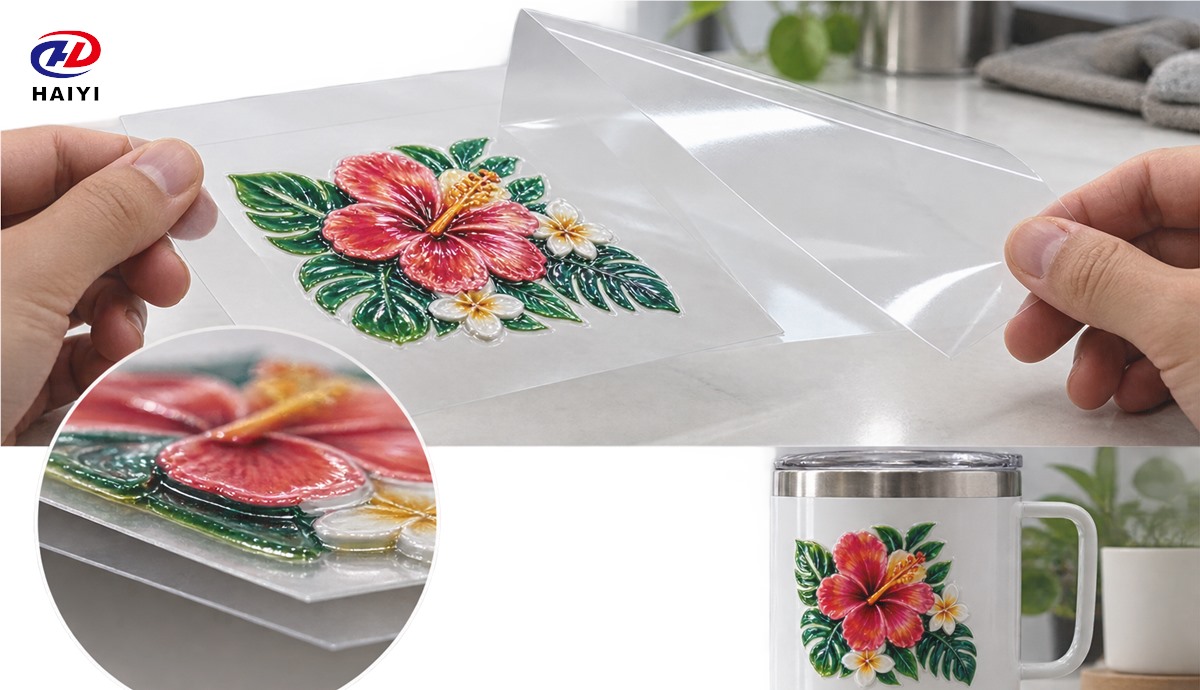
In a common UV DTF workflow, the image is printed and UV-cured on A film. B film is laminated over the cured image and acts as a transfer carrier. The image is lifted from A film, positioned on a clean hard surface, pressed into contact, and the remaining carrier is removed. Product constructions vary, so the supplier’s sequence takes priority over a generic description.
A and B films are not automatically interchangeable across suppliers. Release force, adhesive behavior, surface energy, thickness, and liner construction must work as a system. A low-priced B film that leaves residue or fails to pick up fine detail can make an otherwise good A film unusable.
Where can businesses buy UV DTF film in sheets?
Common sources include the film manufacturer, an authorized regional distributor, a specialist print-supply wholesaler, or a converter that cuts master rolls into sheets. The right source depends on order volume, service needs, lead time, packaging, and whether private-label supply is required. Marketplaces can help locate products, but they rarely replace technical qualification and lot traceability.
| Kaynak | Strength | Risk to check |
|---|---|---|
| Üretici | Customization, volume, technical traceability | MOQ, freight, sample-to-bulk consistency |
| Regional distributor | Faster delivery and local support | Lot age, stock rotation, limited customization |
| Specialist reseller | Small quantities and mixed consumables | Rebranding, unclear origin, A/B mismatch |
| Sheet converter | Custom dimensions and packs | Cut quality, dust, squareness, packing flatness |
What should a supplier disclose before sampling?
Request the exact A/B construction, printable side identification, sheet width and length, dimensional tolerance, thickness or construction reference, recommended ink family, printer compatibility, curing and lamination guidance, storage conditions, shelf-life policy, packing quantity, lot code, and change-control process. Ask whether bulk sheets come from the same construction as the sample.
Do not accept universal compatibility as a substitute for testing. UV printers differ in ink chemistry, lamp energy, print sequence, media transport, and vacuum behavior. Target objects differ in texture, coating, curvature, and contamination. A supplier should explain the test boundary rather than guarantee every surface.
What should be inside a useful sample kit?
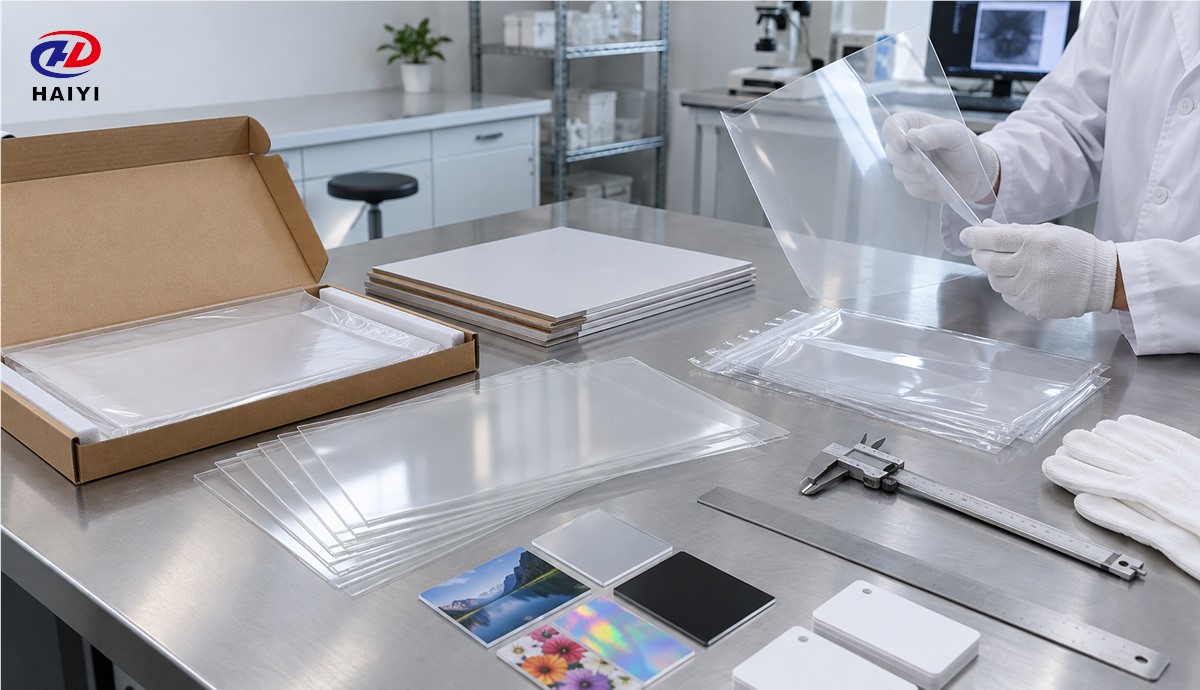
A useful kit contains enough matched A and B sheets for repeated tests, not one demonstration sheet. It should arrive flat, clean, separated from abrasive materials, and identified by product and lot. Include both typical graphics and difficult elements such as fine lines, small reversed areas, white underbase, gradients, solid color, and variable varnish height when applicable.
How should UV DTF sheets be tested?
- Condition sealed sheets in the print room before opening.
- Inspect flatness, edges, dust, scratches, blocking, and liner identification.
- Load the correct side and print an approved control file.
- Check ink wetting, white coverage, color registration, UV cure, and surface finish.
- Laminate with controlled alignment, pressure, speed, and cleanliness.
- Test pickup and release on flat, curved, smooth, and representative customer surfaces.
- Inspect fine detail, bubbles, silvering, residue, edge lift, scratches, and adhesive transfer.
- Repeat the test with multiple sheets and retain labeled samples.
The target surface must be clean and compatible. Dust, oil, release agents, low surface energy, rough texture, flexible substrates, and severe curves can prevent uniform contact. UV DTF is commonly used on many rigid objects, but suitability should be proven on the actual article and under its intended use conditions.
Which sheet-quality details matter in production?
- Flatness: curled sheets can feed poorly, contact printer components, or laminate unevenly.
- Squareness and size: inconsistent cuts disrupt registration and gang-sheet planning.
- Surface cleanliness: dust and scratches become visible defects in clear transfer layers.
- Release balance: pickup must be complete without leaving ink or adhesive behind.
- Static control: excessive static attracts debris and complicates handling.
- Batch consistency: the approved setting must remain usable when the next carton arrives.
- Packing: rigid support, sealed protection, and clear lot labels preserve the sheets during freight and storage.
Are sheets or rolls better?
Sheets suit desktop printers, sampling, short runs, mixed jobs, and businesses that want simple inventory units. Rolls suit continuous workflows, repeated gang-sheet production, and operations that can control web tension and lamination. Sheets reduce roll-change and winding concerns, while rolls reduce repeated sheet loading and may improve material utilization at volume.
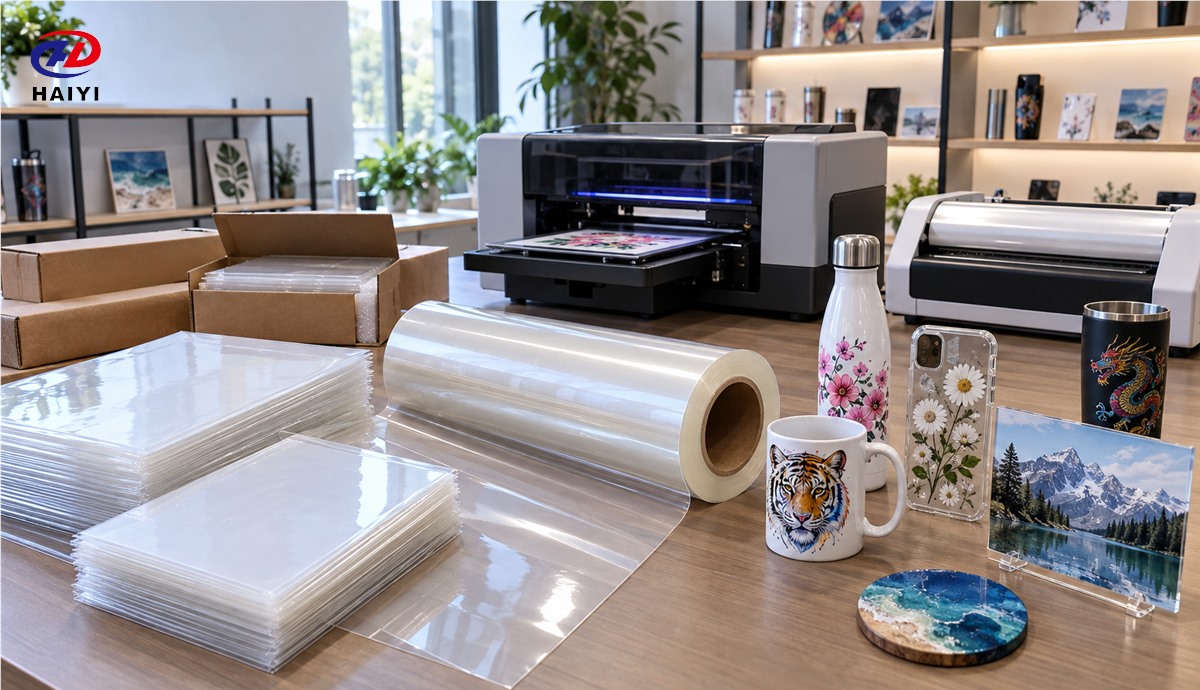
Choose the format by printer design, usable print width, job mix, labor, waste, packaging, storage, and volume. The UV DTF film satın alma rehberi covers the wider system decision, while the UV DTF production process explains the operating sequence.
What should appear in a UV DTF sheet RFQ?
State printer model and usable bed size, ink system, A/B sheet dimensions, thickness or construction requirement, monthly volume, sheets per pack, private-label needs, carton limits, target markets, test surfaces, sample plan, quality criteria, desired lead time, and shipping destination. Ask the supplier to identify assumptions and propose alternatives when a requirement conflicts with their standard construction.
Sıkça sorulan sorular
Can UV DTF sheets be used on garments?
UV DTF is generally intended for suitable hard surfaces, not flexible garments. Textile DTF film and adhesive powder are designed for heat-pressed fabric applications.
Can A film from one supplier be used with B film from another?
It may be physically possible, but compatibility cannot be assumed. Test pickup, release, residue, detail retention, and storage stability before approving a mixed system.
Why do sheets arrive curled?
Roll memory, temperature, packing pressure, material construction, and transport can contribute. Specify flat protective packing and inspect samples after they have conditioned in the print room.
Request wholesale or custom UV DTF sheet supply
Haiyi supports wholesale and customized film programs for distributors and print-supply businesses. Share your sheet size, printer, ink, A/B workflow, packaging, private label, sample protocol, and monthly volume. Haiyi ile iletişime geçin to evaluate matched samples and build a repeatable UV DTF film sheet specification.