

What Is DTF Transfer Film? Structure, Types, and Uses
Learn how coated PET DTF transfer film receives ink, works with adhesive powder, and releases a finished textile transfer.

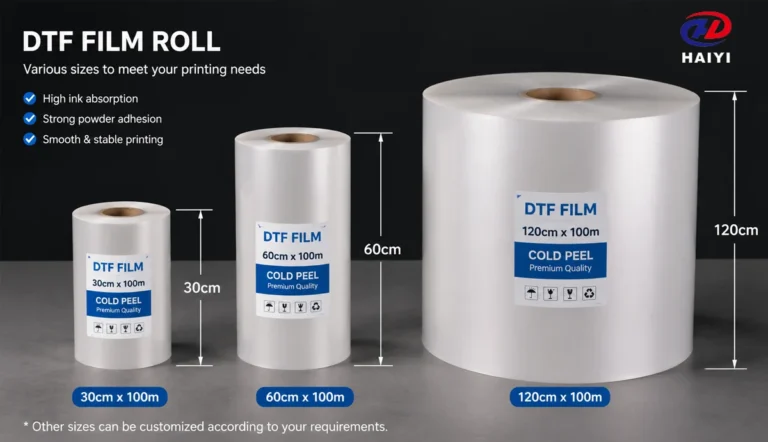
DTF transfer film is a coated PET carrier used to receive a digitally printed image and move that image onto a textile with adhesive powder, controlled heat, and pressure. The film is temporary: it supports printing and transfer, then peels away while the printed adhesive layer remains on the garment.
Quick answer: DTF film is not ordinary clear plastic. Its coating must manage wet ink, white ink, adhesive powder, curing heat, dimensional stability, and release. Film quality therefore affects print sharpness, powder cleanliness, peel behavior, production speed, and the consistency of the finished transfer.
What does DTF mean?
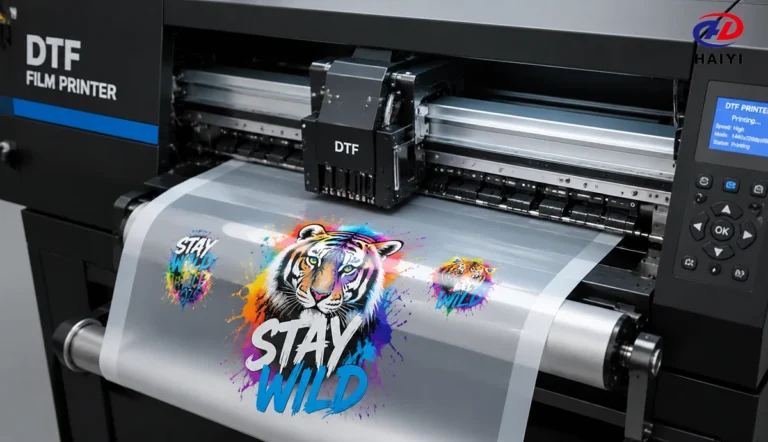
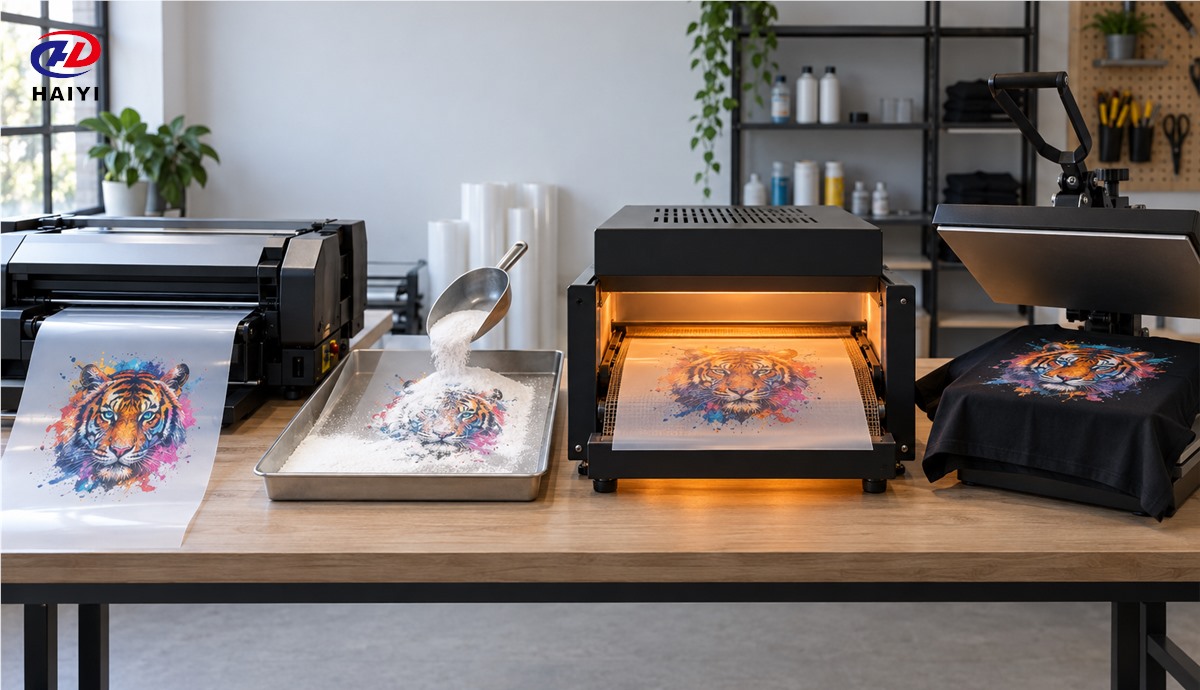
DTF means direct to film. A printer deposits colored ink and a white backing layer onto coated film. Hot-melt adhesive powder is applied while the ink remains receptive, excess powder is removed, and the transfer is cured. A heat press then bonds the image to the garment. After the specified hot, warm, or cold peel condition is reached, the carrier is removed.
This method differs from printing directly on a garment because the image is first built on a carrier. It also differs from sublimation because DTF creates a bonded image layer, while sublimation dyes compatible polyester or polymer-coated material. UV DTF is another separate process for hard surfaces and uses UV-curable ink plus matched carrier and laminate films.
How is DTF transfer film constructed?
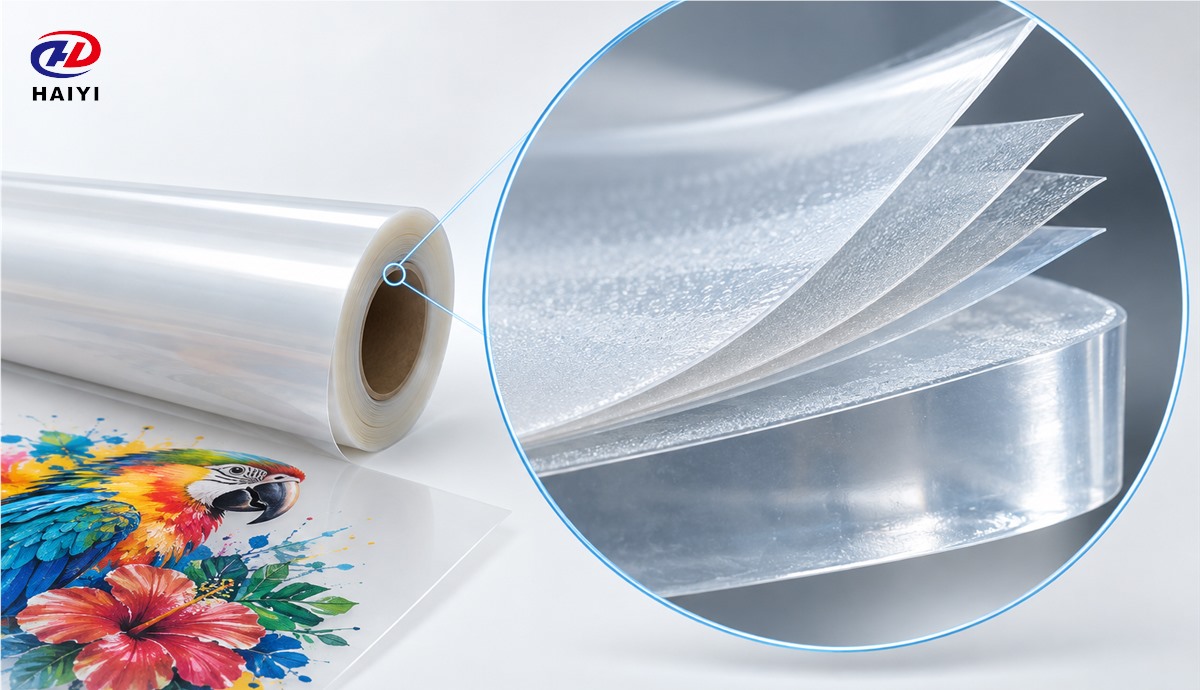
The PET base gives the sheet or roll mechanical strength and dimensional stability. One functional surface is engineered to receive the ink system and release the cured transfer at the correct stage. Depending on the product design, additional treatment may help control static, transport, powder behavior, or backside friction. Suppliers may describe coatings differently, so buyers should compare performance evidence rather than count marketing layer names.
A consistent film keeps the printed image in place without uncontrolled spreading. It should travel through the printer without skew, remain acceptably flat during curing, and peel without pulling fine details from the garment. These functions are connected: a change that improves release but weakens ink hold can create a different production problem.
How does DTF film work from printing to peeling?
- Print: the mirrored design is printed on the coated side using the intended color and white-ink sequence.
- Powder: compatible hot-melt powder coats the wet image while excess powder is removed from non-image areas.
- Cure: controlled heat fuses the adhesive without damaging the ink or distorting the carrier.
- Press: verified temperature, time, and pressure activate the adhesive against the garment.
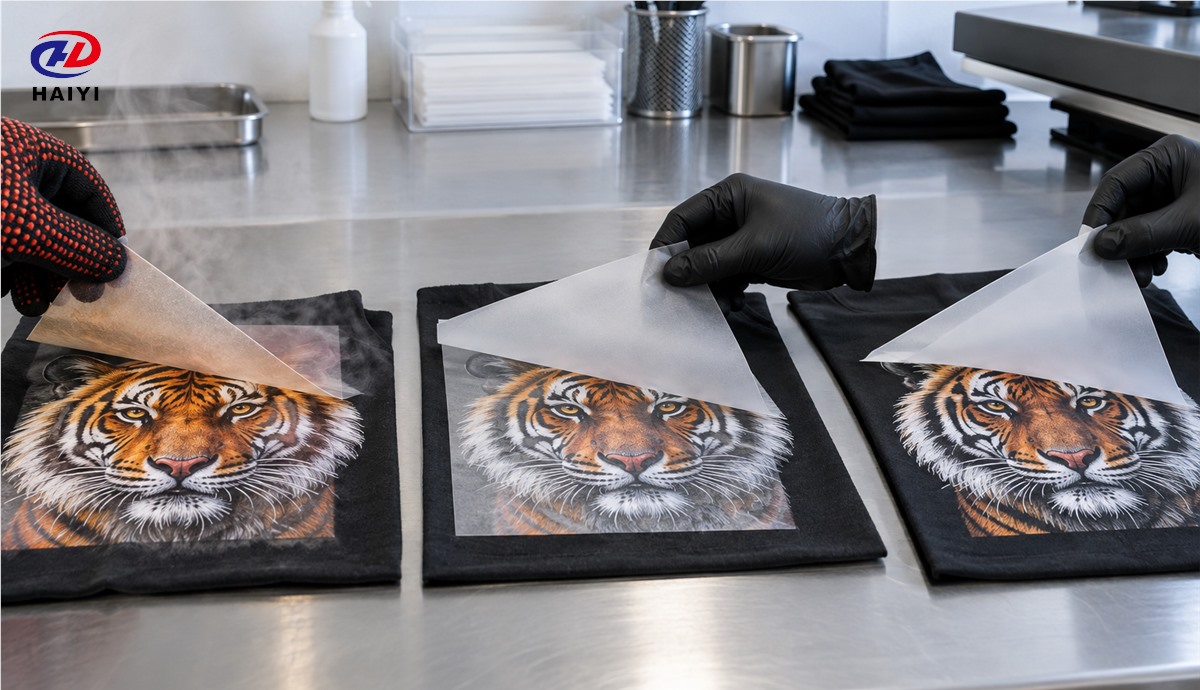
- Peel: the carrier is removed at the temperature specified for that film system.
- Finish: a post-press may be used when required to stabilize finish and edge adhesion.
The complete process is described in the DTF transfer printing guide. Operators who need a task sequence can use the separate step-by-step DTF film guide.
What types of DTF film are commonly sold?
| Формат | Наилучший вариант | Buyer checks |
|---|---|---|
| Sheets | Sampling, desktop printers, short runs | Sheet flatness, squareness, coating side, packing |
| Rolls | Continuous printing and higher volume | Width tolerance, winding, splice policy, core, length |
| Hot or immediate peel | Fast production flow | Release stability at the specified peel moment |
| Warm peel | Balanced speed and controlled release | Defined cooling window and operator repeatability |
| Холодный цедра | Processes that prioritize cooling before removal | Complete cooling, clean release, cycle planning |
| Single-sided or double-sided treatment | Different transport and anti-slip needs | Printer compatibility, backside friction, static |
Is one peel type always better?
No. Peel type changes production timing, but it does not alone determine image quality. The correct choice depends on the film coating, adhesive, ink system, press, garment, operator rhythm, and required finish. A fast peel that is unstable on one system may create more rework than a controlled warm or cold peel. Buyers should test the actual material combination and document the correct peel window.
Which fabrics can DTF film support?
DTF is commonly used on cotton, polyester, many blends, and other heat-press-compatible textiles. Compatibility is not determined by fiber name alone. Fabric finish, stretch, dye migration, heat sensitivity, surface texture, and intended care conditions all influence the result. Dark fabrics are possible because the transfer normally includes a white ink backing.
Always test the target garment. A stable result on a cotton sample does not prove performance on a coated performance fabric, stretch blend, or dye-sensitive polyester. Production approval should include appearance, adhesion, stretch recovery, wash behavior, and any migration risk relevant to the product.
What quality problems can come from the film?
Film-related symptoms can include ink beading, uncontrolled spread, mottled solids, powder contamination outside the image, static, feeding skew, curling, film shrinkage, blocking, inconsistent release, residue, or edge lift. However, the film is only one possible cause. Ink condition, nozzle performance, RIP settings, powder, curing, press calibration, environment, storage, and operator handling must be checked before assigning blame.
How should B2B buyers specify DTF film?
A useful purchase specification defines roll or sheet dimensions, core size, winding direction, coating side, peel condition, printer platform, ink and powder system, target production speed, packaging, labeling, lot traceability, sample approval, and acceptance tests. Avoid vague terms such as premium or universal unless the supplier can translate them into measurable behavior.
- Ask for a sample from the same product construction intended for bulk supply.
- Run a controlled print, powder, cure, press, peel, stretch, and wash comparison.
- Confirm how the supplier identifies lots and handles change control.
- Inspect winding, edges, flatness, coating consistency, and protective packing.
- Agree on defect reporting, retained samples, and replacement procedure before volume orders.
For a deeper technical view, read the guide to DTF film layer structure. Buyers planning recurring volume can also review DTF transfer film wholesale planning.
Часто задаваемые вопросы
Which side of DTF film is printed?
Print on the coated side specified by the supplier. Appearance alone can be misleading, so use packaging instructions or a supplier-confirmed test rather than assuming the duller or glossier side.
Can DTF film be reused?
Production film is designed as a transfer carrier for one print-and-peel cycle. Reusing peeled film does not restore the original coating or dimensional condition and is not a reliable production practice.
Does DTF film determine wash resistance?
Film affects print and release, but wash performance also depends on ink, adhesive powder, curing, pressing, garment, and care conditions. Evaluate the complete system with a defined wash test.
Source DTF film around a real production requirement
Haiyi provides wholesale and customized DTF film for distributors and production users. Share your printer, film dimensions, ink and powder, peel preference, target fabrics, packing, labeling, and annual volume. Связаться с Хайи to request samples and build a specification for repeatable supply.