

How Long Does DTF Printing Take? A Production Workflow Guide
Understand real DTF production time across artwork, printing, powdering, curing, pressing, peeling, inspection, bottlenecks, and order planning.

Reading time: 8 minutes
A prepared DTF transfer can be applied to one garment in a few minutes, but complete DTF production takes longer because artwork, RIP processing, printing, powder application, curing, handling, heat pressing, peeling, post-pressing, inspection, and packing all consume capacity. The answer to “How long does DTF printing take?” must therefore define where the clock starts and whether it measures one sample, one transfer, or a production batch.
A five-minute demonstration may be realistic for applying a ready transfer to a prepared shirt under favorable conditions. It is not a universal end-to-end lead time for artwork approval, transfer production, garment finishing, quality control, and order completion.
What stages determine total DTF production time?
Total DTF production time is the sum of active work, machine cycles, waiting, movement, setup, inspection, and rework across the full route. Some stages can overlap, while others create a queue. The slowest sustained stage limits line output even if another machine is much faster.
| Stage | What happens | Main time drivers |
|---|---|---|
| Order and artwork | Specifications, files, colors, sizes, placements, approvals | Missing information, revisions, low-quality files |
| Prepress and RIP | Artwork cleanup, mirroring, white layer, color settings, nesting | Design count, personalization, manual layout |
| Stampa | Color and white ink are deposited on coated film | Print mode, image area, ink load, printer width, nozzle condition |
| Powder and cure | Adhesive is applied, excess is removed, and the transfer is cured | Line speed, coverage, oven capacity, cure window |
| Transfer handling | Film is cooled or conditioned, cut, sorted, and queued | Peel system, sheet size, order complexity, labeling |
| Garment application | Garment is loaded, pressed, peeled, and post-pressed if required | Press count, operator rhythm, garment construction, peel timing |
| Quality and packing | Placement, adhesion, appearance, count, and packaging are checked | Inspection level, defect rate, rework, order sorting |
How long does artwork and prepress take?
Artwork and prepress can take less time than printing for a clean, approved, repeat file, or much longer for a new order with missing fonts, low resolution, transparent edges, unclear size, or many personalization fields. Production should not begin until design size, placement, garment color, and approval responsibility are clear.
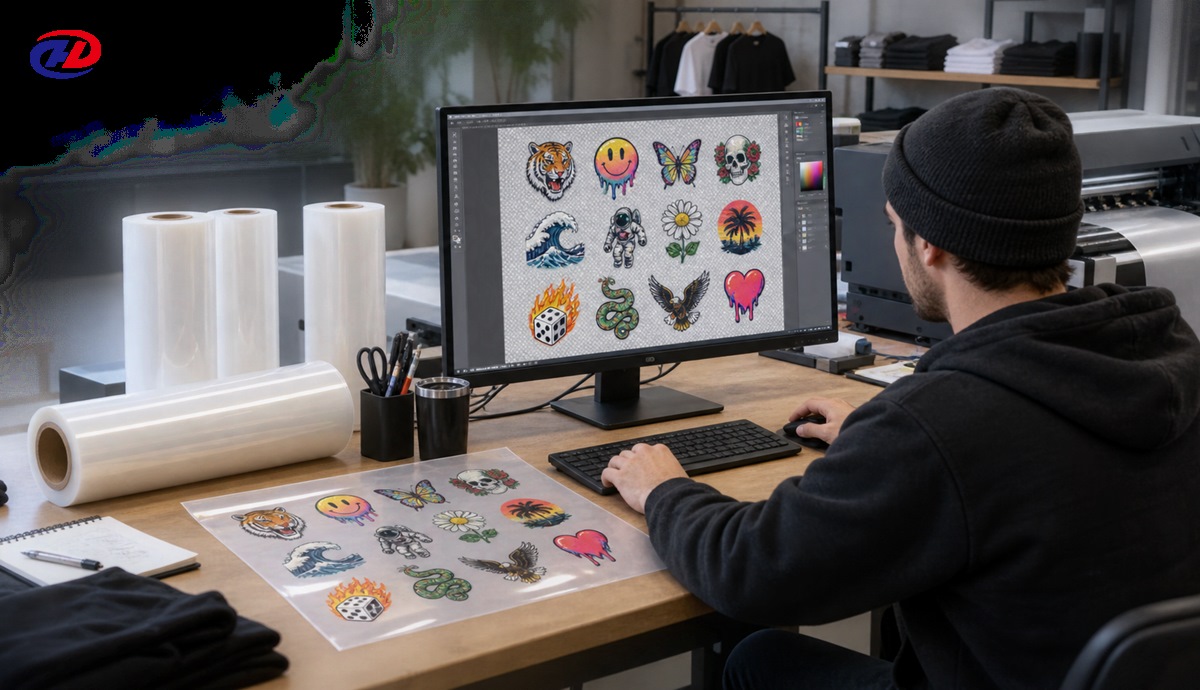
Gang-sheet planning improves film utilization and can reduce print changes, but maximum packing density is not the only goal. Designs need enough spacing for powder removal, cutting, sorting, and press placement. A layout that saves a small strip of film but creates slow manual handling can increase total cost. Haiyi’s DTF gang sheet layout guide explains this balance.
What controls DTF printing speed?
DTF printing speed depends on the printer, selected print mode, film width, pass count, resolution, ink coverage, white underbase, maintenance condition, file queue, and actual usable uptime. A nominal square-meter-per-hour rating does not equal accepted transfer output because cleaning, nozzle checks, film loading, color correction, and rejected sections reduce availability.
Measure accepted printed area per hour over a normal shift. Separate planned maintenance from unplanned interruption, and record whether the printer waits for the curing line. This identifies whether a faster printer would improve finished output or simply create a larger queue.
Why are powder application and curing often the bottleneck?
Powder application and curing often limit output because wet printed film must receive even adhesive coverage, lose excess powder, and pass through a validated heat process without smearing or under-curing. The printer, shaker, and oven must operate as one balanced line.
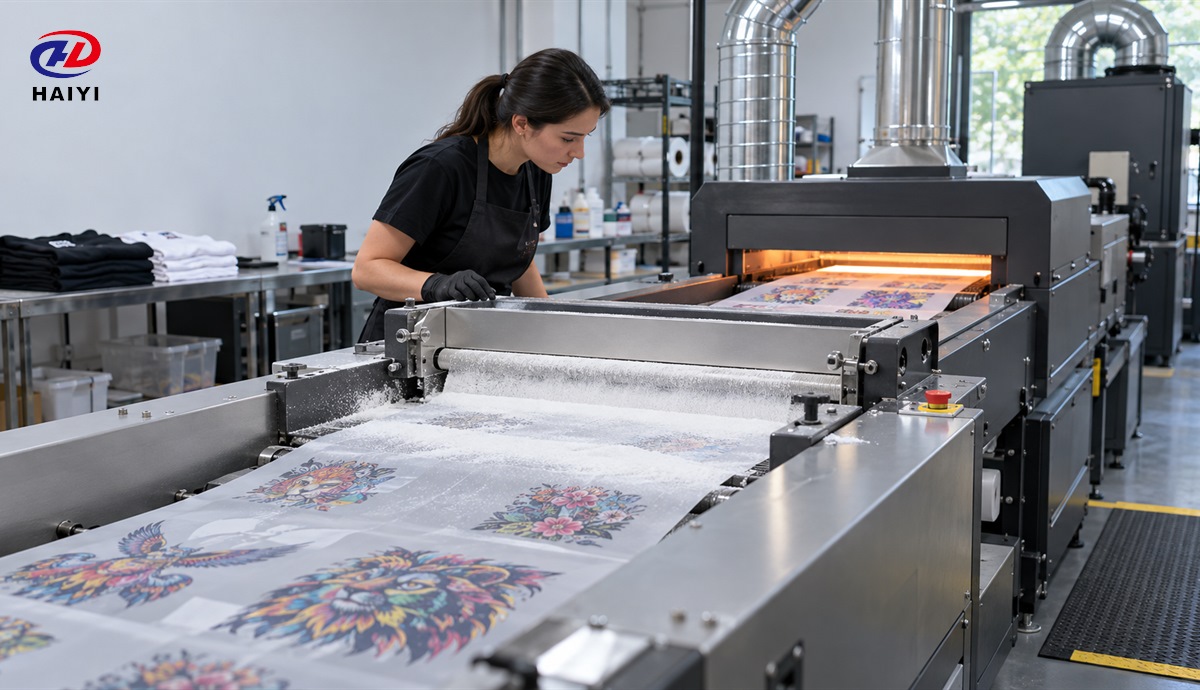
Increasing line speed is useful only if powder still covers the wet ink, excess powder is removed, and the adhesive reaches the approved cured state. Under-cure can cause oiliness, powder transfer, weak adhesion, or later wash failure. Excess heat can distort film, change ink or adhesive behavior, and reduce the process window. Use the exact film and powder supplier’s guidance, then validate the actual oven and ink load.
How much time does heat pressing add?
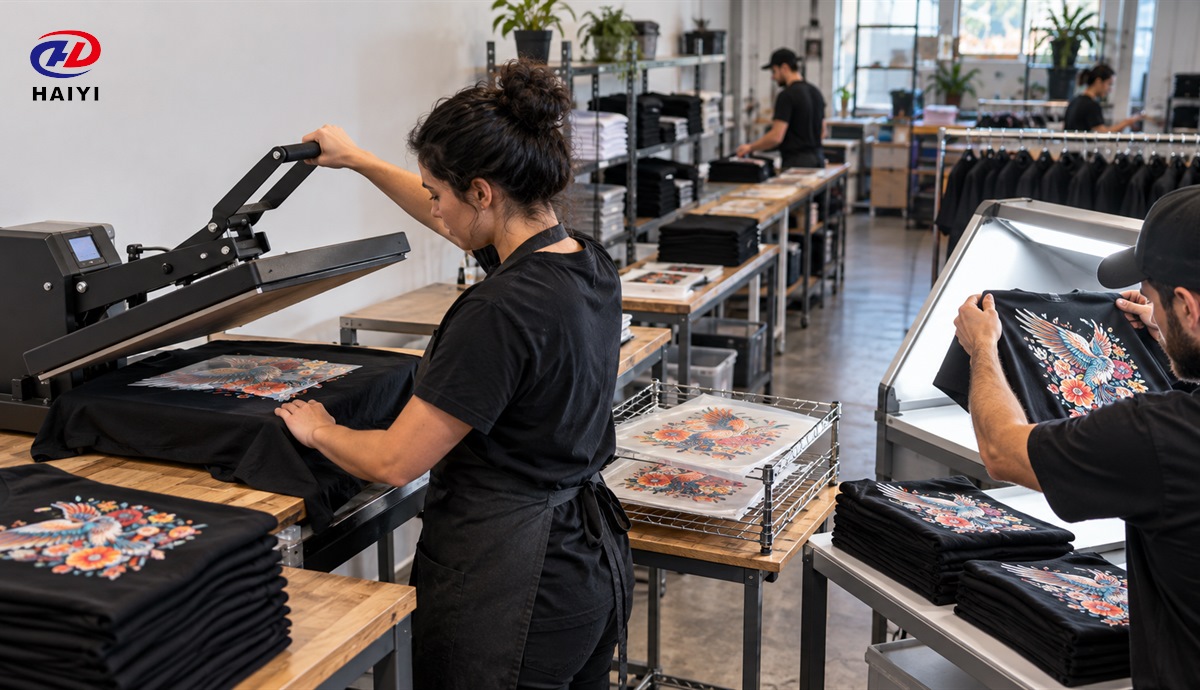
Heat-press time includes more than the timer countdown. The operator must identify the garment, prepare and load it, remove moisture or wrinkles if the approved process requires a pre-press, position the transfer, close the press, wait, unload, follow the correct peel window, post-press when required, inspect, and move the piece.
A nominal 10- or 15-second press cycle can therefore occupy a station for much longer. Cold-peel transfers may also require cooling space and work-in-process control. Press capacity should be measured as accepted garments per hour at the required placement accuracy, not as 3,600 divided by the timer setting.
Can DTF transfers be produced before garments arrive?
Yes. One advantage of DTF is that approved, cured transfers can be produced separately and applied later if they are stored and handled under controlled conditions. This can shorten garment turnaround, support distributed pressing, and reduce finished-garment inventory.
Preproduction also creates responsibilities. Transfers need order identification, protection from heat, moisture, contamination, abrasion, and bending, plus stock rotation and an approved storage period. A transfer without traceability can save printing time but create sorting and rework later.
How should a shop calculate DTF order lead time?
A shop should calculate lead time from the required completion date backward through each constrained stage. Include queue time, setup, production, inspection, likely rework, maintenance, material availability, and approval delay. Do not promise from the fastest observed sample cycle.
A practical estimate uses three layers:
- Touch time: active labor spent preparing files, loading materials, cutting, pressing, inspecting, and packing.
- Machine and process time: printing, curing, pressing, cooling, and any required conditioning.
- Queue and risk allowance: waiting for equipment, approvals, shifts, maintenance, replacement material, and controlled rework.
For repeat orders, compare estimated and actual time by stage. A growing difference reveals where the standard is outdated or where a new bottleneck has formed.
How can DTF production be made faster without lowering quality?
Improve flow before increasing machine settings. Standardize the order form, artwork naming, approved RIP presets, film loading, powder control, cure verification, garment placement, press recipes, inspection, and packing sequence. Place tools and materials at the point of use, and separate rework from normal flow.
Use gang sheets that balance film utilization with cutting and sorting. Build fabric-specific press recipes instead of troubleshooting every garment from zero. Maintain printers and verify presses before a rush order. Add capacity at the measured bottleneck: an additional heat press will not help if artwork approval or curing is the constraint.
What quality gates should remain even in a fast workflow?
A fast DTF workflow still needs file approval, nozzle and color control, film and powder identification, cure verification, first-piece approval, placement check, correct peel timing, final appearance inspection, count reconciliation, and retained evidence when the order requires it. Removing these gates may reduce visible cycle time while increasing hidden rework and complaints.
New combinations should pass a controlled DTF consumables compatibility test. Operators who need the complete sequence can use the DTF transfer production guide.
Frequently asked questions about DTF production time
Can a DTF shirt be made in five minutes?
A prepared transfer can be positioned, pressed, peeled, and inspected on one ready garment within a few minutes in some workflows. That timing excludes artwork, printing, powdering, curing, queue time, setup, and most order administration.
What is the slowest stage in DTF production?
The slowest stage varies. Printing and curing often constrain transfer production, while heat pressing, cooling, sorting, or artwork approval may constrain finished-garment output. Measure the complete line.
Does hot-peel film always increase production speed?
Hot-peel film can reduce cooling delay, but total speed also depends on release consistency, operator movement, press capacity, rework, and garment handling. Validate accepted garments per hour rather than peel speed alone.
How should a distributor compare DTF film productivity?
Compare usable film area, feeding stability, print quality, powder behavior, cure window, peel consistency, press cycle, defect rate, and repeat-lot performance. The lowest film price or fastest claimed peel does not define total productivity.
Build a productive DTF film program with Haiyi
Haiyi supplies wholesale and customizable DTF film for distributors, production shops, and private-label programs. B2B buyers can test roll widths, peel options, feeding stability, curing behavior, and repeat-lot performance on their actual line. Review Haiyi’s DTF film buying guide, then contattare Haiyi with your printer width, line configuration, monthly volume, peel workflow, and target throughput.